Tuesday, February 27, 2018

Why seemingly fit people die of cardiac arrest

Being seemingly healthy is no insurance against heart disease. Those who appear healthy, and are particular about diet and exercise, seem to be succumbing too. Today, heart attacks are striking at a younger age, making those in their 30s and 40s the new high-risk categories, possibly due to high-pressure lifestyles.

“A person who looks healthy could have been living with some blockages in his/her artery for a long time and this could lead to sudden cardiac arrest at times,” says a Dr. According to the specialists, cardiac arrest is an electrical malfunction that disrupts your heart’s rhythm so that it stops pumping blood around your body. A heart attack occurs when there’s a blockage in an artery leading to the heart. This reduces the blood flow (and therefore oxygen) to the heart muscle. The heart usually doesn’t stop beating during a heart attack, unless your heart attack leads to cardiac arrest. 

A cardiologist says: “Eight out of 10 times, the cause of a cardiac arrest is a blockage in the heart. For 20% of the cases, there could be a different reason.” He lists these as a clot in the lungs which stops oxygen supply to the heart, sudden bleeding in the brain, wherein all body mechanisms, including the heart, stop functioning, intake of toxic drug in huge amounts that can stop the heart’s functioning abruptly, a viral infection that leads to cardiomyopathy (irregular signal generated from an undetected weak heart muscle), or congenital heart defects that have gone undetected.

According to the cardiologists, 50% of all heart attacks in Indian men occur under the age of 50 and 25% of all heart attacks in Indian men under the age of 40. The figures for women were not immediately available.

“The problem of non-detection of heart-related ailments is a very serious issue,” says a Dr. One in four people, even when they have 70% and more blockages, don’t show any symptoms, or report only certain vague ones like fatigue. “Last week, in a single day, three unsuspecting people, all in their 30s, were diagnosed with serious artery blockages of more than 70% at our hospital,” he says. One was there for a routine check, the other two were getting tested before undergoing some other surgery. All of them exercised regularly and not one of them had experienced any heart-related symptoms like fatigue or breathlessness.

Prevention matters
The biggest reason behind the growing numbers and decreasing age in heart-related ailments is a low awareness of risk factors and inefficient testing procedures, particularly among the youth. “The symptoms to keep a look out for are shortness of breath, extensive fatigue for which the reason is not clear (in fact, a person’s ability to exercise may also diminish), build-up of fluid in the body somewhere, persistent cough or wheezing, lack of appetite, nausea, confusion, impaired thinking and increased heart rate,” lists the Dr. 

He says everyone above the age of 35 should undergo an annual cardiac check-up as Indians are genetically predisposed to develop coronary artery disease early in their lives. “Your treating doctor might be able to recommend some additional tests, which are able to pick up any blockage at an early stage, thus opening an opportunity to prevent death from cardiac arrest,” he adds. 

According to the  Dr., routine exercise tests like TMT (treadmill test) only pick up artery blockages beyond 75%. So to pick these up at a lower level, it is important for those above 40 to go for sophisticated cardiac tests like calcium scoring by CT scan—this holds particularly true for those with a family history, those who travel a lot, are overweight, diabetic, heavy smokers and exercisers. 

“If in a CT scan of heart arteries calcium is found, then early blockages, even 10-15% blockages, can be identified and specific treatments like aspirin and cholesterol-lowering drugs, etc., can be given so that the damage doesn’t progress and heart attack can be prevented,” he says.

Stress is very often a factor. “While it does not directly cause heart attacks, sudden, severe stress can lead to stress cardiomyopathy (or broken heart syndrome). Therefore, keeping our stress levels in check is as important as keeping our triglyceride and cholesterol numbers tamed,” says an interventional cardiologist and head of the department of preventive cardiology and rehabilitation at the hospital. Those who internalize the stress are in greater danger.

The Dr. says excess unaccustomed exercise can also be dangerous. Sometimes, youngsters get 
motivated to try out body-building activities like weight-lifting. Too much exercise in a short span can lead to problems. A thorough medical check-up is important before starting any high-intensity exercise as this may trigger rupture of the plaque, leading to a heart attack.

The Dr. warns that smokers who exercise heavily are highly prone to heart attacks, even with 40-50% blockage. In fact, he says, they have been observing heart attacks even in young, heavy smokers with blockages of as little as 10%. That is because heavy smoking and exercise can lead to the formation of blood clots. So a lower percentage of blockage can also rupture suddenly, with a bad clot forming on top, thus blocking the artery totally and suddenly to 100%, and leading to a heart attack. “It’s almost like something gets stuck in a narrowed water pipe, stopping water flow suddenly,” he explains. “Plus women are more asymptomatic compared to men, so they need to be even more careful,” he adds.

“It is important to educate people that no one can be completely safe from cardiac arrest, and therefore it is important to keep the risk factors (diabetes, obesity, high blood pressure, etc.) down to a minimum, and, most importantly, catch the blockages as soon as possible, so that the right preventive treatments can begin,” says the Dr..

Labels: , , , , , , , , , , , , , , , ,

Saturday, January 04, 2014

When a lean, healthy person has a stroke out of the blue

When a lean, healthy, physically active person has a stroke, seemingly out of the blue, the cause may well be a heart rhythm abnormality called atrial fibrillation.
Such was the fate of Pamela Bolen of Brooklyn, then 67, who said she collapsed last year at home. Luckily, her husband, Jack, heard her fall, called an ambulance, and within minutes she was at New York Methodist Hospital. There she was given the drug tissue plasminogen activator, or tPA, to dissolve the clot that was blocking circulation in her brain. The treatment spared her lasting disability.
“I had high blood pressure which was completely controlled with medication, but I didn’t know I had atrial fibrillation until I had a stroke,” Bolen said in an interview. The condition slows blood flow from the heart and was the likely cause of the clot that resulted in her stroke.
About three million Americans have atrial fibrillation, characterised by multiple irregular electrical signals that cause the heart’s upper chambers, the atria, to contract rapidly, without their usual coordination. This sends an erratic signal to the ventricles, the lower chambers that supply blood to the lungs and rest of the body. People with the disorder face a much higher risk of stroke, and most require treatment to prevent this potentially crippling and sometimes fatal consequence.
“As many as one in five or six strokes is due to atrial fibrillation, and in a lot of these people the rhythm disorder was undetected before the stroke,” said Dr. Christian T. Ruff, cardiologist at Brigham and Women’s Hospital in Boston, who studies new treatments for the disorder.
People with symptomatic A-fib, as it is commonly called, may experience periodic palpitations (a sense that the heart is pounding or fluttering), chest discomfort, shortness of breath, unusual fatigue or dizziness.
A-fib can show up during an electrocardiogram, or EKG, but because the abnormal rhythm may not occur all the time, people suspected of having the condition usually must wear a Holter monitor for days or weeks to obtain a certain diagnosis. This small portable device, connected to electrodes on the chest, continuously records the heart’s rhythm and sends the data to a doctor or company for evaluation.
A-fib is more common in men, tall people and the elderly. As the population ages, the incidence is rising; more than 460,000 new cases are diagnosed annually, a number expected to double in the next 25 years. The condition is also becoming more prevalent at any age, experts say, because of a rise in three leading risk factors — high blood pressure, diabetes and obesity.
These conditions can damage the heart’s electrical system, Dr. Ruff wrote last year in the journal Circulation. Other risk factors include a prior heart attack, overactive thyroid, sleep apnea, excessive alcohol consumption, abnormal heart valves, lung disease and congenital heart defects.
Researchers at the University of California, San Francisco, reported this month in Annals of Internal Medicine that people with a high rate of premature atrial contractions, which can be detected by a Holter monitor worn for 24 hours, face a significantly increased risk of developing A-fib. Dr. Gregory M. Marcus, the senior author and director of clinical research at U.C.S.F.’s cardiology division, theorized that eradicating these premature contractions with drugs or a procedure that destroys the malfunctioning area of the heart may reduce the risk of the rhythm disorder.
Step 1 in treating A-fib is to identify and correct reversible risk factors. Step 2 — and most important, according to Dr. Ruff — is to prevent blood clots from forming by treating patients with anticoagulants.
The most commonly prescribed and least costly treatment is warfarin, also known by the brand name Coumadin, in use for more than half a century. But while highly effective at reducing the risk of stroke, warfarin is a very tricky drug. It interacts with a number of foods, especially those like spinach and kale that are rich in vitamin K, and other drugs that a patient may have to take.
People metabolise warfarin at different rates, making it necessary to repeatedly check a patient’s clotting ability to reduce the risk of excessive bleeding while maintaining an effective anticoagulant level.
Dr. Ruff said that more than half of A-fib patients were either not on an anticoagulant or on an ineffective dose. Fearful of a hemorrhage in the brain, or uncontrolled bleeding in an accident or emergency surgery, doctors may prescribe an amount of warfarin insufficient to prevent a stroke, he said.
Last year, Dr. Sanjiv Narayan, an electrophysiologist at the University of California, San Diego, and co-authors described a way to more accurately identify the electrical “hot spots” in the heart responsible for an abnormal rhythm. Ablating those regions was nearly twice as effective as the standard approach to eliminating atrial fibrillation with ablation, the team reported in The Journal of the American College of Cardiology.
But even when all traces of A-fib are eliminated, Dr. Ruff said, continued treatment with an anticoagulant is needed to guard against stroke. “Once a person has had A-fib, there is an increased risk of stroke even if their heart is in normal rhythm,” he said.

ps- this is only for information, always consult you physician before having any particular food/ medication/exercise/other remedies.
ps- those interested in recipes are free to view my blog-

http://gseasyrecipes.blogspot.com/


for info about knee replacement, you can view my blog-


http://Knee replacement-stick club.blogspot.com/


for crochet designs


http://My Crochet Creations.blogspot.com

Labels: , , , , , , , , , , , , , , ,

Tuesday, July 09, 2013

EVERYTHING YOU WANT TO KNOW ABOUT STROKE

Illustration of Stroke Causes
What Is a Stroke?
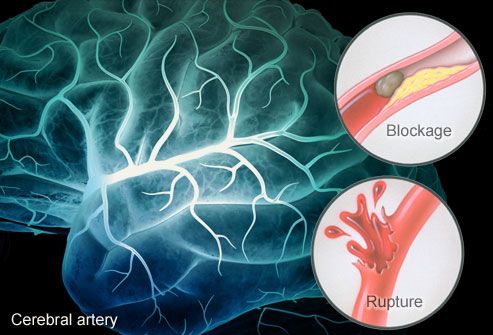
Stroke is a medical emergency and a leading cause of death. It occurs when a blood vessel in the brain bursts or, more commonly, when a blockage develops. Without treatment, cells in the brain quickly begin to die. The result can be serious disability or death. 
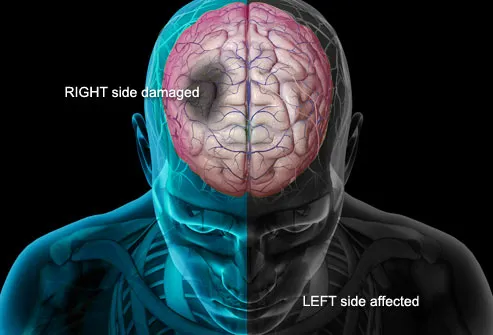
Stroke Attacking Brain and Body
Stroke Symptoms
Sudden numbness or weakness of the body, especially on one side.
Sudden vision changes in one or both eyes, or difficulty swallowing.
Sudden, severe headache with unknown cause.
Sudden problems with dizziness, walking, or balance.
Sudden confusion, difficulty speaking or understanding others.
Call for help immediately if you notice any of these symptoms.


Stroke Test: Talk, Wave, Smile
The F.A.S.T. test helps spot symptoms. It stands for:
Face. Ask for a smile. Does one side droop?
Arms. When raised, does one side drift down?
Speech. Can the person repeat a simple sentence? Does he or she have trouble or slur words?
Time. Time is critical. Call for help immediately if any symptoms are present.

Stroke: Time = Brain Damage
Every second counts when seeking treatment for a stroke. When deprived of oxygen, brain cells begin dying within minutes. There are clot-busting drugs that can curb brain damage, but they have to be used within three hours of the initial stroke symptoms. Once brain tissue dies, the body parts controlled by that area won't work properly. This is why stroke is a top cause of long-term disability.

Diagnosing a Stroke
When someone with stroke symptoms arrives in the ER, the first step is to determine which type of stroke is occurring. There are two main types, and they are not treated the same way. A CT scan can help doctors determine whether the symptoms are coming from a blocked blood vessel or a bleeding one. Additional tests may also be used to find the location of a blood clot or bleeding within the brain.

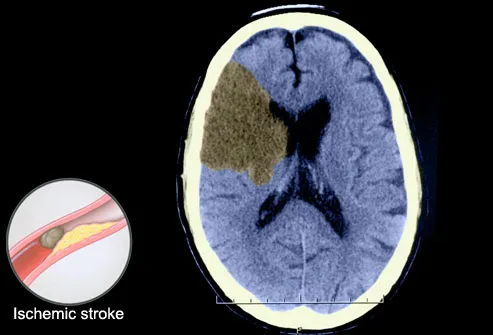
Ischemic Stroke Seen on CT Scan of Brain
Ischemic Stroke
The most common type of stroke is known as an ischemic stroke. Nearly nine out of 10 strokes fall into this category. The culprit is a blood clot that obstructs a blood vessel inside the brain. The clot may develop on the spot or travel through the blood from elsewhere in the body.
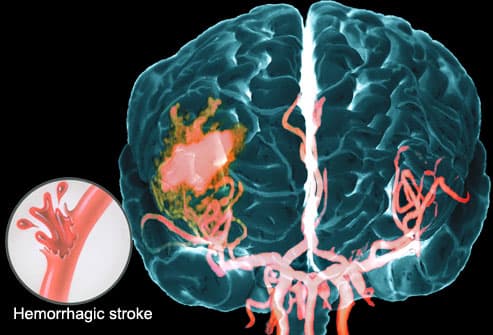
Hemorrhagic Stroke Seen on MRA of Brain

Haemorrhagic Stroke
Haemorrhagic strokes are less common but far more likely to be fatal. They occur when a weakened blood vessel in the brain bursts. The result is bleeding inside the brain that can be difficult to stop.

TIA Mini Stroke Highlighted on Ultrasound

'Mini-Stroke' (TIA)
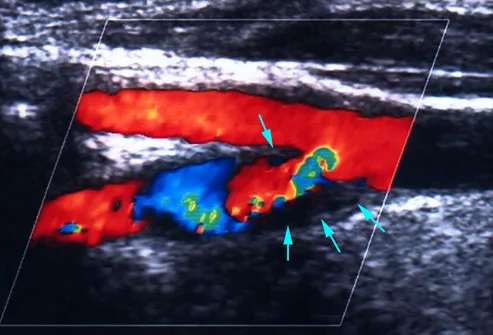
A transient ischemic attack, often called a "mini-stroke," is more like a close call. Blood flow is temporarily impaired to part of the brain, causing symptoms similar to an actual stroke. When the blood flows again, the symptoms disappear. A TIA is a warning sign that a stroke may happen soon. It's critical to see your doctor if you think you've had a TIA. There are therapies to reduce the risk of stroke.

Sectioned Artery with Blockage

What Causes a Stroke
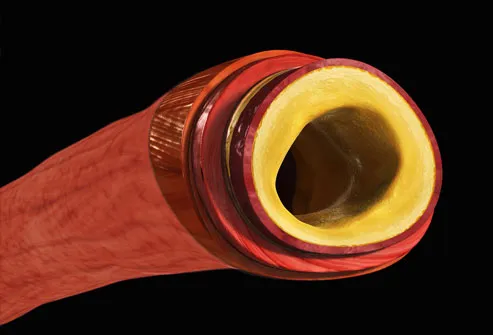
A common cause of stroke is atherosclerosis -- hardening of the arteries. Plaque made of fat, cholesterol, calcium, and other substances builds up in the arteries, leaving less space for blood to flow. A blood clot may lodge in this narrow space and cause an ischemic stroke. Atherosclerosis also makes it easier for a clot to form. Haemorrhagic strokes often result from uncontrolled high blood pressure that causes a weakened artery to burst.

Risk Factors: Chronic Conditions
Certain chronic conditions increase your risk of stroke. These include:
High blood pressure
High cholesterol
Diabetes
Obesity
Taking steps to control these conditions may reduce your risk.


Certain behaviours also increase the risk of stroke:
Smoking
Getting too little exercise
Heavy use of alcohol

Diet

Eating too much fat and cholesterol can lead to arteries that are narrowed by plaque. Too much salt may contribute to high blood pressure. And too many calories can lead to obesity. A diet high in fruits, vegetables, whole grains, and fish may help lower stroke risk.

Factors Beyond  Your  Control

Some stroke risk factors are beyond your control, such as getting older or having a family history of strokes. Gender plays a role, too, with men being more likely to have a stroke. However, more stroke deaths occur in women. Finally, race is an important risk factor. African-Americans, Native Americans, and natives from Alaska are at greater risk compared to people of other ethnicities.

Angiogram Showing Results of t-PA Treatment


 Emergency Treatment
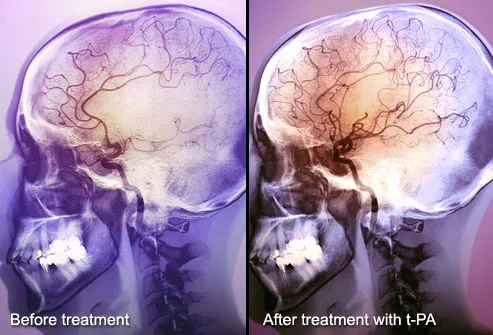
For an ischemic stroke, emergency treatment focuses on medicine to restore blood flow. A clot-busting medication is highly effective at dissolving clots and minimizing long-term damage, but it must be given within three hours of the onset of symptoms. Haemorrhagic strokes are more difficult to manage. Treatment usually involves attempting to control high blood pressure, bleeding, and brain swelling.

 Long-Term Damage

Whether a stroke causes long-term damage depends on its severity and how quickly treatment stabilizes the brain. The type of damage depends on where in the brain the stroke occurs. Common problems after a stroke include numbness in the arms or legs, difficulty walking, vision problems, trouble swallowing, and problems with speech and comprehension. These problems can be permanent, but many people regain most of their abilities.

Rehab Therapies- 1) Speech Therapy

Rehabilitation helps patients regain lost skills and learn to compensate for damage that can't be undone. The goal is to help restore as much independence as possible. For people who have trouble speaking, speech and language therapy is essential. A speech therapist can also help patients who have trouble swallowing.

2)Physical Therapy
Muscle weakness, as well as balance problems, are very common after a stroke. This can interfere with walking and other daily activities. Physical therapy is an effective way to regain strength, balance, and coordination. For fine motor skills, such as using a knife and fork, writing, and buttoning a shirt, occupational therapy can help.

Talk Therapy
It's common for stroke survivors to experience a wide range of intense emotions, such as fear, anger, worry, and grief. A psychologist or mental health counsellor can provide strategies for coping with these emotions. A therapist can also watch for signs of depression, which frequently strikes people who are recovering from a stroke.


Preventive Steps: 1) Lifestyle
People who have had a stroke or TIA can take steps to prevent a recurrence:
Quit smoking.
Exercise and maintain a healthy weight.
Limit alcohol and salt intake.
Eat a healthier diet with more veggies, fish, and whole grains.

2) Medications
For people with a high risk of stroke, doctors often recommend medications to lower this risk. Anti-platelet medicines, including aspirin, keep platelets in the blood from sticking together and forming clots. Anti-clotting drugs, may be needed to help ward off stroke in some patients.  Finally, if you have high blood pressure, your doctor will prescribe medication to lower it.

3) Surgery
In some cases, a stroke results from a narrowed carotid artery -- the blood vessels that travel up each side of the neck to bring blood to the brain. People who have had a mild stroke or TIA due to this problem may benefit from surgery known as carotid endarterectomy. This procedure removes plaque from the lining of the carotid arteries and can prevent additional strokes.
Angioplasty For Stroke Prevention

4) Balloon and Stent
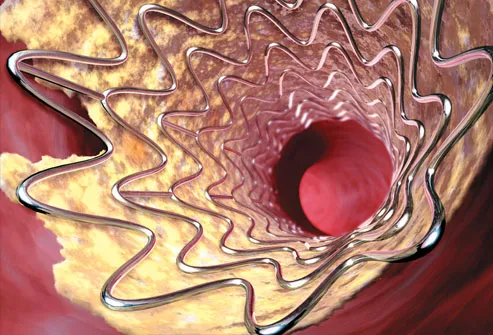
Doctors can also treat a clogged carotid artery without major surgery in some cases. The procedure, called angioplasty, involves temporarily inserting a catheter into the artery and inflating a tiny balloon to widen the area that is narrowed by plaque. A metal tube, called a stent, can be inserted and left in place to keep the artery open.

Life After a Stroke
More than half of people who have a stroke regain the ability to take care of themselves. Those who get clot-busting drugs soon enough may recover completely. And those who experience disability can often learn to function independently through therapies. While the risk of a second stroke is higher at first, this risk reduces over time.


 ps- this is only for information, always consult you physician before having any particular food/ medication/exercise/other remedies.


ps- those interested in recipes are free to view my blog-

http://gseasyrecipes.blogspot.com/

for info about knee replacement, you can view my blog-

http://Knee replacement-stick club.blogspot.com/

for crochet designs

http://My Crochet Creations.blogspot.com/

I've not given details about designs, but those interested are free to mail me for the same.


Labels: , , , , , , , , , , , , , , , , ,

Saturday, June 15, 2013

What is a transient ischemic attack (TIA)?

A transient ischemic attack (TIA, mini-stroke) is a short-lived stroke that gets better and resolves. It is a short-lived episode (less than 24 hours) of temporary impairment of brain function that is caused by a loss of blood supply. A TIA causes a loss of function in the area of the body that is controlled by the portion of the brain affected. The loss of blood supply to the brain is most often caused by a clot that spontaneously forms in a blood vessel within the brain (thrombosis). However, it can also result from a clot that forms elsewhere in the body, dislodges from that location, and travels to lodge in an artery of the brain (emboli). Arterial spasm and, rarely, a bleed into brain tissue are other causes of a TIA. Many people refer to a TIA as a "mini-stroke."
Some TIAs develop slowly, while others develop rapidly. By definition, all TIAs resolve within 24 hours. Strokes take longer to resolve than TIAs, and with strokes, complete function may never return and reflect a more permanent and serious problem. Although most TIAs often last only a few minutes, all TIAs should be evaluated with the same urgency as a stroke in an effort to prevent recurrences and/or strokes. TIAs can occur once, multiple times, or precede a permanent stroke. A transient ischemic attack should be considered an emergency because there is no guarantee that the situation will resolve itself and function will return spontaneously without the help of medical intervention.
A TIA from a clot in the blood vessel that supplies the retina of the eye can cause temporary visual loss (amaurosis fugax), which is often described as the sensation of a black, dark curtain coming down. A TIA that involves the carotid artery (the largest blood vessel supplying the brain) can produce problems with movement or sensation on one side of the body, which is the side opposite to the actual blockage. An affected patient may experience temporary double vision; dizziness (vertigo); loss of balance; one-sided weakness or complete paralysis of the arm, leg, face or one whole side of the body; or be unable to speak or understand commands.


ps- this is only for information, always consult you physician before having any particular food/ medication/exercise/other remedies.


ps- those interested in recipes are free to view my blog-

http://gseasyrecipes.blogspot.com/


for info about knee replacement, you can view my blog-


http://Knee replacement-stick club.blogspot.com/


for crochet designs


http://My Crochet Creations.blogspot.com/


I've not given details about designs, but those interested are free to mail me for the same.

Labels: , , , , , , , , , , , , , , , , ,

Thrombotic stroke

The blockage of an artery in the brain by a clot (thrombosis) is the most common cause of a stroke. The part of the brain that is supplied by the clotted blood vessel is then deprived of blood and oxygen. As a result of the deprived blood and oxygen, the cells of that part of the brain die and the part of the body that it controls stops working. Typically, a cholesterol plaque in one of the brain's small blood vessels ruptures and starts the clotting process.
Risk factors for narrowed blood vessels in the brain are the same as those that cause narrowing blood vessels in the heart and heart  attack (myocardial infarction). These risk factors include:
  • high blood pressure (hypertension),
  • high cholesterol,
  • diabetes, and
  • smoking.

ps- this is only for information, always consult you physician before having any particular food/ medication/exercise/other remedies.


ps- those interested in recipes are free to view my blog-

http://gseasyrecipes.blogspot.com/


for info about knee replacement, you can view my blog-


http://Knee replacement-stick club.blogspot.com/


for crochet designs


http://My Crochet Creations.blogspot.com/


I've not given details about designs, but those interested are free to mail me for the same.


Labels: , , , , , , , , , , , ,

Embolic stroke

This type of stroke may occur when a blood clot or a piece of atherosclerotic plaque 

(cholesterol and calcium deposits on the wall of the inside of the heart or artery) breaks 

loose, travels through the bloodstream, and lodges in an artery in the brain. When blood flow 

stops, brain cells do not receive the oxygen and glucose they require to function and a stroke 

occurs. This type of stroke is referred to as an embolic stroke. For example, a blood clot 

might originally form in the heart chamber as a result of an irregular heart rhythm, like atrial 

fibrillation. Usually, these clots remain attached to the inner lining of the heart, but 

occasionally they can break off, travel through the bloodstream (embolize), form a plug in a 

brain artery, and cause a stroke. An embolism can also originate in a large artery (for 

example, the carotid artery, a major artery in the neck that supplies blood to the brain) and 

then travel downstream to clog a small artery within the brain.


ps- this is only for information, always consult you physician before having any particular food/ medication/exercise/other remedies.


ps- those interested in recipes are free to view my blog-

http://gseasyrecipes.blogspot.com/


for info about knee replacement, you can view my blog-


http://Knee replacement-stick club.blogspot.com/


for crochet designs


http://My Crochet Creations.blogspot.com/


I've not given details about designs, but those interested are free to mail me for the same.


Labels: , , , , , , , , , , ,

Saturday, May 11, 2013

BENEFITS AND RISKS OF JOINT -HIP, KNEE, REPLACEMENTS


Benefits

"There are two main reasons to have a joint replacement," says  a professor of orthopaedic surgery. "The best reason is pain relief."
During a hip or knee replacement, a surgeon removes the painful, damaged surfaces of the joint and replaces them with plastic or metal implants. This gets rid of the pain, because the diseased cartilage and bone are no longer there.
The second reason is to improve joint function, but the results are less predictable. After a joint replacement, many people can walk more easily. Some may be able to ride a bike or play golf. But there are no guarantees.

Risks

Joint replacements carry the same risks as other major surgeries. This includes the risk of dangerous infections or blood clots. People with heart conditions, poorly controlled diabetes, or weak immune systems are the most vulnerable. Surgeons use antibiotics and blood thinners to try to prevent some complications.
The other major risk is that the new joint may not work as well as hoped. Weakness and stiffness are common problems, particularly in the knee. "Patients who don't actively rehabilitate will not regain the maximum range of motion," . For best results, knee surgery patients should stick to their rehab schedule of exercise, rest, and medicines.
Less common problems include an implant that becomes loose or dislocates. And it's important to know the implant could wear out after about 20 years. That means you may need another joint replacement down the road.

Is Joint Replacement for You?

Joint replacement may be the right choice if you're in a lot of pain and other treatments haven't helped enough. But you want to be sure the joint is the true source of pain , says an orthopaedic surgeon. "The source could be something other than the joint itself, even if arthritis is visible on an MRI."
If you actually have nerve or muscle pain, a joint replacement won't help. Your doctor can tell the difference by doing a careful physical exam and by asking you questions about your pain. "Be cautious if a doctor tells you you need a hip or knee replacement without doing a physical exam,"  adds a Dr.

Realistic Expectations

A joint replacement can cure pain, but it can't restore the hip or knee you had when you were younger. People shouldn't expect to move the joint the way they did 20 or 30 years ago.
As for a patient, he went forward with his knee replacement. After four months of intense rehabilitation, the pain was gone. He's back to speed-walking and climbs 100 steps every day to keep his knee strong. On a recent vacation to Italy and Croatia, he wore a pedometer. "There were times when I comfortably walked 7 miles in a day," he says. "It feels like my knee now."

Consider a joint replacement "if pain is interfering with how you want to live your life."

knee, hip, replacement, surgery, physical, exam, exercises, rehab, medications, implants, wear, rest, blood, clot, immune system, heart, diabetes, benefits, risks, 

Labels: , , , , , , , , , , , , , , , , , ,