Thursday, May 07, 2026

Got High Blood Pressure? Massage These 3 Points

 While high blood pressure is caused by a variety of things, its most common cause is hypertension. One of the most effective ways to treat it naturally is with Traditional Chinese Medicine (TCM), which aims to bring your body back into balance. Let's take a look: 

DISCLAIMER: This article is for informative purposes only. Please consult a trained practitioner for further help and a more detailed overview.

How It Works 

Qi (or Life Force Energy) is at the heart of Chinese reflexology and TCM. It's the energy of creation and it flows through our body, just as blood circulates through our arteries and veins.

Located within the body are 12 primary channels or pathways that enable Qi to flow. When Qi is flowing through the body as it should, we are in a state of balance - we feel energized, alive and healthy. But when Qi is disrupted, the disharmony in your body will manifest as a physical symptom over time. To get a better idea of how Qi works in the body, compare it to the flow of a river. If the river is flowing smoothly, then the ecosystem is in balance. If on the other hand the river is obstructed, sediment begins to accumulate, causing blockages both upstream and downstream.

In the body, stress tends to be the culprit that constricts the flow of Qi, causing obstructed energy in some areas and limiting energy flow to others. However, applying pressure to specific points has been known to help reduce high blood pressure. These pressure points almost always involve those that treat disharmonies in the kidney and liver meridians (energy channels that transport Qi throughout the body).

3 Reflexology and Acupressure Points for Hypertension

1. The Kidneys 

Take Caution: As this point is located near an acupuncture point used for inducing labor, if pregnant, do not massage this area. 

To alleviate symptoms associated with hypertension, massage the kidney point. Doing so will help boost your Qi within the kidney, strengthening and harmonizing it, thus supporting kidney function.
acupressure

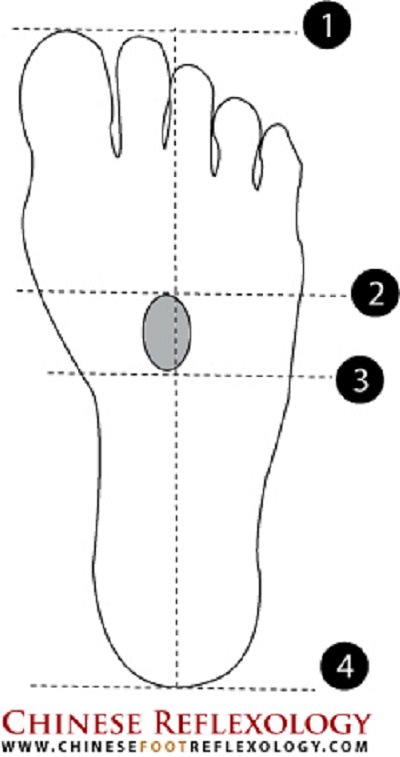
Where: Your kidney reflexology point is located on the soles of both feet. Imagine a horizontal line located halfway through your foot (line 3) and another at the bottom of the ball of your foot (line 2). Next, imagine a vertical line dividing your foot in half. This line intersects the horizontal lines 2 and 3. 

How: Massage this point by pressing it with your thumb and rubbing it in an up and down motion for about 15 to 30 seconds. For added pressure, you may also use your knuckles. Repeat on the other foot, practicing this technique daily. 

Tip: If skin irritation arises due to the friction of rubbing, stop massaging the point until the skin heals. Alternatively, you can also use a lubricant such as almond oil.

2. The Liver

Take Caution: This point is located near an acupuncture point used for inducing labor. If pregnant, do not massage this area. In TCM, the liver point plays a key role in ensuring the smooth flow of Qi throughout the body. Emotions, such as anger and frustration, are associated with this organ and can thus negatively impact its ability to balance and smooth the flow of Qi within the body.
acupressure


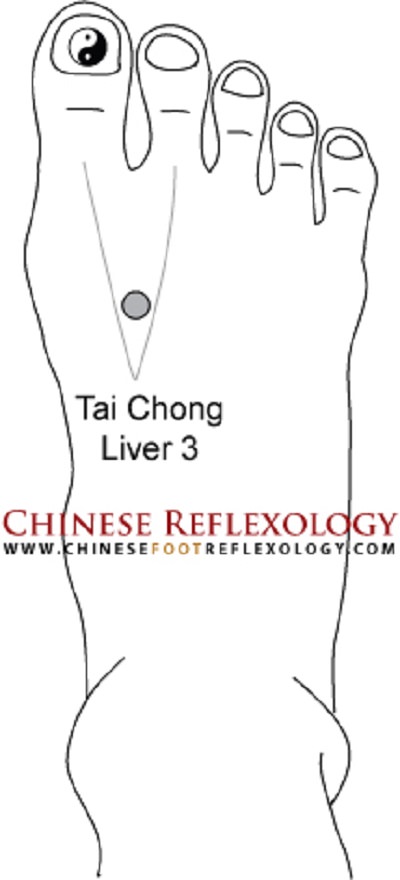
Where: Located at the top of the foot, this point is found between the big toe and the second toe. To find its precise location with your thumb, trace the bones of the two toes until you feel the point at which they intersect. Then, slide your thumb about a thumb-width above this intersection and press into the 'webbing' between the bones. 

How: Press and hold this point for about one minute on each foot. Besides smoothing the flow of Liver Qi in the body, it will also nourish the blood - the liver's primary function includes filtering the blood and breaking down toxins in the body. 

3. The Heart 

Stress and tension are often the biggest culprits that raise blood pressure and disrupt the natural flow of Qi in the body. When your body is stressed, one way to combat the feeling of tension is to locate and massage the heart point.
acupressure

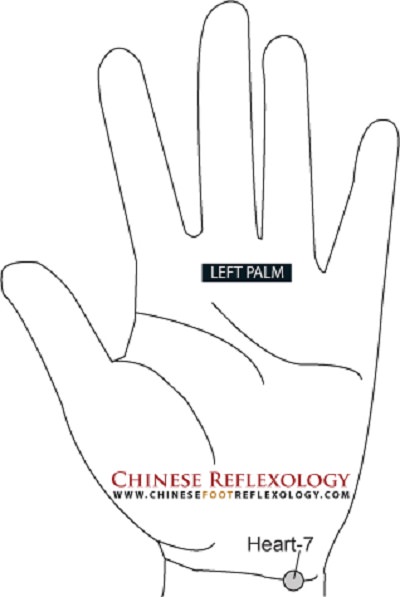
Where: Palm facing upwards, look at your wrist. At the base of your palm where your hand meets your wrist, you will see a crease in the skin. And while there are quite a few lines in this area, one will appear to be more prominent than the others. Once you've identified this crease, notice where the base of your ring and pinky finger meet and imagine a vertical line from this point reaching down toward your wrist crease. 

How: Press on this point with your thumb and hold it down for about 60 seconds on each wrist. Do so any time you feel stressed or upset to calm yourself down.


This is only for your information, kindly take the advice of your doctor for medicines, exercises and so on.   


Labels: , , , ,

Thursday, April 09, 2026

New Research Gives Another Reason to Reduce Salt Intake

It’s long been known that too much salt intake is linked to an increase in blood pressure leading to a likelier risk of heart attack or stroke, but now there’s another reason why it is recommended to stay away from this white seasoning as much as possible. In a study conducted at the Feil Family Brain and Mind Research Institute in New York, high salt consumption was associated with memory and learning difficulties, and the surprising thing is that this problem is due to the brain's connection to the intestines.

The new connection found between the brain and the intestines

When researchers examined the reason behind their study results, which showed that the brain suffered damage after consuming a lot of salt, they found that there was a connection between the small intestine and the brain. The high amount of salt consumed stimulated immune changes in the small intestine, which led to poor blood flow to the brain, thereby impairing cognitive functioning.

If you’ve reached middle age, we have bad news for you - the harmful effect on the brain worsens as the years pass. However, there’s also some good news - when you stop consuming a lot of salt the brain returns to normal function.

So, how can you continue to consume salt and prevent its harmful effects?
You may think that this study’s motive is to encourage people to stop consuming salt, but it really isn’t. You just have to know how to consume it in moderation and in the right quantity for your body. The American Heart Association recommends consuming 2,300 mg of sodium per day or less, which is about a teaspoon of salt, but most people consume more, not necessarily because they add salt to their food, but because a lot of processed food comes packed with sodium. You’re probably consuming more salt than you think and need:

Bread - One slice may not seem to contain too much salt, but it contains 230 mg of sodium, multiply it by the number of slices you eat per day and you’ll find that you consume far more salt than you think.

Pizza
- One slice of pizza can contain 760 mg of sodium, but rarely is anyone ever satisfied with only one?

Instant soups and meals - Within a few minutes, you can prepare yourself a serving of about 940 mg of sodium or more, so make sure to check the sodium content before buying these products. Giving them up altogether would be the smart move here.

Cold cuts - 3 grams of turkey cold cuts will put 780 mg of sodium in your body, and the same amount of salami will add about 1,300 mg of sodium to your diet, so it’s recommended to give up the cold cuts. 

Cottage cheese – There’s no need to throw this commodity out of the house, but you should reduce how much you eat of it. One cup of cottage cheese contains 920 mg of sodium, so it is recommended to consume less than this cheese or at least look for its lowered or sodium-free version.

In addition to this, when you cook food at home, control the amount of salt you add to it. If you feel that your food is lacking flavor, add more seasoning ingredients, such as spices or herbs. 


This is only for your information, kindly take the advice of your doctor for medicines, exercises and so on.   


Labels: , , , , , , , ,

Friday, December 26, 2025

Coffee Doesn't Just Kick-Start Your Day - It's Healthy Too

Coffee's distinctive smell and palatable taste are what help an estimated 100 million Americans pry themselves out of bed each morning. However, while its addictive flavor keeps us wanting more, you may find comfort in knowing the many hidden health benefits of consuming a daily cup of Joe. In truth, coffee is actually pretty healthy - it is packed with antioxidants and beneficial nutrients. What's more, studies show that coffee drinkers have a lower risk of developing serious diseases.
Read on to discover the 12 reasons you should wake up to a delectable cup of coffee:

1. It's great for the liver
In 2006, a study that included 125,000 people aged 22 and over found those who drank at least one cup of coffee a day were 20 percent less likely to develop liver cirrhosis - an autoimmune disease caused by excessive alcohol consumption that can lead to liver failure and cancer. Studies have also shown that consuming coffee regularly (four or more cups a day) may help prevent people from developing non-alcoholic fatty liver disease (NAFLD).

2. It  Reduces Chances of Skin Cancer

..if you are a woman. A study conducted by Bringham and Women's Hospital and Harvard Medical School, followed 112,897 men and women over a 20-year period. They discovered that women who drank more than three cups of coffee a day were less likely to develop skin cancer than those who didn't.

3. Reduces your chances of  Type 2 Diabetes

 According to a study from the American Chemical Society, drinking coffee may reduce your chances of developing Type 2 diabetes. Researchers found that people who drink four or more cups of coffee a day reduce their chances of developing Type 2 diabetes by 50 percent.


4. It keeps your brain healthier for longer
 
Studies conducted on a group of people aged 65 and older at the University of South Florida and the University of Miami respectively found that those with higher levels of caffeine in their blood developed Alzheimer's disease two to four years later than those with lower levels of caffeine. The study's co-author and neuroscientist, Dr Chuanhai Cao, reported he firmly believed that moderate coffee consumption can appreciably reduce your risk of Alzheimer's or delay its onset.

5. It can make you more Intelligent
 
Coffee is renowned for its quick-fix energy-boosting effects. However, aside from giving you a much-needed jolt, coffee makes you sharper. According to CNN, coffee allows your brain to work in a more efficient and smarter way. It improves your reaction time, vigilance, attention and logical reasoning.

6. It reduces you risk  of Heart Disease
 
In a study conducted by Korean researchers, participants who consumed three to five cups of Joe a day were less likely to show the first signs of heart disease. However, it is important to consider other dietary factors too, as Koreans typically have a different diet to Westerners.

7. It reduces your risk of Multiple Sclerosis
 
Recent studies have shown that four cups of coffee a day may help protect against the development and re-occurrence of Multiple Sclerosis. It is believed that coffee prevents neural inflammation, which may lead to the disease.

8. It reduces your risk of Colorectal cancer
 
Consuming coffee can reduce the chances of developing colorectal cancer by 26 percent. According to one study, the more coffee you consume the lower the risk.

9. It contains more antioxidants that fruits and vegetables
 
A study conducted in 2005 found that nothing comes close to providing as many antioxidants as coffee. While fruits and vegetables are loaded with antioxidants, the human body absorbs the most from coffee.

10. It can lessen the symptoms of Parkinson's
 
Studies show that people who consume caffeine are less likely to develop Parkinson's. It also stated that drinking coffee may help people with Parkinson's disease control their movement.

11. The scent of coffee can reduce stress
 
Research conducted at the Seoul National University examined the brains of rats who were stressed as a result of sleep deprivation. The study found that those who were exposed to coffee aromas experienced changes in brain proteins tied to that stress.

12. It boosts your mood
 
A study by the National Institute of Health found that those who drank more than four cups of java a day were less likely to be depressed. Coffee's mood boosting benefits do not occur due to the 'caffeine high', rather coffee makes you feel good due to its trusty antioxidants.


This is only for your information, kindly take the advice of your doctor for medicines, exercises and so on.   


Labels: , , , , , , , , , , , ,