Friday, April 18, 2025

3 Exercises to Reduce Anxiety and PTSD

Coping with anxiety and PTSD is not easy, and while professional treatment is welcome, it does not always provide the relief sufferers expect, at least not in daily coping. The truth is that there is no one solution that fits everyone, and each person needs to find their way to deal with the symptoms they experience. That is why we present to you today 3 somatic exercises you can try, which many report help reduce the intensity of the feelings they experience in moments of anxiety and PTSD. These exercises involve the whole body, and before starting any of them, it is recommended to ask yourself: "On a scale of 1 to 10, how anxious am I?" Try the chosen exercise, ask yourself again, and check if that number has decreased—this way, you'll know you found the exercise that suits you

1. Joint activation 
 When your mind is preoccupied with something, it’s hard to stop the automatic thoughts that come. Any attempt to do so will fail, but what can help is occupying the mind with something else, and it’s easiest to focus on the physical sensation in your body. For this, you will activate your body slowly and calmly, starting from the bottom and gradually moving upwards until you significantly reduce the symptoms you’re experiencing.

Start with one leg—slowly move your foot in circular motions 10 times in one direction and focus on the sensation created in the joint. Then do the same in the other direction, and after that, repeat with the other leg. If you are lying on your back, you can do the same with your knees while your thighs are in the air. If you’re standing, you can place your hands on your knees and rotate them together in circular motions. Also, rotate your pelvis to both sides, and then pause and try to notice the sensation in your lower body compared to the upper body—do you feel a difference? 
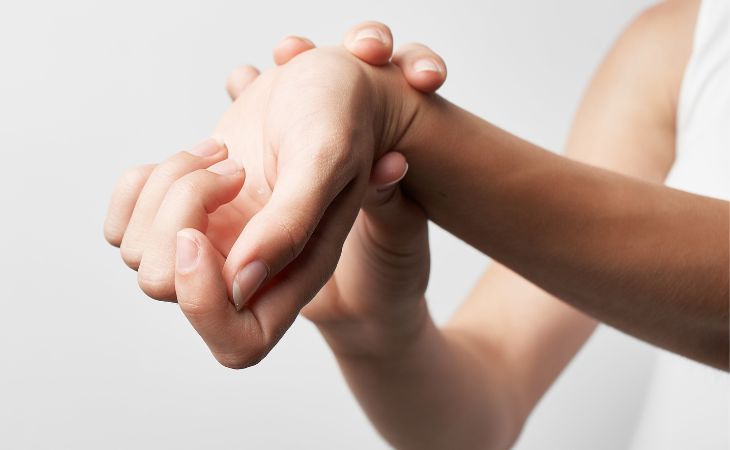
 Exercises for coping with anxiety and PTSD: Woman stretching her wrist joint
 
Now do the same with your wrists—one at a time or both together—then with your elbows and shoulders. Finally, rotate your head to one side and then to the other. Throughout the exercise, remember to focus on the sensation created in the joint during the rotations—this will help your mind focus on something else and move the energy around your body instead of trapping it inside.


2. Deep breathing and "voo" exhalations 
 The respiratory and cardiovascular systems are interconnected and influence each other—when one operates faster, so does the other. While we cannot directly control our heartbeat, we can definitely control our breathing. Some people find that deep breaths help restore calm to their body and bring their heart rate to a relaxed pace. If you have tried breathing exercises in the past and found them helpful, you might want to try the "voo" exhalation exercise.
 Exercises for coping with anxiety and PTSD: Woman performing a breathing exercise
 
To begin the exercise, place one hand on your chest and the other on your abdomen, and take a deep, slow breath. Then exhale the air while making a "voo" sound—try to make the sound come as much as possible from your abdomen and not your throat. This is an ancient breathing exercise that calms the vagus nerve, which runs from the brain to the diaphragm, and supports the parasympathetic nervous system responsible for relaxation when the body is at rest. Do this 10 times and see how you feel. 
 
3. Focusing on observing something calming 
There are many things that can be calming, like the support of another person, a warm bath, or even a thick, heavy blanket resting on your body. However, such things can also be found through sight alone, and that is the goal of this exercise. Look around for something that can calm you—some people find it helpful to gaze at something sparkling and beautiful, while others prefer a natural element like a leaf swaying on a branch in the wind. 
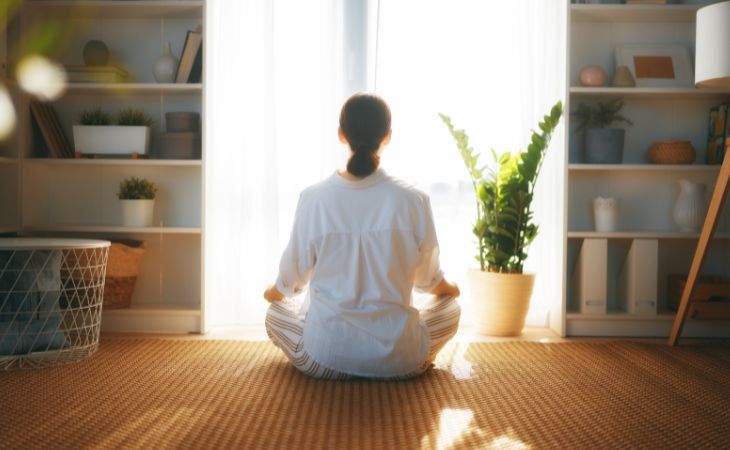
 Exercises for coping with anxiety and PTSD: Woman meditating
 
For some people, focusing on something distant works even better—the farther away it is, the more calming its effect can be. However, you might find it helpful to concentrate on something close to you, to which you can direct your entire gaze and examine closely. Try the exercise both ways to discover what works better for you, and focus your gaze until you feel its calming effect—this might take a few minutes. If you like, you can even combine this exercise with one of the previous ones and perform them simultaneously.


To sum up 
When we suffer from PTSD or anxiety, the symptoms can be severe and exhausting. The recovery process is long and not easy, but don’t let the symptoms make you think it’s impossible. Try the exercises we suggested when you feel overwhelmed, and give yourself a chance to relax and regain functionality in moments when you feel like you’re falling apart. They will help balance your body and mind, providing quick relief when you need it most.

This is only for your information, kindly take the advice of your doctor for medicines, exercises and so on.   


Labels: , , , , , , , , , ,

Wednesday, March 09, 2022

What is Osteoporosis? Know about its symptoms, causes and treatment

Do you know that frequent joint pain or bone pain can be a sign of Osteoporosis? Do you wonder what is Osteoporosis? Osteoporosis is a bone disease in which the bones become weak and brittle because of the loss of mineral density. In this condition, even bending over or coughing can cause a fracture!

Known as 'Silent disease', this condition often develops without any symptoms or pain, and it is usually not discovered until the weakened bones cause painful fractures. Osteoporosis-related fractures most commonly occur in the hip, wrist, or spine. However, people across the globe are less aware of this silent disease and it is very important that the right information reaches the general public so that they can take up all the necessary precautions to avoid it.

In this episode of Jagran Dialogues, Subhasish Dutta, Deputy Editor, Jagran New Media, spoke to Dr. Vineesh Mathur, Director - Division of Spine, Institute Of Musculoskeletal Disorders and Orthopaedics, and discussed osteoporosis, its symptoms, and treatment.

Here's an excerpt from the interview:

Q- What is osteoporosis and how does this disease develop?

Dr. Vineesh Mathur- Osteoporosis is a very common disorder and awareness about this disorder has grown gradually in the past 2-3 decades. There was time weakening of bones was considered a sign of aging and this was considered natural and not classified as a disease. But, now after thorough consideration, this disorder is considered a disease because in people of the same age group there is a vast difference in their quality of bones. Osteoporosis is the degradation of bone and its quantity. Bones get brittle due to the loss of minerals and calcium. This disorder is linked with age, sex. When bone mass gets lower than normal then it is considered Osteoporosis. It is a silent disease and there are no symptoms of this disorder.

Q- What are causes of Osteoporosis? Are women more affected by Osteoporosis if compared to men?

Dr. Vineesh Mathur- There is a very common myth in your question that this disorder affects only women. But, no men also suffer from this disease. Almost one-third of males can be suffering from this disorder. Its causes are multiple, it is linked with lifestyle and genes. If a person does not have an active lifestyle or do weight-bearing chores then this disorder might be common in them. It is also linked with hormonal problems such as Thyroid, diabetes, and metabolic disorders. Bone mass is not a static thing, if mass on it becomes less then people might suffer from Osteoporosis. Females are more prone to suffer from this disease because of menopause which happens around the age of 50. the process of menopause in females causes dramatic hormonal changes and these changes might affect bone health too. However, males also suffer from this disorder but the process is more gradual and they might see the disorder affecting them at age of 60 or 65.


This is only for your information, kindly take the advice of your doctor for medicines, exercises and so on.   

https://gscrochetdesigns.blogspot.com. one can see my crochet creations  
https://gseasyrecipes.blogspot.com. feel free to view for easy, simple and healthy recipes    
https://kneereplacement-stickclub.blogspot.com. for info on knee replacement


Labels: , , , , , , , , , , , , ,

Tuesday, February 23, 2021

8 Great Tips For Improving Your Posture

Good posture is important for maintaining good physical health, as well as literally helping us to put our best foot forward. In addition, we also tend to look our very best when we're standing or sitting properly. Here's everything you need to know about having good posture:

1. Creative Ways to Improve Posture 
 Posture
Posture Method A: "Think String" Try visualizing a string that emerges from the top of your head and pulls you gently upward toward the ceiling. This can help to guide your sense of proper positioning and height. 
 
Posture Method B: Tape a giant X to your back 
Posture
Have someone tape a giant X to your back, then put a straight line of tape across your shoulders to close the top of the X. Hold each shoulder back before taping and use wide, non-stretch tape. Ideally, you should change the tape each day, but you can also try a posture corrector if doing this seems a little too drastic to you. 
 
Posture Method C: Don't be a sloucher  

To avoid slouching when you walk, always imagine that you're walking along with a book balanced on top of your head. 
 
Posture Method D: 
 Posture
Focus on your calves Allow your posture and balance to rely more on your calves. You can do this by putting a bounce in your step. It'll free up the rest of your upper body and allow it to relax. In addition, assuming a more upright posture takes pressure off your back, shoulders, and neck, and helps you to work on your abdominal muscles. 
 
 2. Sitting Posture  
 Posture
Method A: Sit up straight 
Follow these basic guidelines to ensure your sitting posture is as good as can be: 
• Use an ergonomically-designed chair and adjust it properly to your height and weight. You can try using a small pillow for lumbar support if an ergonomic chair isn’t an option. 
• Keep your back aligned with the back of your office chair to stop yourself from slouching. 
• Turn the angle of your computer monitor slightly more upward, so that you force yourself to sit upright to see the screen better. 
• As with standing posture, keep your shoulders straight and squared, your head upright, and your neck, back, and heels aligned. 
• Keep both feet on the ground as often as you can. 
 
Method B: 
Posture
Take standing breaks Even if you sit with perfect posture in the best chair in the world, you still need to stand up and stretch every so often. You can do a little exercise or just stand there for a few minutes. The fact of the matter is that our bodies weren't designed to sit down all day long, so it's a must that you at least stand (and preferably move around) every so often throughout the day. 
 
3. Walking Posture 
  
All you need to do for maintaining good posture is simply viewing it as an extension of your standing posture. Keep your head up, shoulders back, your chest out and your eyes looking straight ahead. Be sure to avoid pushing your head forward. 
 
4. Sleeping Posture  
Posture
You can help your posture by doing certain things to prepare for your night's sleep. Use a firmer mattress to help maintain proper back support, and try sleeping on your back to help keep your shoulders straight. Don't worry if you try sleeping on your side - try slipping a small, flat pillow between your knees to keep your spine aligned and straight. Make sure you're using a good pillow to provide proper support to your head and shoulders. 
 
5. Driving Posture
 Posture
Keep your back against your seat and your head aligned with the headrest. Adjust your seat so that your legs are at a proper distance away from the pedals and your arms are at a proper distance away from the steering wheel. If your chin is bunched up above the steering wheel, then you're sitting too close. 
 Posture
 
Your headrest should be adjusted in such a way that the middle of your head rests against it. Tilt it as you require to achieve this. Make sure that there are no more than four inches between the back of your head and the headrest. 
 
6. Train Your Core Muscles  
 
You can keep your entire musculoskeletal system functioning optimally by doing a few simple exercises to support your posture. Try lying on your back with your legs bent at a 90-degree angle at the knee, keeping your feet on the floor. Pull your belly-button toward your spine and hold. Hold it for 10 seconds, and repeat eight times. Repeat the exercise daily. Breathe normally during the exercise. 
 
7. Standing Posture  
 Posture
Method A: Finding your center
Good posture is all about finding alignment and balance. Place your feet about a shoulder's width apart and stand up straight. Keep your weight on the balls of your feet to prevent you from slouching as a result of resting on your heels. Next, keep your shoulders squared. Although it might feel unnatural at first, you'll soon get the hang of it. Pull your head back and upward. You can make this easier by imagining that the top of your head is reaching the ceiling. Not only will doing this improve your posture, but it'll also make you look taller and leaner.

Posture
 
Method B: Teach your body what standing correctly feels like 
Stand with your back against a door or wall, and touch it with the back of your head, shoulders, and butt. Don't worry if it feels uncomfortable - that's what the training is for. With enough practice, it'll feel uncomfortable not to stand this way. 
 
8. General Posture
Posture

Good posture is about keeping your body in alignment. It's as simple as being able to draw a straight line from your earlobe through your shoulder, hip, knee and down to the middle of your ankle. Can you do that? If so, you've got it. Try using a mirror to align your ears, shoulders, and hips. These points make a straight line, but your spine should actually curve in a very slight "S".

This is only for your information, kindly take the advice of your doctor for medicines, exercises and so on.     

https://gscrochetdesigns.blogspot.com. one can see my crochet creations  
https://gseasyrecipes.blogspot.com. feel free to view for easy, simple and healthy recipes    
https://kneereplacement-stickclub.blogspot.com. for info on knee replacement


Labels: , , , , , ,