Friday, April 18, 2025

3 Exercises to Reduce Anxiety and PTSD

Coping with anxiety and PTSD is not easy, and while professional treatment is welcome, it does not always provide the relief sufferers expect, at least not in daily coping. The truth is that there is no one solution that fits everyone, and each person needs to find their way to deal with the symptoms they experience. That is why we present to you today 3 somatic exercises you can try, which many report help reduce the intensity of the feelings they experience in moments of anxiety and PTSD. These exercises involve the whole body, and before starting any of them, it is recommended to ask yourself: "On a scale of 1 to 10, how anxious am I?" Try the chosen exercise, ask yourself again, and check if that number has decreased—this way, you'll know you found the exercise that suits you

1. Joint activation 
 When your mind is preoccupied with something, it’s hard to stop the automatic thoughts that come. Any attempt to do so will fail, but what can help is occupying the mind with something else, and it’s easiest to focus on the physical sensation in your body. For this, you will activate your body slowly and calmly, starting from the bottom and gradually moving upwards until you significantly reduce the symptoms you’re experiencing.

Start with one leg—slowly move your foot in circular motions 10 times in one direction and focus on the sensation created in the joint. Then do the same in the other direction, and after that, repeat with the other leg. If you are lying on your back, you can do the same with your knees while your thighs are in the air. If you’re standing, you can place your hands on your knees and rotate them together in circular motions. Also, rotate your pelvis to both sides, and then pause and try to notice the sensation in your lower body compared to the upper body—do you feel a difference? 
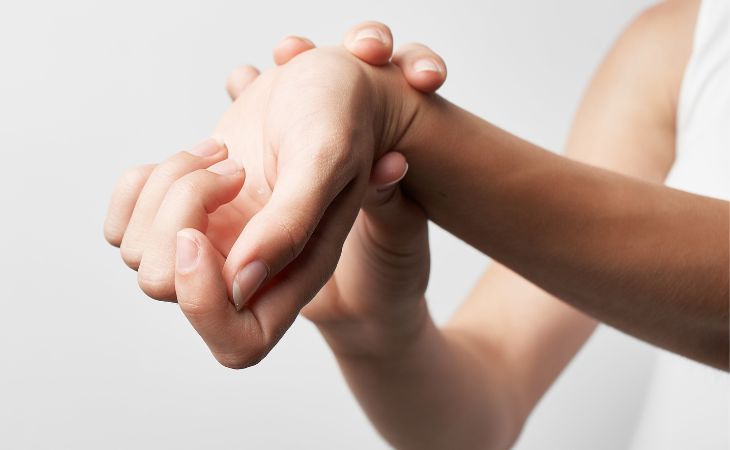
 Exercises for coping with anxiety and PTSD: Woman stretching her wrist joint
 
Now do the same with your wrists—one at a time or both together—then with your elbows and shoulders. Finally, rotate your head to one side and then to the other. Throughout the exercise, remember to focus on the sensation created in the joint during the rotations—this will help your mind focus on something else and move the energy around your body instead of trapping it inside.


2. Deep breathing and "voo" exhalations 
 The respiratory and cardiovascular systems are interconnected and influence each other—when one operates faster, so does the other. While we cannot directly control our heartbeat, we can definitely control our breathing. Some people find that deep breaths help restore calm to their body and bring their heart rate to a relaxed pace. If you have tried breathing exercises in the past and found them helpful, you might want to try the "voo" exhalation exercise.
 Exercises for coping with anxiety and PTSD: Woman performing a breathing exercise
 
To begin the exercise, place one hand on your chest and the other on your abdomen, and take a deep, slow breath. Then exhale the air while making a "voo" sound—try to make the sound come as much as possible from your abdomen and not your throat. This is an ancient breathing exercise that calms the vagus nerve, which runs from the brain to the diaphragm, and supports the parasympathetic nervous system responsible for relaxation when the body is at rest. Do this 10 times and see how you feel. 
 
3. Focusing on observing something calming 
There are many things that can be calming, like the support of another person, a warm bath, or even a thick, heavy blanket resting on your body. However, such things can also be found through sight alone, and that is the goal of this exercise. Look around for something that can calm you—some people find it helpful to gaze at something sparkling and beautiful, while others prefer a natural element like a leaf swaying on a branch in the wind. 
 Exercises for coping with anxiety and PTSD: Woman meditating
 
For some people, focusing on something distant works even better—the farther away it is, the more calming its effect can be. However, you might find it helpful to concentrate on something close to you, to which you can direct your entire gaze and examine closely. Try the exercise both ways to discover what works better for you, and focus your gaze until you feel its calming effect—this might take a few minutes. If you like, you can even combine this exercise with one of the previous ones and perform them simultaneously.


To sum up 
When we suffer from PTSD or anxiety, the symptoms can be severe and exhausting. The recovery process is long and not easy, but don’t let the symptoms make you think it’s impossible. Try the exercises we suggested when you feel overwhelmed, and give yourself a chance to relax and regain functionality in moments when you feel like you’re falling apart. They will help balance your body and mind, providing quick relief when you need it most.

This is only for your information, kindly take the advice of your doctor for medicines, exercises and so on.   


Labels: , , , , , , , , , ,

Friday, March 17, 2023

Easy Exercises to Improve Blood Flow in the Body

When varicose veins appear in the feet, nails become weak, and hair loss occurs, these are indications that blood circulation is problematic. Proper blood flow is essential for carrying oxygen and nutrients to various body organs and removing toxins. Restricted blood flow can lead to various medical problems that can harm the body's systems and general well-being. If you strain certain muscles during the day or sit in front of the computer for long hours, it can impair blood flow to certain organs. To alleviate this problem, exercises, and stretches designed for different body parts can help improve blood flow, alleviate pain, and promote overall well-being. A feeling of coldness in the palms can also suggest blood circulation issues that can be addressed through exercise and stretches.

Blood Flow Exercises

1. Improving blood flow in the hands 
 Blood Flow Exercises
When blood circulation to the hand area is poor, it can cause discomfort or pain during daily activities. To regulate blood flow and strengthen hand muscles, the following exercises should be performed daily:

Instructions: 
1. Reach with your hands forward and shake them to increase blood flow. 
 
2. Tightly clench your hands into fists for 10 seconds and repeat 5-6 times. 
 
3. Stretch your fingers apart for a few seconds and repeat 4-5 times. 
 
4. Press the palms against each other or against a hard surface. Repeat this 3-4 times. 
 
5. Finish by massaging the muscles of each palm with the fingers of the other hand. 
 
 
2. Improving blood flow to the feet 
 
Similarly, to improve blood circulation in the feet, exercises can be performed to help regulate blood flow and strengthen foot muscles. These exercises are especially beneficial for individuals who sit for prolonged periods. They can be done barefoot or with soft-soled shoes. 
 
Instructions: 
 
1. The first exercise involves sitting comfortably lifting each leg forward when straight and returning it to its original position. The exercise should be repeated five times for each leg.

Blood Flow Exercises

2. The second exercise involves placing both feet on the ground, lifting and lowering the heel of each foot to increase blood flow to the toes. This exercise should also be repeated five times for each foot.
Blood Flow Exercises
3. Step three of the exercise involves lifting your left leg to a comfortable height with your toes pointing toward the ceiling. Hold this position briefly and then point your toes forward, resembling the starting pose of a ballerina's point. This sequence should be repeated five times for each foot.
Blood Flow Exercises
4. Rotate your foot in clockwise and counterclockwise circles while holding it up in the air. Complete 10 rotations in each direction for both feet. 
 
 
3. Improving blood flow to the head and feet 
 
The following exercise is very effective for improving blood circulation and relieving strain in many organs in the body: it improves blood flow to the head and hair, as well as to the area of ​​the legs that hardly move if you sit for most of the day, and above all allows the heart to rest, since it does not have to circulate the blood against gravity to the head. There are two options for performing the exercise, so if you haven't done a candle stand lately, you should try and perform the exercise with your legs resting against a wall, and only later hold them in the air by yourself. 
 Blood Flow Exercises
Instructions: 
1. Lie on your back, fold your legs, and press them to your buttocks. 
 
2. For the next step, lift your legs and buttocks off the floor, so that your feet point towards the ceiling, and bring your chin closer to your chest. Avoid turning your head in order not to injure yourself. 
 
3. Use your hands to support your lower back, and take deep breaths. 
 
4. Stay in the position as long as you feel comfortable, up to 5 minutes.


4. The downward-facing dog position improves blood flow to the spine, brain, and limbs 
 
This exercise is an "inverted exercise" which places the body in a position it is not used to. The manner of standing increases the blood flow to the spine area and is therefore very beneficial for those suffering from back pain, and also allows better blood flow to the brain and limbs. 
 Blood Flow Exercises
 Instructions: 
 
1. Start in a six-legged position on the floor, then slowly straighten your legs and arms, while lifting your buttocks up. 
 
2. Be sure to keep your hands shoulder-width apart and your feet hip-width apart. 
 
3. Try to push the floor as much as possible with your hands and feet without moving, and feel how your spine lengthens. 
 
4. Stay in this position for about 30 seconds.


5. Triangle stretch to improve blood flow to the upper body and legs  
 
The following stretch will help you improve blood flow to your leg muscles, as well as your upper body. It doesn't strain the back muscles or over-activate them. 
Blood Flow Exercises
 Instructions: 
 
1. Begin by standing straight with your legs spread apart, with one leg turned to the side and the other leg extended. 
 
2. Stretch your right arm upwards and simultaneously reach down with your left hand to touch the floor. 
 
3. Hold this position for a few seconds, and repeat it four more times.
 
4. Switch your legs and perform five more stretches with your left hand up and your right hand down.


6. Cat-cow stretch to improve blood flow to the back, chest, neck, and head 
 
To improve blood flow to the back, chest, neck, and head, end the exercise sequence with the cat-cow position. This pose is particularly helpful for individuals who experience back or neck pain or spend prolonged periods sitting.
Blood Flow Exercises
Instructions: 
 
1. Start on all fours with your arms straight, legs bent, and hips spaced hip-width apart. 
 
2. The second step of the exercise involves inhaling and transitioning into the cat pose. This involves lifting your head without removing your hands from the floor, while simultaneously pulling up your chest and arching your lower back. 
 
3. The third step requires exhaling and moving into the cow position, where you lower your head as far as possible without bending your arms while arching your lower back and lowering your buttocks.
 
4. Repeat both parts of this exercise 10 times.

This is only for your information, kindly take the advice of your doctor for medicines, exercises and so on.  

https://gscrochetdesigns.blogspot.com. one can see my crochet creations  
https://gseasyrecipes.blogspot.com. feel free to view for easy, simple and healthy recipes    
https://kneereplacement-stickclub.blogspot.com. for info on knee replacement
https://GSiyers home remedies.blogspot.com     is my latest addition to my blogs. I'm going to add posts there, do give me your valuable feed back on my blogs. Thanks a lot, take care, be healthy and be happy. 

Labels: , , , , , , , , , , , ,

Tuesday, March 15, 2022

The Puzzling Virus That Infects Almost Everyone

Statistically speaking, the virus known as Epstein-Barr is inside you right now. It is inside 95% of us. It spreads through saliva, so perhaps you first caught the virus as a baby from your mother, who caught it as a baby from her mother. Or you picked it up at day care. Or perhaps from a friend with whom you shared a Coke. Or the pretty girl you kissed at the party that cold New Year’s Eve.

If you caught the virus in this last scenario—as a teen or young adult—then Epstein-Barr may have triggered mono, or the “kissing disease,” in which a massive immune response against the pathogen causes weeks of sore throat, fever, and debilitating fatigue. For reasons poorly understood but not unique among viruses, Epstein-Barr virus, or EBV, hits harder the later you get it in life. If you first caught the virus as a baby or young child, as most people do, the initial infection was likely mild, if not asymptomatic. Unremarkable. And so this virus has managed to fly under the radar, despite infecting almost the entire globe. EBV is sometimes jokingly said to stand for “everybody’s virus.” Once inside the body, the virus hides inside your cells for the rest of your life, but it seems mostly benign.

In the decades since its discovery by the virologists Anthony Epstein and Yvonne Barr in 1964, the virus has been linked not only to mono but also quite definitively to cancers in the head and neck, blood, and stomach. It’s also been linked, more controversially, to several autoimmune disorders. Recently, the link to one autoimmune disorder got a lot stronger: Two separate studies published this year make the case—convincingly, experts say—that Epstein-Barr virus is a cause of multiple sclerosis, in which the body mistakenly attacks the nervous system. “When you mentioned the virus and MS 20 years ago, people were like, Get lost … It was a very negative attitude,” says Alberto Ascherio, an epidemiologist at Harvard and a lead author of one of those studies, which used 20 years of blood samples to show that getting infected with EBV massively increases the risk of developing multiple sclerosis. The connection between virus and disease is hard to dismiss now. But how is it that EBV causes such a huge range of outcomes, from a barely noticeable infection to chronic, life-altering illness?

In the face of a novel coronavirus, my colleague Ed Yong noted that a bigger pandemic is a weirder pandemic: The sheer number of cases means that even one-in-a-million events become not uncommon. EBV is far from novel; it belongs to a family of viruses that were infecting our ancestors before they were really human. But it does infect nearly all of humanity and in rare occasions causes highly unusual outcomes. Its ubiquity manifests its weirdness. Decades after its discovery and probably millennia after those first ancient infections, we are still trying to understand how weird this old and familiar virus can be. We do little to curb the spread of Epstein-Barr right now. As the full scope of its consequences becomes clearer, will we eventually decide it’s worth stopping after all?

From its very discovery, Epstein-Barr confounded our ideas of what a virus can or cannot do. The first person to suspect EBV’s existence was Denis Burkitt, a British surgeon in Uganda, who had the unorthodox idea that the unusual jaw tumors he kept seeing in young children were caused by a then-undiscovered pathogen. The tumours grew fast—doubling in size in 24 to 48 hours—and were full of white blood cells or lymphocytes turned cancerous. This disease became known as Burkitt’s lymphoma. Burkitt suspected a pathogen because the jaw tumors seemed to spread from area to neighboring area and followed seasonal patterns. In other words, this lymphoma looked like an epidemic.

In 1963, a biopsy of cells from a girl with Burkitt’s lymphoma made its way to the lab of Anthony Epstein, in London. One of his students, Yvonne Barr, helped prepare the samples. Under the electron microscope, they saw the distinctive shape of a herpesvirus, a family that also includes the viruses behind genital herpes, cold sores, and chicken pox. And the tumor cells specifically were full of this virus. Case closed? Not yet. At the time, the idea that a virus could cause cancer was “rather remote,” says Alan Rickinson, a cancer researcher who worked in Epstein’s lab in the 1970s. “There was a great deal of skepticism.” What’s more, the virus’s ubiquity made things confusing. Critics pointed out that sure, children with Burkitt’s lymphoma had antibodies to EBV, but so did healthy children in Africa. So did American children for that matter, as well as isolated Icelandic farmers and people belonging to a remote tribe in the Brazilian rainforest. The virus was everywhere scientists looked, yet Burkitt’s lymphoma was largely confined to equatorial Africa. What if EBV was just an innocent bystander? Why wasn’t the virus causing disease anywhere else?

It was. Scientists just didn’t know where to look until a stroke of luck clued them in. In 1967, a technician in a Philadelphia lab studying EBV and cancer fell ill with symptoms of mono. Because she was one of the few people who had tested negative for EBV antibodies, she had regularly donated blood for lab experiments that needed a known negative sample. When she came back after the illness, she started testing positive, highly positive. The timing suggested what we now know: EBV is the most common cause of mono.

Scientists eventually found more links between the virus and other cancers: nasopharyngeal cancer, stomach cancer, Hodgkin’s lymphoma, ​​and other forms of lymphoma. In all, it plays a role in 1.5 % of cancers globally. Those first two are cancers in the cells lining the throat and stomach, which EBV can infect. The others are in white blood cells or lymphocytes, which the virus actually specializes in infecting. In particular, EBV infects a type of lymphocyte called a B cell, each of which is born to recognize a different hypothetical enemy. If a certain B cell never finds its matching enemy, it dies as part of the body’s ruthless culling of useless immune cells. If it does find a match, however, the B cell divides and transforms into memory B cells, which will remain to guard against infection for the rest of a person’s life.

EBV’s genius is that it co-opts this normal process. It manipulates infected B cells into thinking they have been activated, so that they turn into long-lasting memory B cells where the virus can hide for decades. (All herpesviruses in the family have this unusual ability to become latent, though they hide out in different types of cells. The chicken-pox virus, for example, uses nerve cells, sometimes coming out to cause shingles.) Occasionally, EBV emerges from its hiding place, replicating just enough to get by. If it replicates too little, it won’t find another host before getting shut down by the immune system. If it replicates too much, it risks harming its current host. The virus and immune system are in constant balance, each holding the other in check. There’s an “elegance with which this virus has established a long-term relationship with the host,” says Sumita Bhaduri-McIntosh, an Epstein-Barr virologist and infectious-disease doctor at the University of Florida.

When this balance is interrupted, one possible result is cancer. As part of its manipulation of infected cells, EBV seems to suppress their normal dying process. And if the cell that refuses to die has other aberrant properties, then you can get cancers like Burkitt’s lymphoma. “In most cases, when the virus appears in this cancer, and subsequently in other cancers, it is one part of a chain,” Rickinson says. “It’s obviously not the sole driver of growth.” This explains why EBV doesn’t cause cancer in everyone it infects, only in those unlucky enough to have also acquired the wrong set of other mutations. In the case of Burkitt’s lymphoma, the cancerous cells also have a strange rearrangement of chromosomes, which scientists learned is linked to malaria infection. This accounted for the unique geographic pattern that Burkitt had observed. EBV is everywhere, but Burkitt’s lymphoma was common only in places where malaria is also endemic.

Epstein-Barr became known as the first human virus linked to not just an immediate disease but also cancers that can appear years after initial infection. It challenged the traditional paradigm of viruses causing short-term illnesses that resolve and confer immunity. After all, the virus stays inside our bodies and continues to interact with our immune systems for the remainder of our lives.

Over the years, more hints of EBV’s unusual abilities started appearing. The virus or the antibodies to it seemed to be disproportionately found in people suffering from autoimmune disorders such as rheumatoid arthritis, lupus, and multiple sclerosis as well as those suffering from chronic fatigue syndrome, also known as myalgic encephalomyelitis. These chronic conditions, whose biological mechanisms are even more elusive than cancer’s, are particularly hard to study. While the correlations between EBV and these disorders were suggestive, they were in no way definitive. People who have these conditions might almost all have EBV, but then almost all healthy people have EBV too. “That’s not a very good place to start doing epidemiology, when you have 95 percent in the control group,” says Paul Farrell, an EBV researcher at Imperial College London.

The recent study from Harvard’s Ascherio got around this by looking at a massive archive of serum samples taken from people over 20 years. The collection came from the Department of Defense, which stores serum from routine tests for HIV. Among the 10 million adults with samples in the repository, researchers were able to find enough people who were initially negative for EBV but then contracted it during the 20-year period. And those who did get the virus were 32 times as likely to develop multiple sclerosis as those who did not. A 2nd study from Stanford adds a possible causation to this correlation: Some multiple-sclerosis patients have antibodies that bind both an EBV protein and a protein in the brain, which is erroneously targeted by the immune system in multiple sclerosis. This kind of cross-reaction has long been suspected in MS but only now identified. “It’s just like a great volcano of information,” says Rickinson about the recent studies. As with EBV-associated cancers, though, only a tiny sliver of people infected with the virus end up developing multiple sclerosis, so some other trigger or triggers must also be in play. We’re only at the beginning of understanding this process.

COVID, too, has revived interest in Epstein-Barr’s long-term consequences. A recent long-COVID study found EBV infection to be one of four major risk factors, suggesting that some long-COVID symptoms might be caused by reactivation of EBV when the body is weakened from fighting the coronavirus.

This association is perhaps not surprising. The debilitating fatigue associated with long COVID and other post-viral syndromes does look, in some ways, like the fatigue caused by mono. And in the 1980s, doctors noticing the similarity had begun diagnosing chronic Epstein-Barr virus syndrome in patients whose mono-like symptoms of fatigue and sore throat did not go away for months. Eventually, however, experts took Epstein-Barr out of the name and gave it the more general term of chronic fatigue syndrome, because EBV does not seem to be the sole cause of such symptoms. Chronic fatigue syndrome may have several different explanations, but the virus may still play a role in some cases even after mild infections, says Hank Balfour, a pathologist at the University of Minnesota. He has also described cases of " chronic mono,” in which a severe initial EBV infection triggers mono symptoms that either linger or recur for months or even years. Mono’s acute phase typically lasts for weeks, which is already unusually long for a virus but is well documented. There isn’t much research on chronic mono though, and the diagnosis is not widely accepted among doctors. “It needs, I think, more attention,” Balfour says. Long COVID remains a baffling consequence of the novel coronavirus, but even the long-term consequences of very common viruses like EBV are poorly understood.

As the long-term picture of EBV comes into focus, how do we think about the danger of a virus that is ubiquitous, that rarely causes serious disease but has devastating consequences when it does? We currently have no way of preventing EBV infection, short of avoiding all human interactions that might share saliva: a mother kissing her baby, a toddler doing almost anything. Vaccines have been in the works for decades; Epstein himself worked on one. The link to multiple sclerosis, many long-time researchers now hope, will revive interest in an EBV vaccine. More than a decade ago, a pharmaceutical company abandoned a vaccine candidate that successfully prevented mono but not EBV infection altogether. The result was “discouraging from a pharmacoeconomic point of view,” Balfour says, because there wasn’t a clear demand for a vaccine that prevented only mono. Preventing multiple sclerosis, however, might add an extra incentive.

Two new vaccine candidates, from the National Institute of Health and Moderna, have entered or are about to enter clinical trials. A key question is whether they can do better than the old vaccine. “We would of course like to prevent infection. That’s the ultimate goal, but we think even if we don’t prevent infection, we can still reduce EBV-associated disease,” says Jeffrey Cohen, a virologist at the NIH who works on one of the vaccines. That’s because symptomatic EBV infections—such as mono—are associated with a higher likelihood of developing EBV-associated diseases, adds Balfour, who has also worked on a vaccine. However, studying how the vaccine might stop diseases that develop years later, such as cancers or multiple sclerosis, will be very hard in a typical vaccine trial. The incidences are so low, and the diseases take so long to appear, that a vaccine trial in hundreds or thousands of people over a few years is unlikely to offer much definitive evidence. Most likely, Cohen says, if the vaccines work against mono, they can be approved to prevent the disease in people who have not yet been infected by EBV. Once it’s on the market and hundreds of thousands of people get it and are followed over years, then the effect on cancer or multiple sclerosis may finally become clear.

All of these recent advances make it a “fascinating time” for EBV research, says Rickinson, the biologist who once worked with the eponymous Epstein. “Unfortunately,” he says, “I’m unable to pursue it myself.” He recently retired from the University of Birmingham after devoting nearly 50 years to studying this enigmatic virus. It’s up to the next generation now—to figure out EBV’s remaining secrets and perhaps a better way of coexisting with it.


This is only for your information, kindly take the advice of your doctor for medicines, exercises and so on.   

https://gscrochetdesigns.blogspot.com. one can see my crochet creations  
https://gseasyrecipes.blogspot.com. feel free to view for easy, simple and healthy recipes    
https://kneereplacement-stickclub.blogspot.com. for info on knee replacement


Labels: , , , , , , , , , , , , , , , ,