Monday, December 11, 2023

This Sign On Your Face May Indicate Liver Disease

 Your skin can reveal a lot about your health. In some cases, it can even point to a serious health issue. If you ever notice several clusters of tiny blood vessels suddenly appear on your face, you could be suffering from liver disease. Even though a single cluster like this - called a spider angioma in medicine - usually isn’t a cause for concern, multiple spider angiomas are indicative of chronic liver disease in 95 percent of cases, states a recent study. 


What are spider angiomas?

 Spider Angioma woman examining face

Spider angiomas, also known under the names spider nevus and spider veins, are often a sign of chronic liver problems, especially alcohol-related liver cirrhosis. These skin imperfections are usually found on the face, neck, chest, and arms. They resemble spider-like clusters of small blood vessels, often with a central red spot in the middle. The color of the blood vessels varies from red to blue and purple

Pressing on a spider angioma with your finger will make it disappear, but releasing your finger and restoring the blood supply to the area will make the angioma reappear. Spider veins are usually painless to the touch.


The causes of spider angioma 
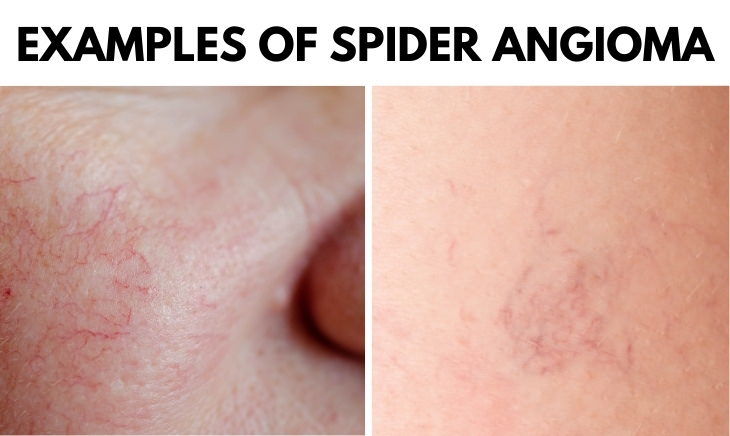
 Spider Angioma examples
 
While multiple spider angiomas can point to a variety of dangerous health concerns, including liver disease, rheumatoid arthritis, hormonal problems, and skin cancer, a singular spider nevus isn’t a cause for concern on its own. This is because skin injuries, excessive sun exposure, and even pregnancy are all common causes of spider angiomas as well. 
 
If you notice a singular spider angioma in a child, pregnant woman, or healthy adult, the chances of it being caused by a serious underlying condition are minimal and you shouldn’t be concerned. If you have a spider angioma, it will be a relief to know that these skin imperfections are usually benign and do not require any treatment.

The takeaway message is - be mindful of these skin imperfections and seek medical help if you experience other alarming symptoms, such as fatigue, bloating, or yellow skin or eyes. 
 
 
This is only for your information, kindly take the advice of your doctor for medicines, exercises and so on.   

https://gscrochetdesigns.blogspot.com. one can see my crochet creations  
https://gseasyrecipes.blogspot.com. feel free to view for easy, simple and healthy recipes    
https://kneereplacement-stickclub.blogspot.com. for info on knee replacement
https://cancersupportindia.blogspot.com  for infor on cancer and health related topics
https://GSiyers home remedies.blogspot.com   is the latest addition to my blogs. I'm going to add posts there, do give me your valuable feed back on my blogs. Thanks a lot, take care, be healthy and be happy.
 

Labels: , , ,

Wednesday, March 09, 2022

What is Osteoporosis? Know about its symptoms, causes and treatment

Do you know that frequent joint pain or bone pain can be a sign of Osteoporosis? Do you wonder what is Osteoporosis? Osteoporosis is a bone disease in which the bones become weak and brittle because of the loss of mineral density. In this condition, even bending over or coughing can cause a fracture!

Known as 'Silent disease', this condition often develops without any symptoms or pain, and it is usually not discovered until the weakened bones cause painful fractures. Osteoporosis-related fractures most commonly occur in the hip, wrist, or spine. However, people across the globe are less aware of this silent disease and it is very important that the right information reaches the general public so that they can take up all the necessary precautions to avoid it.

In this episode of Jagran Dialogues, Subhasish Dutta, Deputy Editor, Jagran New Media, spoke to Dr. Vineesh Mathur, Director - Division of Spine, Institute Of Musculoskeletal Disorders and Orthopaedics, and discussed osteoporosis, its symptoms, and treatment.

Here's an excerpt from the interview:

Q- What is osteoporosis and how does this disease develop?

Dr. Vineesh Mathur- Osteoporosis is a very common disorder and awareness about this disorder has grown gradually in the past 2-3 decades. There was time weakening of bones was considered a sign of aging and this was considered natural and not classified as a disease. But, now after thorough consideration, this disorder is considered a disease because in people of the same age group there is a vast difference in their quality of bones. Osteoporosis is the degradation of bone and its quantity. Bones get brittle due to the loss of minerals and calcium. This disorder is linked with age, sex. When bone mass gets lower than normal then it is considered Osteoporosis. It is a silent disease and there are no symptoms of this disorder.

Q- What are causes of Osteoporosis? Are women more affected by Osteoporosis if compared to men?

Dr. Vineesh Mathur- There is a very common myth in your question that this disorder affects only women. But, no men also suffer from this disease. Almost one-third of males can be suffering from this disorder. Its causes are multiple, it is linked with lifestyle and genes. If a person does not have an active lifestyle or do weight-bearing chores then this disorder might be common in them. It is also linked with hormonal problems such as Thyroid, diabetes, and metabolic disorders. Bone mass is not a static thing, if mass on it becomes less then people might suffer from Osteoporosis. Females are more prone to suffer from this disease because of menopause which happens around the age of 50. the process of menopause in females causes dramatic hormonal changes and these changes might affect bone health too. However, males also suffer from this disorder but the process is more gradual and they might see the disorder affecting them at age of 60 or 65.


This is only for your information, kindly take the advice of your doctor for medicines, exercises and so on.   

https://gscrochetdesigns.blogspot.com. one can see my crochet creations  
https://gseasyrecipes.blogspot.com. feel free to view for easy, simple and healthy recipes    
https://kneereplacement-stickclub.blogspot.com. for info on knee replacement


Labels: , , , , , , , , , , , , ,

Sunday, October 10, 2021

Can irregular periods raise the risk of heart disease?

For most women, monthly periods come up like clockwork, and are usually taken as a good sign of well-being. However, having irregular periods is something that draws concern. From the risk of PCOS, stress and reproductive health, irregular periods can take a huge toll on vital body functioning. In fact, as per doctors, your periods can also have an impact on your heart health, and hence, should be checked out at once. But how concerned should you be? We explain

What makes irregular periods a big risk?

While missing out or having irregular monthly flow can happen due to quite a few many causes, PCOS, or Polycystic Ovary Syndrome is one of the prime causes which lead to irregular menstruation.

Known to affect 1 in 8 women of reproductive ages, PCOS is starting to turn into an epidemic on its own, with more and more cases being reported in recent years. The condition, which is hugely caused by lifestyle problems, hormonal imbalances can lead to problematic effects on the overall health, including weight gain, hormonal disruption, disturbed period flow, reproductive issues and flag the risk of metabolic differences. However, what raises alarm bells is that despite being such a common disease, many women continue to be blatantly unaware, or misinformed about their symptoms, and have poor knowledge about what they are suffering from is PCOS. This, in turn, not only impacts their reproductive health gravely, but also leads to delayed diagnosis, poor overall health. In particular, ignoring the risk factors can mean bad news for the heart.

PCOS, irregular periods and heart health: What's the connection?

With PCOS, one of the primary features which is reported amongst most women is irregular periods. The troubled periods are caused by hormonal problems, which further offset metabolic differences, including insulin resistance. Having excess levels of male hormones in the body, along with insulin resistance (which is characteristic of diabetes) can raise cholesterol, lipid profiles as well. This, in turn, is how women with PCOS or undergoing period problems could put them at the risk of developing heart diseases, or having an elevated risk of cardiac ailments.

Studies have also found that women who do have PCOS have a whopping 28% higher risk of developing heart problems than women who normally menstruate and do not suffer from consequential irregularities. Plus, the overall risk of heart disease amongst women is also on the higher side than men, which again makes the situation worrisome and one which requires attention.

Now, one of the prime reasons as to why PCOS raises the risk of heart problems lies in the symptoms and side-effects it creates. Insulin resistance, for example, does not just lead to diabetes, but also raises other metabolic flags in the body. From a cardiovascular viewpoint, being insulin resistant, undergoing high loads of stress (another common factor with PCOS) raised lipid levels and other metabolic abnormalities doubles up the risk of heart problems. This is one of the reasons as to why doctors attest that early diagnosis, and management of PCOS is important.


Since women suffering from PCOS can also face weight problems, and find it struggles-ome to lose weight, they also put themselves at the risk of inflammation and higher BMI levels. Inflammation and obesity are precursors for vascular problems and again, a significant risk factor for heart disease. Sedentary lifestyle, poor to no level of physical activity can also make the risk graver. Thus, it's imperative to be aware, manage and treat PCOS from the initial stage.

How can you manage PCOS and lower your risk of heart problems?

With PCOS, while there's no available medical cure, the best way possible to effectively manage and curb one's PCOS symptoms lies in critical lifestyle modifications. Here are some of the ways how women with PCOS can reduce their risk, and lead a healthy life:

-Work towards weight reduction and maintaining good BMI levels suitable for your age and height.

-Follow a good diet, and minimize intake of added sugar and processed foods.

-Have an antioxidant, protein rich diet. Lessen your dependence on junk, preserved, packaged or other foods which may have chemical traces.

-Some women also benefit from going gluten-free or dairy-free

-Make sure you workout or engage in physical activity, 4-5 times a week. Moderate intensity exercises are best suited.

-Work to reduce your stress levels

-Try following yoga and meditation to seek therapeutic relief.

-Follow heart-healthy practices.

-Ensure you get undisturbed, regular sleep.


This is only for your information, kindly take the advice of your doctor for medicines, exercises and so on.   

https://gscrochetdesigns.blogspot.com. one can see my crochet creations  
https://gseasyrecipes.blogspot.com. feel free to view for easy, simple and healthy recipes    
https://kneereplacement-stickclub.blogspot.com. for info on knee replacement


Labels: , , , , , , , , ,