Tuesday, June 06, 2017

How to cope with Dementia

A lot of things can be done to cope with the initial stages of dementia. A person goes through a wide range of emotions such as fear, denial, frustration, and anger, post the diagnosis. Here is a list of tips that will help a patient with dementia to cope better:

  1. Physical health: For a dementia patient, it is very important to take care of one’s health. A good diet along with regular exercise and adequate rest is a prerequisite to manage this disorder.
  2. Regular check-ups: Regular medical check-ups with the doctor are necessary in this condition. Depression and other mental health problems should be discussed with a professional.
  3. Quit alcohol: Alcohol might give momentary pleasure from the misery, but it has long-standing implications. It reacts with the medicine and creates additional health and memory-related complications.
  4. Allocate time for difficult tasks: With time, it can become difficult to perform even the simplest of tasks. The patient should accordingly schedule the time to perform the tasks which may be difficult to carry out. Adequate breaks should be taken while performing a task to avoid getting fatigued.
  5. Redefine work: If a patient is suffering from dementia is still working, it should be ensured that the work is more manageable from a desk. Planning an early retirement may be a good idea in order to cope with dementia.
  6. Be organised: Keeping track of things can get difficult with time. It, therefore, makes sense to organise all belongings systematically. Putting labels on doors and drawers also help.
  7. Continue pursuing your hobbies: Amidst the difficulty and the depression, it is a good idea to continue doing things that are fun. While such activities might require some assistance from the doctor and family members, this helps the patient to be cheerful and healthy.
  8. Maintain notes: Since dementia is involved with forgetfulness, it makes sense to maintain a diary and keep records of phone numbers, people, appointments, etc.
  9. Communication channel: Maintaining a direct communication channel with family, friends, and relatives is a good idea. Sharing feelings will go a long way in maintaining relations with loved ones.
  10. Support group: Joining a dementia support group can be highly beneficial for the patient. It will not only give the patient company but also make sure that the patient gets a lot of useful information about the disorder. It also helps in keeping the morale up.
  11. Getting ready for the future: Things need to be meticulously planned well in advance to ensure that when the disease progresses, the patient has enough people to look after him. Things such as medical arrangements, financial assets, and property details should be carefully handed over as per the patient's wish. This will ensure a smooth run of the patients’ life when they can no longer take care of themselves.
  12.  this is only for your information, kindly take the advice of your doctor for medicines, exercises and so on.   
    https://gscrochetdesigns.blogspot.com. one can see my crochet creations 
    https://gseasyrecipes.blogspot.com. feel free to view for easy, simple and healthy recipes    
    https://kneereplacement-stickclub.blogspot.com. for info on knee replacement
       

Labels: , , , , , , , , , , , , ,

Wednesday, August 26, 2015

Everything You Need To KNow About Glaucoma

Glaucoma is a medical condition of the eye where the optic nerve becomes damaged, and worsens over time. The buildup of pressure inside the eye, known as intraocular pressure, is the eye's inability to drain out the aqueous humor fluid properly. The optic nerve damage can lead to loss of vision and permanent blindness within a couple of years if left untreated.
 The two main types of the disease are open-angle glaucoma and angle-closure glaucoma. Open-angle glaucoma is the most common of the pair. In the open-angle, the eye structures appear normal, but the fluid doesn't flow properly through the drain of the eyes, known as the trabecular meshwork.  
 The latter of the diseases, angle-closure glaucoma, is categorized by poor drainage of the eye, due to the angle between the iris and the cornea, which then becomes obstructed by the iris and results in blurred vision. 
 There are numerous ways in which the eye disease may be treated. The treatments are prescription eye drops for less severe problems, microsurgery to thoroughly drain out the fluid of the eye, or through various laser surgery procedures.
 Please consult your physician if you are suffering from any of the symptoms listed below, or if you have a history of glaucoma in your family. It's important to have a complete eye exam to minimize the risks at an early stage.
External Causes:
  • Blockage of blood vessels in the eye
  • Blunt injury to the eye
  • Chemical damages to the eye
  • Severe eye infection
  • Inflammatory conditions of the eye (Uveitis)
Symptoms
  • Seeing halos around lights
  • Vision loss
  • Redness in the eye
  • Sudden hazy or blurred vision
  • Nausea or vomiting
  • Pain in the eye
  • Narrowing of vision (tunnel vision)
  • Flashes of light or black spots
  • Double vision
  • Seeing spots, ghost-like images
People at Most Risk:
  • Are over the age of 40
  • Have a family history of glaucoma
  • People of African-American ancestry
  • Have poor vision
  • Have thin corneas
  • Have diabetes
  • Have had trauma to the eye or eyes
  • Take certain steroid medications, such as prednisone
7 Preventative Measures Against Glaucoma:
 
1) Healthy Diet - Maintaining a healthy diet is essential for preventing diseases of all sorts. Green leafy vegetables are high in chlorophyll, which is a vital component that improves vision and protects against glaucoma. Make sure you add spinach, kale, beetroot, and carrots, to your salad and dietary intake. The omega-3 fatty acids of cold water fish are also beneficial for healthy eyesight. 

2) Eye Exercises - You can practice from a wide assortment of eye exercises to maintain optimal vision. Eye exercises prevent strain and sharpen concentration. Here are a few exercises you can perform at home:
  • The Pencil Exercise - Hold a pencil at an arm’s length and focus on it and slowly bring it closer to your nose. Move the pencil farther from your eyes until you can no longer keep it in focus. Perform this exercise about ten times a day.
  • The Eye Rolling Exercise - Roll your eyes in a clockwise direction for a few seconds, and then counter-clockwise for a few seconds. Repeat the process four or five times, and blink your eyes in between each set.
  • The Eye Blinking Exercise - Try blinking your eyes in quick spurts, 20 to 30 times without squeezing your eyes shut, which is known as eyelid fluttering. Close your eyes and let them rest for a while after you are done. 
  • The Concentration Exercise - Focus your vision on a distant object for a short period. Try staring at the moon outside for a few minutes to avoid straining of the eyes. 
3) Sunning and Palming - The Bates Method of sunning and palming, helps flex and reactivate the lens of the eye. Here's how to perform each technique:
  • The Sunning Process - Let the sun shine directly onto your closed eyelids, while breathing in deeply. You can sun in the morning for a couple of minutes. 
  • The Palming Process - Rub your palms together to generate heat and then gently cup them over your closed eyes without applying any pressure. Keep your eyes covered so that no trace of light can enter. 
 
4) Wild Asparagus - You might not have liked asparagus when you were young, but you will certainly appreciate the benefits this spring vegetable has for maintaining healthy vision. Eating a few sticks of asparagus can help prevent such eye disorders as glaucoma and cataracts. Here is an interesting recipe you can prepare:
  • Mix 1 teaspoon of wild asparagus with 1/2 teaspoon of honey.
  • Consume twice daily with a glass of warm milk for a few months. 
5) Ginkgo Biloba - The Chinese have relied on the Ginkgo Biloba for over 5,000 years to treat a variety of medical conditions. Ginkgo Biloba affects ocular blood flow and protects the optic nerve from damages. It is also used to improve memory, relieve stress and even help treat Alzheimer's disease. Take 120-mg standardized capsules once a day, or in two to three divided doses. Make sure you consult your doctor before taking any Ginko Biloba capsules. 
 
6) Bilberry - This powerful bilberry herb is ideal for treating night blindness and protecting against macular degeneration of the eye. It contains a chemical called anthocyanoside, which supplies the bloodstream with anti-inflammatory properties. Eat a 1/2 cup of them per day, or in supplement form as an alternative. Take 160 mg of bilberry extract (with 25 percent anthocyanidin) twice daily, or several times per week. Consult your doctor beforehand if you are planning to take the herb in capsule form. 
  
7) Almonds - Almonds are a great snack alternative to sugary candy bars and potato chips, high in sodium. They help improve vision with the powerful omega-3 fatty acid components, and  provide you with a much-needed boost of energy during the day. A handful of almonds can increase brain function and even save you from fatigue. Try this quick and easy almond paste recipe:
  • Take about 5 to 10 almonds and let them soak in water overnight.
  • Peel the skin off and grind them the following morning.
  • The mixture will turn into an almond paste, which you can consume with a glass of warm milk for breakfast. 
  • Repeat process for a few months. 
Extra Bonus Tips:
  • Visit your eye doctor for regular checkups.
  • Don't spend too much time watching T.V. or sitting directly in front of a computer screen, since they both contribute to straining of the eyes.
  • Keep a safe distance about 18 to 24 inches away from the screen while you are working.
  • Purchase an anti-glare screen to avoid glare on your computer. 
  • Wear a pair of UV sunglasses when you're outside to protect your eyes from the beaming sunlight.
  • Avoid reading in areas where the lighting is dim, since it adds strain to the eye muscles.
  • Use good quality eye cosmetics to shield the eyes.
  • Do not wear glasses that have the wrong prescription.
  • Take frequent visual breaks from your computer, resting your eyes every 20 minutes or so.
  • Get a good night's sleep to prevent eye discomfort and blurry vision.
  •  
    THIS IS ONLY FOR INFORMATION, ALWAYS CONSULT YOU PHYSICIAN BEFORE HAVING ANY PARTICULAR FOOD/ MEDICATION/EXERCISE/OTHER REMEDIES.


    PS- THOSE INTERESTED IN RECIPES ARE FREE TO VIEW MY BLOG-
    HTTP:GSEASYRECIPES.BLOGSPOT.COM


    FOR INFO ABOUT KNEE REPLACEMENT, YOU CAN VIEW MY BLOG
    HTTP://KNEE REPLACEMENT-STICK CLUB.BLOGSPOT.COM/

    FOR CROCHET DESIGNS- http://My Crochet Creations.blogspot.com/

Labels: , , , , , , , , , , , , , , , ,

Monday, November 04, 2013

Eye Exams A Must For Diabtetics

 Researchers have said that people who are suffering from diabetes should also get their eye check-ups done regularly.
Diabetic retinopathy is the most common form of this disease, and affects about 28.5 percent of Americans with diabetes age 40 and older. That’s more than 7 million people, and the number is expected to reach more than 11 million by the year 2030.
The condition can creep up quietly. It gradually weakens small blood vessels in and around the retina, the light-sensing layer of tissue at the back of the eye. If the disease progresses, these vessels may rupture and leak blood into the eye; they can also spread and grow on the surface of the retina and cause scarring.
Typically, diabetic retinopathy has no symptoms until it reaches an advanced stage. But the disease can be detected early through a comprehensive dilated eye exam. In this procedure, an eye professional will put drops in your eye to dilate (widen) the pupil, which allows a closer look at the retina.
The good news is that with early detection, timely treatment, and appropriate follow-up, the risk of severe vision loss from diabetic retinopathy can be reduced by 95 percent. There are several effective treatment options including laser surgery and injections of anti-VEGF drugs. These drugs block the actions of a protein that can cause abnormal blood vessels to grow and leak fluid. 

ps- this is only for information, always consult you physician before having any particular food/ medication/exercise/other remedies.
ps- those interested in recipes are free to view my blog-

http://gseasyrecipes.blogspot.com/


for info about knee replacement, you can view my blog-


http://Knee replacement-stick club.blogspot.com/


for crochet designs


http://My Crochet Creations.blogspot.com

Labels: , , , , , , , , , , , , ,

Monday, September 09, 2013

SIMPLE PHILOSOPHY TO FOLLOW IN LIFE TO BE HAPPY !


Mayonnaise Jar
  When things in your life seemalmost too much to handle,
When 24 Hours in a day is not enough,
Remember the mayonnaise jar and 2 glasses of beer.

A professor stood before his philosophy class
 
 and had some items in front of him.
When the class began, wordlessly,
He picked up a very large and empty mayonnaise jar
And proceeded to fill it with golf balls.

He then asked the students, if the jar was full.
They agreed that it was.

The professor then picked up a box of pebbles and poured
them into the jar.   He shook the jar lightly.
The pebbles rolled into the open Areas between the golf balls.

He then asked the students again if the jar was full.  They agreed it was.

The professor next picked up a box of sand and poured it into the jar.
 Of course, the sand filled up everything else.
He asked once more if the jar was full. The students responded with a unanimous 'yes.'

The professor then produced two glasses of beer from under the table and poured the entire contents into the jar, effectively
filling the empty space between the sand.  The students laughed.

'Now,' said the professor,   as the laughter subsided,
'I want you to recognize that this jar represents your life.
The golf balls are the important things - family,
children, health, Friends, and Favourite passions –
Things that if everything else was lost and only they remained, Your life would still be full.

The pebbles are the other things that matter like your job, house, and car.

The sand is everything else --The small stuff.

'If you put the sand into the jar first,'  He continued,
there is no room for  the pebbles or the golf balls.
The same goes for life.

If you spend all your time and energy on the small stuff,
You will never have room for the things that are important to you.


So...


Pay attention to the things that are critical to your happiness.
Play With your children.
Take time to get medical checkups.
Take your partner out to dinner.

There will always be time to clean the house and fix the disposal.

'Take care of the golf balls first --
The things that really matter.
Set your priorities. The rest is just sand.'

One of the students raised her hand and inquired what the beer represented.

The professor smiled.
'I'm glad you asked'.

It just goes to show you that no matter how full your life may seem,
there's always room for a glass of beer with a friend.'

Labels: , , , , , , , , , , , ,

Thursday, August 29, 2013

Cut risk of diabetes by 30 per cent with just 30 minutes of physical activity

The number of people suffering from diabetes is on the rise. Whether we blame a sedentary lifestyle or the food we eat, there is no ignoring the number of people who fall a prey to the disease. According to experts this disease is not only a blood sugar disorder but is a vascular disease.  

With almost everyone spending so much of their time in a sedentary job, how can one stay healthy and safe from diabetes? Here are some things you can do:

Be physically active: You have probably heard this advice a million times, but it is true. The best way to keep healthy is to exercise. It not helps reduce weight, but also regulates blood sugar levels. Half an hour of exercise whether aerobic exercise, or activities like dancing, playing tennis, brisk walking etc. reduces the risk of Type 2 diabetes by 30%. If you do not have time in the day, you could try taking a fifteen minute walk after each meal within your office complex. This helps regulate one’s blood sugar levels thereby reducing the risk of developing diabetes. 

Healthy diet:  Eating foods that are rich in fibre helps to naturally balance sugar levels in the body. Avoid the habit of overeating and instead divide your meals into 5-6 meals including snacks  etc. There is one sneaky demon when it comes to eating – emotional eating. Yup, when you are stressed out or just feeling low, one does tend to turn to food to calm down. Avoid this habit, it leads to weight gain and eventually diabetes. Junk food is also a strict no-no as they are a major reason of obesity and diabetes. 

Get proper sleep: Sleeping for at least 7-8 hours in a day is a must since proper sleep will make you feel energetic, and most importantly keep a check on your cravings for high-calorie food.  
Manage stress: Stress is one of the major reasons for diabetes.  Studies suggest that the more stressed out a person is the more he/she tends to resort to unhealthy food habits or start smoking and/or binge drinking. How stress works is that the stress hormones alter blood glucose levels directly increasing the risk of the diabetes. To lower your stress levels you could try yoga, meditation, exercising, listening music or anything that makes you happy and stress free.

Get Regular health check-ups: As the saying goes, better safe than sorry, getting regular health check-up especially after the age of 45 is always a good idea. But if you have known risk factors (like high blood pressure or obesity), discuss them with your doctor. 


ps- this is only for information, always consult you physician before having any particular food/ medication/exercise/other remedies.

ps- those interested in recipes are free to view my blog-

http://gseasyrecipes.blogspot.com/

for info about knee replacement, you can view my blog-

http://Knee replacement-stick club.blogspot.com/

for crochet designs

http://My Crochet Creations.blogspot.com/

Labels: , , , , , , , , , ,

Friday, March 01, 2013

Some exercises to help Peripheral Neuropathy

Low Impact Exercises

Swimming or water aerobics can be gentle forms of exercise. Water supports your body, putting less pressure on feet affected by nerve pain. Yoga and tai chi may also be good choices. Their movements may help with balance and relaxation.

Start doing exercises slowly & increase them gradually


Starting exercise can be challenging. Make it easier by starting slowly. Try five minutes of extra movement a day and add a little more time each day. It is recommended  that  building up to 30 minutes a day, five days a week.
If you have nerve damage and are concerned about falls, start with some moves to build your balance.


How to improve your balance

Build your balance by practising rising out of a chair. Do it three times in a row. At first you can use your arms to help and steady you. Work towards doing it unassisted. This is one of several moves to try to improve your balance.


Balance on One Leg

Slowly raise one foot off the ground so that you are standing on one leg. Try holding for 30 seconds, then switch. As you get better, try and balance for a little longer. You can practice this move almost anywhere -- at the sink in the morning, while shopping, or while talking  on the phone. Your goal is to do this hands-free. In case you need to steady yourself, have a stable object nearby.


Tight rope walking ?!
No high wire needed for this move -- just follow the same motion. Practice walking heel to toe. Line one foot up directly in front of the other as you step forward. Leave some bend in your knees and spread out your arms to help you balance. For an extra challenge, reverse and try taking a few steps backwards.
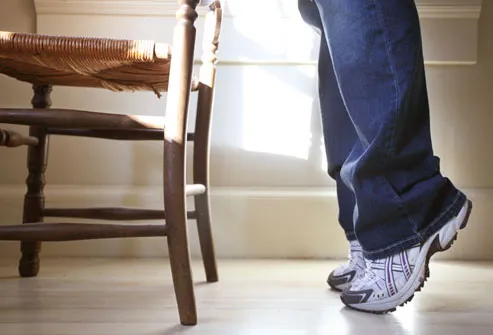
Standing on toes
Stand near a chair, railing, or other object for support. Slowly rise up onto the balls of both feet and hold. Do three times. Each time try and hold longer.
Balance moves can be done every day. With more confidence in your balance you can add other activities.

Check before & after exercise
Get your heart, eyes, and feet checked out by your doctor before starting a new form of exercise. After each workout look for injury to feet, and other areas prone to injury. When you have diabetes blisters, cracks, cuts, and scrapes should be treated with extra care to avoid infection.

Good shoes & some healthy snacks for exercising
Having a good fitting pair of athletic shoes is especially important for people with diabetes. They can help you avoid foot injury. When shopping, look for a roomy toe box to prevent unwanted rubbing and blisters.
On your way to exercising, pack a quick source of carbohydrates in case your blood sugar drops. Hard candy and raisins may be good choices.

Check your blood sugar before & after exercise
Check blood glucose before and after exercise. It can help you learn exercise's effect on your blood sugar to help you manage it. The safe range for exercise is between 100 and 250 mg/dL.
If your average blood sugar is over 250 mg/dL and you have type 1 diabetes, you'll want to check for ketones in your urine. If it is moderate or high, delay exercise until it lowers.

Exercising with a friend or pet makes it feel more fun
Make plans with a good friend or your pet to work out.  You and your buddy can help each other stay committed to exercising. Making it social may provide extra motivation. And picking a workout buddy at your fitness level can also help you to feel comfortable. Other ways to work out with others include group classes at the gym or recreational teams.

Try something new or different to keep off boredom while exercising
By mixing up the routine of exercises, with something new will make it more interesting & it will also motivate you to continue with your exercises. Try a new sport, but see that it is up to your fitness level only, but before trying, ask your Dr.'s permission. Above all do it slowly, within your limits.


Labels: , , , , , , , , , , , , , , , ,

Friday, August 31, 2012

Peripheral Neuropathy- How exercise can help avoid/ reduce pain


Prevent Diabetes Nerve Damage

Staying dedicated to exercise may help control nerve pain or peripheral neuropathy. According to one study, people who took a brisk one-hour walk on a treadmill four times a week slowed how quickly their nerve damage worsened. The key is making exercise a regular part of your life with diabetes. But first, speak with your doctor to see which exercise is right for you.

Low-Impact Exercise

Swimming or water aerobics can be gentle forms of exercise. Water supports your body, putting less pressure on feet affected by nerve pain. Yoga and tai chi may also be good choices. Their movements may help with balance and relaxation.

Overcome Fear, Start Slow

Starting exercise can be challenging. Make it easier by starting slowly. Try five minutes of extra movement a day and add a little more time each day. 

If you have nerve damage and are concerned about falls, start with some moves to build your balance.


Working on Balance

Build your balance by practicing rising out of a chair. Do it three times in a row. At first you can use your arms to help and steady you. Work towards doing it unassisted. This is one of several moves to try to improve your balance.


Balance on One Leg

Slowly raise one foot off the ground so that you are standing on one leg. Try holding for 30 seconds, then switch. As you get better, try and balance for a little longer. You can practice this move most anywhere -- at the sink in the morning, in line at the grocery store, or while talking on the phone. Your goal is to do this hands-free. In case you need to steady yourself, have a stable object nearby.


Walk a Tight Rope

No high wire needed for this move -- just follow the same motion. Practice walking heel to toe. Line one foot up directly in front of the other as you step forward. Leave some bend in your knees and spread out your arms to help you balance. For an extra challenge, reverse and try taking a few steps backwards.


Tippy Toe

Stand near a chair, railing, or other object for support. Slowly rise up onto the balls of both feet and hold. Do three times. Each time try and hold longer.

Balance moves can be done every day. With more confidence in your balance you can add other activities.


Get Checked Before You Start, 

Get your heart, eyes, and feet checked out by your doctor before starting a new form of exercise. After each workout look for injury to feet, and other areas prone to injury. When you have diabetes blisters, cracks, cuts, and scrapes should be treated with extra care to avoid infection.


Proper Footwear and Pack a Snack

Having a good fitting pair of athletic shoes is especially important for people with diabetes. They can help you avoid foot injury. When shopping, look for a roomy toe box to prevent unwanted rubbing and blisters.

On your way to exercising, pack a quick source of carbs in case your blood sugar drops. Hard candy and raisins may be good choices.


Blood Sugar and Exercise

Check blood glucose before and after exercise. It can help you learn exercise's effect on your blood sugar to help you manage it. The safe range for exercise is between 100 and 250 mg/dL.

If your average blood sugar is over 250 mg/dL and you have type 1 diabetes, you'll want to check for ketones in your urine. If it is moderate or high, delay exercise until it lowers.


Make Fitness Fun

By making exercising something you enjoy, you'll be more likely to keep it up. Did you like a certain activity as a teen or child? Try picking it back up again. Having fun can boost your fitness and your spirits. You don't need to work up a major sweat to gain benefits.


Make a Date

Make plans with a buddy to work out. A friend, neighbor, your partner, or even your pet are great options. You and your buddy can help each other stay committed to exercising. Making it social may provide extra motivation. And picking a workout buddy at your fitness level can also help you to feel comfortable. Other ways to work out with others include group classes at the gym or recreational teams.


Try Something New

Mix up your routine. Try a new sport or take a lesson to learn a new activity, such as golf, badminton, bowling, kayaking, or ballroom dancing. Or check out a new exercise DVD or video. The idea is to fight boredom and keep physical activity interesting.

Labels: , , , , , , , ,

Monday, June 18, 2012

Myths about HEART


Mistakes about Heart


When it comes to your heart, maybe you think you’re doing everything right. You’re not overweight, you try to exercise regularly and the last time you checked, your blood pressure and cholesterol numbers were within your target range. You’re off to a great start, but on a daily basis you may be doing small things that over time can add up to big problems for your heart. Here are 20 common mistakes that people make, the effects they can have on your health and how you can turn these habits into good ones. 


forgetting to floss
“Dental health and heart health go together, and there’s a lot of science suggesting that poor dental health and gingivitis can promote heart disease,” says a Dr. "The chronic inflammation that occurs in the lining of the gums in the mouth sets up chronic inflammation throughout your body, and little bursts of bacteria may actually get into your bloodstream. People who brush and floss more often have excellent dental hygiene, and actually have lower rates of heart disease.”


skimping on your zzz’s
Close to half of all Americans don’t get enough sleep, according to a recent Gallup poll. In fact, one in six people get a measly five hours of sleep a night. Whether you go to bed too late, get up too early or toss and turn all night long, if you don’t get enough rest, you may be harming your heart. “Sleep promotes lower blood pressure and reduces the likelihood of irregular heartbeats, and people who have good sleep habits are less likely to have heart failure and heart attacks,” says Dr. “If you do have trouble getting a good night’s sleep -- which is eight hours for most people -- see your doctor and get evaluated.” Your doctor may help you determine if there’s a medical reason for your poor sleep, such as restless leg syndrome or sleep apnea, and get you treatment if necessary. She may also suggest sleep habits that might help you sleep better, such as not eating a big meal or drinking alcohol right before bedtime, and trying to go to bed and get up at the same time every day.


Holidaying
You already know that vacations can help you de-stress and relax. But there’s also evidence that not going on vacation may raise your risk for heart disease. In the 1990s, a 20-year study of about 750 women revealed that those who vacation less than once every six years had a 50 to 100 percent greater risk of heart attack compared with women who vacationed twice a year. More recently, data from the Wisconsin Women’s Health Study found that women who take vacations frequently are less likely to become tense, depressed or tired and are more satisfied with their marriages -- all psychological boosts that may reduce heart disease risk.


not eating a colorful diet
And by colorful, we mean fruits and vegetables. In addition to fiber, vitamins, minerals and antioxidants, fruits and vegetables tend to be high in potassium. “When it comes to managing blood pressure, increasing the potassium you consume in foods is just as important as reducing the sodium you consume,” says a Dr. “Potassium blunts the effects of sodium to help lower high blood pressure.” Citrus fruits, bananas, potatoes, tomatoes and beans are all great sources of potassium. “White” foods count too: A recent study showed a 52 percent decreased risk of stroke incidence for people who ate a high intake of white fruits and vegetables (think apples, pears, cucumbers and cauliflower) compared to a low intake.


staying inside
You’ve been told to limit your sun exposure to minimize your risk of skin cancer, and that’s smart advice. Getting sunburned is not recommended for anyone. However, your body needs some sun exposure to help you maintain adequate levels of vitamin D, an essential vitamin that is manufactured in your skin in the presence of sunlight and, research is revealing, has multiple benefits in the body overall and to your heart. In one recent study, doctors in New York found that people who had low levels of vitamin D were more likely to have plaque buildup in their blood vessels than those who had higher levels of vitamin D in their blood. Several studies suggest that low vitamin D contributes to high blood pressure, and that getting more of the vitamin can help control the condition. 


How much D do you need? Regardless of your skin tone, during the warmest months, as little as five to 30 minutes of sun exposure (without sunscreen) at least twice a week between 10 a.m. and 3 p.m. to your face, arms, legs or back should be enough to help your body manufacture adequate amounts of vitamin D, according to the National Institutes of Health. If you live north of Boston or Northern California, you may not get enough in the winter. Ask your doctor if you need a blood test to check your levels of vitamin D. Taking a supplement may help get your D levels up and keep your heart healthy.


thinking more is more
You’ve probably heard that some vegetable oils are healthier for your heart than others. Olive, canola, peanut, safflower and sunflower oil all contain monounsaturated fat, which not only lowers your overall cholesterol, but also raises your HDL, or “good,” cholesterol. Switching from corn oil to canola oil, for example, is one important step to help your heart, but limiting the amount of oils and fats in your diet is also important. “People think that because olive oil, for example, is a healthy oil, they can eat as much as they want, and at restaurants they’ll dip their bread into it and just soak up as much as they can,” says a Dr. “Like all fats, monounsaturated oils are calorie dense. One serving size of olive oil is just one teaspoon. Lose track and you can consume a lot of extra calories.”


Walk instead of drive through
You’ll help your heart (and save a little gas) if you park your car and walk into your bank, dry cleaner or drugstore. At any store, park a little farther away from the door and use the time you’d normally spend searching for the closest parking spot to walk instead, advises Dr.  “People think they need to set aside 45 minutes to exercise, and that can feel regimented and a bit overwhelming to some. But if you build up to 10,000 steps a day, that is equivalent to 45 minutes to an hour of exercise. Every step counts.”


missing checkups
You’re healthy and don’t appear to be at any increased risk of heart disease, so you stretch out your time between checkups, or just skip them. Sound familiar? Bad idea. Heart disease can be a silent killer; many people who have it don’t have obvious symptoms. For that reason, the American Heart Association recommends that beginning at age 20, “normal” people with no increased risks for heart disease have full cholesterol checks done every five years, blood pressure checked at least every two years, body mass index calculated at each healthcare visit and beginning at age 45, blood glucose checked every three years. If you have certain risk factors, you may need more frequent checks. Consult your doctor.


not eating dairy
If you’re like many people, you’ve cut back on dairy products to save calories and reduce the fat in your diet, but this may not be the way to go. “Dairy is an important part of the diet, but choose low-fat or skim milk, yogurt, reduced-fat cheeses and other low-fat rather than full-fat options,” says a Dr. Several studies now indicate that diets high in low-fat dairy products may reduce risk for diabetes in both men and women. And diabetes, in turn, increases the risk of heart disease. In the latest study, doctors nationwide looked at more than 82,000 postmenopausal women followed for eight years and found that the women with the highest dairy intakes cut their risk for developing type 2 diabetes by 50 percent compared with women with the lowest intakes of dairy products. Eating low-fat yogurt seemed particularly beneficial in reducing diabetes risk in this study.


Snack Right
Chips or pretzels may be a quick, tasty afternoon snack, but the salt and sugar they contain may well raise your blood pressure and/or your triglyceride level. Plus, because they’re mostly simple carbohydrates, you’re likely to feel hungry an hour later and eat more. A better choice? “Eating about one ounce of nuts a day has been shown to reduce your bad cholesterol by 8 percent to 20 percent” says a Dr. Mix them up to maximize their benefits. Macadamia nuts have the most monounsaturated fats of any nut. Pistachios and pecans are high in beta-sitosterol, a substance that may help lower cholesterol levels, and pistachios have the most potassium of any nut. Walnuts contain omega-3 fatty acids, which can help lower cardiovascular disease risks. Almonds have been shown in several studies to lower cholesterol levels, including levels of LDL, or “bad,” cholesterol. Stick to around 1.5 ounces keep calories down. That’s about 20 pecan halves or almonds, about 15 cashews, about 10 walnuts or macadamias or about 48 pistachios.


bypassing beans
Pinto, black, kidney and other types of beans provide a great source of protein without saturated fat, and they’re one of the best sources of soluble fiber, which is important in reducing cholesterol. “Oatmeal and barley are other good sources of soluble fiber, which acts like a sticky broom to sweep the cholesterol out of the blood vessels.
limiting your spice rack
There’s a lot more to seasonings than salt and pepper. The American Heart Association recommends trying to limit your sodium intake to 1,500 milligrams per day. In addition to looking for low-sodium options in prepared foods, such as soups and sauces, expand your use of other spices to keep your food tasting good and satisfying without too much salt. “Instead of salt, try sprinkling fresh chives or thyme on your potato, or season chicken or vegetables with rosemary,” suggests Smithson. “Or try a little cilantro on your melon; it sounds like an odd combination, but it’s delicious.”


stocking up on soda...
...and energy drinks and sports drinks. These beverages are the number one source of added sugar in the American diet. The AHA recommends that women consume no more than 100 calories (6 teaspoons) of added sugar per day, and men no more than 150 calories (9 teaspoons). A single 12-ounce soft drink contains 130 calories or about 8 teaspoons. “This added sugar raises the triglyceride levels in your blood,” says Smithson. “Triglycerides are a type of fat that can actually make your blood thicker. So, if you already have some cholesterol building up in your arteries, and then you’re trying to push thicker blood through there, it’s easy to see how problems occur.” Switch to water, or squeeze a lemon, lime or other fruit into a seltzer or brew up some unsweetened iced tea to quench your thirst. And don’t think you need a sports drink to replace your electrolytes. Unless you’re working out vigorously for more than one hour a day, it’s just not necessary, says Smithson.


forgetting your family history
To know your own risk for heart disease, you need to know if it runs in your family. “You should be aware of what sicknesses not only your parents have or had, but also how your siblings are doing,” says Dr. Foody. “If your brother or sister have any signs of heart disease, especially at an early age, your risks may be higher than you realize.” Ask your family members about their own health and the health of any relatives, such as grandparents, uncles and aunts. If they have already died, try to find out not only how they died, but at what age. Knowing their lifestyle habits can be helpful, too. For example, if your grandfather died from a heart attack at age 78, but was overweight and smoked two packs of cigarettes a day, your own risk may not be as high as if your grandfather, who appeared fit and never smoked, died while jogging at age 40.


canceling dates with friends or family
Sure, you’re busy, but nurturing your relationships with loved ones not only enhances your life, but also may even lengthen it. In a recent 13-year study of more than 3,000 people, researchers at the University of Pittsburgh found that women were twice as likely as men to describe themselves as lonely, and the loneliest women had a 76 percent higher risk of coronary heart disease than those who said they were not lonely. Loneliness was associated with lower levels of physical activity in both men and women; among women, it was also linked to smoking and being overweight. Previous studies have found that people who describe themselves as lonely don’t handle stress as well and don’t sleep as well as those who have more social support. “We know that an isolated person in their 50s and 60s has many more health problems than a person who is surrounded by people they can depend on, whether from their church or friends or a husband or kids,” says a Dr.. “You don’t have to be married, but everyone needs someone they can rely on sometimes.”


skipping your morning joe
“People feel guilty for drinking coffee, but it’s loaded with antioxidants that may help reduce inflammation in the body, a risk factor for heart disease,”. It’s not the caffeine in it that helps the heart, it’s the antioxidants, so drinking a cup or two of either decaf or regular coffee may help lower your risks for heart disease.” Of course, it’s best to skip the sugar, which turns your coffee into candy.
not eating dessert
Recent studies have shown that eating small amounts of chocolate every day can lower risk of cardiovascular disease by 37 percent, reduce risk of stroke by 20 to 29 percent and may also reduce risk for diabetes. “Dark chocolate should be a guilt-free dessert, because it’s filled with flavonoids, which help protect your heart by lowering bad cholesterol and preventing inflammation,” . “When you’re buying dark chocolate, make sure the first ingredient is cacao, because that’s where the flavonoids are. Cacao by itself is bitter, so some sugar or corn syrup may be in the product, and that’s okay, as long as the first ingredient is dark chocolate or cacao. Try a few and see which ones you like the best.” Again, the secret is moderation. About two candy bars per week, or about 1/4 quarter of a candy bar per day, is the recommended amount of chocolate to help your heart.


being a multitasker
You cook dinner while you talk on the phone and help your child do his homework. Or you juggle so many projects at work that you don’t really feel that you do your best on any of them. Trying to do too many things at once is one of the warning signs that you may not be dealing well with the stress in your life, according to the American Heart Association. Other signs include working too much, rushing around and not getting much done, delaying things you need to do, talking very fast and eating to calm down. Chronic stress may cause increases in your heart rate and blood pressure that could damage the walls of your arteries. Step back and look at the stress in your life, and consider reprioritizing the things you’re doing. Also, consider learning some stress-management techniques. Your local hospital or continuing education program may offer a class in stress reduction, or your doctor may be able to refer you to someone who can teach you some stress-reduction techniques. Trying yoga, meditation, visualization, progressive relaxation or deep-breathing exercises may also help you reduce your stress level.


not going public
You’ve finally decided to quit smoking, and you’ve even set a date to do it. Then you think, “I better not tell anyone in case I don’t make it.” Wrong! “Go up to whomever you know that cares about you -- family, friends, co-workers -- and say, ‘As of this date I am quitting smoking,’” suggests Dr.  “Then, if those people in your circle see you smoking or see you struggling, they’re there to support you, and that’s essential. It also helps you because you’re accountable not only to yourself, but also to them.” Another tip? Wherever you used to stash your cigarettes, leave yourself a reminder note about how important your heart is, or how much your family depends on you.


saving up for the weekend
Drinking a small amount of alcohol may increase your levels of good cholesterol. The American Heart Association currently advises drinking up to one alcoholic drink a day for women and up to two for men. One drink is one 12-ounce beer, 4 ounces of wine, 1.5 ounces of 80-proof spirits or 1 ounce of 100-proof spirits. “A lot of people ask me if they can skip their glasses during the week and drink it all on Saturday night,” says Dr.  “The answer is no. It doesn’t work that way. Higher quantities of alcohol can harm heart muscle, promote heart failure and arrhythmias like atrial fibrillation, as well as potentially damage other organs, including the liver.” Too much alcohol has also been shown to raise levels of triglycerides (a type of fat) in the blood -- one more reason to drink only in moderation and to spread it out over the course of the week.


Labels: , , , , , , , , , , , , , , , , , , ,