Monday, February 22, 2021

Artemisia plant extracts show potential anti-SARS-CoV-2 activity in vitro

A team of scientists from Germany and the USA recently explored the effectiveness of traditional plant medicines in treating severe acute respiratory syndrome coronavirus 2 (SARS-CoV-2) infection. Their findings reveal that various extracts of two medicinal plants, namely Artemisia annua and Artemisia afra, can potentially inhibit SARS-CoV-2 replication in vitro without causing any cytotoxicity. The study is currently available on the bioRxiv* preprint server.
Study: In vitro efficacy of Artemisia extracts against SARS-CoV-2. Image Credit: Scisetti Alfio / Shutterstock Background

Background

The recent outbreak of coronavirus disease 2019 (COVID-19), caused by the SARS-CoV-2 pathogen, has put a large burden on the healthcare systems of many countries globally. Although about 80% of COVID-19 patients develop only mild symptoms or remain asymptomatic, the disease has claimed more than 2.4 million lives worldwide since its emergence in December 2019. In the initial phase of the pandemic, many antiviral medicines already approved for other diseases have been repurposed to treat critically ill COVID-19 patients. Many vaccines with good efficacy and safety levels have also been developed and approved in record time to curb the pandemic's growth.

Various synthetic derivatives (artesunate) of artemisinin, which is a bioactive natural compound found in Artemisia annua plants, are typically being used as antimalarial medicines. The antimicrobial properties of these bioactive compounds have been recognized clinically. Different extracts of Artemisia annua containing high amount of artemisinin are currently undergoing phase 2 clinical trials to treat COVID-19 patients. Since April 2020 in Madagascar, Covid-Organics drinks containing mainly Artemisia annua extracts are being used as a miracle intervention to treat and prevent COVID-19.     

In the current study, the scientists have explored the efficacy of Artemisia annua and Artemisia afra extracts and Covid-Organics in preventing SARS-CoV-2 infection in vitro. Using various animal cell lines, they specifically examined whether these plant products are able to inhibit replication of SARS-CoV-2 and feline coronavirus.

Important observations

Both water and ethanolic extracts of dried leaves of Artemisia annua and Artemisia afra were used in this study. In addition, 500 mg of pure artemisinin and dried form of 50 ml of Covid-Organics were dissolved in dimethyl sulfoxide and tested for activity using various in vitro experimentations.

To determine its antiviral activity, the scientists first incubated feline coronavirus with different concentrations of plant extracts and pure artemisinin solution on a monolayer of feline kidney cells. Using plaque formation assay, they observed that all tested extracts significantly inhibited viral replication in a dose-dependent manner. Specifically, they observed that at a concentration range of 5 – 10 mg/ml, all tested extracts significantly inhibited viral replication, whereas no inhibition was observed at less than 2 mg/ml concentration. Based on these findings, they selected the most potent extracts with the highest antiviral activity for further experimentations on SARS-CoV-2.

A set of experiments conducted using the monkey kidney cell line revealed that the extracts at a concentration of less than 2 mg/ml had potent antiviral activity against SARS-CoV-2. The strongest SARS-CoV-2 inhibitory effects were observed for water extracts of Artemisia annua and Artemisia afra and an ethanolic extract of Artemisia annua. Since Artemisia afra does not contain artemisinin, the scientists believe that other bioactive compounds present in the plant may be responsible for the observed anti-SARS-CoV-2 activity.  

Using a separate set of experiments, the scientists estimated that these extracts could induce cytotoxic effects at a concentration range of 10 – 20 mg/ml, which was significantly higher than the concentrations required for antiviral activities. This observation indicates that these extracts can potently inhibit SARS-CoV-2 replication without affecting cell viability.

The preparations made from Covid-Organics drink showed higher antiviral activity against SARS-CoV-2 compared to Feline coronavirus. However, the selectivity index (the window between cytotoxicity and antiviral activity) of Covid-Organics drink was estimated to be 5.2, making it less promising as an antiviral medicine.
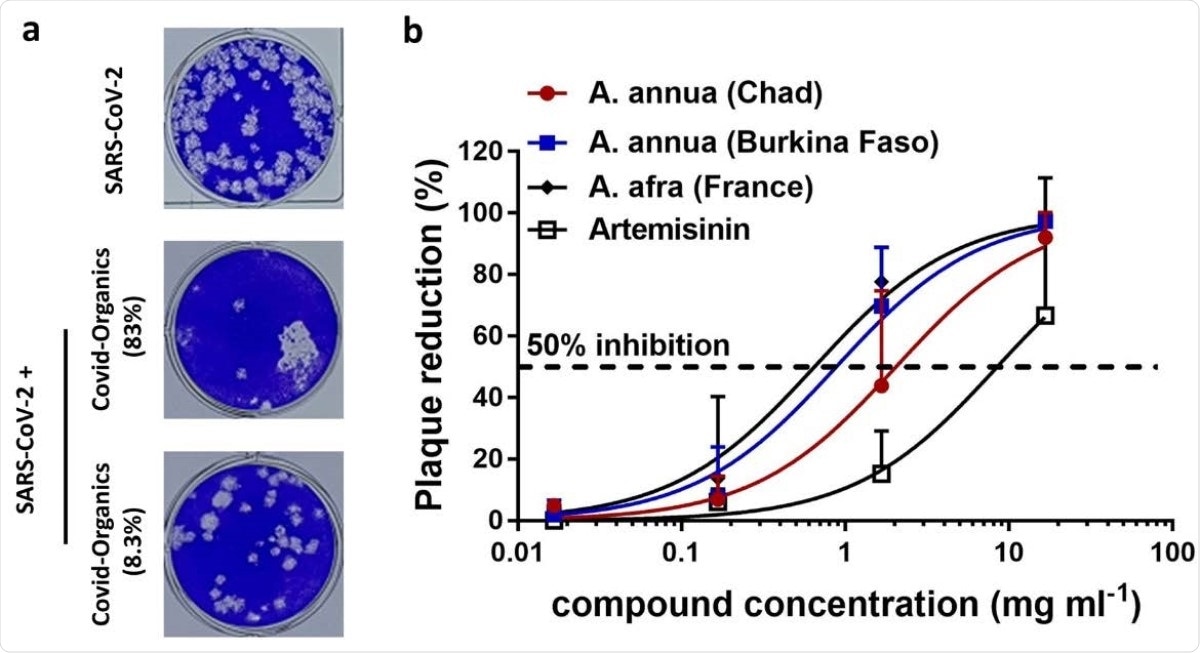
(a) Images of the SARS-CoV-2 plaques incubated with different dilutions of Covid- Organics. The dose is expressed by percentage of the raw drink. (b) Concentrationdependent inhibition SARS-CoV-2 replication using different extracts. Values are expressed as mean ±SD,
(a) Images of the SARS-CoV-2 plaques incubated with different dilutions of Covid- Organics. The dose is expressed by percentage of the raw drink. (b) Concentrationdependent inhibition SARS-CoV-2 replication using different extracts. Values are expressed as mean ±SD, n=3.

Study significance

The study reveals that various extracts of Artemisia annua and Artemisia afra have potential antiviral activities against SARS-CoV-2. However, the scientists mention that further studies are required to check whether appropriate serum levels of Artemisia compounds needed to inhibit SARS-CoV-2 can be achieved in patients. Moreover, further animal and human clinical trials are required to determine whether these in vitro observations can be translated for actual clinical use.

This is only for your information, kindly take the advice of your doctor for medicines, exercises and so on.     

https://gscrochetdesigns.blogspot.com. one can see my crochet creations  
https://gseasyrecipes.blogspot.com. feel free to view for easy, simple and healthy recipes    
https://kneereplacement-stickclub.blogspot.com. for info on knee replacement

Labels: , , , , , , , , , , , ,

Friday, June 06, 2014

Papaya hals Breast Cancer Cell Growth !

Make sure that you have some as often as possible.
The gorgeous Fruit Papaya....
Papaya was the only studied food found to halt breast cancer.

Scientists studied 14 plant foods commonly consumed in Mexico to determine their ability to halt breast cancer cell growth. These included avocado, black sapodilla, guava, mango, prickly pear cactus (nopal), pineapple, grapes, tomato, and papaya.

They also evaluated beta-carotene, total plant phenolics, and gallic acid contents and antioxidant capacity. They found that only papaya had a significant effect on stopping breast cancer cell growth.
Papaya is a store-house of cancer-fighting lycopene.

The intense orangey-pink colour of papaya means it is chock full of cancer fighting carotenoids. Not only beta carotene, but lycopene is found in abundance. The construction of lycopene makes it highly reactive towards oxygen and free radicals.

Scientists at the University of Illinois think this anti-oxidant activity contributes to its effectiveness as a cancer fighting agent. Epidemiological studies have indicated an inverse relationship between lycopene intake and prostate cancer risk. They showed that oral lycopene is highly bio available, accumulates in prostate tissue, and is localised in the nucleus of prostate epithelial cells.

In addition to antioxidant activity, other experiments have indicated that lycopene induces cancer cell death, anti-metastatic activity, and the up-regulation of protective enzymes. (The experiment report on cancer cells, Phase I and II studies have established the safety of lycopene supplementation in done on October 8, 2008).

Prostate cancer was the subject of a study in Australia that looked at 130 prostate cancer patients and 274 hospitalized controls. The scientists found that men who consumed the most lycopene-rich fruits and vegetables such as papaya were 82% less likely to have prostate cancer. In this study, green tea also exerted a powerful anti-cancer effect. When lycopene-rich foods were consumed with green tea, the combination was even more effective, an outcome the researchers credited to their synergy. ( Asia Pacific Journal of Clinical Nutrition, 2007).

Isothiocyanates found in papaya restore the cell cycle to eliminate cancer.

Organo-sulphur compounds called isothiocyanates are found in papaya. In animal experiments, isothiocyanates protected against cancers of the breast, lung, colon, pancreas, prostate, as well as leukaemia, and they have the potential to prevent cancer in humans. Isothiocyanates have shown themselves capable of inhibiting both the formation and development of cancer cells through multiple pathways and mechanisms. (International Journal of Oncology, October, 2008).

Types of isothiocyate fruit and vegetable.

Researchers in Japan - clarified the mechanisms of action in a type of isothiocyanate found in papaya known as BITC, which underlies the relationship between cell cycle regulation and appropriate cell death. When cancerous cells die on schedule, they are no longer a problem.

The researchers established that BITC exerted cancer cell killing effects that were greater in the proliferating cells than in the quiescent cells. Cancer cells that are proliferating are much more dangerous than cancer cells that are in a state of dormancy. (Forum of Nutrition, 2009).

Enzymes (Vinegar) from papaya digest proteins including those that protect tumours.

The fruit and other parts of the papaya tree, also known as the paw paw tree, contain papain and chymopapain, powerful proteolytic enzymes that facilitate chemical reactions in the body.

They promote digestion by helping to break down proteins from food into amino acids that can be recombined to produce protein useable by humans.

Proteolytic enzymes protect the body from inflammation and help heal burns. They do a good job of digesting unwanted scar tissue both on the skin and under its surface.

Being a proteolytic enzyme, papain is able to destroy intestinal parasites, which are composed mostly of protein. To rid the body of intestinal parasites, half a cup of papaya juice can be alternated each hour for twelve consecutive hours with the same amount of cucumber or green bean juice.

Research has shown that the physical and mental health of people is highly dependent on their ability to produce proteins they can use effectively.

However, as people age, they produce less of the enzymes needed to effectively digest proteins from food and free needed amino acids. They are left with excessive amounts of undigested protein which can lead to overgrowth of unwanted bacteria in the intestinal tract, and a lack of available amino acids.

Eating papaya after a meal promotes digestion, and helps prevent bloating, gas production, and indigestion. It is quite helpful after antibiotic use to replenish friendly intestinal bacteria that were the casualties in the war against the unwanted bacteria. When the intestinal tract is well populated with friendly bacteria, the immune system is strengthened, and can protect better against flu and cancer.
Papaya contains fibrin, another useful compound not readily found in the plant kingdom.

Fibrin reduces the risk of blood clots and improves the quality of blood cells, optimising the ability of blood to flow through the circulatory system. Fibrin is also important in prevention strokes.

Proteolytic enzymes containing fibrin are a good idea for long plane rides to minimize the potential of blood clots in the legs. People who sit at a desk all day might want to use proteolytic enzymes too. Proteolytic enzymes are able to digest and destroy the defence shields of viruses, tumours, allergens, yeasts, and various forms of fungus.

Once the shield is destroyed, tumours and invading organisms are extremely vulnerable and easily taken care of by the immune system. Undigested proteins can penetrate the gut and wind up in the bloodstream where they are treated by the immune system as invaders. If too many undigested proteins are floating around, the immune system becomes overburdened and unable to attend to the other tasks it was meant to do. Proteolytic enzymes can digest these rogue proteins, freeing up the immune system.

Let's ensure a slice of papaya every day in our diet. Papaya juice will be great.
Have a great day.....along with a slice of papaya.


THIS IS ONLY FOR INFORMATION, ALWAYS CONSULT YOU PHYSICIAN BEFORE HAVING ANY PARTICULAR FOOD/ MEDICATION/EXERCISE/OTHER REMEDIES.


PS- THOSE INTERESTED IN RECIPES ARE FREE TO VIEW MY BLOG-
HTTP:GSEASYRECIPES.BLOGSPOT.COM/
FOR INFO ABOUT KNEE REPLACEMENT, YOU CAN VIEW MY BLOG-
HTTP://KNEE REPLACEMENT-STICK CLUB.BLOGSPOT.COM/

FOR CROCHET DESIGNS


HTTP://MY CROCHET CREATIONS.BLOGSPOT.COM


Labels: , , , , , , , , , , , , , , ,

Wednesday, January 15, 2014

Key proteins regulating heart's electrical communication found

Researchers at Cedars-Sinai Heart Institute in Los Angeles have found that six proteins - five more than previously thought - regulate the rapid flow of electrical communication signals, coordinating heart cells to produce a stable heartbeat.
The smallest of these proteins directs the largest in performing its role of coordinating billions of heart cells during each heartbeat.
Together, the proteins synchronise the beating heart, the researchers claimed.
"The findings advance our understanding of cell-to-cell communication at the root of healthy heart function. When there is less cell communication, which occurs in failing hearts, chances are greater of disturbances in heart rhythm that can result in disability or death," said Robin Shaw, senior author of the study.
Till date, scientists had recognised just one protein involved in cell-to-cell communication that occurs through conduits known as 'gap junctions', said the study.
"The finding adds startling diversity to a key biological process whereby, heart cells communicate with each other electrically," said Eduardo Marbán, director of the Cedars-Sinai Heart Institute.
"The implications are major for arrhythmias and heart failure," he added.
The researchers have also determined that a class of drugs known as 'mTOR inhibitors' - those already used for immunosuppression in organ transplants - can be used to prevent erratic and sometimes fatal heart rhythms.
A properly beating heart is necessary to pump blood to the brain, lungs and other organs.
Cell-to-cell communication occurs in all other organs. The same proteins that help heart cells communicate also play a role in brain function, bone development and insulin production in the pancreas, the study said.

ps- this is only for information, always consult you physician before having any particular food/ medication/exercise/other remedies.
ps- those interested in recipes are free to view my blog-

http://gseasyrecipes.blogspot.com/


for info about knee replacement, you can view my blog-


http://Knee replacement-stick club.blogspot.com/


for crochet designs


http://My Crochet Creations.blogspot.com

Labels: , , , , , , , , , , , , , , , , , ,

Wednesday, January 08, 2014

Vitamin E essential to repair cell, muscle

Vitamin E is rubbed on the skin to reduce signs of ageing and is consumed by runners to improve endurance. But scientists now have found how the powerful antioxidant helps repair tears in the plasma membrane.
Daily activities such as eating and exercise can tear the plasma membrane and a new research by Georgia Health Sciences University shows that vitamin E is essential to repair, the journal Nature Communications reported.
Without repair of muscle cells, for example, muscles eventually waste away and die in a process similar to what occurs in muscular dystrophy, said a university statement. (Read: Eat spinach, almonds for increasing Vitamin E levels and preventing memory loss)
Muscle weakness is a common complaint in diabetes, another condition associated with inadequate plasma membrane repair.
“Without any special effort we consume vitamin E every day and we don’t even know what it does in our bodies,” said Paul McNeil, Georgia’s cell biologist and study co-author.
Century-old animal studies linked vitamin E deficiency to muscle problems but how that happens remained a mystery until now, McNeil said.
According to him, lack of membrane repair causing muscle wasting and death prompted him to look at vitamin E.
Vitamin E appears to aid repair in several ways. As an antioxidant, it helps eliminate destructive byproducts from the body’s use of oxygen that impede repair.
Because it’s lipid-soluble, vitamin E can actually insert itself into the membrane to prevent free radicals from attacking. It also can help keep phospholipids, a major membrane component, compliant so they repair better after a tear.


ps- this is only for information, always consult you physician before having any particular food/ medication/exercise/other remedies.
ps- those interested in recipes are free to view my blog-

http://gseasyrecipes.blogspot.com/


for info about knee replacement, you can view my blog-


http://Knee replacement-stick club.blogspot.com/


for crochet designs


http://My Crochet Creations.blogspot.com

Labels: , , , , ,

Monday, September 02, 2013

IMPORTANCE OF CALCIUM

Calcium is the most abundant mineral in the body. More than 99% is stored in—and helps fortify—teeth and bones, while the remainder goes toward blood vessel and muscle function, cell communication, and hormone secretion.

Where to get it: Dairy products contain the highest amounts of naturally occurring calcium; plain low-fat yoghurt leads the pack with 415 mg (42% DV) per serving. Dark, leafy greens (such as kale and Chinese cabbage) are another natural source of calcium, which can also be found in fortified fruit juices and cereals.


For calcium rich recipe- see my recipe blog.


ps- this is only for information, always consult you physician before having any particular food/ medication/exercise/other remedies.


ps- those interested in recipes are free to view my blog-

http://gseasyrecipes.blogspot.com/


for info about knee replacement, you can view my blog-


http://Knee replacement-stick club.blogspot.com/


for crochet designs


http://My Crochet Creations.blogspot.com

Labels: , , , , , , , , , , , , , , , , ,

Friday, August 02, 2013

Eating oily fish can prevent oral and skin cancers

Omega-3 fatty acids, contained in oily fish such as salmon and trout, selectively inhibit growth and induce cell death in early and late-stage oral and skin cancers, a new study suggests.

In vitro tests showed omega-3 fatty acids induced cell death in malignant and pre-malignant cells at doses which did not affect normal cells, suggesting they have the potential to be used in both the treatment and prevention of certain skin and oral cancers.

Omega-3 polyunsaturated fatty acids cannot be made by humans in large quantities and so we must acquire them from our diet.

The scientists  were studying a particular type of cancer called squamous-cell carcinoma (SCC).

Squamous cells are the main part of the outermost layers of the skin, and SCC is one of the major forms of skin cancer.

However, squamous cells also occur in the lining of the digestive tract, lungs, and other areas of the body.   Oral squamous cell carcinomas (OSCC) are the sixth most common cancer worldwide and are difficult and very expensive to treat.


ps- this is only for information, but always consult you physician before having any particular food/ medication/exercise/other remedies.

ps- those interested in recipes are free to view my blog-

http://gseasyrecipes.blogspot.com/

for info about knee replacement, you can view my blog-

http://Knee replacement-stick club.blogspot.com/

for crochet designs

http://My Crochet Creations.blogspot.com/

I've not given details about designs, but those interested are free to mail me for the same.

Labels: , , , , , , , , , , , , , ,