Wednesday, May 10, 2017

New engineered bone marrow may make transplants safer

A team of US scientists led by an Indian origin researcher has developed biometric bone tissues that could provide new bone marrow for patients needing transplants as well as make the procedure much safer.

Before a transplant, a patient is first given doses of radiation, sometimes in combination with drugs, to kill off any existing stem cells in the patient`s bone marrow. 

This pre-treatment is meant to improve the success of the transplant by clearing up space in the marrow, allowing donor cells to survive and grow without competition from the patient`s own cells. 
But this treatment often comes with harmful side effects such as nausea, fatigue, loss of fertility and others.

The new bone-like implant gives donor cells their own space to live and grow without competition, eliminating the need to wipe out the host`s pre-existing cells.

"We`ve made an accessory bone that can separately accommodate donor cells. This way, we can keep the host cells and bypass irradiation," said Shyni Varghese, Professor at the University of California San Diego.

The implants, detailed in the journal PNAS, mimic the structure of long bones in the body, consisting of an outer bone compartment and an inner marrow compartment and are made of a porous hydrogel matrix.

When implanted under the skin of mice, the structures, then matured into bone tissues that have a working blood vessel network and a bone marrow inside that supplies new blood cells. 

After four weeks, the implanted marrow contained a mix of host and donor blood cells. They also found this mix circulating in the bloodstream of mice even after 24 weeks.

However, these implants would be limited to patients with non-malignant bone marrow diseases, where there aren't any cancerous cells that need to be eliminated, the researchers said.

 this is only for your information, kindly take the advice of your doctor for medicines, exercises and so on.   
https://gscrochetdesigns.blogspot.com. one can see my crochet creations 
https://gseasyrecipes.blogspot.com. feel free to view for easy, simple and healthy recipes    
https://kneereplacement-stickclub.blogspot.com. for info on knee replacement   

Labels: , , , ,

Friday, April 25, 2014

How spinal injury can lead to paralysis

The rampant unauthorised and unproven stem cell transplant for spinal cord injury can leave a person paralysed below the level of injury, health experts said Thursday. 

Issuing a statement to caution people about such practices and create awareness on the issue, the Association of Spine Surgeons of India (ASSI) said: "There is an urgent need to create awareness on the issue, and advise the spinal cord injured and their families to make informed decisions regarding the plethora of 'effective' stem transplant treatments being offered across the world." 

"Over the past decade, various clinics in India and abroad have started offering experimental treatments, often involving transplants of stem cells, which are advertised as having beneficial effects, even though there is little or no evidence supporting such claims," said ASSI president Ram Chaddha. 

He added these stem cells transplant procedures attempt to establish credibility by citing experimental studies that have no direct relation to the spinal cord injuries. 

Sajan Hegde, consultant spine surgeon at Apollo Hospital who also heads its orthopaedics department, said the only accurate way to determine that a treatment is beneficial is to carry a properly designed study with an appropriate control group. 

"It is important to conduct valid clinical trials to evaluate whether stem cell and cellular transplant can be offered as a valid option after the spinal cord injury. Some properly conducted trials are now being undertaken, but it is advisable to wait for the results from these objective studies," he said.

PS- THIS IS ONLY FOR INFORMATION, ALWAYS CONSULT YOU PHYSICIAN BEFORE HAVING ANY PARTICULAR FOOD/ MEDICATION/EXERCISE/OTHER REMEDIES.
PS- THOSE INTERESTED IN RECIPES ARE FREE TO VIEW MY BLOG-
HTTP:GSEASYRECIPES.BLOGSPOT.COM/
FOR INFO ABOUT KNEE REPLACEMENT, YOU CAN VIEW MY BLOG-
HTTP://KNEE REPLACEMENT-STICK CLUB.BLOGSPOT.COM/

FOR CROCHET DESIGNS


HTTP://MY CROCHET CREATIONS.BLOGSPOT.COM

Labels: , , , ,

Saturday, March 22, 2014

Stem cells may help cure bladder issues

Scientists have now managed to produce tissue from human stem cells that could be transplanted into patients with defective or diseased bladder, says a study.
For the first time, scientists have succeeded in coaxing laboratory cultures of human stem cells to develop into the specialized, unique cells needed to repair a patient's defective or diseased bladder.
The breakthrough was developed at the University of California's (UC) Davis Institute for Regenerative Cures and published in the scientific journal Stem Cells Translational Medicine.
It is significant because it provides a pathway to regenerate replacement bladder tissue for patients whose bladders are too small or do not function properly, such as children with spina bifida and adults with spinal cord injuries or bladder cancer, reported Science Daily.
"Our goal is to use human stem cells to regenerate tissue in the lab that can be transplanted into patients to augment or replace their malfunctioning bladders," said Eric Kurzrock, professor and head of the division of paediatric urologic surgery at UC Davis Children's Hospital and lead scientist of the study.
Another benefit of the UC Davis study is the insight it may provide about the pathways of bladder cancer, which is diagnosed in more than 70,000 Americans each year, according to the National Cancer Institute.

ps- this is only for information, always consult you physician before having any particular food/ medication/exercise/other remedies.
ps- those interested in recipes are free to view my blog-
http://gseasyrecipes.blogspot.com/
for info about knee replacement, you can view my blog-
http://Knee replacement-stick club.blogspot.com/

for crochet designs


http://My Crochet Creations.blogspot.com

Labels: , , , , , , ,

Wednesday, January 15, 2014

Key proteins regulating heart's electrical communication found

Researchers at Cedars-Sinai Heart Institute in Los Angeles have found that six proteins - five more than previously thought - regulate the rapid flow of electrical communication signals, coordinating heart cells to produce a stable heartbeat.
The smallest of these proteins directs the largest in performing its role of coordinating billions of heart cells during each heartbeat.
Together, the proteins synchronise the beating heart, the researchers claimed.
"The findings advance our understanding of cell-to-cell communication at the root of healthy heart function. When there is less cell communication, which occurs in failing hearts, chances are greater of disturbances in heart rhythm that can result in disability or death," said Robin Shaw, senior author of the study.
Till date, scientists had recognised just one protein involved in cell-to-cell communication that occurs through conduits known as 'gap junctions', said the study.
"The finding adds startling diversity to a key biological process whereby, heart cells communicate with each other electrically," said Eduardo Marbán, director of the Cedars-Sinai Heart Institute.
"The implications are major for arrhythmias and heart failure," he added.
The researchers have also determined that a class of drugs known as 'mTOR inhibitors' - those already used for immunosuppression in organ transplants - can be used to prevent erratic and sometimes fatal heart rhythms.
A properly beating heart is necessary to pump blood to the brain, lungs and other organs.
Cell-to-cell communication occurs in all other organs. The same proteins that help heart cells communicate also play a role in brain function, bone development and insulin production in the pancreas, the study said.

ps- this is only for information, always consult you physician before having any particular food/ medication/exercise/other remedies.
ps- those interested in recipes are free to view my blog-

http://gseasyrecipes.blogspot.com/


for info about knee replacement, you can view my blog-


http://Knee replacement-stick club.blogspot.com/


for crochet designs


http://My Crochet Creations.blogspot.com

Labels: , , , , , , , , , , , , , , , , , ,

Tuesday, October 22, 2013

Breast milk, bee venom and bone marrow transplants – the different things that could cure HIV/AIDS!

Scientists have for the first time identified a protein in breast milk that neutralises HIV and may protect babies from acquiring the virus from their infected mothers. The protein, called Tenascin-C or TNC, had previously been recognised as playing a role in wound healing, but had not been known to have antimicrobial properties. The discovery could lead to potential new HIV-prevention strategies. Researchers found the TNC protein in breast milk binds to and neutralises the HIV virus, protecting exposed infants who might otherwise become infected from repeated exposures to the virus.
‘Even though we have antiretroviral drugs that can work to prevent mother-to-child transmission, not every pregnant woman is being tested for HIV, and less than 60 per cent are receiving the prevention drugs, particularly in countries with few resources,’ said senior study author. ‘So there is still a need for alternative strategies to prevent mother-to-child transmission, which is why this work is important,’ she said.
In their study, the team screened mature milk samples from uninfected women for neutralising activity against a panel of HIV strains, confirming that all of the detectable HIV-neutralisation activity was contained in the high molecular weight portion. Using a multi-step protein separation process, the researchers narrowed the detectable HIV-neutralisation activity to a single protein, and identified it as TNC.
Should we be optimistic or cautious? This isn’t the first time that we’ve been presented with tales that an HIV cure is on its way. The most famous of them are: 
 The Berlin Patient Case – Leukaemia
For a long time researchers believed there was no cure. Even five years ago, a scientist who wanted to work on HIV cure research was laughed at. But all that changed with the Berlin Patient. He – an HIV-positive man who developed leukaemia. After first-line cancer treatments failed, a bone marrow transplant procedure was done. Two transplants later, not only was his leukaemia in remission, his immune system actually managed to ward off HIV. He no longer takes antiretroviral drugs or tests positive for HIV. Essentially, he was cured.  
Bee venom to cure HIV?
A study suggested that bee venom might have the potency to kill the human immunodeficiency virus (HIV). Researchers had demonstrated that a toxin called melittin which is found in bee venom is the reason for this. The researchers used nanoparticle technology to target the virus. Particles smaller than HIV were infused with bee venom and since HIV cells are smaller than normal body cells the nanoparticles only targeted HIV.
‘Melittin on the nanoparticles fuses with the viral envelope,’ said research instructor. ‘The melittin forms little pore-like attack complexes and ruptures the envelope, stripping it off the virus.’ Adding, ‘We are attacking an inherent physical property of HIV. Theoretically, there isn’t any way for the virus to adapt to that. The virus has to have a protective coat, a double-layered membrane that covers the virus.’
Stem cell therapy to overcome HIV?
In a path-breaking breakthrough two people were believed to have overcome HIV after undergoing stem-cell therapy! The news has met with widespread elation with experts believing that a cure might be on the cards. Doctors announced  that two previously HIV-positive patients no longer had detectable virus levels in their blood or tissue after having bone marrow stem-cell transplants to treat cancer between two and four years ago.
Aggressive antiretroviral treatment 
There were reports in March 2013 of a toddler who was completely cured of the virus after being born of it. She has been cured of the disease after following an aggressive regime of drugs. This was the second documented case of a person being completely cured of the virus after an adult known as the Berlin Patient was cured as a result of bone-marrow transplant. This startling piece of information was discovered when the baby’s mother stopped treatment and doctors lost track of the baby who was given a bout of heavy drugs (current procedure suggests only a modest daily dose of antiretroviral treatment) about 30 hours after she was born at a rural hospital, doctors said at a medical meeting. However, a doctor poured cold water on cold water on what was termed ‘the greatest medical breakthrough of the century’.  
In his piece, the Dr.   pointed out in his column, exposure to HIV doesn’t mean that the baby will have HIV. ‘We will likely never know if those cells were from the child or maternal cell that has been transmitted during pregnancy or birth.’ When a child is born, he or she has some maternal cells in his system so it’s impossible to tell whether the child actually had HIV or not, or the tests detected the maternal HIV positive cells.
The MX2 gene
According to a study published , scientists have discovered a new gene which can inhibit the HIV virus from spreading after it has entered the body.  It was conducted by introducing the virus to two separate lines of human cells. On one line, they introduced the MX2 gene along with the virus, while on the other they didn’t. The line on which the MX2 gene was introduced, it was seen that the virus had stopped replicating. 
ps- this is only for information, always consult you physician before having any particular food/ medication/exercise/other remedies.
ps- those interested in recipes are free to view my blog-

http://gseasyrecipes.blogspot.com/


for info about knee replacement, you can view my blog-


http://Knee replacement-stick club.blogspot.com/


for crochet designs


http://My Crochet Creations.blogspot.com


Labels: , , , , , , , , , , , , , , , ,

Monday, October 21, 2013

Organ regenerating blood vessel cells set to make transplants history

Damaged or diseased organs could be healed with an injection of blood vessel cells, which may eliminate the need for donated organs and transplants in future, researchers have claimed.

In the studies, the researchers show that endothelial cells -- the cells that make up the structure of blood vessels -- are powerful biological machines that drive regeneration in organ tissues by releasing beneficial, organ-specific molecules.

They discovered this by decoding the entirety of active genes in endothelial cells, revealing hundreds of known genes that had never been associated with these cells.

The researchers also found that organs dictate the structure and function of their own blood vessels, including the repair molecules they secrete.

A professor of genetic medicine, said that together, the studies show that endothelial cells and the organs they are transplanted into work together to repair damage and restore function.

He  is also an investigator  said that their work suggests that that an infusion of engineered endothelial cells could engraft into injured tissue and acquire the capacity to repair the organ.

He said that these studies - along with the first molecular atlas of organ-specific blood vessel cells reported in the Developmental Cell paper-- will open up a whole new chapter in translational vascular medicine and will have major therapeutic application.

ps- this is only for information, always consult you physician before having any particular food/ medication/exercise/other remedies.
ps- those interested in recipes are free to view my blog-

http://gseasyrecipes.blogspot.com/


for info about knee replacement, you can view my blog-


http://Knee replacement-stick club.blogspot.com/


for crochet designs


http://My Crochet Creations.blogspot.com

Labels: , , , , , , , , ,

Sunday, September 29, 2013

Now, an alternative for heart transplant

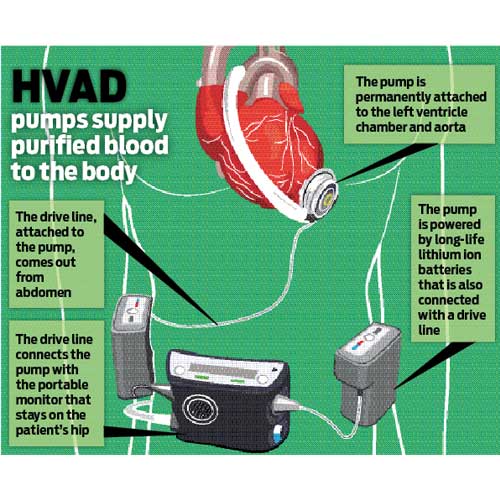
On 24 August this year, 42 year-old cardiac patient got a new lease of life when the Heartware Ventricular Assist Device (HVAD) was transplanted in his heart at a Hospital in Chennai. It was the first such surgery in the country. 

HVAD is a tiny device that pumps blood in a heart that has been irreparably damaged. It is a new ray of hope for people who suffer from cardiac ailments that cannot be treated through angioplasty or a coronary bypass surgery. 


The patient was diagnosed with dilated cardiomyopathy (weakened heart muscle that leads to heart failure) in May 2011, and was under medical care and strict lifestyle modifications since then. But things changed in July this year, when he suddenly felt chest pain and passed out in his car when he was returning after dinner. An employee of the Hospital was passing by. He pulled him out of the car, and performed  cardiopulmonary  resuscitation (CPR). However, when that didn’t work he was rushed to the hospital, where he was revived with electric shocks. 

“His Left Ventricular had failed. For such cases we have only two options, heart transplant which is not possible immediately, or put the HVAD pump, the latest technology across the world,” Dr. said. “The arrival of HVAD in India will be a major medical milestone for those who cannot avail a transplant,” he said. 

He added, “Within a few weeks of operation, the patient can ambulate, take a shower, go out for a walk, travel short distances and also climb stairs. The unique advantage of this device is that it’s the smallest available in the world and fits fully within the small space around the heart. There is no need to open up other body cavities to fit it inside. This is a beautiful advantage because it reduces overall invasiveness. The only issue is the cost, around Rs. 80 lakhs.”

Meanwhile, he feels rejuvenated. “It’s a second life for me. I used to feel weak and drowsy at work, and while spending time with my wife and children. Now, just few weeks after my surgery, I already feel 10 years younger. After several years I can read a magazine completely without falling asleep midway,” he said. 


ps- this is only for information, always consult you physician before having any particular food/ medication/exercise/other remedies.
ps- those interested in recipes are free to view my blog-

http://gseasyrecipes.blogspot.com/


for info about knee replacement, you can view my blog-


http://Knee replacement-stick club.blogspot.com/


for crochet designs


http://My Crochet Creations.blogspot.com

Labels: , , , , , , , , ,

Saturday, August 31, 2013

Old cancer drug may help transplant patients

Scientists have discovered that an old cancer drug can be used to prevent rejection of transplanted tissue.

Researchers  believe their discovery could lead to new treatment for both transplant patients and those with autoimmune diseases.

"Our group was studying the effects of the old tumour drug Zebularine, developed in the 1960s, and by chance we discovered that it had completely unexpected effects on the immune system," said a Senior Professor of Neurosurgery .

"It turned out that Zebularine has the ability to subdue the reaction of the body's immune system. This could be important in situations where tissue or organs are transplanted.

"We also think it could be used to curb the body's attacks on its own tissue in autoimmune diseases, for instance type 1 diabetes or rheumatoid arthritis," said researcher .

In studies on animals, the researchers used rats that were made diabetic. The researchers transplanted the islets of Langerhans - cell groups in the pancreas producing insulin - from healthy rats from another kind of rat into those with diabetes.

The diabetic rats were divided into two groups; one group were treated with Zebularine and the other, the control group, did not receive any treatment. The diabetic rats that were treated with Zebularine survived for a significantly longer period than the untreated rats.

"It is very interesting that we only treated them with Zebularine for two weeks, but the effects of the treatment could be observed throughout the 90-day follow-up period," he said.

"The findings are very exciting and are a sign that the immune system was not just generally suppressed, but that the treatment was more targeted. Neither did we see any signs of side-effects," he added.

The researchers are now working intensively to further refine the treatment. The next step is to teach certain cells in the immune system - the dendritic cells - to accept certain specific proteins using the Zebularine treatment. This would mean that the treatment could be targeted even more. 

ps- this is only for information, always consult you physician before having any particular food/ medication/exercise/other remedies.

ps- those interested in recipes are free to view my blog-

http://gseasyrecipes.blogspot.com/

for info about knee replacement, you can view my blog-

http://Knee replacement-stick club.blogspot.com/

for crochet designs

http://My Crochet Creations.blogspot.com

Labels: , , , , , , , , , , , , ,