Saturday, May 22, 2021

Signs of a Bed Bug Problem!

Bed bug infestations are on the rise in the United States. These pesky little critters can be difficult to spot, but they do leave behind some distinct trails, so check out these subtle signs that indicate that you might have a bed bug problem.

1. People You Know Have Had Bed Bugs
Bed bug infestations can spread from house to house, especially in apartment blocks where they don’t have to travel far. There are now more people affected by bed bugs in the United States than ever before – they were virtually unheard of just ten years ago. Therefore, if you know someone who has had a bed bug problem, be safe and check your home for intruders.

2. There Are Small, Itchy Bites on Your Body 
Bed bugs leave small, itchy, and inconsistent bites on their victim’s body. Therefore, if you notice clusters of bites, especially if they’re in straight lines of three, you need to check for bed bugs. This isn’t a sure sign, though. Some people might not even show any signs of having been bitten by bed bugs. This is why it’s important for people to inspect for bed bugs on regular occasions. 
 
3. You Frequently Stay in Hotel Rooms Signs of Bed Bugs

This is one of the primary ways that bed bugs spread. If you’re staying in a hotel, you really should give the room and bed a thorough survey before staying the night. If you notice any signs of bed bugs, ask to be relocated to a different room. When leaving, you should always examine your luggage too. 
 
4. There Are Dark Stains on Your Sheets or Pillowcases 
Since bed bugs are messy, they often leave behind small stains wherever they’ve been. Any odd stains that appear on your sheets or pillowcases should be inspected and not ignored. 
 
5. You’ve Only Looked for Bed Bugs in Your Bed
Signs of Bed Bugs
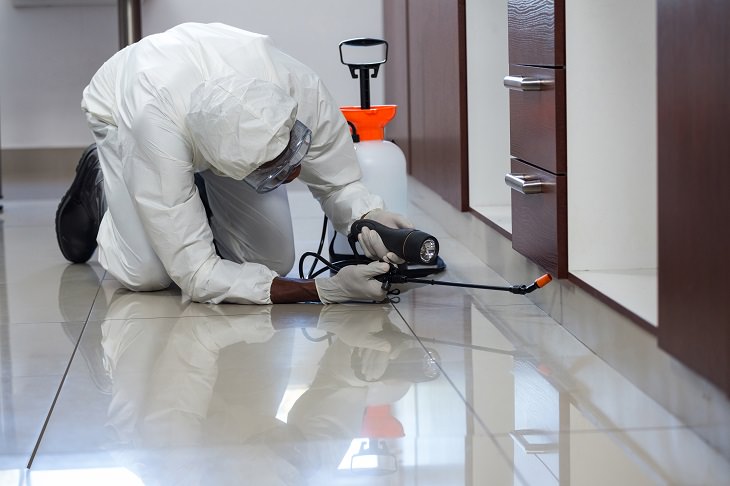
Despite their name, bed bugs can thrive in multiple locations outside of a bed. According to a 2015 survey carried out by the National Pest Management Association, nearly all (99.6%) of pest professionals nationwide have treated bed bugs in the last year, and many of those cases didn’t involve beds at all. Therefore, if you’re looking for bed bugs, you need to check the seams of chairs and couches, drawer joints, and areas with loose wallpaper too.
 
6. There Are Skin Flakes on Your Bed or Clothing  
Skin flakes from bed bugs are small, oval, and brown, and are one of the major indicators of a bed bug infestation. If you find any of these small casings around your house, you’ve got bed bugs. Don’t be embarrassed though, as even the cleanest of homes can get infested with these annoying little critters. 
 
7. You Recently Bought Secondhand Furniture Without Washing It
Getting a great deal on furniture is awesome, but secondhand furniture can bring unwanted pests such as bed bugs into your house. Therefore, you should thoroughly inspect any furniture that you’re thinking about bringing into your home. 
 
8. There Are Brownish Red Stains on Your sheet That Smear When Wiped  
As gross as it sounds, bed bugs can leave clusters of poop on sheets. If you find small stains that smear when wiped with a wet rag, it could be evidence of bed bug fecal matter. If you find this alongside mattress seams or box spring edges, you could have yourself a bed bug problem.


This is only for your information, kindly take the advice of your doctor for medicines, exercises and so on.   

https://gscrochetdesigns.blogspot.com. one can see my crochet creations  
https://gseasyrecipes.blogspot.com. feel free to view for easy, simple and healthy recipes    
https://kneereplacement-stickclub.blogspot.com. for info on knee replacement


Labels: , , , , , , , ,

Friday, February 28, 2020

Researchers at the University of Waterloo have developed a system using harmless microwaves and artificial intelligence (AI) software to detect even small, early-stage tumours within minutes. The new inexpensive technology could save lives and money by routinely screening women for breast cancer without exposure to radiation. The research, Breast Tumor Diagnosis using Machine Learning with Microwave Probes, was presented at a recent conference in Yemen. "Our top priorities were to make this detection-based modality fast and inexpensive," said Omar Ramahi, a professor of electrical and computer engineering at Waterloo. "We have incredibly encouraging results and we believe that is because of its simplicity. " A prototype device -- the culmination of 15 years of work on the use of microwaves for tumour detection, not imaging -- cost less than $5,000 to build. It consists of a small sensor in an adjustable box about 15 centimetres square that is situated under an opening in a padded examination table. Patients lie face-down on the table so that one breast at a time is positioned in the box. The sensor emits microwaves that bounce back and are then processed by AI software on a laptop computer. By comparing the tissue composition of one breast with the other, the system is sensitive enough to detect anomalies less than one centimetre in diameter. Ramahi said a negative result could quickly rule out cancer, while a positive result would trigger referral for more expensive tests using mammography or magnetic resonance imaging (MRI). "If women were screened regularly with this, potential problems would be caught much sooner -- in the early stages of cancer," he said. "Our system can complement existing technology, reserving much more expensive options for when they're really needed. "We need a mixture, a combination of technologies. When our device sent up a red flag, it would mean more investigation was warranted. " In addition to reducing patient wait times and enabling earlier diagnosis, Ramahi said, the device would eliminate radiation exposure, improve patient comfort and work on particularly dense breasts, a problem with mammograms. It would also save health-care systems enormous amounts of money and, because of its low cost and ease of use, dramatically increase access to screening in the developing world. Researchers have applied for a patent and started a company, Wave Intelligence Inc. of Waterloo, to commercialize the system and hope to begin trials on patients within six months. Three rounds of preliminary testing included the use of artificial human torsos known as phantoms.

Researchers at the University of Waterloo have developed a system using harmless microwaves and artificial intelligence (AI) software to detect even small, early-stage tumours within minutes. The new inexpensive technology could save lives and money by routinely screening women for breast cancer without exposure to radiation. The research, Breast Tumor Diagnosis using Machine Learning with Microwave Probes, was presented at a recent conference in Yemen.

"Our top priorities were to make this detection-based modality fast and inexpensive," said Omar Ramahi, a professor of electrical and computer engineering at Waterloo. "We have incredibly encouraging results and we believe that is because of its simplicity.


" A prototype device -- the culmination of 15 years of work on the use of microwaves for tumour detection, not imaging -- cost less than $5,000 to build.

It consists of a small sensor in an adjustable box about 15 centimetres square that is situated under an opening in a padded examination table. 


Patients lie face-down on the table so that one breast at a time is positioned in the box. The sensor emits microwaves that bounce back and are then processed by AI software on a laptop computer.
By comparing the tissue composition of one breast with the other, the system is sensitive enough to detect anomalies less than one centimetre in diameter.

Ramahi said a negative result could quickly rule out cancer, while a positive result would trigger referral for more expensive tests using mammography or magnetic resonance imaging (MRI).


 "If women were screened regularly with this, potential problems would be caught much sooner -- in the early stages of cancer," he said. "Our system can complement existing technology, reserving much more expensive options for when they're really needed.


 "We need a mixture, a combination of technologies. When our device sent up a red flag, it would mean more investigation was warranted.

" In addition to reducing patient wait times and enabling earlier diagnosis, Ramahi said, the device would eliminate radiation exposure, improve patient comfort and work on particularly dense breasts, a problem with mammograms. 


It would also save health-care systems enormous amounts of money and, because of its low cost and ease of use, dramatically increase access to screening in the developing world. 


Researchers have applied for a patent and started a company, Wave Intelligence Inc. of Waterloo, to commercialize the system and hope to begin trials on patients within six months. Three rounds of preliminary testing included the use of artificial human torsos known as phantoms.


This is only for your information, kindly take the advice of your doctor for medicines, exercises and so on.     

https://gscrochetdesigns.blogspot.com. one can see my crochet creations  
https://gseasyrecipes.blogspot.com. feel free to view for easy, simple and healthy recipes    
https://kneereplacement-stickclub.blogspot.com. for info on knee replacement
 

Labels: , , , , , , , , , , , , , , , , , ,

Saturday, August 31, 2019

7 Step Baking Soda Solution to Your Troublesome Splinter

Having a splinter is awful. At best it's uncomfortable, at worst it can be horribly painful, particularly to small children. What's more, the thought of removing that wooden intruder with tweezers or a pin is enough to strike any soul with trepidation. But, luckily, here is a simple homemade solution you can make using baking soda. So, whip that magical powder out of its cupboard and let's get to work!
Step 1: Do not squeeze at it!
First, it's important you get a good idea of what kind of splinter you are dealing with, and where precisely it is. Squeezing may cause the splinter to go deeper into your skin, or even break it up into smaller pieces that are even harder to remove. So, refrain from squeezing.
Step 2: Clean the area, using soap and water
Always do this when you have any kind of open wound, to avoid infections. Then dry yourself off with a paper towel. Do so very gently, so as not to aggravate the wound. Remember that wood loves moisture, so keep it as dry as you can. 
Step 3: Look at the splinter using a magnifying glass
Make sure that the splinter is small. The method we are about to use makes the skin swell. This swelling will push out the splinter. But this will only work on small splinters. If yours seems rather large, you will have to consider some other methods.
Step 4: Make Your Baking Soda Paste
Your paste will be made with 1/4 teaspoon of baking soda and a little water. We want a nice thick paste.
Step 5: Apply your paste to the area
The best way to do this is to spread the paste on a bandage and place it over the splinter.
Step 6: Wait 1 day, then take the bandage off
Take the bandage off after one day. If you can see the splinter sticking out, you will then be able to pull it out (step 7) with a pair of tweezers, without penetrating your skin. And if it's sticking out but you can barely see it, it may naturally come out when you take a wash. 
If the splinter is still inside, repeat steps 4-6 as many times as necessary.
Step 7: Apply a topical anesthetic
Once you are ready to pull out the splinter, the area will still fees quite painful, apply some Baby Orajel to the wound. This ointment causes numbing, which should furnish you with the confidence to proceed. Wait just a couple of minutes and then pull it out with some tweezers. Finished.
THIS IS ONLY FOR INFORMATION, ALWAYS CONSULT YOU PHYSICIAN BEFORE HAVING ANY PARTICULAR FOOD/ MEDICATION/EXERCISE/OTHER REMEDIES.                                    PS- THOSE INTERESTED IN RECIPES ARE FREE TO  VIEW MY BLOG-                                                                                           https://gseasyrecipes.blogspot.com/                                                                                                                                                FOR INFO ABOUT KNEE REPLACEMENT, YOU CAN VIEW MY BLOG-                                                                       https:// kneereplacement-stickclub.blogspot.com/                                                                                                                     FOR CROCHET DESIGNS                                                                                                   
                                https://gscrochetdesigns.blogspot.com
 

Labels: , , , , , , , , , , , , , , , , , , ,

Saturday, May 10, 2014

Indian-origin scientist develops leadless pacemaker

The world's first wireless pacemaker, developed by an Indian-origin scientist, has shown promising results after one year of human trials.

The device, resembling a tiny, metal silver tube and smaller than a triple-A battery, is only a few centimeters in length, making it less than ten per cent the size of a traditional pacemaker. "This is the first time we've seen one-year follow-up data for this innovative, wireless cardiac pacing technology and our results show the leadless pacemaker is comparable to traditional pacemakers," said Dr Vivek Reddy, Director of Arrhythmia Services at The Mount Sinai Hospital here, who is the study's co-investigator. 

In comparison to a conventional pacemaker, the new-age leadless pacemaker eliminates the need for a surgical pocket and no visible pacemaker device under a patient's chest skin, no incision scar on the chest, no connector wires or leads, and no restrictions on a patient's daily activities. The device's benefits may also allow for less patient discomfort, infections, and device complications and dysfunction. "Our latest findings further support the promising performance and safety of this minimally-invasive, non-surgical pacing device. More long-term follow-up of these LEADLESS study patients will further our understanding of the potential advantages, benefits, and complication risks of leadless pacemaker technology, along with additional ongoing, larger trials," Dr Reddy said.

The study's long-term follow-up has evaluated 32 patients with a slowed heartbeat, bradycardia at two hospitals in Prague and one in Amsterdam, the hospital said in a statement. The miniature, leadless cardiac pacemaker is placed directly inside a patient's heart without surgery during a catheter-guided procedure through the groin via the femoral vein. 

It works by closely monitoring the heart's electrical rhythms and if the heart beat is too slow it provides electrical stimulation therapy to regulate it. The findings, which assessed device performance and patient outcomes through 12-months of follow-up, show pacing thresholds (0.43 volts) and sensing (10.32 mV) of the leadless pacemaker device are equivalent to those in traditional pacemakers. 

Reddy presented the one-year LEADLESS study data findings during his late-breaking clinical trial presentation on May 9 at Heart Rhythm 2014, the Heart Rhythm Society's 35th Annual Scientific Sessions in San Francisco. Reddy was the first to implant the leadless pacemaker in the United States at The Mount Sinai Hospital launching the multicenter clinical trial LEADLESS II which aims to further test the leadless pacemaker more widely for safety and efficacy in 670 patients at 50 centers across the US and Canada. 

More than 4 million patients globally have a pacemaker, and 700,000 new patients receive one each year, the hospital said.


PS- THIS IS ONLY FOR INFORMATION, ALWAYS CONSULT YOU PHYSICIAN BEFORE HAVING ANY PARTICULAR FOOD/ MEDICATION/EXERCISE/OTHER REMEDIES.
PS- THOSE INTERESTED IN RECIPES ARE FREE TO VIEW MY BLOG-
HTTP:GSEASYRECIPES.BLOGSPOT.COM/
FOR INFO ABOUT KNEE REPLACEMENT, YOU CAN VIEW MY BLOG-
HTTP://KNEE REPLACEMENT-STICK CLUB.BLOGSPOT.COM/

FOR CROCHET DESIGNS


HTTP://MY CROCHET CREATIONS.BLOGSPOT.COM

Labels: , , , , , , , , , , ,