Monday, April 07, 2025

The Buteyko Method: A Healthier Way to Breathe

Do you sometimes feel like you’re short of breath? It could be due to health issues like asthma, or perhaps anxiety, but sometimes we simply don’t know how to breathe properly. Yes, it’s possible to get something as simple as breathing wrong, but you’ll be pleased to discover that you can learn how to control your breathing rhythm and make it more efficient. One way to do this is through the Buteyko Method—a breathing technique developed in the 1950s by a Ukrainian doctor named Konstantin Buteyko, designed to change our breathing patterns.
Professionals who practice this method claim it can help treat about 150 different health issues, including diabetes, attention difficulties, and chronic fatigue. While these claims lack comprehensive, evidence-based proof, there are some recent studies that have demonstrated the benefits of the Buteyko Method for specific conditions. Today, we’ll present those to you, along with a guide to performing the method and warnings for people who should avoid it.

2 Proven Benefits of the Buteyko Method 
Before we dive into the details of performing the method, let’s understand what it has been proven to do for the body and why it might be worth adopting for some people. Once you master this breathing technique, you’ll be able to breathe more efficiently, which can prevent feelings of shortness of breath and coughing, and even clear your airways. This has two benefits proven by studies: 
 
1. Regulating Breathing 
During Asthma and Anxiety Attacks There are moments in life that cause us to over-breathe—a condition medically known as "hyperventilation." This often happens during an asthma or anxiety attack, where the body expels a lot of carbon dioxide but takes in little oxygen, leading to a drop in blood oxygen levels. The Buteyko Method was actually developed specifically to address this issue. Indeed, it was proven in a 2018 study to help regulate breathing during an asthma attack.

Another study conducted with 200 participants and published in 2000 even showed that it could reduce the need for an inhaler when participants watched a video demonstrating the method and practiced along with it—compared to participants who watched a placebo method video. Additionally, a 2008 study demonstrated that people who learned the Buteyko Method (without a video) were better able to control their asthma symptoms and also reduced their inhaler use.

Buteyko Method: A woman performing a breathing exercise
2. Reducing the Risk of Sleep Apnea  
A 2019 study showed that the Buteyko Method helps treat people with eustachian tube obstruction, which is often linked to sleep apnea, and a study published in 2020 proved that relieving pressure and obstruction in the eustachian tube indeed helps prevent sleep apnea. However, it’s worth noting that in the first study, the best results were seen in participants who also used steroid nasal drops, more so than those who relied solely on nasal drops without the breathing technique. To achieve such results, you need to practice the Buteyko Method regularly until it becomes a natural habit and part of your life.


In addition to these proven benefits, we’ll mention again that advocates of the method claim it may also contribute to widening the bronchial tubes and easing shortness of breath symptoms associated with asthma and other chronic lung diseases. It’s said to help prevent snoring, allergies, high blood pressure, and concentration difficulties, but as noted, these are not proven or substantiated benefits at this time. 
 
How to Perform the Buteyko Method?  
This method can help in the moment you need it, such as when you’re experiencing shortness of breath, but it’s even more effective if practiced daily. In fact, some doctors treat breathing difficulties with a series of personal training sessions. To make this habit an integral part of your life, it’s recommended to practice for 15-20 minutes, 3 times a day, over 6 weeks. 
 
Here’s how to do it: 
 
1. Preparation  
Sit on the floor or a chair. 
Keep your back straight and upright. 
Relax your breathing muscles—the diaphragm and intercostal muscles. 
Breathe normally for a few minutes. 
 
2. Controlled Pause 
Exhale air calmly, then hold your breath (without inhaling). Use your finger and thumb to pinch your nose closed. 
Continue holding your breath until you feel the urge to inhale (this may cause involuntary diaphragm movements), then inhale. 
Breathe normally for at least 10 seconds. 
Repeat this several more times.
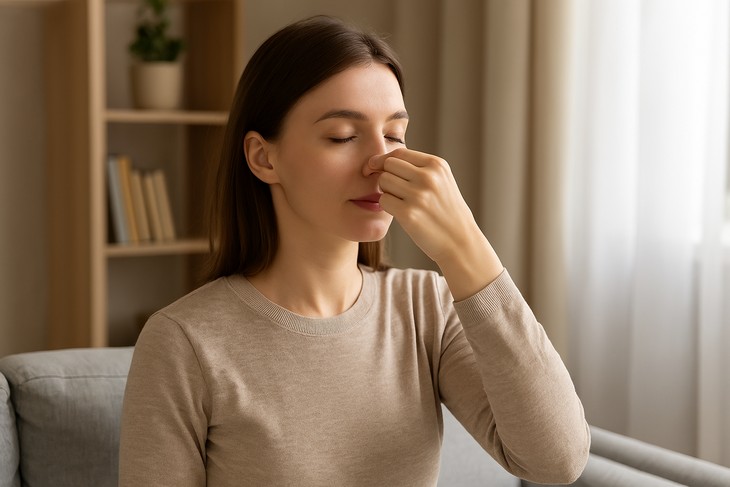
 
Buteyko Method: A woman pinching her nose with her fingers

3. Maximum Pause 
Exhale air calmly, then hold your breath (without inhaling).
Use your finger and thumb again to pinch your nose closed. 
Hold your breath for as long as you can—roughly twice as long as in the previous step. 
When you reach a point of moderate discomfort, inhale air.
Breathe normally for at least 10 seconds. 
Repeat this several more times.


Tips for Beginners 
When performing the Buteyko Method, always inhale and exhale through your nose only. If you start to feel shortness of breath, high levels of discomfort, or anxiety, stop the exercise immediately and return to normal breathing. The more you persist and practice the exercise, the longer you’ll be able to hold your breath. If you reach a point where the controlled pause lasts a minute and the maximum pause lasts 2 minutes, that’s excellent. 
 
Who Should Avoid Trying the Buteyko Method? 
Despite the benefits of this breathing technique, it’s not suitable for everyone, and it’s recommended to avoid it if you suffer from: 
 High blood pressure 
Heart disease
 Epilepsy 
Severe health conditions 
 
If you’re concerned, it’s best to consult a doctor knowledgeable in this area—typically an ENT specialist or a physician trained in the Buteyko Method—before starting self-treatment like this. You can also try other breathing techniques that can help you address breathing-related issues in additional ways. 
 
In Summary 
The Buteyko Method has been proven to help primarily those who suffer from shortness of breath due to asthma or anxiety, or from sleep apnea. It can be performed during an episode of shortness of breath or practiced regularly to naturally improve breathing, even during sleep. If you want to see good results and enhance your breathing, you should practice it 3 times a day for 6 weeks, and it might also be advisable to meet a few times with a specialist doctor who can personally teach and guide you.


This is only for your information, kindly take the advice of your doctor for medicines, exercises and so on.   


Labels: , , , , ,

Sunday, January 17, 2021

Period weight gain: Why it happens and why you must not worry about it

Reasons for weight gain

Picture this: You have been exercising and eating healthy all along. Even then when you step on the weight scale at the end of the week, you notice a higher number than last week. You feel heavier and your clothes seem a bit tighter. Does this happen with you every month close to your monthly cycle?

If yes, then you are not alone. Period weight gain is real and is quite normal. Close to those 5 painful days of the month, most women gain weight but it is temporary.

​Period and weight gain

The fluctuation in the weighing scale during the monthly menstrual cycle is mostly due to water retention. This is caused due to hormones- estrogen and progesterone, which rapidly decrease before the period. The drop in the level of these hormones tells your body that it’s time to begin menstruation. These two hormones are also responsible for managing the electrolytes balance and fluctuation in it forces the tissues to accumulate more fluid, resulting in water retention, or edema. The process of water retention often leads to swelling or puffiness in your breasts and stomach. So, the weight gain during the period is basically water and not fat. As soon as you are done with your 5 days, the level of hormones comes back to normal and you lose all the gained weight.

Other reasons for weight gain

These hormones can also make you feel bloated and your clothes might feel tighter.

Thirdly, during the period, craving for unhealthy and fattening food increases. Most of the time women cave in to their cravings and binge eat. That's due to fall in the level of progesterone, which works as an appetite stimulant. Eating high-sugar or high-fat foods can increase calorie intake and a low amount of physical activity can easily lead to weight gain.

​How much weight most women gain during this time

Most women gain 2 to 3 kilos during their period. But this weight is generally water weight and after the period is over, the extra weight is lost automatically. The changes generally start to appear 3 to 4 days before the monthly cycle and disappear 2-3 day after that. Other normal symptoms noticed during the period include:

Depression

Anxiety

Irritability

Confusion

Social withdrawal

Insomnia

Headache

Aches and pains

Fatigue

Skin problems

Abdominal pain

Thirst and appetite changes

breast tenderness

bloating

​How to minimise weight gain

There is no need to worry about water weight gain during the period. It is quite normal. You just need to stay away from eating unhealthy, sugar and fat-laden food items. The weight gain caused due to overeating is permanent and you have to make extra effort to lose those extra kilos. Here are a few things that you can do during the period to stay healthy.

Drink more water: Drink enough water throughout the week. This will help to maintain the electrolyte level in the body and prevent your body from conserving fluids.

Eat fiber-rich foods: Eating fiber-rich foods can prevent constipation, which is common during this time. Fiber will help in easy movement of bowel and prevent you from overeating.

Reduce salt intake: Eating too much salt during this time can increase water retention and make you feel more bloated. So, avoid excessive salt intake as much as possible.

Exercises: It is absolutely alright to exercise during the period. Even if you choose to perform low-impact exercises, it is alright. Do not skip it.

This is only for your information, kindly take the advice of your doctor for medicines, exercises and so on.     

https://gscrochetdesigns.blogspot.com. one can see my crochet creations  
https://gseasyrecipes.blogspot.com. feel free to view for easy, simple and healthy recipes    
https://kneereplacement-stickclub.blogspot.com. for info on knee replacement


Labels: , , , , ,

Saturday, September 21, 2019

Alzheimer's: Head device reduces memory loss in 7 out of 8 people

An open-label clinical trial working with eight people with Alzheimer's disease concluded that a new wearable device that emits electromagnetic impulses was able to significantly improve memory loss in seven of these participants within 2 months. 

Alzheimer's disease affects millions of people in the United States and worldwide, but as yet there is no cure for this progressive neurodegenerative condition.

The condition's main physiological characteristic is the aggregation of beta-amyloid and tau protein in the brain, which disrupt normal communication pathways between brain cells.

Scientists have been aware of this aspect of Alzheimer's for years but have so far been unable to prevent the aggregates from forming, or to dissolve them once formed — not in humans, at least.

But now, researchers affiliated with NeuroEM Therapeutics — a medical device company based in Phoenix, AZ — have developed a wearable device that, according to their recent open-label clinical trial, can significantly reduce memory loss in Alzheimer's by disaggregating toxic protein formed in the brain.

The device has the shape of a cap, and it emits electromagnetic waves in a frequency that, as preclinical studies in mice have shown, can help reverse memory loss. The research team that conducted the clinical trial reports the groundbreaking results in a study paper .

"Despite significant efforts for nearly 20 years, stopping or reversing memory impairment in people with Alzheimer's disease has eluded researchers," notes one of the researchers, Dr. Amanda Smith, who is the director of clinical research at the University of South Florida Health's Byrd Alzheimer's Institute in Tampa.

    "These results provide preliminary evidence that [transcranial electromagnetic treatment] administration we assessed in this small [Alzheimer's disease] study may have the capacity to enhance cognitive performance in patients with mild to moderate disease."
    Dr. Amanda Smith


'Highly significant improvement' at 2 months

For the trial, the researchers worked with eight participants with mild to moderate Alzheimer's disease and their caretakers, who received instructions on how to use the therapeutic device at home. The participants received the treatment twice a day for 2 months, and each session lasted just 1 hour.

By the end of the 2 months, none of the participants had experienced any side effects. Brain scans conducted by the researchers at the end of the study showed that the eight individuals had not developed tumors or brain bleeding as a result of having used the device.

To assess whether the treatment had helped the participants, the investigators used The Alzheimer's Disease Assessment Scale-Cognitive Subscale test (ADAS-cog), the most widely recognized method of assessing cognitive function.

The team found that seven of the eight participants saw an increase of over 4 points in cognitive performance on the ADAS-cog scale after 2 months. This, the researchers explain, is as if the participants' cognitive function had "rejuvenated" by a year.

"We were particularly surprised that this highly significant improvement in the ADAS-cog was maintained even 2 weeks after treatment was completed," says Dr. Gary Arendash, CEO of NeuroEM Therapeutics. "The most likely explanation for continued benefit after cessation of treatment is that the Alzheimer's Disease process itself was being affected," he adds.

The researchers also collected blood and cerebrospinal fluid samples from the participants both at baseline and at the end of the clinical trial.

In analyzing them, they found that the intervention appeared to have led to the disaggregation of beta-amyloid plaques and tau tangles, which are associated with progressive cognitive function impairment in Alzheimer's.

Furthermore, MRI scans also suggested that after the 2-month treatment period, the participants had better communication between brain cells present in the cingulate cortex, which plays a key role in cognitive function — including decision making.


Further steps

The researchers behind the innovative device also note that they received the best feedback they could have received: all of the participants decided to hang onto the devices they got as part of the clinical trial.

"Perhaps the best indication that the 2 months of treatment was having a clinically important effect on the [Alzheimer's disease] patients in this study is that none of the patients wanted to return their head device to the University of South Florida/Byrd Alzheimer's Institute after the study was completed," says Dr. Arendash.

The team is particularly excited about the device's effect on toxic brain plaques. They say that drugs tested in clinical trials have, so far, been much less successful in disaggregating these disruptive buildups.

So, the investigators do not plan on stopping at this small clinical trial. Going forward, they have offered the current trial's participants' the opportunity to take part in a much larger clinical trial, which the research team is now organizing.


All the former participants have accepted this offer. The new trial is due to last around 17 months, on average, and will include about 150 participants with a diagnosis of mild to moderate Alzheimer's disease.

The medical device company hope that they will be able to gain Food and Drug Administration (FDA) approval for their technology over the next couple of years and make the device available to the public by 2021.


this is only for your information, kindly take the advice of your doctor for medicines, exercises and so on.   
https://gscrochetdesigns.blogspot.com. one can see my crochet creations 
https://gseasyrecipes.blogspot.com. feel free to view for easy, simple and healthy recipes    
https://kneereplacement-stickclub.blogspot.com. for info on knee replacement


Labels: , , , , , , , , , , , , , , , ,

Monday, June 16, 2014

Indian-origin scientist paves way for improved epilepsy treatments

Researchers at the University of Toronto, including one of Indian-origin, have now discovered a complex network of proteins that could help in the treatment of neurological disorders such as epilepsy, autism spectrum disorder and schizophrenia.

“Our study pertains to the discovery of the ying-yang for neuronal cross-talk that is essential for normal healthy brain function,” Chennai born Vivek Mahadevan, a Ph.D student at the University of Toronto in Canada, was quoted as saying to IANS.

Neurons in the brain communicate with other neurons through synapses, communication that can either excite or inhibit other neuron.

According to lead investigator of the study, professor Melanie Woodin, “an imbalance among the levels of excitation and inhibition - a tip towards excitation, for example, causes improper brain function and can produce seizures.”

This complex brings together three key proteins - KCC2, Neto2 and GluK2 - required for inhibitory and excitatory synaptic communication.

KCC2 is required for inhibitory impulses, GluK2 is a receptor for the main excitatory transmitter glutamate, and Neto2 is an auxiliary protein that interacts with both KCC2 and GluK2.

The discovery of the complex of three proteins is path breaking as it was previously believed that KCC2 and GluK2 were in separate compartments of the cell and acted independently of each other.
“Finding that they are all directly interacting and can co-regulate each other's function reveals for the first time a system that can mediate excitation-inhibition balance among neurons themselves,” Mahadevan added.

As there is no cure for epilepsy and the treatments which are available can only curb its effects such as convulsions and seizures, the main focus should be on its prevention.

Mahadevan, along with other biologists carried out the study on mice brain via biochemistry, fluorescence imaging and electrophysiology experiments.

The findings appeared in the journal Cell Reports.


THIS IS ONLY FOR INFORMATION, ALWAYS CONSULT YOU PHYSICIAN BEFORE HAVING ANY PARTICULAR FOOD/ MEDICATION/EXERCISE/OTHER REMEDIES.


PS- THOSE INTERESTED IN RECIPES ARE FREE TO VIEW MY BLOG-
HTTP:GSEASYRECIPES.BLOGSPOT.COM/
FOR INFO ABOUT KNEE REPLACEMENT, YOU CAN VIEW MY BLOG-
HTTP://KNEE REPLACEMENT-STICK CLUB.BLOGSPOT.COM/

FOR CROCHET DESIGNS


HTTP://MY CROCHET CREATIONS.BLOGSPOT.COM

Labels: , , , , , , , , , ,

Sunday, April 06, 2014

HOW TO SURVIVE A HEART ATTACK WHEN YOU ARE ALONE??


Since many people are alone when they suffer a 
heart attack, without help,the person whose heart is 
beating improperly and who begins to feel faint, has 
only about 10 seconds left before losing 
consciousness.


However,these victims can help themselves by 
coughing repeatedly and very vigorously. A deep 
breath should be taken before each cough, and the 
cough must be deep and prolonged, as when 
producing sputum from deep inside the chest.

A breath and a cough must be repeated about every 
two seconds without let-up until help arrives, or 
until 
the heart is felt to be beating normally again.


Deep breaths get oxygen into the lungs and 
coughing 
movements squeeze the heart and keep 
the blood circulating. The squeezing pressure on the 
heart also helps it regain normal rhythm. In this 
way, heart attack victims can get to a hospital. Tell 
as many other people as possible about this. It could 
save their lives!!

A cardiologist says If everyone who sees this post 
shares it to 10 people, you can bet that we'll save at 
least one life..

PS- THIS IS ONLY FOR INFORMATION, ALWAYS CONSULT YOU PHYSICIAN BEFORE HAVING ANY PARTICULAR FOOD/ MEDICATION/EXERCISE/OTHER REMEDIES.
PS- THOSE INTERESTED IN RECIPES ARE FREE TO VIEW MY BLOG-
HTTP://GSEASYRECIPES.BLOGSPOT.COM/
FOR INFO ABOUT KNEE REPLACEMENT, YOU CAN VIEW MY BLOG-
HTTP://KNEE REPLACEMENT-STICK CLUB.BLOGSPOT.COM/

FOR CROCHET DESIGNS


HTTP://MY CROCHET CREATIONS.BLOGSPOT.COM


Labels: , , , , , , , ,