Monday, November 29, 2021

New Framework for Analyzing Alzheimer’s Disease Identifies Not One Form, but Three

According to the commonly accepted model, Alzheimer’s disease is characterized by an ineluctable sequence, from the accumulation of toxic proteins in the brain to dementia resulting from neurodegeneration. While this deterministic sequence is sometimes true, it does not seem to be the case for all patients. Moreover, the disappointing results of recently marketed drugs have highlighted the need to reconsider this disease, which affects nearly 10 million people in Europe.

A European consortium of physicians and scientists, led by the University of Geneva (UNIGE) and the University Hospitals of Geneva (HUG), in Switzerland, which also includes INSERM in France, has analyzed the data presented in nearly 200 previously published studies.

Far from being a monolithic disease where the same causes produce the same effects, this analysis proposes a categorization of patients into three groups, each with its own dynamics. In addition, the research team calls for an increased effort to screen people at risk, in order to implement preventive measures as early as possible.

This work, to be read in the journal Nature Reviews Neuroscience, proposes a profound paradigm shift in the way Alzheimer’s disease is understood.

Alzheimer’s disease is usually described as a four-step sequence: a deposit of amyloid appears in the cerebral cortex, then hyperphosphorylated tau protein increases and aggregates in neurons. They then cause neurodegeneration, and finally cognitive decline, with memory loss as the first symptom.

The first drug targeting the deposition of amyloid plaques in the brain, approved a few months ago by the European and American regulatory authorities, has however proved relatively disappointing.

“Yet, if we consider Alzheimer’s disease as a sequential cascade of biological events, it should have been much more effective,” explains Giovanni Frisoni, Professor in the Department of Readaptation and Geriatrics at the UNIGE Faculty of Medicine and Director of the HUG Memory Centre, who directed this work.

“Stopping the production of beta-amyloid with a drug should logically interrupt neuronal loss and therefore memory loss, which has not been massively observed. Furthermore, we have found that some people with amyloid do not develop cognitive symptoms. What does protect their brain from neurotoxicity?”

Not one, but three diseases

To better understand why the deterministic model of the disease is found in some cases but not in others, the scientists conducted a systematic literature review, some articles of which tend to confirm this model, while others refute it.

“Our interpretive framework showed that Alzheimer’s disease is more complex than it appears,” continues Daniele Altomare, a researcher in Giovanni Frisoni’s group, who took part in this work. “Three groups of patients can be distinguished according to their risk factors, the characteristics of their disease and their clinical fate.”

Thus, the cascade prediction is only confirmed in one of these three groups, where patients carry an inherited genetic mutation known as “autosomal dominant.” Fortunately, this mutation is rare, as it leads to the systematic development of an early cognitive deficit (between 30 and 50 years of age).

In the sporadic form, the development of cognitive deficit symptoms differs according to the presence or absence of a genetic variation, the e4 allele of the APOE gene, which appears to be an important risk factor: two third of carriers will indeed develop, sooner or later, the symptoms of Alzheimer’s disease.
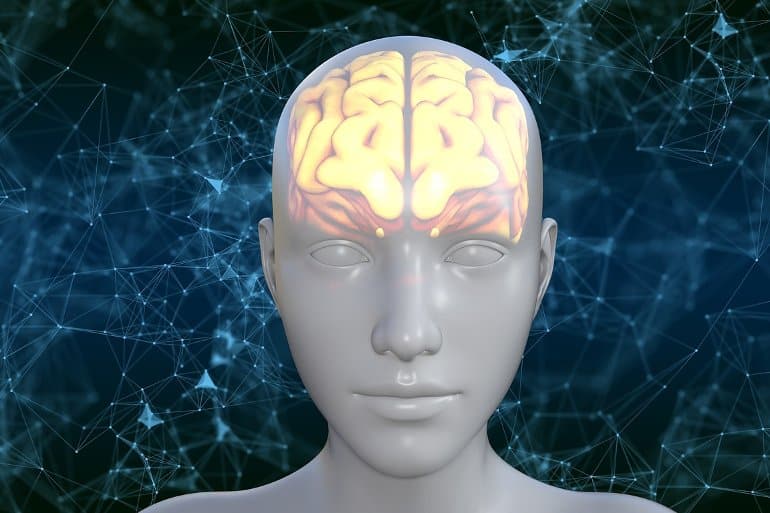
This shows a model of a head and a brain
Alzheimer’s disease is usually described as a four-step sequence: a deposit of amyloid appears in the cerebral cortex, then hyperphosphorylated tau protein increases and aggregates in neurons.

The third group consists of people without associated genetic mutation for whom the presence of neurotoxic proteins appears to be an important but not unique risk factor.

“Half of our patients belong to this third group,” emphasizes Giovanni Frisoni. “Our probabilistic model therefore suggests that all genetic and environmental risk factors should be considered. Cognitive impairment develops when their weight overcomes the resilience of the brain, which is itself determined by protective factors of genetic and environmental origin.”

As in the case of cardiovascular disease

In the case of patients with cardiovascular disease, preventing risks (hypertension, obesity, etc.) in people who have never had a heart attack or stroke results in a very significant reduction in the number of cases in the following years. In contrast, such treatment after a stroke or heart attack brings only minimal benefits in terms of recovery.

“In our view, the same reasoning should apply to Alzheimer’s disease: it is essential to treat people at risk before symptoms appear.”

Identifying people at risk has until now required expensive and invasive procedures such as positron emission tomography (PET) scans and lumbar punctures. But the recent development of instruments capable of detecting the presence of beta-amyloid and hyperphosphorylated tau in the blood is about to change this and could allow the inclusion of such screening in routine check-ups.

“Although patient management will not change overnight, a more detailed understanding of the biological mechanisms at work will make it possible to develop more precise research protocols that take into account the different forms of Alzheimer’s disease,” say the authors.

This analysis is in line with the work carried out by Professor Bruno Dubois at INSERM, co-author of this study, aimed at applying precise clinical diagnostic criteria.

“In the years to come, we hope to adapt preventive and therapeutic strategies to each individual, rather than according to a standardized protocol that has already shown its limits.”


This is only for your information, kindly take the advice of your doctor for medicines, exercises and so on.   

https://gscrochetdesigns.blogspot.com. one can see my crochet creations  
https://gseasyrecipes.blogspot.com. feel free to view for easy, simple and healthy recipes    
https://kneereplacement-stickclub.blogspot.com. for info on knee replacement


Labels: , , , , , , , , , ,

Thursday, June 10, 2021

3 Simple Habits That Can Protect Your Brain From Cognitive Decline

You might think that the impact of aging on the brain is something you can’t do much about. After all, isn’t it an inevitability?

To an extent, as we may not be able to rewind the clock and change our levels of higher education or intelligence (both factors that delay the onset of symptoms of aging). But adopting specific lifestyle behaviors–whether you’re in your thirties or late forties–can have a tangible effect on how well you age. Even in your fifties and beyond, activities like learning a new language or musical instrument, taking part in aerobic exercise, and developing meaningful social relationships can do wonders for your brain. There’s no question that when we compromise on looking after ourselves, our aging minds pick up the tab. 

The Aging Process and Cognitive Decline

Over time, there is a build-up of toxins such as tau proteins and beta-amyloid plaques in the brain that correlate to the aging process and associated cognitive decline. Although this is a natural part of growing older, many factors can exacerbate it. Stress, neurotoxins such as alcohol and lack of (quality and quantity) sleep can speed up the process.

Neuroplasticity–the function that allows the brain to change and develop in our lifetime–has three mechanisms: synaptic connection, myelination, and neurogenesis. The key to resilient aging is improving neurogenesis, the birth of new neurons. Neurogenesis happens far more in babies and children than adults. A 2018 study by researchers at Columbia University shows that in adults, this type of neuroplastic activity occurs in the hippocampus, the part of the brain that lays down memories. This makes sense as we respond to and store new experiences every day, and cement them during sleep. The more we can experience new things, activities, people, places, and emotions, the more likely we are to encourage neurogenesis.

With all this in mind, we can come up with a three-point plan to encourage “resilient aging” by activating neurogenesis in the brain:

1. Get your heart rate up

Aerobic exercise such as running or brisk walking has a potentially massive impact on neurogenesis. A 2016 rat study found that endurance exercise was most effective in increasing neurogenesis. It wins out over HIIT sessions and resistance training, although doing a variety of exercise also has its benefits.

Aim to do aerobic exercise for 150 minutes per week, and choose the gym, the park, or natural landscape over busy roads to avoid compromising brain-derived neurotrophic factor production (BDNF), a growth factor that encourages neurogenesis that aerobic exercise can boost. However, exercising in polluted areas decreases production.

If exercising alone isn’t your thing, consider taking up a team sport or one with a social element like table tennis. Exposure to social interaction can also increase the neurogenesis, and in many instances, doing so lets you practice your hand-eye coordination, which research has suggested leads to structural changes in the brain that may relate to a range of cognitive benefit. This combination of coordination and socializing has been shown to increase brain thickness in the parts of the cortex related to social/emotional welfare, which is crucial as we age.

2. Change your eating patterns

Evidence shows that calorie restriction, intermittent fasting, and time-restricted eating encourage neurogenesis in humans. In rodent studies, intermittent fasting has been found to improve cognitive function and brain structure, and reduce symptoms of metabolic disorders such as diabetes. Reducing refined sugar will help reduce oxidative damage to brain cells, too, and we know that increased oxidative damage has been linked with a higher risk of developing Alzheimer’s disease. Twenty-four hour water-only fasts have also been proven to increase longevity and encourage neurogenesis.

Try any of the following, after checking with your doctor:

  • 24-hour water-only fast once a month
  •  Reducing your calorie intake by 50%-60% on two non-consecutive days of the week for two to three months or on an ongoing basis
  • Reducing calories by 20% every day for two weeks. You can do this three to four times a year
  • Eating only between 8 a.m. to 8 p.m., or 12 p.m. to 8 p.m. as a general rule

3. Prioritize sleep

Sleep helps promote the brain’s neural “cleaning” glymphatic system, which flushes out the build-up of age-related toxins in the brain (the tau proteins and beta amyloid plaques mentioned above). When people are sleep-deprived, we see evidence of memory deficits, and if you miss a whole night of sleep, research proves that it impacts IQ. Aim for seven to nine hours, and nap if it suits you. Our need to sleep decreases as we age.

Of course, there are individual exceptions, but having consistent sleep times and making sure you’re getting sufficient quality and length of sleep supports brain resilience over time. So how do you know if you’re getting enough? If you naturally wake up at the same time on weekends that you have to during the week, you probably are. If you need to lie-in or take long naps, you’re probably not. Try practicing mindfulness or yoga nidra before bed at night, a guided breath-based meditation that has been shown in studies to improve sleep quality. There are plenty of recordings online if you want to experience it.

Pick any of the above that work for you and build it up until it becomes a habit, then move onto the next one and so on. You might find that by the end of the year, you’ll feel even healthier, more energized, and motivated than you do now, even as you turn another year older.


This is only for your information, kindly take the advice of your doctor for medicines, exercises and so on.   

https://gscrochetdesigns.blogspot.com. one can see my crochet creations  
https://gseasyrecipes.blogspot.com. feel free to view for easy, simple and healthy recipes    
https://kneereplacement-stickclub.blogspot.com. for info on knee replacement


Labels: , , , , , , , , , , ,