Monday, January 05, 2026

A Single Brain Scan Halfway Through Your Life Can Reveal How Fast You're Aging

 Brain scan 

The rate at which our bodies age and wear down doesn't necessarily match our actual age, and the differences can help predict lifespan and disease risk. Now, researchers have developed a new tool for assessing biological age from a single brain scan taken halfway through our lives.

The tool, put together by an international team of scientists, is based on a dataset of 1,037 people born in Dunedin in New Zealand in 1972 and 1973. The health of these individuals has been carefully tracked over time, giving scientists a useful long-term database of stats that reflect the body's actual age – not how many birthdays have passed.

Here, the researchers used those stats to assess biological aging, and train a tool they've called DunedinPACNI – Pace of Aging Calculated from NeuroImaging. That sums up its function, which is to match aging to markers in the brain.

The system has the potential to quickly assess the body's age to a good degree of accuracy, and from there health and disease risks, including the chances of dementia. Rather than needing multiple tests over time, just a single brain scan is required.

"What's really cool about this is that we've captured how fast people are aging using data collected in midlife," says neuroscientist Ahmad Hariri from Duke University in North Carolina.

"And it's helping us predict diagnosis of dementia among people who are much older."

 DunedinPACNI takes in 99 key brain measurements to make its assessment, including the thickness of the cerebral cortex – which affects language and thinking – and the volume of gray matter in the brain.

Once the researchers had developed DunedinPACNI, they tested it on a variety of data from other health research projects, covering more than 50,000 people in total. It was shown to work well at estimating biological age, and at predicting future health problems such as cognitive impairment and heart attacks.

It's not a tool that offers perfect accuracy each time, but it scores as well as or better than current biological age assessment methods, the researchers say. What's more, it was shown to be useful across different demographic and socioeconomic groups.

"The link between aging of the brain and body is pretty compelling," says Hariri. "It seems to be capturing something that is reflected in all brains."
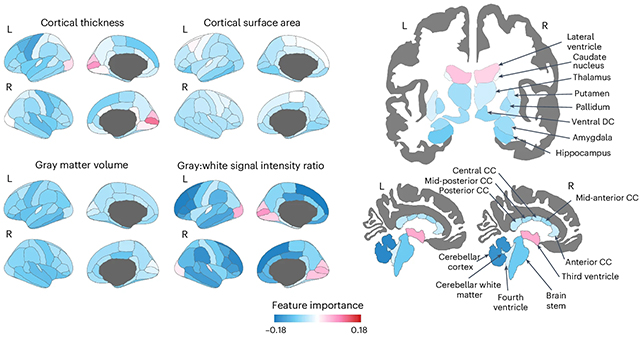
 

Brain scan differences


The researchers looked at how brain structure matched biological age. (Whitman et al., Nat. Aging, 2025)

If we know that someone's body is aging faster than their chronological age, it means measures can be taken to reduce the risk of health problems – years or even decades before those health problems might otherwise become evident. Changes in diet or exercise at that point could make a major difference.

The researchers are particularly interested in predicting the risk of the various types of dementia, including Alzheimer's disease. As people live longer across the world, rates of dementia are increasing, and the best way to tackle the condition could be to stop it developing in the first place.

"We really think of it as hopefully being a key new tool in forecasting and predicting risk for diseases, especially Alzheimer's and related dementias, and also perhaps gaining a better foothold on progression of disease," says Hariri.

The research has been published in Nature Aging.


This is only for your information, kindly take the advice of your doctor for medicines, exercises and so on.   


Labels: , , , , , ,

Monday, November 29, 2021

New Framework for Analyzing Alzheimer’s Disease Identifies Not One Form, but Three

According to the commonly accepted model, Alzheimer’s disease is characterized by an ineluctable sequence, from the accumulation of toxic proteins in the brain to dementia resulting from neurodegeneration. While this deterministic sequence is sometimes true, it does not seem to be the case for all patients. Moreover, the disappointing results of recently marketed drugs have highlighted the need to reconsider this disease, which affects nearly 10 million people in Europe.

A European consortium of physicians and scientists, led by the University of Geneva (UNIGE) and the University Hospitals of Geneva (HUG), in Switzerland, which also includes INSERM in France, has analyzed the data presented in nearly 200 previously published studies.

Far from being a monolithic disease where the same causes produce the same effects, this analysis proposes a categorization of patients into three groups, each with its own dynamics. In addition, the research team calls for an increased effort to screen people at risk, in order to implement preventive measures as early as possible.

This work, to be read in the journal Nature Reviews Neuroscience, proposes a profound paradigm shift in the way Alzheimer’s disease is understood.

Alzheimer’s disease is usually described as a four-step sequence: a deposit of amyloid appears in the cerebral cortex, then hyperphosphorylated tau protein increases and aggregates in neurons. They then cause neurodegeneration, and finally cognitive decline, with memory loss as the first symptom.

The first drug targeting the deposition of amyloid plaques in the brain, approved a few months ago by the European and American regulatory authorities, has however proved relatively disappointing.

“Yet, if we consider Alzheimer’s disease as a sequential cascade of biological events, it should have been much more effective,” explains Giovanni Frisoni, Professor in the Department of Readaptation and Geriatrics at the UNIGE Faculty of Medicine and Director of the HUG Memory Centre, who directed this work.

“Stopping the production of beta-amyloid with a drug should logically interrupt neuronal loss and therefore memory loss, which has not been massively observed. Furthermore, we have found that some people with amyloid do not develop cognitive symptoms. What does protect their brain from neurotoxicity?”

Not one, but three diseases

To better understand why the deterministic model of the disease is found in some cases but not in others, the scientists conducted a systematic literature review, some articles of which tend to confirm this model, while others refute it.

“Our interpretive framework showed that Alzheimer’s disease is more complex than it appears,” continues Daniele Altomare, a researcher in Giovanni Frisoni’s group, who took part in this work. “Three groups of patients can be distinguished according to their risk factors, the characteristics of their disease and their clinical fate.”

Thus, the cascade prediction is only confirmed in one of these three groups, where patients carry an inherited genetic mutation known as “autosomal dominant.” Fortunately, this mutation is rare, as it leads to the systematic development of an early cognitive deficit (between 30 and 50 years of age).

In the sporadic form, the development of cognitive deficit symptoms differs according to the presence or absence of a genetic variation, the e4 allele of the APOE gene, which appears to be an important risk factor: two third of carriers will indeed develop, sooner or later, the symptoms of Alzheimer’s disease.

This shows a model of a head and a brain
Alzheimer’s disease is usually described as a four-step sequence: a deposit of amyloid appears in the cerebral cortex, then hyperphosphorylated tau protein increases and aggregates in neurons.

The third group consists of people without associated genetic mutation for whom the presence of neurotoxic proteins appears to be an important but not unique risk factor.

“Half of our patients belong to this third group,” emphasizes Giovanni Frisoni. “Our probabilistic model therefore suggests that all genetic and environmental risk factors should be considered. Cognitive impairment develops when their weight overcomes the resilience of the brain, which is itself determined by protective factors of genetic and environmental origin.”

As in the case of cardiovascular disease

In the case of patients with cardiovascular disease, preventing risks (hypertension, obesity, etc.) in people who have never had a heart attack or stroke results in a very significant reduction in the number of cases in the following years. In contrast, such treatment after a stroke or heart attack brings only minimal benefits in terms of recovery.

“In our view, the same reasoning should apply to Alzheimer’s disease: it is essential to treat people at risk before symptoms appear.”

Identifying people at risk has until now required expensive and invasive procedures such as positron emission tomography (PET) scans and lumbar punctures. But the recent development of instruments capable of detecting the presence of beta-amyloid and hyperphosphorylated tau in the blood is about to change this and could allow the inclusion of such screening in routine check-ups.

“Although patient management will not change overnight, a more detailed understanding of the biological mechanisms at work will make it possible to develop more precise research protocols that take into account the different forms of Alzheimer’s disease,” say the authors.

This analysis is in line with the work carried out by Professor Bruno Dubois at INSERM, co-author of this study, aimed at applying precise clinical diagnostic criteria.

“In the years to come, we hope to adapt preventive and therapeutic strategies to each individual, rather than according to a standardized protocol that has already shown its limits.”


This is only for your information, kindly take the advice of your doctor for medicines, exercises and so on.   

https://gscrochetdesigns.blogspot.com. one can see my crochet creations  
https://gseasyrecipes.blogspot.com. feel free to view for easy, simple and healthy recipes    
https://kneereplacement-stickclub.blogspot.com. for info on knee replacement


Labels: , , , , , , , , , ,