Monday, January 05, 2026

A Single Brain Scan Halfway Through Your Life Can Reveal How Fast You're Aging

 Brain scan 

The rate at which our bodies age and wear down doesn't necessarily match our actual age, and the differences can help predict lifespan and disease risk. Now, researchers have developed a new tool for assessing biological age from a single brain scan taken halfway through our lives.

The tool, put together by an international team of scientists, is based on a dataset of 1,037 people born in Dunedin in New Zealand in 1972 and 1973. The health of these individuals has been carefully tracked over time, giving scientists a useful long-term database of stats that reflect the body's actual age – not how many birthdays have passed.

Here, the researchers used those stats to assess biological aging, and train a tool they've called DunedinPACNI – Pace of Aging Calculated from NeuroImaging. That sums up its function, which is to match aging to markers in the brain.

The system has the potential to quickly assess the body's age to a good degree of accuracy, and from there health and disease risks, including the chances of dementia. Rather than needing multiple tests over time, just a single brain scan is required.

"What's really cool about this is that we've captured how fast people are aging using data collected in midlife," says neuroscientist Ahmad Hariri from Duke University in North Carolina.

"And it's helping us predict diagnosis of dementia among people who are much older."

 DunedinPACNI takes in 99 key brain measurements to make its assessment, including the thickness of the cerebral cortex – which affects language and thinking – and the volume of gray matter in the brain.

Once the researchers had developed DunedinPACNI, they tested it on a variety of data from other health research projects, covering more than 50,000 people in total. It was shown to work well at estimating biological age, and at predicting future health problems such as cognitive impairment and heart attacks.

It's not a tool that offers perfect accuracy each time, but it scores as well as or better than current biological age assessment methods, the researchers say. What's more, it was shown to be useful across different demographic and socioeconomic groups.

"The link between aging of the brain and body is pretty compelling," says Hariri. "It seems to be capturing something that is reflected in all brains."
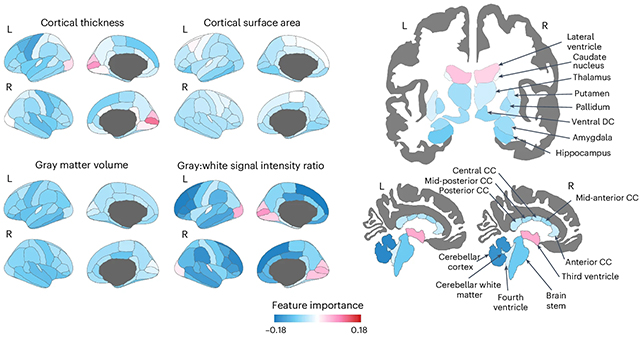
 

Brain scan differences


The researchers looked at how brain structure matched biological age. (Whitman et al., Nat. Aging, 2025)

If we know that someone's body is aging faster than their chronological age, it means measures can be taken to reduce the risk of health problems – years or even decades before those health problems might otherwise become evident. Changes in diet or exercise at that point could make a major difference.

The researchers are particularly interested in predicting the risk of the various types of dementia, including Alzheimer's disease. As people live longer across the world, rates of dementia are increasing, and the best way to tackle the condition could be to stop it developing in the first place.

"We really think of it as hopefully being a key new tool in forecasting and predicting risk for diseases, especially Alzheimer's and related dementias, and also perhaps gaining a better foothold on progression of disease," says Hariri.

The research has been published in Nature Aging.


This is only for your information, kindly take the advice of your doctor for medicines, exercises and so on.   


Labels: , , , , , ,

Thursday, September 25, 2025

The Promise of Zilebesiran for High Blood Pressure

For decades, the cornerstone of managing hypertension—high blood pressure—has been a daily regimen of oral pills. But what if controlling this "silent killer" could be as simple as an injection once or twice a year? This is the paradigm-shifting potential of zilebesiran, an investigational drug that is showing profound success in late-stage clinical trials, offering hope for millions who struggle to keep their blood pressure in check.

A landmark international study, KARDIA-2, recently published in The Journal of the American Medical Association (JAMA), has provided compelling evidence for this new approach. The trial demonstrated that a simple, subcutaneous injection of zilebesiran administered every six months could significantly and safely lower blood pressure in patients whose condition was not adequately controlled by their existing medications. This breakthrough could revolutionize the treatment of a disease that affects an estimated 1.28 billion adults worldwide and is a leading cause of heart attack, stroke, kidney disease, and premature death. 
 
The Challenge of Control and the KARDIA-2 Findings 
 
The core problem in hypertension management often isn't the lack of effective drugs, but rather inconsistent adherence to taking them day after day. The KARDIA-2 trial directly addressed this real-world challenge. The study enrolled 672 adults with mild-to-moderate hypertension whose blood pressure remained elevated despite being on a standard antihypertensive drug, such as a diuretic or a calcium channel blocker. 
 
Participants were randomly assigned to receive either a single 600 mg injection of zilebesiran or a placebo, in addition to their regular medication. The results at the three-month mark were striking. Patients who received the zilebesiran injection saw a clinically meaningful, placebo-adjusted drop in their 24-hour average systolic blood pressure. The reductions were substantial, with patients on the diuretic indapamide seeing an additional drop of 12.1 mmHg. This powerful effect was sustained, with significant blood pressure reductions persisting at the six-month mark.

Dr. Manish Saxena of Queen Mary University of London, the lead investigator for the trial and senior author of the JAMA paper, highlighted the significance of the findings. "This study demonstrates the efficacy and safety of zilebesiran when added to commonly used first-line antihypertensive drugs," he stated. "The novelty of this treatment lies in its long duration of action; a single injection every six months could help millions of patients better manage their condition." 
 
A Revolutionary Mechanism: Silencing the Source 
 
Zilebesiran, which is being co-developed by Alnylam Pharmaceuticals and Roche, operates on a completely different principle than traditional blood pressure medications. It is an RNA interference (RNAi) therapeutic, a cutting-edge technology that essentially "silences" a specific gene. 
 
Most existing blood pressure drugs work by targeting various parts of the Renin-Angiotensin-Aldosterone System (RAAS), a hormonal cascade that regulates blood pressure. Zilebesiran takes a novel "upstream" approach. It is designed to find and turn off the gene responsible for producing a protein called angiotensinogen (AGT) in the liver.

Angiotensinogen is the sole precursor for all angiotensin peptides, the hormones that ultimately cause blood vessels to constrict and blood pressure to rise. By blocking AGT at its source, zilebesiran leads to a durable and consistent reduction in these pressor hormones, allowing blood vessels to relax and blood pressure to fall. Because it's a long-acting formula, a single injection can maintain this effect for up to six months. 
 
Safety and the Path Forward 
 
The KARDIA-2 study, building on the positive results of the earlier KARDIA-1 monotherapy trial, also reported an encouraging safety profile. The most common adverse events were mild injection-site reactions. Importantly, there were no significant concerns regarding issues sometimes seen with other RAAS-inhibiting drugs, such as hypotension (abnormally low blood pressure) or hyperkalemia (high potassium levels). 
 
The journey for zilebesiran is not over. The next phase of research, a study named KARDIA-3, is already underway. This trial will evaluate the drug's effectiveness in a higher-risk population: patients with uncontrolled hypertension who also have established cardiovascular or chronic kidney disease.

Furthermore, the developers are planning a large-scale global outcomes trial. This will be the ultimate test, designed to determine if the sustained blood pressure reduction provided by zilebesiran translates into a tangible decrease in life-threatening events like heart attacks, strokes, and cardiovascular-related deaths. 
 
If these future studies prove successful, zilebesiran could herald a new era in hypertension care. By replacing the burden of daily pills with a simple, twice-yearly injection administered by a healthcare professional, this innovative therapy promises to overcome the challenge of medication adherence, ensuring that patients receive consistent, around-the-clock protection. For the millions living with the constant threat of high blood pressure, this long-acting solution could be life-changing.


This is only for your information, kindly take the advice of your doctor for medicines, exercises and so on.   


Labels: , , , , ,

Wednesday, September 10, 2025

Cardiologist Shares Life-Saving Tips Amidst Rising Heart Attacks

Amidst a growing number of heart diseases and cardiac arrests observed in the world, cardiologist Dr Alok Chopra provided a step-by-step guide on how to save a person during a heart attack. In an Instagram video shared on August 31, Dr Chopra was seen talking on the Impact Stories podcast, where he recommended these six life-saving tips to help a person overcome a sudden heart attack when immediate medical assistance is not possible.

Cardiologist’s Step-By-Step Guide During Heart Attack 

STEP 1: Ensure all the people gathered around the patient disperse to let the air sneak through and ease the patient’s breathing struggle.

STEP 2: Next up, sit down and straddle the patient, laying them down with legs stretched in opposite directions. “Typically, I am on my knees, pressing my entire weight down. The only way this can happen is by straddling the patient to apply maximum pressure," said Dr Chopra.

STEP 3: Make sure the sternum is compressed at least 3 to 6 inches. The patient may suffer a rib fracture or other injury because of this, but that can be cured later on.

STEP 4: If the person is approaching fatality, their colour will start to change and appear bluish or darkish. When the natural skin shade starts restoring itself on the body, the person is getting better.

STEP 5: Don’t stop, continue helping the patient with your best efforts. A minute of pressing may not be enough to safeguard the individual.

STEP 6:If the person does not recover within five to ten minutes, it is clear that they are deceased.

Cardiopulmonary Resuscitation

Chopra’s recommendations entail a series of chest compressions, called Cardiopulmonary Resuscitation (CPR). Since heart attacks are caused by the formation of blood clots and the blockage of arteries, chest compressions help manually pump blood through the heart and maintain circulation in case of a cardiac arrest.

During a CPR, a helping hand is required to press the patient’s chest hard for about 100 to 120 times while also providing timely rescue breaths. Individuals trained in giving CPR start by giving 30 chest compressions before giving two rescue breaths.


This is only for your information, kindly take the advice of your doctor for medicines, exercises and so on.   

https://gscrochetdesigns.blogspot.com. one can see my crochet creations  
https://gseasyrecipes.blogspot.com. feel free to view for easy, simple and healthy recipes    
https://kneereplacement-stickclub.blogspot.com. for info on knee replacement
https://GSiyers home remedies.blogspot.com   is the latest addition to my blogs


Labels: , , , , ,

Thursday, August 31, 2023

6 Things We All Get Wrong About CHOLESTEROL

Being diagnosed with high cholesterol can be scary - not only because of the dangerous ability of this fatty substance to clog your arteries but also because anyone can get it at any time without ever suspecting. Despite popular belief, high cholesterol and atherosclerosis (the stiffening and narrowing of blood vessels caused by cholesterol plaques) are not diseases that only affect overweight or older people. These are extremely common conditions that require proper screening and self-care - so pay attention to these 6 misconceptions, and don’t let them mislead you and ruin your health.

Myth 1. I would feel it if I had high cholesterol
This is one of the biggest myths about high cholesterol. Most people who have high cholesterol notice no signs of symptoms until the condition is already starting to cause complications like a heart attack or stroke. In relatively rare cases, yellow fatty growths called xanthomas may appear on the skin; their presence, however, is usually a sign of extremely high cholesterol levels.

As atherosclerosis progresses and cholesterol deposits build up in the blood vessels, the blood supply to the tissues organs starts decreasing and a person may experience symptoms like fatigue, muscle weakness, and sweating. Severe atherosclerosis causes complications like chest pain, pain in the legs while walking, kidney damage, heart attack, and stroke.

Ideally, you want to catch high cholesterol early and avoid these life-threatening complications altogether. The only sure way to know if you have high cholesterol is through a blood test. The Centers for Disease Control and Prevention (CDC) recommend getting your cholesterol levels tested at least every 5 years. This can be done with a standard blood test.

Myth 2. All cholesterol harms your health
Cholesterol Myths HDL LDL cholesterol

In itself, cholesterol is not harmful. In fact, it’s necessary for the human body to produce bile acid, vitamin D, healthy new cells, and hormones. In order to transport cholesterol through the blood vessels, the body uses special proteins called lipoproteins. Low-density lipoprotein (LDL) and high-density lipoprotein (HDL) are the two main ones, and they impact our health differently.

LDL (also known as “bad” cholesterol) carries cholesterol from the liver to the cells. LDL is often called “bad” because high levels of it build up in the blood vessels and raise the risk of cardiovascular disease.

HDL (also known as “good” cholesterol) takes the cholesterol back to the liver. The liver helps remove cholesterol from the body, so it reduces one’s risk of cardiovascular issues.

When your doctor tells you that you must lower your cholesterol level, they usually mean LDL levels. Overall, cholesterol isn’t harmful at all, but our sedentary lifestyle and overeating made it so that it is. As Dr. Robert Greenfield explained in an article for Medical News Today, “Our bodies weren’t designed to live in an environment where food was in excess, and so when cholesterol is in excess, it will be deposited in our body. And that deposit center can often be our blood vessels, and that’s when it’s bad for us.”

Myth 3. Young and fit people shouldn’t worry about cholesterol

There is a persistent false belief that only older or overweight people have high cholesterol. While it is true that both obesity and age are risk factors, anyone can have high cholesterol, including fit adults and even children. For this reason, The American Heart Association recommends that everyone check their cholesterol levels once in 5 years, even if you’re young and there’s no history of heart disease in your family.

Smokers, diabetics, older people, people with thyroid issues, heart disease sufferers, and those with a family history of high cholesterol, stroke, or heart attack should get tested even more frequently. You could be genetically predisposed to cholesterol imbalance without ever knowing it, so it’s better to stay on the safe side and get tested regularly. Your lifestyle habits, such as smoking, diet, drinking alcohol, and how much you exercise and sleep all impact your cholesterol levels too, so basically anyone could develop high


Myth 4. Once high cholesterol develops, there’s nothing you can do about it
Cholesterol Myths plaque in blood vessel
Thankfully, cholesterol levels are easier to manage today than ever before. Since we know so much about the causes of high cholesterol, doctors are able to give you detailed guidance that will get your cholesterol levels back to normal. Some patients will have to combine medications with lifestyle changes to lower their cholesterol, but for others, losing weight, eating healthy, avoiding harmful habits like smoking and drinking, and doing a little bit of light exercise every day will be enough to keep their cholesterol levels in check. 
 
You may be prescribed medications like statins and PCSK-9 inhibitors that will improve your cholesterol levels, but also remember to support your wellbeing with those healthy lifestyle habits.
 
 
Myth 5. The healthy range of cholesterol is the same for everyone

Doctors may recommend two different treatments for people with the same cholesterol levels, but why? This is because factors like age, blood sugar levels, blood pressure, weight, and underlying health conditions all influence your cholesterol “target.” For a healthy person, measures below 200 mg/dl of total cholesterol and below 100 mg/dl of LDL cholesterol are considered normal. 

However, someone suffering from high blood pressure, heart disease, or diabetes, for example, should have LDL levels no higher than 70 mg/dl - ideally even lower. All that is to say - only your doctor will be able to assess your cholesterol levels in a comprehensive manner and tell you whether or not you need to adjust them.

Myth 6. If you eat foods high in cholesterol, you will suffer from high cholesterol levels
Cholesterol Myths fast food
Cholesterol is naturally found in animal-derived foods, such as meat, dairy, and eggs. For years, doctors were telling us to stop eating eggs and other foods rich in cholesterol, but more recent research proves that your intake of cholesterol-rich foods doesn’t necessarily correlate with high blood cholesterol. In moderation, cholesterol-rich foods are actually fine to eat.

In fact, the very ingredient we demonized - eggs - has a high content of the “good” HDL cholesterol, which is why many nutrition experts are now advising everyone to eat 1-2 eggs a day. Recent research points to a different culprit that’s also present in many animal foods - saturated fat - and adds that adding dietary fiber and minimizing the amount of processed food and fatty meat go a long way in reducing one’s cholesterol levels.

Lastly, there’s some compelling evidence that people who exercise regularly are not as likely to have high blood cholesterol after eating foods high in cholesterol as those with a sedentary lifestyle - so exercise in combination with your diet may be another important factor to consider.


This is only for your information, kindly take the advice of your doctor for medicines, exercises and so on.   

https://gscrochetdesigns.blogspot.com. one can see my crochet creations  
https://gseasyrecipes.blogspot.com. feel free to view for easy, simple and healthy recipes    
https://kneereplacement-stickclub.blogspot.com. for info on knee replacement
https://cancersupportindia.blogspot.com  for infor on cancer and health related topics
https://GSiyers home remedies.blogspot.com   is the latest addition to my blogs. I'm going to add posts there, do give me your valuable feed back on my blogs. Thanks a lot, take care, be healthy and be happy.

Labels: , , , , , , ,

Sunday, July 24, 2022

Heart attacks in healthy people: A popular shower habit could take the blame

Heart diseases have for long been the deadliest killers around the world – yet, it is shocking how the incidence of heart attacks in healthy people  has skyrocketed in the past few years, especially since the coronavirus pandemic kicked off. Several celebrities, actors, singers, and cricketers succumbed to the cardiovascular condition when blood flow to the heart comes to a halt suddenly starving the organ of oxygen. Although it is often associated with comorbidities like hypertension, high cholesterol, and poor lifestyle choices like smoking – a popular shower habit could contribute to a heightened risk of the deadly condition.

Initial heart attack symptoms include shortness of breath, jaw, and chest pain. However, certain external factors could contribute to the onset of this condition in heart disease patients – exposure to a sudden gush of water for instance.

How do shower habits contribute to heart attack risk?
According to experts, cold showers can have a negative effect on heart patients as “it could precipitate a heart attack or heart rhythm irregularities," reports The Conversation.
Cold showers can shock the blood vessels in the skin causing them to contract thereby obstructing smooth blood flow in the body. This can increase heart rate, making it harder for the heart to pump blood around the body. As a result, pressure increases causing heart attacks  even in healthy people. The American Heart Association, too, cites research published in the journal of Physiology which said that plunging into cold water during hot weather may cause heart attacks in young, fit and healthy people. This is due to an autonomic conflict which can trigger abnormal heart rhythms and may in extreme cases cause sudden death.
Are cold showers always harmful?
When taken prudently, cold showers can do more good than harm. An extensive study on the benefits of cold showers revealed that people who took them for 30 to 90 seconds a day were 29 per cent less likely to take time off from work due to sickness as this habit can strengthen the immune system.

This is only for your information, kindly take the advice of your doctor for medicines, exercises and so on.   

https://gscrochetdesigns.blogspot.com. one can see my crochet creations  
https://gseasyrecipes.blogspot.com. feel free to view for easy, simple and healthy recipes    
https://kneereplacement-stickclub.blogspot.com. for info on knee replacement


Labels: , , , , , , , , ,