Wednesday, October 20, 2021

How to Choose the Best Cooking Oils for Every Task

The mutual ingredient in any recipe, be it a salad, dessert, sauce, soup or a main dish are cooking oils. They’re just essential in any kitchen, there’s no way around it, and knowing which oil works best for which task can become the card up your sleeve that will elevate your cooking skills from average to profound. Not pairing cooking oils to a specific dish, on the other hand, can ruin its taste and texture, as anyone suffering a fiasco after trying to crisp up French toast using butter will know.
In order to know which oil to use in which case, you’ll have to know a little science, as the smoke point of a specific oil variety is what makes it suitable for a specific task. The general rule is the higher the smoke point of an oil, the crispier the result. 
 
That’s why oils with a high smoke point, such as avocado oil, ghee, refined olive, and peanut oil, are typically used when high temperatures are involved and are best for frying, grilling, and roasting. Oils with lower smoke points, e.g. butter, shortening or linseed, on the other hand, will never yield a crispy crust at high temperatures. 
 
Another thing to consider is the taste of the oil, with sweeter or neutral oils like butter and sunflower oil being more suitable for baking desserts, whereas more fragrant oils, e.g. pumpkin seed oil, sesame oil, and extra virgin olive oil shine the most as an ingredient in salad dressings, sauces, and dips.
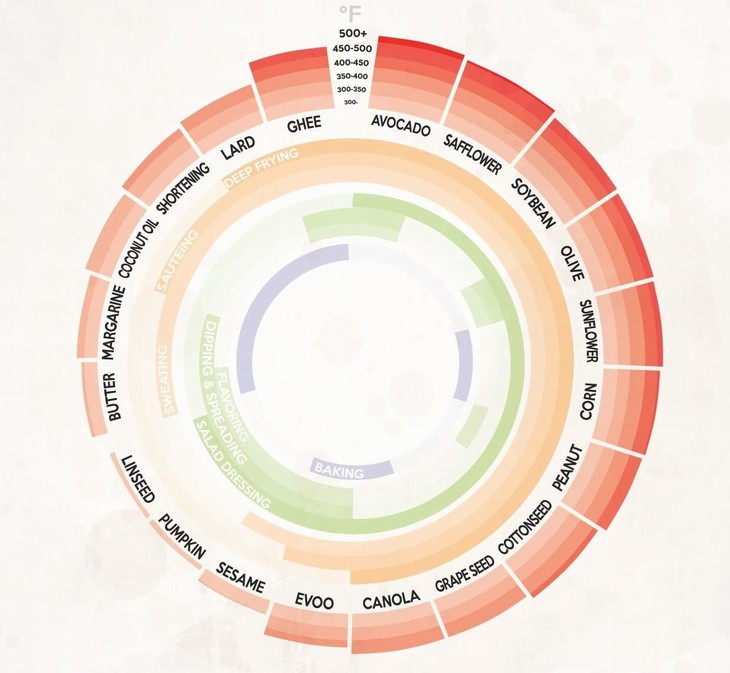
Cooking Oils For Every Task chart
The last thing to consider is the degree of refinement: refined oils typically have a higher smoke point than their virgin counterparts. So, extra virgin olive oil, for instance, will be best suited for salads and dressings, whereas refined olive oil will be perfect for baking, roasting and sauteing. 
 
Also, don’t forget that you can always mix several oils together to get a blend that will yield your desired results and taste. Returning to the example of French toast, I typically mix butter and grape seed oil to get perfectly crispy, and yet rich and buttery French toast. 
 
The chart above explains the best application for several popular oil varieties. Below we list the best cooking oils for each culinary task, be it flavoring, baking, roasting or frying.

The Best Oils For Cool Dishes
Cooking Oils For Every Task salad
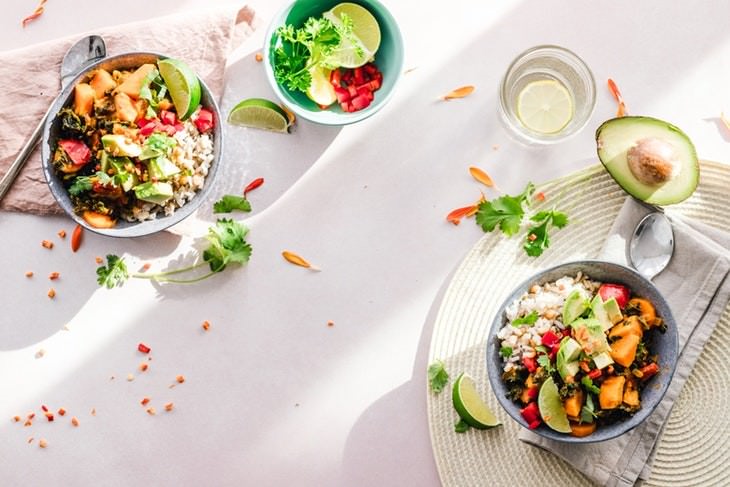
Salads, dips, marinades, and dressings are the most receptive of interesting, fragrant oils that have a relatively low smoke point. These oils include unrefined peanut oil, extra virgin olive oil, sesame oil, linseed or pumpkin oil. 
 
When choosing a specific type of oil, consider its flavor, texture, and color. Unrefined coconut oil, for instance, will have a strong coconut taste and will impart that taste onto the dish, which may not benefit all salads or marinades.

The Ultimate Cooking Oils for Cooking at High Temperatures (Roasting, Searing and Frying)
Cooking Oils For Every Task stir fry
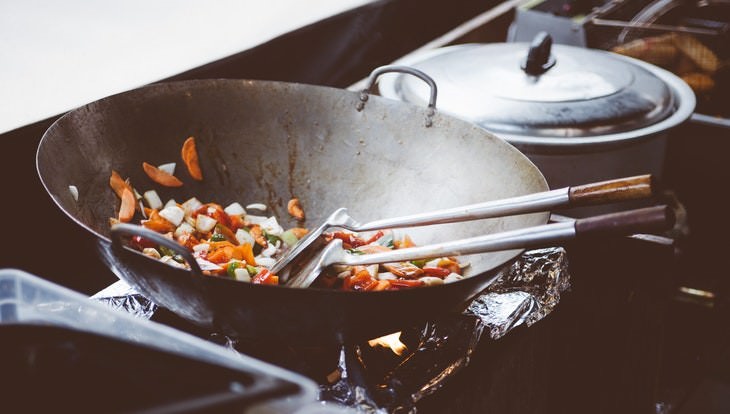
As we mentioned previously, you’ll need an oil that has a high smoke point to yield that crispy, caramelized crust. These oils include refined avocado oil, which has the highest smoke point, but also other refined oils, like peanut, olive, sunflower, vegetable and coconut oil. 
 
Since these oils are all refined, they typically have a very neutral flavor profile and can be used interchangeably.  
 
These Oils Are the Best Cooking Oils for Stewing and Sauteing
Sauteing, preparing a sauce or stewing requires longer cooking times over medium to low temperatures and so oils with medium to high smoke points are perfect to achieve this task. These oils include olive oil, canola or vegetable oil, sesame oil, avocado oil, grape seed oil, sunflower, corn oil, and others. 
 
Choose the one you like the most, one that fits your taste and budget, and maybe consider how healthy a certain cooking oil is as well since some oils have associated health benefits, whereas others, such as vegetable oils, grease or margarine, have a bad rep. 
 
The Best Cooking Oils for Baking
Baking doesn’t typically require a high smoke point, but a neutral or slightly sweet flavor profile will be essential for baking, especially for desserts. That’s exactly why adding olive oil instead of shortening, even just to grease the pans when making desserts is a big mistake. Instead, choose a neutral oil such as canola, shortening, butter, margarine, virgin coconut or avocado oil for baking.


This is only for your information, kindly take the advice of your doctor for medicines, exercises and so on.   

https://gscrochetdesigns.blogspot.com. one can see my crochet creations  
https://gseasyrecipes.blogspot.com. feel free to view for easy, simple and healthy recipes    
https://kneereplacement-stickclub.blogspot.com. for info on knee replacement

Labels: , , , , , , , , , , , , , ,

Friday, February 21, 2020

Is Eating Burned Food Bad for You?

So, you burned the toast. Beyond a kind of culinary black eye, do you need to worry about the health risk of ingesting charred bread? The question stems from recent research studies noting that high levels of the chemical acrylamide have been linked to cancer in laboratory animals. Acrylamide forms in some foods—particularly grains and starches—during certain types of high-temperature cooking, such as frying, roasting, baking, toasting. Basically, it's a reaction that occurs from the sugars and an amino acid that are naturally present in the food when cooked at a very high temperature. Thus, putting burned (as opposed to light brown) toast in the spotlight.

It's important to note that the high levels of acrylamide used in research studies were much greater than those found in human food. While the U.S. Food and Drug Administration (FDA) does not identify a specific maximum recommended level for acrylamide, it has been actively investigating the effects of it. It also offers guidance on a range of ways to reduce acrylamide levels. No one is suggesting a ban on toast or potatoes. Starches and grains are part of a regular diet. Given the widespread presence of acrylamide in foods, it isn't feasible or necessary to completely eliminate it from one's diet, says FDA chemist Lauren Robin. What's more, the FDA notes that removing any one or two foods from your diet would not have a significant effect on overall exposure to acrylamide. It also does not recommend reducing intake of healthful whole grain foods.


How to Eat Less Acrylamide

According to the FDA, there are some steps you can take to help decrease the amount of acrylamide you eat. (On March 1, 2016, the FDA also posted a final document with practical strategies to help growers, manufacturers, and food service operators lower the amount of acrylamide in foods associated with higher levels of the chemical.) For one, acrylamide is not typically associated with meat, dairy, seafood products, or raw plant-based foods. Boiling and steaming foods do not typically form acrylamide.

For foods where acrylamide is likely to form, the FDA has clear recommendations: When it comes to enjoy toast with breakfast, they say bread should be toasted to a light brown color rather than a dark brown color. Avoid very brown areas. They suggest against storing potatoes in the refrigerator, which can increase acrylamide during cooking. Keep potatoes in a dark, cool place, such as a pantry. Cook cut potato products such as frozen French fries to a golden yellow color rather than a brown color. Brown areas tend to contain more acrylamide.


Fry Less and Eat a Healthier Diet

Regarding cooking methods, frying causes acrylamide formation. If frying frozen fries, follow manufacturers' recommendations on time and temperature and avoid overcooking, heavy crisping, or burning. Cutting down on certain fried foods has the added benefit of helping to maintain a healthy diet in general, while also helping to cut down on the amount of acrylamide you eat. The FDA's best advice for consumers to help limit acrylamide intake is to adopt a healthy eating plan, consistent with the Dietary Guidelines for Americans, that emphasizes fruits, vegetables, whole grains, fat-free or low-fat milk and milk products, lean meats, poultry, fish, beans, eggs, nuts, and limited amounts of saturated fats, trans fats, cholesterol, salt, and added sugars. 


This is only for your information, kindly take the advice of your doctor for medicines, exercises and so on.     

https://gscrochetdesigns.blogspot.com. one can see my crochet creations  
https://gseasyrecipes.blogspot.com. feel free to view for easy, simple and healthy recipes    
https://kneereplacement-stickclub.blogspot.com. for info on knee replacement
 

 source-marthastewart

Labels: , , , , , ,

Wednesday, October 24, 2012

CRUSTY FOODS WORSENS HEART PROBLEMS IN DIABETICS

 Eating crusty foods may worsen heart problems in diabetics. 

There is evidence that cooking methods that create a crust—

think the edge of a brownie or the crispy borders of meats 

prepared at very high temperatures—produce advanced 

glycation end products (AGEs). And AGEs are associated with 

plaque formation, the kind that is seen in cardiovascular 

disease.


For years nutrition experts have advised people with diabetes 

to bake, boil, or grill their food instead of frying it.


That’s still true, but if you have diabetes, you should know that 


AGEs— by-products of food preparation methods that feature 

very high, intense, dry heat—tend to end up on other tissues in 

the body, causing long-term damage.


If you’re fighting this vascular build up anyway, that consuming 


products containing AGEs could worsen the cardiovascular 

complications of diabetes.


In the study, the scientists compared the 10-day food intake of 


65 study participants in two ethnic groups: Mexicans (who have 

higher rates of diabetes and a greater risk of complications 

from the disease) and non-Hispanic whites.


It was found that people with higher rates of cardiovascular 

complications ate more of these glycated products. For each 

unit increase in AGEs intake, a study participant was 3.7 times 

more likely to have moderate to high risk for cardiovascular 

disease.


The study showed that non-Hispanic whites had a higher intake 


of AGEs, and they consumed more saturated fats. However, 

the association between AGEs and cardiovascular disease 

was stronger than for saturated fats and heart disease.


Eating less saturated fat and more fruits, vegetables, and fibre 

are important for people with diabetes, but this study shows 

that food preparation may be important too.


AGEs are higher in any kind of meat, but especially in ground 


meat. If you put hamburgers or brats on the grill, you’ll likely 

have a higher AGEs content than if you chose a whole cut of 

meat, say round steak or chicken.


Boiling or stewing meat would reduce your AGEs intake further. 


And scrambling an egg with cooking spray instead of frying it 

leads to a significant reduction in AGEs.


The scientists said more research is needed before definite 


recommendations can be made. They are planning another 

study in which they’ll examine past AGEs intake of diabetes 

patients.


These findings are preliminary, but they give us ample reason 


to further explore the association between AGEs and 

cardiovascular risk among people with diabetes.

Labels: , , , , , , , , , , , ,