Snacking contributes to fatty liver, abdominal obesity
Snacking on high-fat and high-sugar foods is linked to abdominal fat and fatty liver disease, according to a new study.
The
study found that a hypercaloric diet with frequent meals increases
intrahepatic triglyceride content and fat around the waist, but
increasing meal size did not.
Studies have linked
obesity to the accumulation of abdominal fat and fat in the liver,
making non-alcoholic fatty liver disease (NAFLD) one of the most
prevalent diseases of the liver.
“American children
consume up to 27 per cent of calories from high-fat and high-sugar
snacks,” said lead author Dr. Mireille Serlie with the Academic Medical
Centre Amsterdam in The Netherlands.
“Our study
examines if high meal frequency, with snacking, compared to large meal
consumption contributes to increased intrahepatic and abdominal fat,”
Dr. Serlie said.
For the study, 36 lean men were randomised to a hypercaloric diet or a eucaloric control diet (balanced diet) for six weeks.
Researchers
measured IHTG and abdominal fat using magnetic resonance imaging (MRI)
and insulin sensitivity before and after the diet.
Those
subjects on the hypercaloric diet ate 3 main meals along with
additional calories from high fat and/or high sugar drinks, with or in
between meals, to increase meal size or meal frequency.
Results show that high calorie diets increased BMI.
Eating more frequent meals significantly increased IHTG, while larger sized meals did not.
Researchers
found that belly fat increased in the high fat/high sugar frequency
group and in the high sugar-frequency group. A decrease in liver insulin
sensitivity was found in the high fat/high sugar-frequency group.
“Our
study provides the first evidence that eating more often, rather than
consuming large meals, contributes to fatty liver independent of body
weight gain,” said Dr. Serlie.
“These findings
suggest that by cutting down on snacking and encouraging three balanced
meals each day over the long term may reduce the prevalence of NAFLD,”
Serlie added.
PS-
THIS IS ONLY FOR INFORMATION, ALWAYS CONSULT YOU PHYSICIAN BEFORE
HAVING ANY PARTICULAR FOOD/ MEDICATION/EXERCISE/OTHER REMEDIES.
PS- THOSE INTERESTED IN RECIPES ARE FREE TO VIEW MY BLOG-
HTTP:GSEASYRECIPES.BLOGSPOT.COM/
FOR INFO ABOUT KNEE REPLACEMENT, YOU CAN VIEW MY BLOG-
HTTP://KNEE REPLACEMENT-STICK CLUB.BLOGSPOT.COM/ FOR CROCHET DESIGNS HTTP://MY CROCHET CREATIONS.BLOGSPOT.COM
Sedentary lifestyle in Mumbai leading to increased cases of liver disease
Sedentary way of living is as bad as excessive drinking as it leads to Non-Alcoholic Fatty Liver Disease, warn city doctors
Ravi JadhavDNA
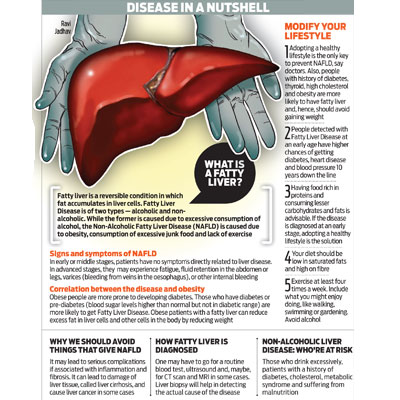
Alcohol is no more the only cause of end-stage liver disease in the city. Doctors say sedentary lifestyle has led to an increasing numbers of Mumbaikars getting the fatty liver problem leading to liver cirrhosis (advance liver disease).
For a long time, excessive consumption of alcohol was considered as the root cause of a damaged liver. But even teetotallers who are overweight, with high abdominal obesity or waist circumference, can suffer from liver disease, say gastroenterologists and liver surgeons.
"The kind of lifestyle people have these days has by and large led to fatty liver disease becoming common among people, and the number is going to increase even further," said Dr SK Mathur, liver transplant expert at Fortis hospital. Fatty liver affects up to 10% of the urban population.
According to health experts, Non-Alcoholic Fatty Liver Disease (NAFLD) can reach epidemic proportions in the years to come, considering the improper lifestyles our youth are tempted to adopt today. Doctors say that in the last few years, there has been a rapid increase in the number of liver cancer patients in India, especially in urban cities, because of unhealthy lifestyles.
NAFLD may cause the liver to swell (steatohepatitis). A swollen liver may cause scarring (cirrhosis) over time and may even lead to liver cancer or liver failure.
Dr Pravin Rathi, head of gastroenterology, BYL Nair Hospital and Bombay Hospital, said, "Obesity is more dangerous than alcohol. Globalisation and westernisation has led to many people getting NAFLD. As obesity and diabetes are correlated with fatty liver, there is an upward trend to the latter. NAFLD is increasing mainly due to wrong dietary habits and high intake of fats and carbohydrates and less of proteins."
While obesity is a cause for concern amongst the youth of India, doctors warn against rapid weight loss regimes. "Rapid weight loss regimes can lead to severe damage to liver. Therefore, people trying to lose weight should go for a gradual loss programme and adopt a healthy lifestyle," added Rathi.
PS- THIS IS ONLY FOR INFORMATION, ALWAYS CONSULT YOU PHYSICIAN BEFORE HAVING ANY PARTICULAR FOOD/ MEDICATION/EXERCISE/OTHER REMEDIES.
PS- THOSE INTERESTED IN RECIPES ARE FREE TO VIEW MY BLOG-
HTTP:GSEASYRECIPES.BLOGSPOT.COM/
FOR INFO ABOUT KNEE REPLACEMENT, YOU CAN VIEW MY BLOG-
HTTP://KNEE REPLACEMENT-STICK CLUB.BLOGSPOT.COM/ FOR CROCHET DESIGNS HTTP://MY CROCHET CREATIONS.BLOGSPOT.COM
Changing meal times could have significant effect on levels of triglycerides in liver
A new research in mice has suggested that merely changing meal times could have a significant effect on the levels of triglycerides in the liver.
The results of this Weizmann Institute of Science study, published in the journal, Cell Metabolism, have important implications for the potential treatment of metabolic diseases. They may also have broader implications for most research areas in the life sciences.
Several biological processes have a fixed schedule, with levels of activity rising and dipping at certain times of the day. Such fluctuations, known as circadian rhythms, are driven by internal “body clocks”. A circadian rhythm is a roughly 24-hour cycle in the physiological processes of living beings. Disruption to this optimum timing system can cause imbalances, leading to diseases such as obesity, metabolic syndrome and fatty liver.
In studying the role of circadian rhythm in the accumulation of lipids in the liver, postdoctoral fellow Yaarit Adamovich and the team in the lab of Dr Gad Asher of the Weizmann Institute's Biological Chemistry Department, together with scientists from Dr. Xianlin Han's lab in the Sanford-Burnham Medical Research Institute, Orlando, US, quantified hundreds of different lipids present in the mouse liver.
They found that a certain group of lipids, namely the triglycerides (TAG), exhibit circadian behaviour, with levels peaking about eight hours after sunrise.
The scientists were astonished to find, however, that daily fluctuations in this group of lipids persist even in mice lacking a functional biological clock, albeit with levels cresting at a completely different time - 12 hours later than the natural schedule.
“These results came as a complete surprise: One would expect that if the inherent clock mechanism is 'dead,' TAG could not accumulate in a time-dependent fashion,” Adamovich said.
So what was making the fluctuating lipid levels “tick” if not the clocks? “One thing that came to mind was that, since food is a major source of lipids - particularly TAG - the eating habits of these mice might play a role.”
However, in mice lacking a functional clock, the team noted that they ingest food constantly throughout the day. This observation excluded the possibility that food is responsible for the fluctuating patterns seen in TAG levels in these mice.
ps- this is only for information, always consult you physician before having any particular food/ medication/exercise/other remedies.
ps- those interested in recipes are free to view my blog-
http://gseasyrecipes.blogspot.com/
for info about knee replacement, you can view my blog- http://Knee replacement-stick club.blogspot.com/ for crochet designs http://My Crochet Creations.blogspot.com
Links between alcoholic liver disease and circadian clock revealed!
Researchers have revealed a putative role for the circadian clock in the liver in the development of alcohol-induced hepatic steatosis, or fatty liver disease.
The team from the University of Notre Dame and the Indiana University School of Medicine has shown that the development of liver steatosis produced by alcohol abuse is intertwined with disturbances of the normal operation of the 24-hour clock system located in the cells of the liver.
The study has suggested that either the circadian clock is important in the actual development of the liver disease or that the development of steatosis disrupts the normal pattern of the clock mechanism.
The researchers said that the mechanism by which chronic alcohol intake is thought to alter the control of fat metabolism in the liver is also a shared signal to the circadian clock mechanism, this being the ratio of production of reduced nicotinamide adenine dinucleotide, and may be a key to the shared disturbance to the two biological mechanisms of lipid metabolism and the circadian clock.
ps- this is only for information, always consult you physician before having any particular food/ medication/exercise/other remedies.
ps- those interested in recipes are free to view my blog-
http://gseasyrecipes.blogspot.com/ for info about knee replacement, you can view my blog- http://Knee replacement-stick club.blogspot.com/ for crochet designs http://My Crochet Creations.blogspot.com


 Ravi Jadhav DNA