Thursday, April 09, 2026

The Spice Cheat-Sheet

 There's usually a good reason for everything, like for the phrase, 'the spice of life', or for why spices used to cost a fortune in days gone by. Spices can make even the most ordinary recipe burst into life with exciting tastes, and turn an average dinner into a gourmet feast, delighting the tongue with exotic flavors from far-flung places. That's why the following spice guide is so useful, and will let you know which spices to mix with which food, so you'll be able to ascend the lofty heights of culinary delight!
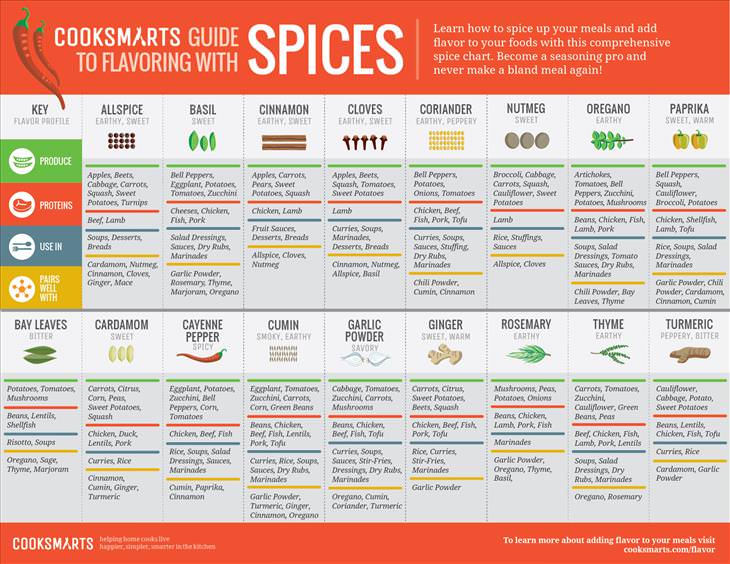
spice infographic cheat sheet

This is only for your information, kindly take the advice of your doctor for medicines, exercises and so on.   


Labels: , , , , , , , , , , , , , , , , , , ,

Tuesday, November 08, 2022

Paprika is Great For Your Health!

Paprika, the vibrant, red, aromatic ground spice made from peppers (in the Capsicum annuum family), is used to add flavor to numerous dishes. This group of spices includes sweet, mild, red bell peppers, hot chili peppers, cayenne peppers, poblano peppers, or Aleppo peppers. Paprika is known to have a smoky, slightly sweet flavor. The color of the spice varies from deep red to orange-red. The spice is commonly used as a garnish in dishes like deviled eggs, hummus, or potato salad, but it can also be added to meat dishes, vegetable stews, and soups.
Benefits of Paprika,
Did you know that this delicious seasoning also has numerous health benefits? Paprika is rich in vitamins and minerals, contains lots of antioxidants, and can even help prevent cancer! Read on to discover the many amazing uses of this incredible red powder.

1. Paprika is loaded with nutrients  
Paprika is a nutrient-rich spice. It’s low in calories and doesn’t have any sodium or cholesterol. Moreover, it also doesn’t contain any saturated fats and is crammed with vitamin C, vitamin A, vitamin B6, and vitamin E. 
 
1 tablespoon (6.8 grams) of paprika powder provides: - 
 
Calories: 19
 
- Protein: 0.325 g 
 
- Fat: 0.296 g 
 
- Carbs: 4 g
 
- Fiber: 2 g 
 
- Vitamin A: 19% of the Daily Value 
 
- Vitamin E: 13% of the Daily Value
 
- Vitamin B6: 9% of the Daily Value 
 
- Iron: 8% of the Daily Value. 
 
One tablespoon of paprika is enough to fulfill your daily vitamin A needs. And while it’s unlikely that you will be consuming this spice enough to make a significant difference to your diet, having it daily can promote healthy digestion by increasing saliva and stomach acids. This helps in breaking down food and making nutrients available for energy.
 
2. May help prevent cancer

Paprika also provides you with antioxidants known as carotenoids. They are plant compounds that offer such health benefits as a reduced risk of certain diseases, particularly some forms of cancer. Carotenoids are found in the cells of an array of plants, particularly those with bright rich colors, like peppers are used to make paprika powder. 
 
The carotenoids typically found in paprika are beta-carotene, beta-cryptoxanthin, and lutein or zeaxanthin. Beta-carotene, lutein, and zeaxanthin have been shown to combat oxidative stress, which is believed to increase your risk of certain cancers. Furthermore, a study of almost 2,000 women found that participants with the highest blood levels of beta carotene, lutein, zeaxanthin, and total carotenoids had a 25–35% lower chance of developing breast cancer.

3. It’s great for the eyes  
As we mentioned, paprika contains vitamin A, lutein, and zeaxanthin. All of these may also boost eye health. Studies have shown that the antioxidants lutein and zeaxanthin, in particular, may prevent eye damage. Also, research suggests that the carotenoids present in paprika can provide protection against eye diseases as well. Additionally, the presence of vitamin B6 in paprika helps keep your eyes healthy. Studies indicate that the consumption of vitamin B6 can lower the onset of macular degeneration and other eye-related diseases.  
 
4. Can improve cholesterol levels  
Research says that paprika may improve your cholesterol levels. One study found that capsanthin, the carotenoid found in paprika, can help raise levels of HDL (good) cholesterol, which is linked with a lower risk of heart disease. 
 
Another 12-week study in 100 healthy adults showed that the participants who took a supplement containing 9 mg of paprika carotenoids daily had notably lower levels of LDL (bad) cholesterol, which is associated with an increased risk of heart disease. In fact, the total cholesterol levels of those who took paprika were lower than those who got the placebo. 
 
5. May help maintain bone health
Paprika is rich in calcium, potassium, and phosphorus, which are all vital for maintaining healthy bones and muscles. Phosphorus, especially, is an important mineral for maintaining bone shape and strength, and a regular dash of this spice in your diet should help keep the connective tissues in the body strong. Phosphorus also helps keep our teeth, gums, and jaws strong, as it controls calcium absorption. Without it, the calcium in our body goes to waste.

6. Helps keep anemia in check 
Since paprika contains a good amount of iron and Vitamin E, it helps the body in producing red blood cells. 
 
Vitamin E is needed to create healthy membranes for the body’s red blood cells while iron is an essential part of hemoglobin, a red protein responsible for transporting oxygen throughout our body. Deficiencies in these two nutrients may lower your red blood cell count and can lead to anemia. It is a condition in which you don't have enough healthy red blood cells to carry sufficient oxygen to your body's tissues. 
 
Anemia is marked by symptoms like fatigue, weakness, shortness of breath, dizziness, and chest pain, but it may also contribute to other illnesses. For example, one study in 200 young women linked low iron consumption to a significant increase in the risk of anemia, compared with those who had sufficient intake.
 
7. May help manage diabetes  
The capsaicin in paprika has the potential to help regulate blood sugar levels and manage diabetes. A 4-week study in 42 pregnant women with diabetes concluded that taking 5 mg of a capsaicin supplement every day considerably decreased post-meal blood sugar levels compared to a placebo. 
 
Another study found that adults who followed a diet rich in capsaicin-containing chili pepper had a marked decrease in their blood insulin levels after meals compared to those who followed a chili-free diet. Lower insulin levels usually signify better blood sugar control.
 
How to use paprika powder Benefits of Paprika,
Benefits of Paprika,
Paprika originated from the West Indies and South America, and it is majorly manufactured in Hungary, Spain, South America, and California. Today, the popular spice is widely used in Europe, Africa, and Asia. Paprika comes in three main varieties that differ in taste and color: regular or basic paprika, Hungarian paprika, and Spanish paprika. 
 
As we mentioned earlier, this delicious spice is typically used as a seasoning for meats, potato salad, and eggs. In addition, you can sprinkle a dash of paprika powder on meals like hard-boiled eggs, salads, cooked rice, chopped veggies, and even sauces or dips. Its smoky and sweet flavor will go particularly well with rice, seafood, and bean dishes. But if you want a spicier kick in your meals, you can use hot paprika to add to soups and stews.

What's more, you can strengthen paprika's flavor profile by adding it to meat. Some people even use paprika in cocktails and on warm or spicy beverages. Use paprika in typical amounts required for cooking and don’t go overboard with it because some spices have been known to cause allergic reactions. Ground paprika lasts between two and three years, and it should be stored the same way you store all of your dried spices - in a cool, dry place inside an airtight container.


Labels: , , , , , , , , , , , , ,

Wednesday, May 01, 2013

5 SPICES' HEALTH BENEFITS


Garam Masala

This warm and fragrant Indian spice blend, whose name literally means "hot mixture," gives a bit of heat and a touch of sweetness to your dishes. It's made using different combinations of coriander, black peppercorns, cardamom, cinnamon, caraway, cloves, ginger, and nutmeg.

How it's healthy: Because it adds complex flavours  you should be able to cut back on the salt you use.

How to use them ? It's great in Indian cuisine, but don't stop there. Try it when cooking fish, pork, chicken, lamb, vegetable stews, soups, and potatoes. It's also great with stewed or roasted cauliflower.

Smoked Paprika

This spice has a rich, smoky flavour and a pronounced heat. It's made with different types of bell and/or chilli peppers that are roasted and ground.

How it's healthy: If you like it hot, you're in luck. Paprika contains capsaicin, which gives it the heat. It's also an antioxidant, so it helps protect your body cells against damage.

Its use- its complex, smoky flavour lends a hearty, filling quality to soups, stews, rice dishes, tomato sauces, and salsas. It's also a great addition to rubs and marinades.

Allspice

This powerful, sweet and fragrant spice from Central America tastes like a mix between cloves, cinnamon, and nutmeg.

How it's healthy: Researchers are studying some of the parts of allspice to see whether it might help fight cancer.
Usage-  Allspice is essential in Caribbean jerk dishes. Try adding it to curries and chilli  too. It's warming and delicious in desserts like cakes and puddings.

Celery Seed

It tastes like a slightly bitter, more concentrated form of celery itself.

How it's healthy: Celery seed is great for perking up the flavour of low-sodium food, so you may use less salt. It also has calcium and iron.

Uses-  sprinkling it on steaks before cooking, and adding it to soups, stews, meatloaf, burgers, rubs, and marinades.

Coriander

This herb's seeds have a mild, toasty, slightly lemony flavour.

How it's healthy: Researchers are investigating whether coriander may help lower cholesterol.

Uses- Use ground coriander in soups, stews, casseroles, cakes, and other baked goods. Crushed coriander seeds are delicious for flavouring burgers, marinades, and dressings.

Labels: , , , , , , , , , , , , , , , , , ,