Sunday, October 19, 2025

Beat Sciatica Pain with These 7 Simple Exercises

Sciatica has become a common problem. If you haven't experienced it yourself, someone you know probably has. By definition, sciatica is tenderness and pain that can occur anywhere along the sciatic nerve. The sciatic nerves are the longest nerves in the human body. There are two nerves - one in each leg - originating from several nerve roots that exit from the spinal cord, passing between layers of the buttock muscles through the muscles at the back of the thigh and down through the outer edge of your leg to your foot. 

The Facts: According to the Journal of Neurosurgery: Spine (2005), it is estimated that more than 5% of the adult population in the United States suffers from sciatica. Furthermore, an individual has a 40% probability of developing sciatica over a lifetime.


The Symptoms of Sciatica: 
Sciatica frequently flares up when bending over, running and sitting (particularly when driving). Symptoms of sciatica typically include: 
• Pain in the lower back, buttocks, back of the thigh and/or calf 
• Fatigue, numbness, or loss of feeling in your legs and/or feet 
• Tingling, burning, pinching, pins and needles 
• An inability to flex your ankles enough to walk on your heels 
• Reduced reflexes in the Achilles tendon (the muscle above the heel) and the knee.

What is the Cause of Sciatica?  
It is important to get to the root of the problem first and discover what is causing your sciatica. This involves seeking advice from your doctor and getting a proper diagnosis before proceeding. Generally, there are two main contributors to sciatica: 
 
• A Herniated Disk: Pain that is caused by a bulging or ruptured disk that pinches or irritates the nearby nerve. 
 
• Piriformis Syndrome: Sciatica that is caused by irritation of the sciatic nerve by a muscle in the buttocks called the piriformis. The muscle can push the sciatic nerve against the tendons beneath it, resulting in buttock and leg pain.

The Good News: How Yoga Can Help 
 
Specific yoga practice can help you overcome the pain: 
 
• For a Herniated Disk: Opt for a yoga practice that progresses from gentle poses to basic foundational postures, which include a variety of standing poses focusing on the alignment, lengthening and strengthening of your lower back. Prior to practicing yoga, ensure that surgery is not required. 
 
• For Piriformis Syndrome: Opt for yoga postures that stretch this muscle. Your approach should be gentle and progressive, as overworking this muscle may lead to spasms and deep buttock pain.
 
What follows is a series of yoga poses that predominantly target the piriformis, helping to relieve sciatic pain: 
 
1. Reclining Big-Toe Pose
 
Exercise - Tips - Relieve Pain - Helpful
Beginner's Tip: To make this pose slightly easier, keep your extended leg’s heel a few inches off the floor; for extra comfort and support you can place your heel on a foam block or a thick book. To help keep your raised foot in the air you can place a strap around the arch of your raised foot. Place a folded blanket under your head for added comfort. 
 
Here's How:
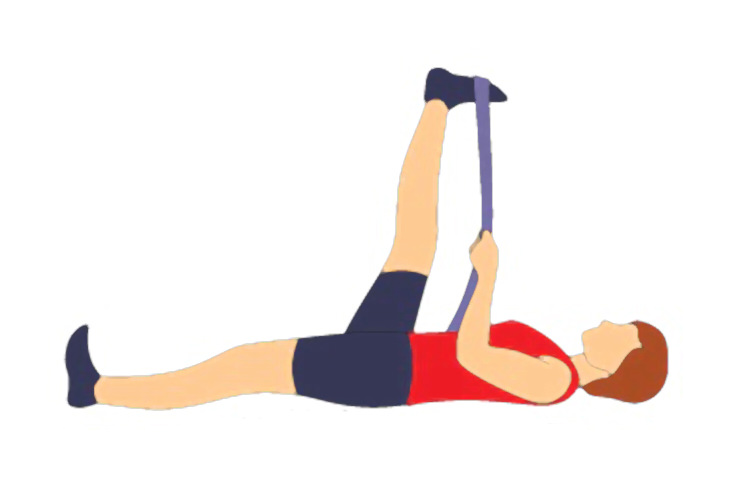
1) Lie on the floor, keep your legs strongly extended with your feet flexed. Exhale and bend your right knee, drawing your thigh to your torso, hugging it to your belly. Keep your left leg extended, pushing actively through the heel. 
 
2) Loop a strap around the arch of your right foot, holding the strap with both hands. On your next inhalation, extend your knee straight, pressing your heel up toward the ceiling. Reach your hands as far up the strap as possible, until your elbows are extended. 
 
3) Keep your shoulder blades broad across the back, pressing lightly into the floor. Keep your collarbones wide, reaching away from the sternum. Your sitting bones should be firmly planted on the floor. 
 
4) Hold the pose for 10 deep breaths. Then lower your leg slowly by bending your knee towards your chest and slowly releasing it to the floor. Repeat the process with your left leg. 
 
2. Staff Pose
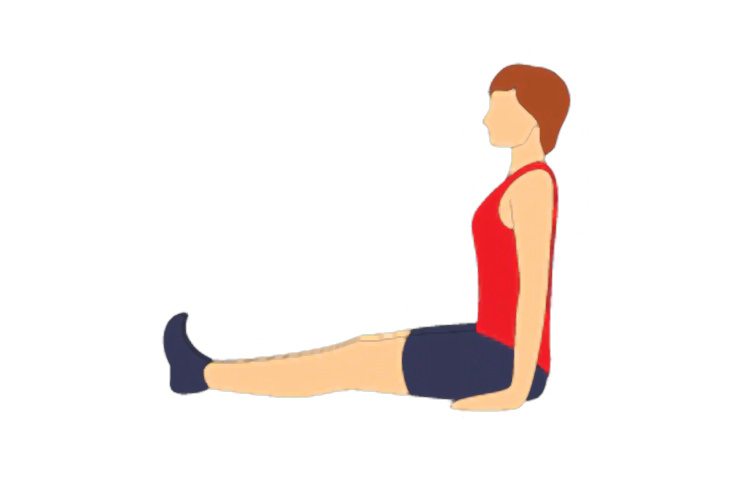
Exercise - Tips - Relieve Pain - Helpful
Beginner's Tip: This is a basic seated pose, which aside from relieving sciatica, will also help improve posture. Lay a 10-pound sandbag across the top of your thighs at the hip crease to help keep your thighs grounded. You can also practice this pose by keeping your back against the wall. 
 
Here's How:  
1) Sit on the floor, extending both legs in front of you. Keep your legs together and your torso upright. If your torso is leaning back, sit up on a blanket or cushion to help lift your pelvis. If practicing against a wall, your sacrum and shoulder blades should touch the wall, but not the lower back or the back of the head. 
2) Sit on the front parts of your sitting bones, keep your thighs firm, pressing them down against the floor, rotating them slightly toward each other. Keep your ankles flexed, pressing out through your heels. Keep your spine long, as if you're being pulled by a string from the crown of your head. Hold for one minute taking long, deep breaths. 
 
3. Pigeon Pose
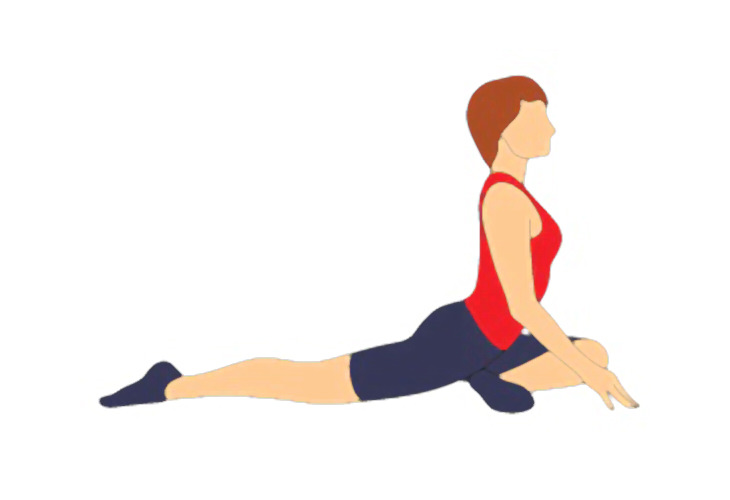
Exercise - Tips - Relieve Pain - Helpful

Beginner's Tip: This pose stretches the piriformis. Place a thick, folded blanket underneath you hip for extra support. 
 
Here's How:
1) Start on all fours. Bring your right knee forward and out between your hands. Slowly sink your hips to the floor. As you do so, release your left leg onto the floor behind you, slowly sliding it back while bringing your body forward. Keep your left toes pressed down on the mat. 
 
2) Your right heel should be in line with your left hip and your shin should be at about a 45-degree angle. If you feel yourself tilting over to the right hip, place a blanket underneath for extra support. Keep your hips parallel to the front of your mat as much as possible. Use your fingertips to support your torso and keep your spine long, shoulder blades drawing close together. Hold for 10 deep breaths and repeat on the other leg. 
 
4. Standing Twist
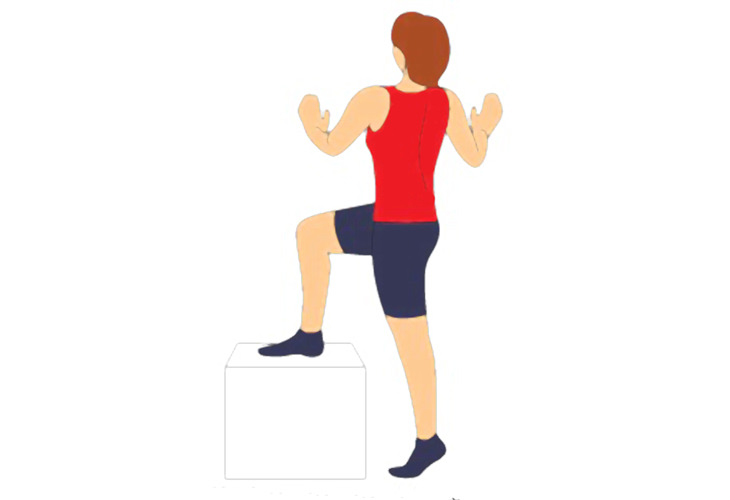
Exercise - Tips - Relieve Pain - Helpful

Beginner's Tip: To reap the benefits of this pose, place a chair against the wall; the chair and the wall will provide you with extra support, enabling you to twist deeper. 
 
Here's How: 
1) Stand with your right hip against the wall with your body facing the chair. Put your right foot up on the chair, keeping your knee bent. Also, keep it in line with your ankle. Your standing leg should be straight. Press your right hand against the wall, to help you balance. 
 
2) Slowly lift your left heel up and turn your torso towards the wall, supporting your hands with the wall. Exhale and lower your heel to the floor, staying in the twist for a couple more breaths. Slowly return to the starting position and repeat on your left side. 
 
5. Preparation for Spinal Twist
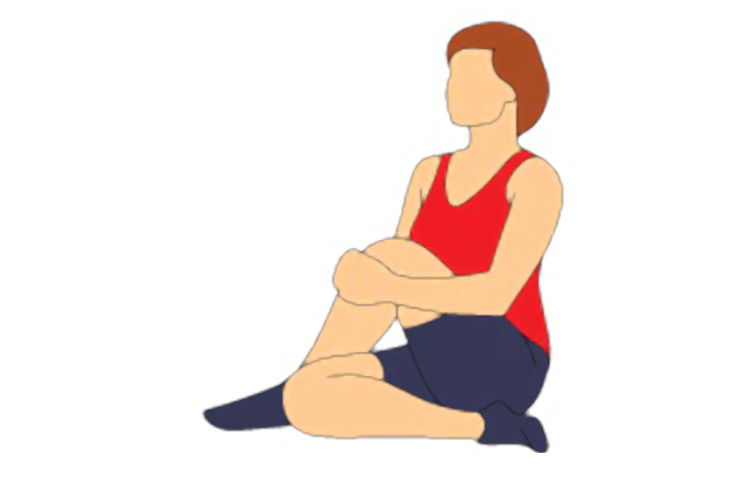
 
Exercise - Tips - Relieve Pain - Helpful

Beginner's Tip: Sit on the corner of a folded blanket for extra support in the full seated spinal twist pose (see below). 
 
Here's How:  
1) Sit with your knees bent and your feet out in front of you. Release your right leg on the floor, taking your right heel to the outside of your right hip. Then bring your left foot around, placing your left heel by your right hip. Your weight should be evenly distributed across your buttocks. 
2) Interlock your fingers over your left knee, while focusing on lengthening your spine. Hold this position for several breaths. Then proceed to the next pose. 
 
6. Simple, Seated Twist
 
Exercise - Tips - Relieve Pain - Helpful
Here's How:  
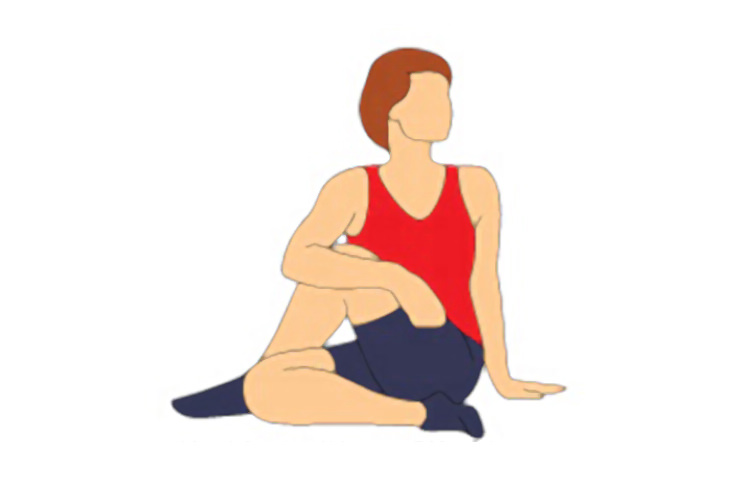
1) From the preparation pose described above, turn your torso (from your waist, not your hip) toward the left knee. Place your left hand behind you, using it as a lever to twist (your weight should not be supported by your left arm). Hold onto your knee with your right hand. 
2) It is vital that you do not go too deeply into the twist, as doing so will worsen piriformis syndrome. Repeat on the opposite side, starting with the pose above. 
 
 7. Cow's Face Pose
Exercise - Tips - Relieve Pain - Helpful

Beginner's Tip: For extra support in this passive stretch, sit on a blanket. If during the pose you notice that your left leg is not touching the floor, or your left knee locks or hurts during the stretch, roll up a second blanket or towel and place it under your knee. 
 
Here's How: 
1) From staff pose (number 2), bend your right knee, bringing your right leg across the left leg. Bring your right foot close to your outer left hip.
2) Move your left leg towards the mid-line - it should be slightly diagonal to your body. Your right hand should be on the floor while your left-hand holds your right foot. Keep your spine extended, holding the position for a couple of breaths, then repeat on the other side.
This is only for your information, kindly take the advice of your doctor for medicines, exercises and so on.   


Labels: , , , , , , , , ,

Friday, January 27, 2017

SOME CAUSES OF BACK PAIN

Back pain could be due to various reasons-
1) Muscle spasms- If you've hurt the tissues or muscles around the spine, it will go into spasm to protect the area. It will flax and stay that way, until the muscles relaxes. Spasms can also be caused due to slipped discs or injuries to the spinal tissues.
Treatment- depending on age, rest and at times over the counter pain relievers may help. At times, rubbing the area with some pain relieving ointment may help. When all these don't help, the physician may prescribe some muscle relaxing medication. If nothing helps and the problem is more severe, you may need more tests and may be surgery, if it is a disk problem.

 2) Kidney stones- these are tiny hard stones which at times can get lodged in ureter , then it can cause severe pain in your lower back, lower abdomen and sides.
Treatment- at times, smaller kidney stones may come out when you drink plenty of water. One can also drink juice of banana stem, by crushing a cup of stem finely chopped with water, strain and drink it at least once a day. By doing so, normally smaller stones may pass out on its own without causing much pain. If the stones are bigger and at times get lodged in some odd place, then one may need "Lithotripsy", to break the stones or may need surgery if that doesn't work.

3) Herniated disk- the disk are soft cushions between each vertebrae.They’re kind of like little jelly-filled doughnuts that sit between each bone. Sometimes they crack and the “jelly” oozes out. If it pushes on your spinal cord or nerves, it can cause back pain that can spread to your legs or arms.
Treatment- if the pain is mild, then rest is advised for some days. If the pain is more, then may be some pain-killer tablets and physical therapy to strengthen and stretch your lower back is tried. If this also doesn't help and the pain persists for some months, then surgery is advised.

4) Arthritis- it is inflammation, stiffness and pain in your joints. A type of spinal arthritis called, spondyloarthropathies, that affect your lower back. It carries more of your body's weight.
Treatment- The Dr. will mostly prescribe rest and anti-inflammatory tablets and some pain killer tablets.If that doesn't help, the Dr. may prescribe steroids, to ease pain and inflammation. But always remember to tell the doctor of the various medications you're already taking.

5) Spinal stenosis- When the spaces in your spinal column narrows, it can put pressure on your spinal cord and the nerves that run from your spine to your arms and legs. That can cause numbness and make it hard for you to move around. Arthritis, tumors, and certain inherited diseases can cause it, and it’s more common after age 50.
 Treatment- Most people will need rest, physical therapy and some strength medication along with pain reliever. But if all these don't help, then surgery may be suggested to relieve the pressure on the spine.

6) Spinal infection- This is a more serious and rare condition that happens when bacteria, a virus, or fungus infects the fluid around your spine or the bones or soft tissues that make up your spinal column. It usually happens after spinal surgery or an accident or injury to your spine.
TREATMENT-you may be given intravenously medicine to fight the infection and may need to be hospitalised for a few days with bed rest. If this also doesn't help, then surgery may be advised.

7)Spondylolisthesis- this happens when one of the vertebrae slips out of place and onto the one below it.  This may put more pressure on that nerve, making it hurt. This normally happens in lower back.

Treatment-Rest, exercise, and medication -- mostly over-the-counter drugs that help with pain and inflammation -- are the most common treatments for this. Your doctor also may suggest physical therapy, or possibly surgery in more severe cases.

 this is only for your information, kindly take the advice of your doctor for medicines, exercises and so on.
https://gscrochetdesigns.blogspot.com. one can see my crochet creations
https://gseasyrecipes.blogspot.com. feel free to view for easy, simple and healthy recipes 
https://kneereplacement-stickclub.blogspot.com. for info on knee replacement


Labels: , , , , , , , , , , , ,

Wednesday, February 17, 2016

Yoga Poses to Help with Your Sciatica Pain

THIS IS ONLY FOR INFORMATION, ALWAYS CONSULT YOUR PHYSICIAN BEFORE HAVING ANY PARTICULAR FOOD/ MEDICATION/EXERCISE/OTHER REMEDIES.

FOR INFO ABOUT KNEE REPLACEMENT, YOU CAN VIEW MY BLOG
HTTP://KNEE REPLACEMENT-STICK CLUB.BLOGSPOT.COM/

FOR CROCHET DESIGNS- http://My Crochet Creations.blogspot.com/


Sciatica has become a common problem - if you haven't experienced it yourself, someone you know probably has. By definition, sciatica is tenderness and pain that can occur anywhere along the sciatic nerve. The sciatic nerves are the longest nerves in the human body. There are two nerves - one in each leg - originating from several nerve roots that exit from the spinal cord, passing between layers of the buttock muscles through the muscles at the back of the thigh and down through the outer edge of your leg to your foot.
The Facts: According to the Journal of Neurosurgery: Spine (2005), it is estimated that more than 5% of the adult population in the United States suffers from sciatica. Furthermore, an individual has a 40% probability of developing sciatica over a lifetime.
 
The Symptoms of Sciatica:
Sciatica frequently flares up when bending over, running and sitting (particularly when driving). Symptoms for sciatica typically include:
  • Pain in the lower back, buttocks, back of the thigh and/or calf
  • Fatigue, numbness, or loss of feeling in your legs and/or feet
  • Tingling, burning, pinching, pins and needles
  • An inability to flex your ankles enough to walk on your heels
  • Reduced reflexes in the Achilles tendon (the muscle above the heel) and the knee.
What is the Cause of Sciatica? 
It is important to get to the root of the problem first and discover what is causing your sciatica. This entails seeking advice from your doctor and getting a proper diagnosis before proceeding. Generally, there are two main contributors to sciatica:
A Herniated Disk: Pain that is caused by a bulging or ruptured disk that pinches or irritates the nearby nerve.
Piriformis Syndrome: Sciatica that is caused by irritation of the sciatic nerve by a muscle in the buttocks called the piriformis. The muscle can push the sciatic nerve against the tendons beneath it, resulting in buttock and leg pain.
The Good News: How Yoga Can Help
Mindful, targeted yoga practice can help you overcome the pain.
For a Herniated Disk: Opt for a yoga practice that progresses from gentle poses to basic foundational postures, which include a variation of standing poses focusing on alignment, lengthening and strengthening your lower back. Prior to practicing yoga, ensure that surgery is not required.
For Piriformis Syndrome: Opt for yoga postures that stretch this muscle. Your approach should be gentle and progressive, as overworking this muscle may lead to spasms and deep buttock pain.

What follows is a series of yoga poses that predominantly target the piriformis, helping to relieve sciatic pain:
 
1. Reclining Big-Toe Pose Beginner's Tip: To make this pose slightly easier, raise the lower-leg heel off the floor by a few inches, or place it on a foam block or thick book for extra comfort and support. You may also use an elastic strap, placing it around the ball of your foot. Place a folded blanket under your head for added comfort.
Here's How:
1. Lie on the floor, keep your legs strongly extended with your feet flexed. Exhale and bend the right knee, drawing your thigh to your torso, hugging it to your belly. Keep your left leg extended, pushing actively through the heel.
2. Loop a strap around the arch of the right foot, holding the strap with both hands. On your next inhalation, extend the knee straight, pressing your heel up toward the ceiling. Reach your hands as far up the strap as possible, until your elbows are extended.
3. Keep your shoulder blades broad across the back, pressing lightly into the floor. Keep your collarbones wide, reaching away from the sternum. Your sitting bones should be firmly planted on the floor.
4. Hold the pose for 10 deep breaths. Then lower the leg slowly by bending the knee towards your chest and slowly releasing it to the floor. Repeat on the left side.
 
2. Staff Pose
Beginner's Tip: This is a basic seated pose, which aside from relieving sciatica, will also help improve posture. Lay a 10-pound sandbag across the top of your thighs at the hip crease to help keep your thighs grounded. You may also practice this pose by keeping your back against the wall.
Here's How:
1. Sit on the floor, extending both legs in front of you. Keep your legs together and your torso upright. If your torso is leaning back, sit up on a blanket or cushion to help lift your pelvis. If practicing against a wall, your sacrum and shoulder blades should touch the wall, but not the lower back or the back of the head.
2. Sit on the front parts of your sitting bones, keep your thighs firm, pressing them down against the floor, rotating them slightly toward each other. Keep your ankles flexed, pressing out through your heels. Keep your spine long, as if you're being pulled by a string from the crown of your head. Hold for one minute taking long, deep breaths.
 
3. Pigeon Pose
Beginner's Tip: This pose stretches the piriformis. Place a thick, folded blanket underneath you hip for extra support.
Here's How:
1. Start on all fours. Bring the right knee forward and out between your hands. Slowly sink your hips to the floor. As you do so, release your left leg onto the floor behind you, slowly sliding it back while bringing your body forward. Keep your left toes pressed down on the mat.
2. Your right heel should be in line with your left hip and your shin should be at about a 45 degree angle. If you feel yourself tilting over to the right hip, place a blanket underneath for extra support. Keep your hips parallel to the front of your mat as much as possible. Use your fingertips to support your torso and keep your spine long, shoulder blades drawing close together. Hold for 10 deep breaths and repeat on the other leg.
 
4. Standing Twist
Beginner's Tip: To reap the benefits of this pose, place a chair against the wall, using both the chair and the wall for extra support, enabling you to twist deeper.
Here's How:
1. Stand with your right hip against the wall with your body facing the chair. Put your right foot up on the chair, keeping your knee bent. Also keep it in line with your ankle. Your standing leg should be straight. Press your right hand against the wall, to help you balance.
2. Slowly lift your left heel up and turn your torso towards the wall, supporting your hands with the wall for extra support. Exhale and lower your heel to the floor, staying in the twist for a couple more breaths. Slowly return to the starting position, repeating on your left side.
 
5. Preparation for Spinal Twist
Beginner's Tip: Sit on the corner of a folded blanket for extra support in the full seated spinal twist pose (see below).
Here's How:
1. Sit with your knees bent and your feet out in front of you. Release your right leg on the floor, taking your right heel to the outside of your right hip. Then bring your left foot around, placing your left heel by your right hip. Your weight should be evenly distributed across your buttocks.
2. Interlock your fingers over your left knee, while focusing on lengthening your spine. Hold this position for several breaths. Then proceed onto the next pose.

. Simple, Seated Twist
Here's How:
1. From the preparation pose described above, turn your torso (from your waist, not your hip) toward the left knee. Place your left hand behind you, using it as a lever to twist (your weight should not be supported by your left arm). Hold onto your knee with your right hand.
2. It is vital that you do not go too deeply into the twist, as doing so will worsen piriformis syndrome. Repeat on the opposite side, starting with the pose above.
 
7. Cow's Face Pose
Beginner's Tip: For extra support in this passive stretch, sit on a blanket. If in the pose you notice that your left leg is not touching the floor, or the left knee locks or hurts during the stretch, roll up a second blanket or towel and place it under your knee.
Here's How:
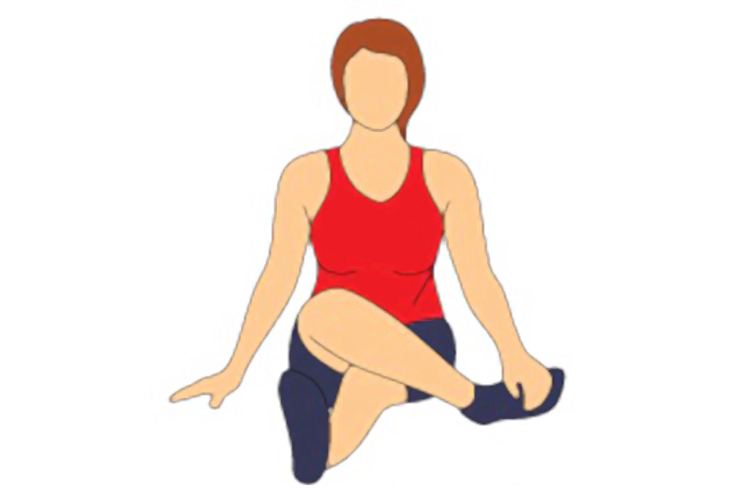
From staff pose (number 2), bend your right knee, bringing your right leg across the left leg. Bring your right foot close to your outer left hip.
Move your left leg towards the mid-line - it should be slightly diagonal to your body. Your right hand should be on the floor while your left hand holds your right foot. Keep your spine extended, holding the position for a couple of breaths, then repeat on the other side.
Labels: , , ,

Thursday, January 08, 2015

Everything One Wants to Know About Sciatics

Illustration showing sciatica location
 Sciatica refers to back pain caused by a problem with the sciatic nerve. This is a large nerve that runs from the lower back down the back of each leg. When something injures or puts pressure on the sciatic nerve, it can cause pain in the lower back that spreads to the hip, buttocks, and leg. Up to 90% of people recover from sciatica without surgery.


Symptoms of Sciatica

The most common symptom of sciatica is lower back pain that extends through the hip and buttock and down one leg. The pain usually affects only one leg and may get worse when you sit, cough, or sneeze. The leg may also feel numb, weak, or tingly at times. The symptoms of sciatica tend to appear suddenly and can last for days or weeks.


Sciatica or Other Back Pain?

Up to 85% of Americans experience some type of back pain during their lives. But this doesn't always involve the sciatic nerve. In many cases, back pain is the result of overextending or straining the muscles in the lower back. What most often sets sciatica apart is the way the pain radiates down the leg and into the foot. It may feel like a bad leg cramp that lasts for days.

 Most people who get sciatica are between the ages of 30 and 50. Women may be more likely to develop the problem during pregnancy because of pressure on the sciatic nerve from the developing uterus. Other causes include a herniated disk and degenerative arthritis of the spine.

 Cause: Herniated Disk

Labels: , , , , , , , , , , ,