Drumstick / Moringa Trees Amazing Values For Chronic Diseases
If plants could be superheroes, the Moringa (Moringa oleifera) tree would be one of them.It is drought tolerant, grows rapidly, has leaves that can be used as a biofertiliser, and has seeds that can help purify water. Even more interesting about this tree, is that it's a
food, a vegetable, and a medicine. Every part of the tree can be
consumed; leaves and young fruits (pods) as food; and the seeds, bark,
flowers, and roots as medicine.
The leaves are highly nutritious. Once harvested and dried, they contain 30 percent protein, all essential amino acids, and have abundant levels of vitamins and minerals.
The trees have a natural defense mechanism
against environmental stress and pests. These are unique chemical
compounds, known as phytochemicals, which include antioxidants and
defense compounds. When consumed these compounds they also protects people against various conditions and diseases. A postdoctoral research working with botanicals to treat obesity and diabetes, they showed a simple way to harness the potent anti-inflammatory compounds in moringa leaves.
Moringa’s safety and efficacy have been reviewed, and have shown promise for the management of diabetes and risk of cardiovascular diseases.
How it Works
Many
phytochemicals, especially plant defense compounds used to ward off
insects, are stored as inactive compounds. When the leaves are crushed,
or chewed by an insect, an enzymatic reaction occurs, releasing the
activated compound. While these can act as a deterrent to bug, tasting bitter or spicy, these compounds act as a potent anti-inflammatory agents in our body.
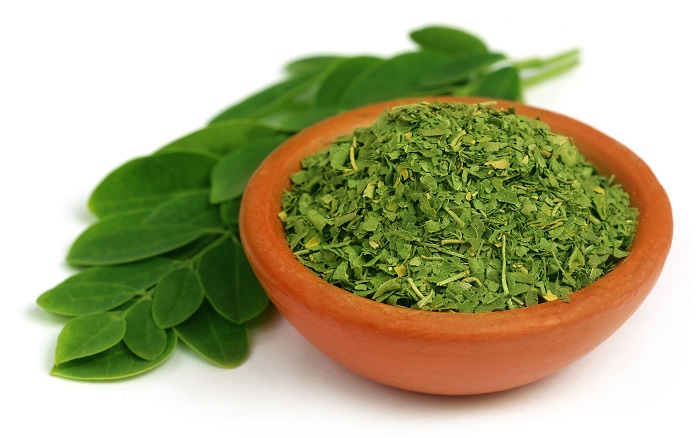
Moringa leaves and powder
The
way it works is that when we’re sick, or have an underlying health
condition like cancer, diabetes, or obesity, our bodies overreact and
cause chronic inflammation. This constant inflammation throws the body
off balance as it’s always in fight mode. While acute inflammation can
help the body heal, like when you cut your finger, chronic inflammation
can be detrimental to health because the immune system is over working.
Inflammation can also cause improper processing of sugars and toxins
that we are exposed to. The phytochemicals from moringa can help reduce this inflammation.
The
bioactive compounds in moringa are called isothiocyanates (ITCs) and
are similar to ones found in broccoli, cabbage and rocket – giving them a
little peppery taste. The researchers were able to patent
a simple process of crushing the leaves when fresh, to release the
active ITCs, and then dry them to a powder containing some of the most
beneficial plant compounds for human health. The researchers showed their ability to reduce chronic inflammation, blood sugar levels, cholesterol, obesity and inflammatory bowel disorders in both cellular and animal models.
Increasing Awareness
Although
moringa has been consumed in South East Asia for centuries, its
introduction to the rest of the world has been slow. Scientific research
on the plant’s benefits has also been limited, although an increase in
academic publications has grown significantly since
2000. With rising pressures of population growth and climate change
causing increased food and nutritional security, particularly in Africa,
moringa offers a tool to address these issues.
People’s awareness
and concern for their health have allowed beneficial plants to gain
more exposure. Over the past five years, awareness of moringa leaves as a
healthy green vegetable has begun to emerge. Not just as packaged and
jarred leaf powders in Nairobi supermarkets and farmers markets, but
also in US and European “superfood markets.”
Moringa leaves
Fresh
moringa leaves are tasty in salads, soups, on eggs, and anything
savoury. But the fresh leaves are fairly perishable and are ideally
consumed within a day of harvesting. The leaves can be added to cooked lentils and eaten with rice and roti. The immature pods can also be eaten
like green beans, and are often found in soups. The dried leaf powder
offers an alternative to those who can’t grow moringa in their backyard
or have access to a farm. The dried powder can be added to porridge,
smoothies, tea, soups, and as a herb to any meal after it has been
cooked. For those who don’t like the spicy, “healthy” taste, moringa
powder is also available in capsules and tea blends.
The leaves can be added to a mixture of rice and dal, which is soaked and ground to a paste with green chilies and salt. Then it is made like thick pancakes/ adai ! The leaves are good source of calcium and fibre.
THIS IS ONLY FOR INFORMATION, ALWAYS CONSULT YOU PHYSICIAN BEFORE
HAVING ANY PARTICULAR FOOD/ MEDICATION/EXERCISE/OTHER REMEDIES.
PS-
THOSE INTERESTED IN
RECIPES ARE FREE TO
VIEW MY BLOG-
https://gseasyrecipes.blogspot.com/
FOR INFO ABOUT KNEE
REPLACEMENT, YOU CAN VIEW MY BLOG-
https:// kneereplacement-stickclub.blogspot.com/
FOR
CROCHET DESIGNS
https://gscrochetdesigns.blogspot.com
The more knowledge we've, more sickness also is added either due to environment, work stress, the number of additives, pesticides are there in our foods, along with all this, due to advancement in technology, which has made our lives easier- washing machines, mixer, grinder, no more walking to post office, as smartphones are there to see and talk ! what more do we want? Yes, one most important thing that we all want is good health. Sadly, we've forgotten grandma's recipes for simple diseases and also for healthy life. So, I thought, let us refresh our minds with all those good foods around us, which can help us lead a healthy life. Sadly, most people think that you get nutrition from foods that are expensive. NO, you can get better nutrition from foods that are inexpensive, freely available and above all, kindly learn that it is always best to consume what is seasonally grown near you.
1. Amla (Indian Gooseberry)
Grate amla and add to smoothies!
The Nutrition Punch:
Amla is 80% water and delivers minerals: calcium, copper, magnesium,
phosphorous, potassium, zinc and iron, and vitamins: carotene, B
vitamins (thiamine(b1) riboflavin (b2) Niacin (B3), Pantothenic acid
(B5), Vitamin B6, Folate) vitamin C and vitamin E, besides multiple
antioxidants. I keep repeating again and again in the posts which mentions amla that just one amla a day is enough to get the Vitamin C that we need for the day. As, you all know that Vitamins B and C are water-soluble, so we need to eat the correct sources every day so, we're not deficient in them.
Grate it and add to smoothies, daals, salads or just juice it.You can make pickles- either fresh or as thoku, which will last long, then amla can be washed and soaked in luke warm water to which turmeric and salt is added, when you get it during the season. Then during off season, you can take a few out as needed, can grind with green chilies to taste and temper with mustard and it goes well with rice, idli, dosa. Or it can be combined with curd to make raita, which goes well with veg. biryani, with keerai kootu, i.e., spinach with dal, as it is the best combo to get iron and vitamin C that we need, as to absorb iron, we need this vitamin.
Another simple pickle called mor neelikai- which literally means amla in curd. Wash amla, wipe it dry, cut in small pieces, add salt, cover and keep for a day. Next day, the water that comes out from amla mixture, use it to grind green chilies to taste, which again are good source of vitamin C, with little hing, add to amla, add curd, you may temper with mustard seeds and store in the fridge ! Even those who didn't like amla, when I gave them this to taste, started loving it !
2. Dry Ginger Powder/ Sonth
The Nutrition Punch:
Ground form of dried ginger roots, this traditional spice is eaten more
in winters (as it is warming). It is not just a taste enhancer, rather
it contains essential oils and is a fair sources of vitamins like beta
carotene, vitamin C, B and minerals like potassium, calcium, zinc, iron
and copper.
Blend it in warm water and sip, make ginger tea with it, add to daals.
Dry ginger powder has anti-inflammatory properties too, so it can be used with pickles, sweets that are made with gur / jaggery and more than that for arthritis, to get rid of joint pain, daily in the morning combine 1/2 tsp. each of turmeric, dry ginger pdr. and fenugreek pdr., add little water in room temperature and gulp it down in empty stomach. You'll relieved of joint pain, as they all being anti-inflammatory, fenugreek is great to reduce blood sugar levels along with its other properties, turmeric is touted as anti-cancer, antioxidant, anti-fungal and so on. After gulping down the concoction, you can have your morning tea / coffee after a few minutes.
3. Fresh Turmeric
Just mix a little powered haldi with warm milk and a little pepper.
The Nutrition Punch: delivers
pyridoxine (vitamin B6), choline, niacin, and riboflavin, vitamin C,
and minerals like calcium, iron, potassium, manganese, copper, zinc, and
magnesium. Also has multiple essential oils such as turmerone and
zingiberene and a star component curcumin that supports better memory,
focus and cognition and fights degenerative processes in the brain. As mentioned in previous one, it is a wonder drug.
Use
it for cooking, add to your tea, or just mix a little powered haldi
with warm milk and a little pepper (to boost the absorption on curcumin).
I use turmeric pdr. to make a drink in morning with ginger to reduce my fat ! I use turmeric pdr. in milk with 2-3 pearls of garlic and simmer for about 15-20 minutes to get rid of my cough and phlegm. I also use it along with listerine, mouthwash to make a paste to apply on fungal nail to get relief from pain ! There are innumerable uses of turmeric, which you can find in my other posts too.
4. Giloy (Heart-Leaved Moonseed)
Juice the leaves and mix with amla juice and drink.
The Nutrition Punch: This
lesser known medicinal herb delivers calcium, phosphorus, iron, copper,
zinc and manganese and is loaded with antioxidants. It is a known
immunity booster and sugar levels stabliser.
Juice the leaves and mix with amla juice and drink. Or mix the powder with warm water; have just before a meal or empty stomach.
5. Ashwagandha (Indian Ginseng)
Make some ashwagandha tea!
The Nutrition Punch: Ashwagandha
contains multiple natural antioxidants and flavonoids and that is why
it has been used to treat inflammation, and as protection against
infection and illness. It boosts the immune system, improves memory and
promotes overall wellness. It has some iron, calcium, carotene (vitamin
A) and vitamin C.
Best way to have it is as ashwagandha tea (make it by boiling the powder with water, milk and tea leaves). Or have the churan.
6. Moringa (Drumstick Leaves Powder)
Add moringa powder to your smoothie or cereal, soups, and stews.
The Nutrition Punch: Moringa
is a rich source of vitamins, minerals, and contains significant
amounts of vitamin A, B, (folic acid, pyridoxine and riboflavin), C, and
E, calcium, manganese, magnesium, potassium, phosphorous, zinc and
protein. It delivers all eight essential amino acids our body needs and
is actually one of very few plant foods that delivers quality protein.
Fresh
moringa leaves can also be cooked in the same way as spinach and other
saags. Or you can add moringa powder to your smoothie or cereal, soups,
and stews, or just mix it up with water and gulp it down.
You can dry the leaves, then roast chana dal and arhar dal in equal quantities along with dry red chilies to taste, once roasted, add little hing powder, once it cools down powder the dals first, then add the dried leaves and powder, it goes well with hot rice and ghee, or with idli, dosa, adai !
7. Garlic
Swallow a clove or two of raw garlic first thing in the morning.
The Nutrition Punch: The
sulfur compounds in garlic serve as its spotlight nutrients and bestow
it mustiple benefits. In addition, garlic is an excellent source of
manganese and vitamin B6; a very good source of vitamin C and copper;
and a good source of selenium, phosphorus, vitamin B1 and calcium.
Swallow a clove or two of raw garlic first thing in the morning. Or use it for cooking liberally.
In my earlier post written various uses of garlic, like with milk and turmeric it is great for cough and phlegm. It has anti-cancer properties too. I was recently told that regular use of garlic in various food preparations will also help to bring down blood sugar levels of diabetic patients.
THIS IS ONLY FOR INFORMATION, ALWAYS CONSULT YOU PHYSICIAN BEFORE
HAVING ANY PARTICULAR FOOD/ MEDICATION/EXERCISE/OTHER REMEDIES.
PS-
THOSE INTERESTED IN
RECIPES ARE FREE TO
VIEW MY BLOG-
https://gseasyrecipes.blogspot.com/
FOR INFO ABOUT KNEE
REPLACEMENT, YOU CAN VIEW MY BLOG-
https:// kneereplacement-stickclub.blogspot.com/
FOR
CROCHET DESIGNS
https://gscrochetdesigns.blogspot.com
Moringa ( drumstick): The Herb That Can Stop Cancer?
Moringa
is a herb that I had never really heard of until quite recently. Yet,
it’s been used for many millennia by people across Africa, Asia and
India for culinary purposes (tasting something like radish). But what
has got scientists very excited is its cancer healing properties
potential. Research has
found that the plant’s cytotoxic effects that harm living cells can
actually be deployed as a weapon against cancerous cells.
Read on to learn more about this exciting medical breakthrough…
What is Moringa?
Moringa
is a genus of flowering plants, of which there are 13 extant species.
The most cultivated and relevant Moringa tree is the moringa oleifera,
which is native to the foothills of the Himalayan mountains of India.
The name Moringa is thought to derive from several related local
languages and means 'drumstick', due to the appearance of the plant –
though I’m not sure if they were often used for rhythmic purposes.
You can take Moringa once a day, either in powder or capsule form. It’s
also possible to apply Moringa oil topically onto the skin to ward off
skin cancer and the growth of fungus.
Anti-Cancer properties The main reason why Moringa has
been getting a lot of attention among scientific circles is due to the
presence of three key compounds which are found in the herb. Each of
these has been shown in studies to inhibit, reduce, stop or kill
cancerous cells, making Moringa an incredibly potent adversary against
cancer.
1. Kaempferol: is
an antioxidant that is also present in healthy foods such as
strawberries, teas, beans, broccoli and apples. This compound is
understood to be adept at stopping cancerous cells from spreading and
reducing inflammation. 2. Rhamnetin: research has suggested that this compound
is able to kill prostate cancer cells. It's also found in annual
wormwood, orchard grass, green veg, sweet Annie and cloves. 3. Isoquercetin: is a compound that inhibits bladder cancer. It’s also found in cranberries, tomatoes, onions, red grapes and cherries.
Application against Cancer Aside from the above three
properties, studies have found that eugenol is also found in the leaves
and bark of Moringa. This means the plant may also be a very good
anti-cancer medicine for leukemia, bone, gastric and skin cancer. There
has also been promising research conducted on mice, in relation to liver
cancer. This research has shown that oxidants in Moringa can repair
liver tissue and provide virtually complete protection. Interestingly,
these anti-cancer properties can only be extracted from the leaves and
bark. The seeds don’t seem to offer any similar medical hope.
Other health benefits of Moringa Compared
to other similar foods, Moringa is amazingly nutritious. The nutritionist advises that a single cup of chopped Moringa
leaves provides: • 3g protein
• 19% RDA of vitamin B6
• 12% RDA of vitamin C
• 11% RDA of iron
• 9% RDA of vitamin A
• 8% RDA of magnesium
THIS IS ONLY FOR INFORMATION, ALWAYS CONSULT YOU PHYSICIAN BEFORE
HAVING ANY PARTICULAR FOOD/ MEDICATION/EXERCISE/OTHER REMEDIES.
PS-
THOSE INTERESTED IN
RECIPES ARE FREE TO
VIEW MY BLOG-
https://gseasyrecipes.blogspot.com/
FOR INFO ABOUT KNEE
REPLACEMENT, YOU CAN VIEW MY BLOG-
https:// kneereplacement-stickclub.blogspot.com/
FOR
CROCHET DESIGNS
https://gscrochetdesigns.blogspot.com