Thursday, March 03, 2022

Iodized Salt Saves You From Thyroid Issues

Iodized salt may initially sound like a strange concept. We mostly know iodine as the brown, pungent-smelling antiseptic we use to sanitize our wounds. How can it be safe for ingestion? It turns out iodine is one of the trace minerals we need to consume on a daily basis, but most of us are deficient in it. Just like fluoride is added to water to help the public consume enough of it, iodine is added to salt for the same purpose. Today we're taking a look at iodized salt. 
 
But before we begin our discussion about iodized salt, let's clarify the meaning of the term trace minerals. According to Brain Balance, these are minerals we must get from our diet, but only in small quantities. "The recommended daily allowance for most trace minerals is between .2 and 15 milligrams". There is a list of common trace minerals on their website, you can read it here.  
 
What is iodine?
It is a trace mineral found naturally in seafood, dairy, grains, and eggs. The thyroid gland uses it to produce hormones. These hormones have a function in wound healing, tissue repair, metabolism regulation, and healthy growth. They also play a role in the regulation of body temperature, blood pressure, and heart rate. 
 
In some parts of the world, it is added to classic old table salt. In the US, no manufacturer is obliged by law to iodize their salt, and if they do, they don't even have to state it on the package. The reason for the fortification of salt with iodine is to prevent an illness called Goiter disease, in which the thyroid gland grows in an attempt to seek more iodine.  
 
History of iodine
Medical writings from as early as 3600 BC in China, show a decrease in goiter size after ingestion of seaweed. Back then, they still didn't know it was thanks to iodine. The element was officially discovered and introduced in 1813 by Joseph Louis Gay-Lussac. He sourced the word iodine from the Greek word ioeides, meaning violet-colored. The link between iodine and goiter size was made shortly after. 
 
Problems in the thyroid gland were most prevalent in the US around the Great Lakes and the Appalachians, far away from the ocean, where the soil was naturally poor in iodine. In these areas, as well as some Northwestern parts of the country, "26%–70% of children had clinically apparent goiter". The distribution of iodized salt became prevalent in the 1920s in the US. It started in Michigan on 1 May 1924, thanks to various reports and extensive research done on the effects of iodine on Goiters disease.

Deficiency
Most of the population may be deficient in iodine to some extent, or is at risk of being deficient in it. We don't just mean in the United States- this is a global scale matter. Vegans and vegetarians are at greater risk, as well as pregnant or breastfeeding women, since they require more iodine than average. This shouldn't be cause for concern though; most of the global population won't experience symptoms as the deficiency is so mild it's almost undetectable. 
 
But in more severe cases, symptoms can arise and affect daily life.

iodine in Diet
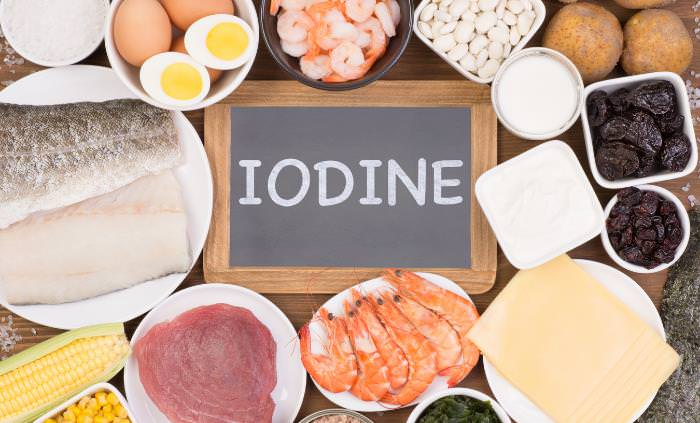
iodine, food sources
Iodized salt is very accessible, and as much as half a teaspoon of it a day is enough to meet the daily recommended dose for iodine. But if you end up consuming more than that over the course of a day, that's fine. Any intake above the minimum is very well tolerated by the body. In fact, in order to overdose on iodine from iodized salt, you'd have to consume over 6 teaspoons of it. And by now we all know that this is far too much salt- iodized or not. 
 
If you don't want to use iodized salt, you can source your iodine straight from your food. It is found in abundance in seaweed, codfish, yogurt, milk, and shrimp, and some smaller amounts can also be found in eggs, canned tuna, and dried prunes.

This is only for your information, kindly take the advice of your doctor for medicines, exercises and so on.   

https://gscrochetdesigns.blogspot.com. one can see my crochet creations  
https://gseasyrecipes.blogspot.com. feel free to view for easy, simple and healthy recipes    
https://kneereplacement-stickclub.blogspot.com. for info on knee replacement

Labels: , , , , , , , ,

Monday, July 22, 2013

Best Bone Protector- Shrimp

Shrimp


Shrimp is high in vitamin B-12, which aids bone density, is crucial in the generation of new cells, and is a good source of vitamin D, an essential ingredient for bone strength.
ps- this is only for information, always consult you physician before having any particular food/ medication/exercise/other remedies.

ps- those interested in recipes are free to view my blog-

http://gseasyrecipes.blogspot.com/

for info about knee replacement, you can view my blog-

http://Knee replacement-stick club.blogspot.com/

for crochet designs

http://My Crochet Creations.blogspot.com/

I've not given details about designs, but those interested are free to mail me for the same.

Labels: , , , , ,

Saturday, June 29, 2013

EATING SHRIMPS AND VITAMIN- C TOGETHER CAN BE TOXIC !

A woman suddenly died unexpectedly with signs of bleeding from her ears, 
nose, mouth & eyes. After a preliminary autopsy it was diagnosed that death was 
due to arsenic poisoning.
Where did the arsenic come from? The police launched an in-depth and 
extensive investigation.
 A medical school professor was invited to come to solve the case.


The professor carefully looked at the contents. In less than half an hour, 
the mystery was solved.

The professor said: & The deceased did not commit suicide and neither was she murdered, she died of  accidental death due to ignorance!


Everyone was puzzled, why accidental death?


The professor said: 'The arsenic was produced in the stomach of the deceased.


The deceased used to take 'Vitamin C' everyday, which in itself is not a 
problem.

The problem was that she ate a large portion of shrimp/prawn during dinner.

 Eating shrimp/prawn is not the problem that's why nothing happened to her 
family even though they had the same shrimp/prawn.
 

 However at the same time the deceased also took 'vitamin C', that is where 
the problem was! Researchers at the University of Chicago in the United States, 
found through experiments, food such as soft-shell contain much higher 
concentration of five potassium arsenic compounds. Such fresh food by itself 
has no toxic effects on the human body.

However, in taking 'vitamin C, chemical reaction occurs and the original non-
toxic elements change to toxic elements. Arsenic 
poisoning has magma role and can cause paralysis to the small blood vessels.

Therefore, a person who dies of arsenic poisoning will show signs of bleeding 
from the ears, nose, mouth & eyes.

As a precautionary measure, DO NOT eat shrimp/prawn when taking 'vitamin C'.


ps- this is only for information, always consult you physician before having any particular food/ medication/exercise/other remedies.


ps- those interested in recipes are free to view my blog-

http://gseasyrecipes.blogspot.com/

for info about knee replacement, you can view my blog-

http://Knee replacement-stick club.blogspot.com/

for crochet designs

http://My Crochet Creations.blogspot.com/

I've not given details about designs, but those interested are free to mail me for the same.


Labels: , , , , , , , , , , , , , ,

Monday, March 25, 2013

Shrimp helps to have stronger bones !

Shrimp is high in vitamin B-12, which aids bone density, is 

crucial in the generation of new cells, and is a good source of 

vitamin D, an essential ingredient for bone strength.

Labels: , , , , , ,