Thursday, April 10, 2025

I swear by this age-old technique to perk up dull, dry and tired skin—it leaves me with serious *glow*

Facial steaming has been used for centuries to cleanse and soothe skin. In fact, steam has been known for its health benefits as far back as Roman times, and it's still very much trusted today.

The straightforward technique simply involves putting your face over steaming hot water. The warm temperatures open pores to help release dirt, grime and excess oils, and the cloud of water works wonders to hydrate and soften your skin. On top of that, the heated mist can boost circulation, ease congestion and it feels very calming to boot.

People always rave about it, but as I spend my days reading about and testing the latest science-backed ingredients and clever beauty tools, it’s not something I had considered trying. After all, how could humble H2O really stand up against the line-up of hard-working formulations on my bathroom shelf?

 After looking into it, though, the DIY facial started to sound more appealing. The idea of rebooting stressed-out skin, while taking a few minutes out to pamper and unwind definitely sounded lovely, and as my house is constantly filled with germs from my daughter’s nursery, the relief from blocked noses and sinuses sounded like a massive perk too.
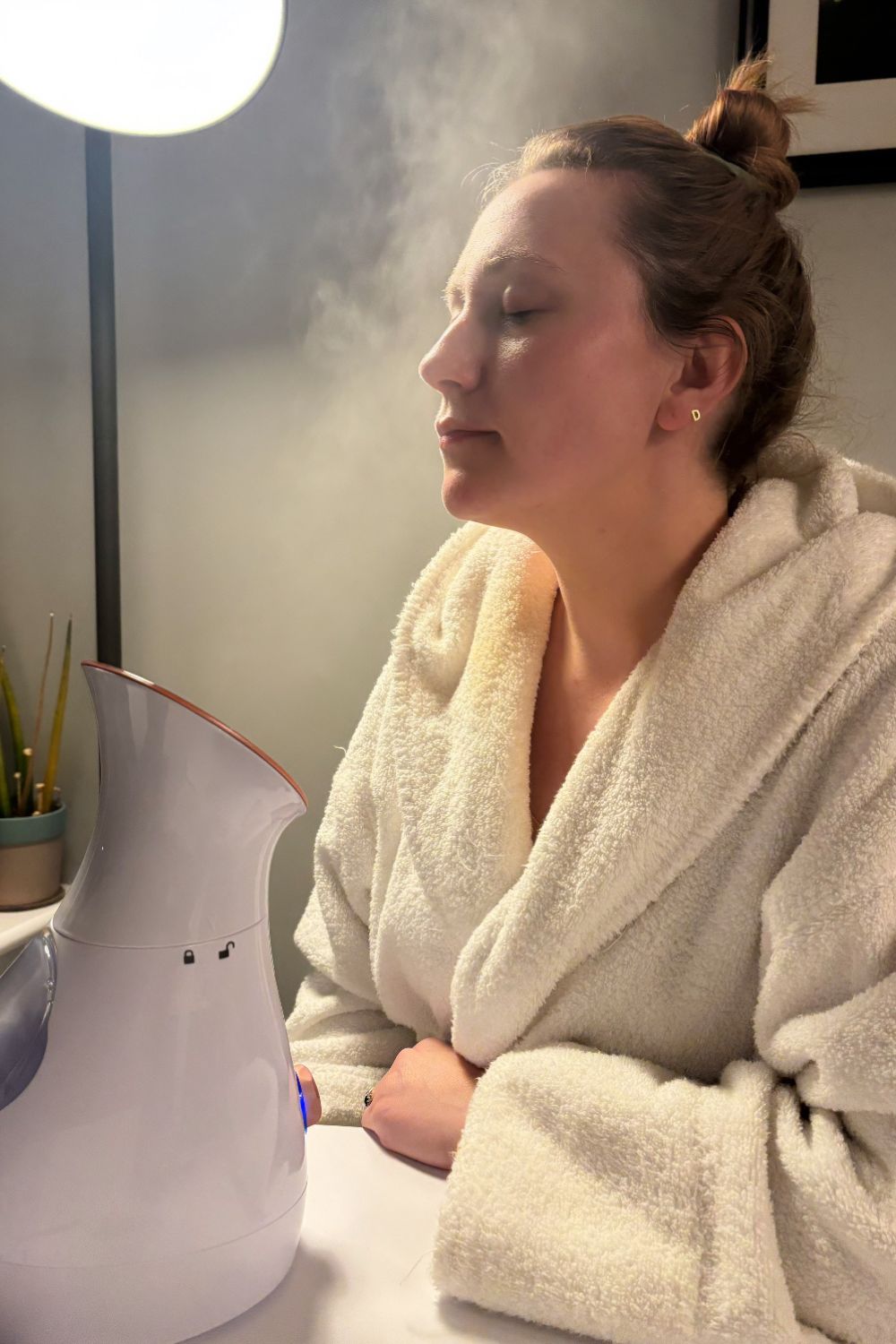
 matilda trying out a facial steamer machine

I decided to give the back-to-basics treatment a go to see if water really could work magic on a dull complexion. I opted for the StylPro 4-in-1 Facial Steamer—I’ve used it twice this week and I’m very happy to report that it really has perked up my tired-looking skin; steaming is now up there as one of my favourite ways to pamper at home.

Before using the machine, I double cleansed to make sure my face was free of makeup and SPF. The handy gadget is designed to be filled with water, and it heats quickly, creating a gentle and steady stream of steam that feels soothing on my cheeks.

Just three to five minutes was enough to make my skin feel properly refreshed and look wonderfully glowy. Steaming opens pores to release oil and deep-seated dirt, so post-treatment, I gently rinsed my face with cool water to remove any grime and then slathered on my usual serum. I found that my complexion was more receptive to my skincare and that products absorbed faster. For even more of a hydration hit and pampering vibe, you could apply a mask afterwards too.


I have been dealing with random breakouts after being guilty of wearing makeup while at the gym recently, and I felt like this soothing treatment left my face feeling squeaky clean and bright again.

I am totally sold on the age-old technique now, but I was intrigued to hear what the experts think. I spoke to holistic facialist and skincare expert at Weleda, Elizabeth King, about her thoughts on facial steaming. "The warmth of facial steaming immediately relaxes the walls of your pores so that deep cleansing can be achieved," she says.

Steaming is particularly useful before applying a cleansing mask. Relaxing the skin first with the steam, means that blockages and congestion are loosened and so the efficacy of the mask is increased.

Adding an oil or herbal infusion like chamomile tea to your steaming water creates additional calming and cleansing benefits for the skin too. "My favourite is a few drops of Weleda’s Aknedoron Purifying Lotion which is a blend of organic echinacea, thyme and calendula, and effectively calms any inflammation, as well as purifies and decongests the pores," adds King. "I love to take deep breaths at the same time, giving myself a steam inhalation for my lungs to."

Read on for the experts top tips for facial steaming below...

  • Thoroughly cleanse your skin first, as you don’t want to steam in make-up and surface dirt
  • If you're opting for the traditional steaming method, always use a flat-bottomed bowl for the hot water and place on a secure surface to avoid any accidents
  • Only go as close to the steam as feels comfortable. If it’s hot, move back a little
  • Try using a facial oil or balm to protect any sensitive areas of the face before steaming, and apply a natural lip balm to the lips for extra comfort
  • Set a timer. For combination and oily skin just aim for a five minute steam once or twice a week. For sensitive and dry skin types, stick to a weekly three minute steam session at first
  • Always finish with a cool rinse or hold a cool cloth over your face for several seconds. While the warmth stimulates the blood circulation, bringing nutrients to the skin, the cool activates the lymphatic system, which acts as your internal skin cleansing system. This removes waste brilliantly, leaving your face looking and feeling clean and clear

by Matilda Stanley, Freelance Writer


This is only for your information, kindly take the advice of your doctor for medicines, exercises and so on.   


Labels: , , , , , , , , , ,

Saturday, March 19, 2022

Scientists have created a fabric that can literally 'hear' your heartbeat

Just when you thought you had the last base covered with your Fitbit or Apple Watch, arrived a new technology that might even rule out that extra accessory.
Granted that engineers never run out of ways to collect additional data, but, hear us out - scientists have created a new fabric that doubles as a microphone + speaker and it is equipped to pick up sounds as faint as your heartbeat.
The study has been published in the journal Nature.
Created by a collaboration of researchers at Massachusetts Institute of Technology (MIT) and Rhode Island School of Design (RISD), the fabric converts sound into mechanical vibrations analogous to the way a microphone functions and subsequently converts these vibrations into electrical signals much the same as our ears.
The team was inspired by the human eardrum to create a soft, sensitive and durable fabric ‘ear’ that can detect sound. “It turns out that this eardrum is made of fibers,” says Yoel Fink, a materials scientist at MIT.
The ‘piezoelectric’ material of the fibre that makes the fabric, produces an electric signal when bent. This enables the fabric to create electric signals from sounds.
Lead author of the study, MIT’s Wei Yan said in a statement, “This fabric can imperceptibly interface with the human skin, enabling wearers to monitor their heart and respiratory condition in a comfortable, continuous, real-time, and long-term manner.”
All fabrics vibrate when exposed to audible sounds similar to our outer ear. However, these vibrations are too small to be sensed - we’re talking on the scale of nanometres.
The fibre scientists created is sensitive to an audible range from a quiet library to heavy traffic. When woven into a fabric, it can pick up handclaps and significantly fainter sounds like heartbeat.
The applications go beyond cardiac monitoring as the fibre can act as a hearing aid for people with hearing loss. This is because it is sensitive enough to sense the direction from which a sound came.
Better still, “It can be integrated with spacecraft skin to listen to (accumulating) space dust, or embedded into buildings to detect cracks or strains,' says Yan.
“It can even be woven into a smart net to monitor fish in the ocean. The fibre is opening widespread opportunities.”
Image courtesy Fink LabMIT Elizabeth MeiklejohnRISD Greg Hren

 This is only for your information, kindly take the advice of your doctor for medicines, exercises and so on.   

https://gscrochetdesigns.blogspot.com. one can see my crochet creations  
https://gseasyrecipes.blogspot.com. feel free to view for easy, simple and healthy recipes    
https://kneereplacement-stickclub.blogspot.com. for info on knee replacement


Labels: , , , ,

Wednesday, July 31, 2019

Stretchable Electronics Used in Soft Wireless, Wearable Health Monitor

The soft and conformable monitor can display electrocardiogram (ECG), respiratory rate, heart rate, and motion activity data as much as 15 m to a portable recording device such as a tablet computer or smartphone. The electronics are mounted on a stretchable substrate and linked to gold, skin-like electrodes via printed connectors that can stretch with the medical film in which they are fixed.

“This health monitor has a key advantage for young children who are always moving, since the soft conformal device can accommodate that activity with a gentle integration onto the skin,” said  an assistant professor. “This is designed to meet the electronic health monitoring needs of people whose sensitive skin may be harmed by conventional monitors.”
  
The monitor has been tested on animal models as well as humans.

Since the device conforms to the skin, it avoids signal problems that can be generated by the motion of the standard metal-gel electrodes across the skin. The device can even acquire accurate signals from a person who is running, walking, or climbing stairs.

“When you put a conventional electrode on the chest, movement from sitting up or walking creates motion artifacts that are challenging to separate from the signals you want to measure,” he said. “Because our device is soft and conformal, it moves with the skin and provides information that cannot be seen with the motion artifacts of conventional sensors.”

On-going evaluation with a wireless health monitor could enhance the assessment of children and help clinicians identify trends sooner, potentially enabling intervention before a condition spreads, said  a pediatric cardiologist.
The generation of continuous data from the respiratory and cardiovascular systems could allow for the application of advanced diagnostics to detect changes in clinical status, response to therapies and implementation of early intervention. A device to literally follow every breath a child takes could allow for early recognition and intervention prior to a more severe presentation of a disease.
A Pediatric Cardiologist
When used in the home, a wearable monitor might sense variations that might not otherwise be obvious, he said. When the wireless device is used in clinical surroundings, children would not feel “tethered” to equipment. “I see this device as a significant change in pediatric health care” the Dr. added.

The monitor uses three gold electrodes fixed in the film that also comprises the electronic processing equipment. The total health monitor measures just three inches in diameter. Soon a more advanced version will measure just half that size. The wireless monitor is currently driven by a small rechargeable battery, but upcoming versions may substitute the battery with an external radio-frequency charging system.

The researchers  are concentrating on pediatric applications due to the need for ambulatory monitoring in children. However, they think that the health monitor could also be used for other patient groups, such as older adults who may also have sensitive skin. For adults, there would be extra benefits.
The monitor could be worn for multiple days, perhaps for as long as two weeks. The membrane is waterproof, so an adult could take a shower while wearing it. After use, the electronic components can be recycled.
An Assistant Professor.
Two versions of the monitor have been built. One is based on medical tape and engineered for short-term application in a hospital or other care facility, while the other uses a soft elastomer medical film permitted for use in wound care. The latter can stay on the skin for a longer period.

“The devices are completely dry and do not require a gel to pick up signals from the skin,” the Prof. explained. “There is nothing between the skin and the ultrathin sensor, so it is comfortable to wear.”
Since the monitor can be worn for extended periods of time, it can offer a long-term record of ECG data useful to understanding potential heart complications.

“We use deep learning to monitor the signals while comparing them to data from a larger group of patients,” the Prof. said. “If an abnormality is detected, it can be reported wirelessly through a smartphone or other connected device.”

The monitor’s circuitry is manufactured using thin-film, mesh-like patterns of copper that can flex with the soft substrate. The only part not flexible is the chips, but they are placed on the strain-isolated soft substrate rather than a traditional plastic circuit board.

Going forward, the researcher plans to decrease the size of the device and incorporate features to measure other health-connected factors such as blood oxygen, temperature, and blood pressure. A major breakthrough would be a clinical trial to assess performance against standard health monitors.
For the researcher, who is an expert in nano- and micro-engineering, the probability of seeing the device in clinical trials—and eventually used in children’s hospitals—is a strong incentive.
It will be a dream come true for me to see something we have developed be helpful to someone who is suffering. We all want to see developments in science and engineering translated into improved patient care.
 An Assistant Professor

THIS IS ONLY FOR INFORMATION, ALWAYS CONSULT YOU PHYSICIAN BEFORE HAVING ANY PARTICULAR FOOD/ MEDICATION/EXERCISE/OTHER REMEDIES.                                    PS- THOSE INTERESTED IN RECIPES ARE FREE TO  VIEW MY BLOG-                                                                                           https://gseasyrecipes.blogspot.com/                                                                                                                                                FOR INFO ABOUT KNEE REPLACEMENT, YOU CAN VIEW MY BLOG-                                                  https:// kneereplacement-stickclub.blogspot.com/                                                                      FOR CROCHET DESIGNS                                                                                                    
                                https://gscrochetdesigns.blogspot.com

Labels: , , , , , , , , , ,