Sunday, August 31, 2025

Peanuts or makhana/ Fox nuts: Which is the healthier snack for weight loss?
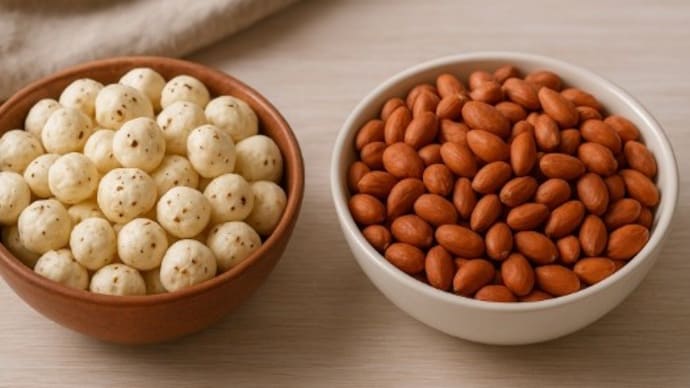
 Makhanas are low in calories and peanuts help to boost eneregy 

Snacking is (mostly) non-negotiable. Whether it’s the 4 pm hunger pangs or a movie-time munch session, we all reach out for something light yet tasty. That’s where the idea of healthy snacking comes in - because chips and dips only win on taste, not nutrition.

Two favourites that often make the cut are makhanas (fox nuts) and peanuts (groundnuts).

A handful of either is a go-to in healthy snacking conversations. Some like them roasted, others swear by salted or spiced-up versions. Versatile, bite-sized, and flavour-packed - they check the health box while doubling up as perfect party munchies.

But here’s the real dilemma: which is actually healthier—makhanas or peanuts - especially if weight loss is the goal? We’ll leave it to the experts to decode that one.


Nutrition face-off


Fox nuts are light on the stomach yet rich in fibre, which helps keep you full for longer. They provide dietary fibre, plant-based protein, potassium, and antioxidants - all of which aid in controlling blood sugar and improving digestion. 

Peanuts, on the other hand, pack more calories but are nutrient-rich. They offer higher protein, vitamin E, B vitamins, magnesium, and heart-friendly fats such as MUFA (monounsaturated fatty acids) and PUFA (polyunsaturated fatty acids). They also contain antioxidants like resveratrol, which protect against oxidative stress.

In terms of carbohydrates, 100 grams of fox nuts have 75–80 grams, but these are low-glycaemic index carbs. Groundnuts have 18–38 grams of carbohydrates. The protein content in fox nuts is 9.7–11.2 grams, while peanuts provide 20–25 grams.

Makhanas also make a safe evening snack to prevent overeating later. Peanuts work well for people with higher energy needs, active lifestyles, fitness enthusiasts, or those focusing on heart and metabolism.

However, people with kidney issues should avoid peanuts because of their potassium content.

The weight loss angle

When it comes to weight loss, calorie count matters. Low-calorie foods are better suited for weight management, giving makhanas an advantage.

“Dry-roasted makhanas are very low in fat and calories, and their fibre helps with satiety. Even if a teaspoon of ghee is used in roasting, the calories stay much lower than peanuts,” says Ipsita Chakravarti, HOD Dietetics, CMRI Kolkata.

Makhanas have around 356 calories per 100 grams, very low fat (0.1 to 0.5 grams), and a good amount of other vitamins and minerals.

Peanuts are healthy, but energy-dense - 100 grams give over 550 calories and 40 to 50 grams of fat per 100 grams. That makes portion control tricky on a calorie-deficit diet. So, makhanas are usually the safer option for weight management.

How to eat them right?

Experts believe that about 30 to 50 grams of each is a decent daily quantity to consume individually.

According to Dr. Karthigai Selvi A, Head of Clinical Nutrition and Dietetics, Gleneagles BGS Hospital, Kengeri, Bengaluru, combining the two is also a good option to get the predominant nutrients from both.

“Combination is always better so that you can get a good amount of protein and fibre, which are important for weight loss. The ideal ratio is 75 per cent fox nuts and 25 per cent groundnuts.”

But there’s a catch: if you don’t drink enough water, the high fibre content can lead to constipation, since fibre absorbs water as it passes through the intestine.


Another factor to keep in mind is the cooking method. Fried or oil-heavy preparations should be minimised. Roasting, mixing with salads, or pairing with other cereals are healthier options.

“We also need to consider overall fat consumption throughout the day. Even if you eat the right amount of fox nuts and groundnuts, but also take in large amounts of saturated fat and refined carbohydrates, it will not aid weight loss,” Dr. Selvi explains.

Salty, spicy and ghee - still healthy?

Makhanas and peanuts both come in spicy, salty, or ghee-roasted versions - because who doesn’t like a little spice and everything nice?

But does flavouring cancel out the health benefits?

Simple roasting or light ghee-roasting can aid vitamin absorption, thanks to butyric acid. Experts caution, however, against going overboard with masala on peanuts. While mild seasoning is fine, too much spice can cause acidity.

The best way to snack on peanuts? Dry roasted. “Peanuts are most beneficial when dry roasted, as frying or heavy salting raises fat and sodium levels, reducing their benefits. Slight roasting enhances the nutritional value of both snacks, but excessive seasoning can be detrimental,” notes Chakravarti.

Final nibble

Fox nuts, with their fibre and low-calorie content, and peanuts, with their protein and healthy fats, can both be consumed in moderation. But relying on only makhanas or only peanuts will not lead to weight loss.

Instead of reaching for junk food, sugary snacks, or fatty foods, opting for makhanas or peanuts is a healthier choice.

“I would suggest that there is no single food that provides all the nutrients your body needs to function. A balanced diet is key - it should include a wide range of foods like vegetables, whole grains, lean proteins, and fruits, as these provide vitamins, minerals, and other macronutrients. An active lifestyle and good sleep cycle, together, aid weight loss,” Dr. Selvi concludes.

However, people with certain comorbidities should consult their doctors or medical professionals for a tailor-made diet.


 This is only for your information, kindly take the advice of your doctor for medicines, exercises and so on.   

https://gscrochetdesigns.blogspot.com. one can see my crochet creations  
https://gseasyrecipes.blogspot.com. feel free to view for easy, simple and healthy recipes    
https://kneereplacement-stickclub.blogspot.com. for info on knee replacement
https://GSiyers home remedies.blogspot.com   is the latest addition to my blogs

Labels: , , , , , ,

Saturday, March 06, 2021

10 Easy Changes To Help You Lose Weight

We all know that being overweight can cause serious health problems. Many of us don't always have the time to exercise and that, in part, leads to the high obesity rates we see in the western world. At the moment, adult obesity rates in western countries has climbed to record levels, passing 25% of the population - that's one in four people!

According to the CDC, being overweight can lead to many potential health issues: 
 
Coronary heart disease 
Type 2 diabetes
Cancers (endometrial, breast, and colon) 
Hypertension (high blood pressure) 
Dyslipidemia (high cholesterol or high levels of triglycerides) 
Stroke 
Liver and gallbladder disease 
Sleep apnea and breathing problems 
Osteoarthritis (a breakdown of the cartilage and bone within a joint) 
Gynecological problems (abnormal periods, infertility) 
 
What many people don’t know is that by making ten minor changes in your daily routine, you can start losing weight quickly

1. Don’t stress 
Stress is the enemy of caloric-burn. A stressed body reduces the amount of calories it burns and changes the way it metabolizes food. A recent research at Ohio State University showed that women who report stress burn an average of 100 calories less than women who weren’t under stress. Consider doing Yoga, as it both helps you relax and burn calories. 
 
2. Stay cool  
Keeping the room temperature between 16–25 °c (62-77 °f) forces your body to burn calories in-order to warm up. If you drink cold water, you’ll burn 25% more calories than if you drink room-temperature water. 
 
3. Drop the mid-morning snack for a mid-afternoon one 
Most nutritionists recommend splitting your meals into smaller ones throughout the day. The Journal of the American Diabetic Association reports that a recent study found that a mid-afternoon snack works better than a mid-morning snack when trying to lose weight.
 
4. Use your non-dominant hand when you eat  
By switching hands, you’re more likely to eat less - a finding reported by the University of Southern California. The reason is that much of our hunger and eating is based on habits. By breaking these habits we become more aware of what we’re doing, and reduce the automatic eating patterns we've developed. 
 
5. Sniff a banana or a green apple  
Yup, don’t eat them, just sniff them! The smell of bananas and green apples suppress appetite just like how sizzling steak or fresh bread awakens it. Scientists aren’t sure why it happens, but the common theory is that taste is 90% smell, so smelling food confuses the body into thinking it’s been eating. 
 
6. Do your exercise in the morning 
A research in Brigham Young University found that women who exercise in the morning are less hungry and more physically active. However, the hunger-suppression effect only lasts while the body temperature is high (which happens when you exercise), so you should also perform small workouts throughout the day (take the stairs, walk home, etc.) to maintain a higher body temperature. 
 
7. Eat with men 
Women tend to be more self-conscious around men, leading them to eat less by an average of 100 calories.
8. “Low Fat” is a lie  
The University of Cornell found that, on average, people will eat 50% more food if it’s labeled “low fat”. The researchers believe that it’s a psychological effect – you see a food is “healthier”, so you feel you can eat more of it. When you see a product with “low fat” or “diet” written on it, eat it as if it’s full fat and you’ll start shedding away your weight. 
 
9. Get prunes in your diet 
Eating 5-6 prunes a day helps you lose about 4.4 lb (2 kg) in 12 weeks. This was found by the University of Liverpool, and the researchers are speculating that the weight is lost thanks to “increased bowel activity”, but without any adverse effects. So, add prunes to your diet, your body will thank you for that. 
 
10. More proteins 
Proteins take longer to break down compared to carbs and fat, forcing the body to increase its metabolism rate by 20%. The slow digestion also means you get full faster and stay full for longer periods of time. So add an egg, a piece of chicken or fish, or some lean beef to your meal - it will give you plenty of protein, with a diet that doesn’t feel like a diet!

This is only for your information, kindly take the advice of your doctor for medicines, exercises and so on.     

https://gscrochetdesigns.blogspot.com. one can see my crochet creations  
https://gseasyrecipes.blogspot.com. feel free to view for easy, simple and healthy recipes    
https://kneereplacement-stickclub.blogspot.com. for info on knee replacement

Labels: , , , , , , , , , ,

Tuesday, February 25, 2020

Nutrition researcher shows how foods affect our hormones and health

Nutrition researcher and New York Times bestselling author Neal Barnard, MD, demonstrates how foods affect our hormones--and our health--in his new book, Your Body in Balance. Dr. Barnard shares the science behind how common conditions--like infertility, weight gain, menopausal symptoms, breast and prostate cancers, thyroid problems, and acne--are fueled by hormones that are hidden in or influenced by the foods we eat.

Imagine experiencing years of unexplained infertility until a simple diet change sets things right. Or suffering from endometriosis, debilitating menstrual cramps, polycystic ovary syndrome, diabetes, or even acne without ever realizing that the solution could be as simple as the food on your plate. Incredibly, most of the people who will benefit from this book do not even realize that a hormone imbalance may be contributing to or even causing their health problem."Dr. Neal Barnard, Nutrition researcher
Food and hormones play a powerful role in fertility and menopause, sex-hormone related cancers, balancing the thyroid, type 2 diabetes, and regulating metabolism. Out Feb. 4, Your Body in Balance shares stories of people who have overcome these health conditions and many others with simple diet changes.

One example is Air Force Iraq War veteran Katherine Lawrence of Fort Worth, Texas, who was facing infertility but now has three healthy children of her own. Lawrence's doctor diagnosed endometriosis and suggested a hysterectomy, a devastating diagnosis for a young woman planning a family. A change in diet resulted in a reduction in her condition to the point that she did not need surgery, a situation her doctor dubbed "a miracle."

"Dr. Barnard walks us through the most common and troublesome ailments which so many of us struggle with: hormone fluctuations, thyroid conditions, and mood disorders--with an eye towards research and solutions based in foods commonly available to us," says Mayim Bialik, neuroscientist and actor.

Boosting fiber in the diet is one strategy that Dr. Barnard recommends for creating healthy hormone balance. A study highlighted in the book illustrates that a higher-fiber, lower-fat diet brings a woman's hormones to a healthier level, which can bring a reduction in breast cancer risk and help women struggling with other hormone-related issues. Researchers found that women who changed the fat and fiber content of their meals under controlled conditions trimmed estradiol levels by 10 to 25 percent. Estrone was tamed to about the same degree, and testosterone was reduced, too.

The book provides step-by-step guidance for understanding what's at the root of many health issues as well as practical tips and 65 hormone-balancing recipes developed by cookbook author Lindsay Nixon.

This is only for your information, kindly take the advice of your doctor for medicines, exercises and so on.     

https://gscrochetdesigns.blogspot.com. one can see my crochet creations  
https://gseasyrecipes.blogspot.com. feel free to view for easy, simple and healthy recipes    
https://kneereplacement-stickclub.blogspot.com. for info on knee replacement
 

Labels: , , , , , , , , , , , , , ,

Thursday, January 23, 2020

20 Mainstream Nutrition Myths (Debunked by Science)

Here are 20 mainstream nutrition myths that have been debunked by scientific research.
Myth 1: The Healthiest Diet Is a Low-Fat, High-Carb Diet With Lots of Grains
Several decades ago, the entire population was advised to eat a low-fat, high-carb diet .

At the time, not a single study had demonstrated that this diet could actually prevent disease.

Since then, many high quality studies have been done, including the Women's Health Initiative, which is the largest nutrition study in history.

The results were clear... this diet does not cause weight loss, prevent cancer OR reduce the risk of heart disease
Bottom Line:
Numerous studies have been done on the low-fat, high-carb diet. It has virtually no effect on body weight or disease risk over the long term.


Myth 2: Salt Should Be Restricted in Order to Lower Blood Pressure and Reduce Heart Attacks and Strokes

The salt myth is still alive and kicking, even though there has never been any good scientific support for it.

Although lowering salt can reduce blood pressure by 1-5 mm/Hg on average, it doesn't have any effect on heart attacks, strokes or death .

Of course, if you have a medical condition like salt-sensitive hypertension then you may be an exception .

But the public health advice that everyone should lower their salt intake (and have to eat boring, tasteless food) is not based on evidence.

    Bottom Line:

    Despite modestly lowering blood pressure, reducing salt/sodium does not reduce the risk of heart attacks, strokes or death.

Myth 3: It Is Best to Eat Many, Small Meals Throughout the Day to "Stoke the Metabolic Flame"

It is often claimed that people should eat many, small meals throughout the day to keep the metabolism high.

But the studies clearly disagree with this. Eating 2-3 meals per day has the exact same effect on total calories burned as eating 5-6 (or more) smaller meals .

Eating frequently may have benefits for some people (like preventing excessive hunger), but it is incorrect that this affects the amount of calories we burn.

There are even studies showing that eating too often can be harmful... a new study came out recently showing that more frequent meals dramatically increased liver and abdominal fat on a high calorie diet .

    Bottom Line:
    It is not true that eating many, smaller meals leads to an increase in the amount of calories burned throughout the day. Frequent meals may even increase the accumulation of unhealthy belly and liver fat.

Myth 4: Egg Yolks Should Be Avoided Because They Are High in Cholesterol, Which Drives Heart Disease
We've been advised to cut back on whole eggs because the yolks are high in cholesterol.

However, cholesterol in the diet has remarkably little effect on cholesterol in the blood, at least for the majority of people .

Studies have shown that eggs raise the "good" choleserol and don't raise risk of heart disease .
One review of 17 studies with a total of 263,938 participants showed that eating eggs had no effect on the risk of heart disease or stroke in non-diabetic individuals .

However... keep in mind that some studies have found an increased heart attack risk in diabetics who eat eggs .

Whole eggs really are among the most nutritious foods on the planet and almost all the nutrients are found in the yolks.

Telling people to throw the yolks away may just be the most ridiculous advice in the history of nutrition.

    Bottom Line:
    Despite eggs being high in cholesterol, they do not raise blood cholesterol or increase heart disease risk for the majority of people.

Myth 5: Whole Wheat Is a Health Food and an Essential Part of a "Balanced" Diet"

Wheat has been a part of the diet for a very long time, but it changed due to genetic tampering in the 1960s.

The "new" wheat is significantly less nutritious than the older varieties .

Preliminary studies have shown that, compared to older wheat, modern wheat may increase cholesterol levels and inflammatory markers .

It also causes symptoms like pain, bloating, tiredness and reduced quality of life in patients with irritable bowel syndrome .

Whereas some of the older varieties like Einkorn and Kamut may be relatively healthy, modern wheat is not.

Also, let's not forget that the "whole grain" label is a joke... these grains have usually been pulverized into very fine flour, so they have similar metabolic effects as refined grains.

    Bottom Line:
    The wheat most people are eating today is unhealthy. It is less nutritious and may increase cholesterol levels and inflammatory markers.

Myth 6: Saturated Fat Raises LDL Cholesterol in the Blood, Increasing Risk of Heart Attacks

For decades, we've been told that saturated fat raises cholesterol and causes heart disease.

In fact, this belief is the cornerstone of modern dietary guidelines.

However... several massive review studies have recently shown that saturated fat is NOT linked to an increased risk of death from heart disease or stroke .

The truth is that saturated fats raise HDL (the "good") cholesterol and change the LDL particles from small to Large LDL, which is linked to reduced risk .

For most people, eating reasonable amounts of saturated fat is perfectly safe and downright healthy.

    Bottom Line:
    Several recent studies have shown that saturated fat consumption does not increase the risk of death from heart disease or stroke.

Myth 7: Coffee Is Unhealthy and Should Be Avoided

Coffee has long been considered unhealthy, mainly because of the caffeine. However, most of the studies actually show that coffee has powerful health benefits.

This may be due to the fact that coffee is the biggest source of antioxidants in the Western diet, outranking both fruits and vegetables... combined.

Coffee drinkers have a much lower risk of depression, type 2 diabetes, Alzheimer's, Parkinson's... and some studies even show that they live longer than people who don't drink coffee .

    Bottom Line:
    Despite being perceived as unhealthy, coffee is actually loaded with antioxidants. Numerous studies show that coffee drinkers live longer and have a lower risk of many serious diseases.

Myth 8: Eating Fat Makes You Fat... So If You Want to Lose Weight, You Need to Eat Less Fat

Fat is the stuff that is under our skin, making us look soft and puffy.

Therefore it seems logical that eating fat would give us even more of it.

However, this depends entirely on the context. Diets that are high in fat AND carbs can make you fat, but it's not because of the fat.

In fact, diets that are high in fat (but low in carbs) consistently lead to more weight loss than low-fat diets... even when the low-fat groups restrict calories .

    Bottom Line:
    The fattening effects of dietary fat depend entirely on the context. A diet that is high in fat but low in carbs leads to more weight loss than a low-fat diet.

Myth 9: A High-Protein Diet Increases Strain on the Kidneys and Raises Your Risk of Kidney Disease

It is often said that dietary protein increases strain on the kidneys and raises the risk of kidney failure.
Although it is true that people with established kidney disease should cut back on protein, this is absolutely not true of otherwise healthy people.
Numerous studies, even in athletes that eat large amounts of protein, show that a high protein intake is perfectly safe .


In fact, a higher protein intake lowers blood pressure and helps fight type 2 diabetes... which are two of the main risk factors for kidney failure .

Also let's not forget that protein reduces appetite and supports weight loss, but obesity is another strong risk factor for kidney failure.

    Bottom Line:
    Eating a lot of protein has no adverse effects on kidney function in otherwise healthy people and improves numerous risk factors.

Myth 10: Full-Fat Dairy Products Are High in Saturated Fat and Calories... Raising the Risk of Heart Disease and Obesity

High-fat dairy products are among the richest sources of saturated fat in the diet and very high in calories.

For this reason, we've been told to eat low-fat dairy products instead.

However, the studies do not support this. Eating full-fat dairy product is not linked to increased heart disease and is even associated with a lower risk of obesity .

In countries where cows are grass-fed, eating full-fat dairy is actually associated with up to a 69% lower risk of heart disease.

If anything, the main benefits of dairy are due to the fatty components. Therefore, choosing low-fat dairy products is a terrible idea.

Of course... this does not mean that you should go overboard and pour massive amounts of butter in your coffee, but it does imply that reasonable amounts of full-fat dairy from grass-fed cows are both safe and healthy.

    Bottom Line:

    Despite being high in saturated fat and calories, studies show that full-fat dairy is linked to a reduced risk of obesity. In countries where cows are grass-fed, full-fat dairy is linked to reduced heart disease.

Myth 11: All Calories Are Created Equal, It Doesn't Matter Which Types of Foods They Are Coming From

It is simply false that "all calories are created equal." Different foods go through different metabolic pathways and have direct effects on fat burning and the hormones and brain centers that regulate appetite .


A high protein diet, for example, can increase the metabolic rate by 80 to 100 calories per day and significantly reduce appetite .

In one study, such a diet made people automatically eat 441 fewer calories per day. They also lost 11 pounds in 12 weeks, just by adding protein to their diet .

There are many more examples of different foods having vastly different effects on hunger, hormones and health. Because a calorie is not a calorie.


Bottom Line:
Not all calories are created equal, because different foods and macronutrients go through different metabolic pathways. They have varying effects on hunger, hormones and health.


Myth 12: Low-Fat Foods Are Healthy Because They Are Lower in Calories and Saturated Fat

When the low-fat guidelines first came out, the food manufacturers responded with all sorts of low-fat "health foods." The problem is... these foods taste horrible when the fat is removed, so the food manufacturers added a whole bunch of sugar instead.


The truth is, excess sugar is incredibly harmful, while the fat naturally present in food is not .
Bottom Line:
 Processed low-fat foods tend to be very high in sugar, which is very unhealthy compared to the fat that is naturally present in foods.


Myth 13: Red Meat Consumption Raises the Risk of All Sorts of Diseases... Including Heart Disease, Type 2 Diabetes and Cancer


We are constantly warned about the "dangers" of eating red meat.


It is true that some studies have shown negative effects, but they were usually lumping processed and unprocessed meat together.

The largest studies (one with over 1 million people, the other with over 400 thousand) show that unprocessed red meat is not linked to increased heart disease or type 2 diabetes .

Two review studies have also shown that the link to cancer is not as strong as some people would have you believe. The association is weak in men and nonexistent in women .


So... don't be afraid of eating meat. Just make sure to eat unprocessed meat and don't overcook it, because eating too much burnt meat may be harmful.

Bottom Line:
It is a myth that eating unprocessed red meat raises the risk of heart disease and diabetes. The cancer link is also exaggerated, the largest studies find only a weak effect in men and no effect in women.


Myth 14: The Only People Who Should Go Gluten-Free Are Patients With Celiac Disease, About 1% of the Population
It is often claimed that no one benefits from a gluten-free diet except patients with celiac disease. This is the most severe form of gluten intolerance, affecting under 1% of people .

But another condition called gluten sensitivity is much more common and may affect about 6-8% of people, although there are no good statistics available yet.


Studies have also shown that gluten-free diets can reduce symptoms of irritable bowel syndrome, schizophrenia, autism and epilepsy .


However... people should eat foods that are naturally gluten free (like plants and animals), not gluten-free "products." Gluten-free junk food is still junk food.


But keep in mind that the gluten situation is actually quite complicated and there are no clear answers yet. Some new studies suggest that it may be other compounds in wheat that cause some of the digestive problems, not the gluten itself.


 Bottom Line:
 Studies have shown that many people can benefit from a gluten-free diet, not just patients with celiac disease.


Myth 15: Losing Weight Is All About Willpower and Eating Less, Exercising More
Weight loss (and gain) is often assumed to be all about willpower and "calories in vs calories out." But this is completely inaccurate.


The human body is a highly complex biological system with many hormones and brain centers that regulate when, what and how much we eat.


It is well known that genetics, hormones and various external factors have a huge impact on body weight .


Junk food can also be downright addictive, making people quite literally lose control over their consumption .


Although it is still the individual's responsiblity to do something about their weight problem, blaming obesity on some sort of moral failure is unhelpful and inaccurate.


Bottom Line:
It is a myth that weight gain is caused by some sort of moral failure. Genetics, hormones and all sorts of external factors have a huge effect.


Myth 16: Saturated Fats and Trans Fats Are Similar... They're the "Bad" Fats That We Need to Avoid
The mainstream health organizations often lump saturated and artificial trans fats in the same category... calling them the "bad" fats.


It is true that trans fats are harmful. They are linked to insulin resistance and metabolic problems, drastically raising the risk of heart disease .
 

However, saturated fat is harmless, so it makes absolutely no sense to group the two together.

Interestingly, these same organizations also advise us to eat vegetable oils like soybean and canola oils.


But these oils are actually loaded with unhealthy fats... one study found that 0.56-4.2% of the fatty acids in them are toxic trans fats !


  Bottom Line:
  Many mainstream health organizations lump trans fats and saturated fats together, which makes no sense. Trans fats are harmful, saturated fats are not.


Myth 17: Protein Leaches Calcium From the Bones and Raises the Risk of Osteoporosis


It is commonly believed that eating protein raises the acidity of the blood and leaches calcium from the bones, leading to osteoporosis.


Although it is true that a high protein intake increases calcium excretion in the short-term, this effect does not persist in the long-term.


The truth is that a high protein intake is linked to a massively reduced risk of osteoporosis and fractures in old age .


This is one example of where blindly following the conventional nutritional wisdom will have the exact opposite effect of what was intended!


 Bottom Line:

 Numerous studies have shown that eating more (not less) protein is linked to a reduced risk of osteoporosis and fractures.


Myth 18: Low-Carb Diets Are Dangerous and Increase Your Risk of Heart Disease

 
Low-carb diets have been popular for many decades now.


Mainstream nutrition professionals have constantly warned us that these diets will end up clogging our arteries.


However, since the year 2002, over 20 studies have been conducted on the low-carb diet.


Low-carb diets actually cause more weight loss and improve most risk factors for heart disease more than the low-fat diet .


Although the tide is slowly turning, many "experts" still claim that such diets are dangerous, then continue to promote the failed low-fat dogma that science has shown to be utterly useless.


Of course, low-carb diets are not for everyone, but it is very clear that they can have major benefits for people with obesity, type 2 diabetes and metabolic syndrome... some of the biggest health problems in the world .


 Bottom Line:
    Despite having been demonized in the past, many new studies have shown that low-carb diets are much healthier than the low-fat diet still recommended by the mainstream.


Myth 19: Sugar Is Mainly Harmful Because It Supplies "Empty" Calories"


Pretty much everyone agrees that sugar is unhealthy when consumed in excess.


But many people still believe that it is only bad because it supplies empty calories.


Well... nothing could be farther from the truth.


When consumed in excess, sugar can cause severe metabolic problems .


Many experts now believe that sugar may be driving of some of the world's biggest killers... including obesity, heart disease, diabetes and even cancer .


Although sugar is fine in small amounts (especially for those who are physically active and metabolically healthy), it can be a complete disaster when consumed in excess.


Myth 20: Refined Seed and Vegetable Oils Like Soybean and Corn Oils Lower Cholesterol and Are Super Healthy


Vegetable oils like soybean and corn oils are high in Omega-6 polyunsaturated fats, which have been shown to lower cholesterol levels.


But it's important to remember that cholesterol is a risk factor for heart disease, not a disease in itself.
Just because something improves a risk factor, it doesn't mean that it will affect hard end points like heart attacks or death... which is what really counts.


The truth is that several studies have shown that these oils increase the risk of death, from both heart disease and cancer.


Even though these oils have been shown to cause heart disease and kill people, the mainstream health organizations are still telling us to eat them.


They just don't get it... when we replace real foods with processed fake foods, we become fat and sick.


How many decades of "research" does it take to figure that out?


This is only for your information, kindly take the advice of your doctor for medicines, exercises and so on.     
https://gscrochetdesigns.blogspot.com. one can see my crochet creations  
https://gseasyrecipes.blogspot.com. feel free to view for easy, simple and healthy recipes    
https://kneereplacement-stickclub.blogspot.com. for info on knee replacement
 

Labels: , , , , , , , , , , , , , , ,