Saturday, January 02, 2021

Who Can Benefit from Having an Emotional Support Dog?

 Having an animal companion is good for the soul. It feels great to feel this kind of unconditional love, completely free of judgment, and to be able to share in that deep emotional connection without even needing to say anything. It gives great comfort to sit with a dog in your lap, sharing a moment of calm and simple happiness together.

We also know dogs can be of great help to the blind, to mobility-impaired individuals, and people suffering from diseases such as diabetes and epilepsy. But can dogs also use their naturally comforting aura to help people suffering from maladies of the soul? Can a dog help an owner suffering from anxiety, depression or PTSD? Certainly.


While emotional support dogs are “working” dogs, just like service dogs, they don’t require any formal training. This is because these dogs don’t have any specific task to accomplish, such as pressing an alarm, guarding you while you’re convulsing, etc. No, their “task” is their companionship. 
 
Simply by being there with you, by showering you with love, by not judging you and seeking your affection, emotional support dogs can help you better manage your mental health.
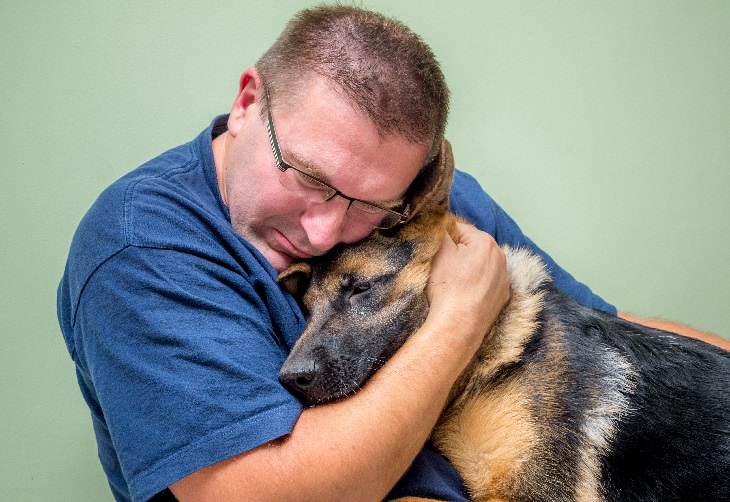
Emotional support dog: comfort, hug
 
Several mental conditions, such as bipolar disorder, PTSD, depression, anxiety, and autism, could make you eligible for an emotional support dog. You need to get a certificate from a licensed mental health professional to either get an emotional support dog or assign an existing pet this job. 
 
The only things that are absolutely required of an emotional support dog are to be calm, well-behaved and obedient. For this reason, irate, jittery, sickly, noisy and obnoxious dogs make poor emotional support animals.

Because an emotional support dog doesn’t constitute a regular pet, you are allowed to bring it with you on airplanes without additional charge, and you are allowed to live with one in your apartment, regardless of pet regulations. You are NOT, however, allowed to bring an emotional support dog to public places (e.g. restaurants) that otherwise forbid it. 
 
You can put a vest on your dog (as long as it is not the same color as a service dog’s) to let people know that this is a working dog that shouldn’t be distracted. 
 
If the idea of having a dog around to comfort you and empower you seems like something that can help you, you should definitely give it a try.

This is only for your information, kindly take the advice of your doctor for medicines, exercises and so on.     

https://gscrochetdesigns.blogspot.com. one can see my crochet creations  
https://gseasyrecipes.blogspot.com. feel free to view for easy, simple and healthy recipes    
https://kneereplacement-stickclub.blogspot.com. for info on knee replacement

Labels: , , , , , , ,

Tuesday, October 08, 2019

Dog ownership linked with longer life, especially for heart patients

Dog owners live longer, and canine companionship may be especially good for people with heart disease and those living alone, new research shows. 

“We studied more than 3 million people, and the results are very significant,” said one of the doctors.

People who own dogs have lower blood pressure, healthier cholesterol levels and a milder stress response than those with canine-free homes, researchers noted. Having a pet - even just a cricket in a cage - is also known to relieve stress, anxiety, depression, loneliness and social isolation. But studies looking at whether having a dog extends survival have had mixed results. 

To investigate, the team searched through medical literature dating back to 1950 and found 10 studies of dog ownership and survival including a total of 3.8 million people. 

Overall, dog owners were 24% less likely to die over the next decade than non-dog owners. People who’d suffered a heart attack or other cardiovascular event had a 65% reduced risk of dying over the next decade if they owned a dog. Dog ownership reduced overall mortality from cardiovascular causes by 31%. 

Increased physical activity plays a key role in the cardiovascular benefits of dog ownership, said the Dr., noting that her own step count has climbed “sky high” since she adopted Romeo, an energetic miniature schnauzer that she walks at least three times a day. 

In another study researchers looked at 181,696 people who had a heart attack between 2001 and 2012, and 154,617 who’d suffered a stroke over the same period. The heart attack patients who owned a dog and lived alone had a 33% lower risk of having another heart attack, while the risk was reduced by 15% for those who lived with a dog plus a partner or child. For stroke patients living solo, the risk of another stroke was 27% lower, while repeat stroke risk was 12% lower for dog owners who didn’t live alone. 

“Given the magnitude of the potential benefit - and likely little or no harm - these findings should encourage clinicians to discuss pet adoption with their patients, particularly those with preexisting cardiovascular disease and those living by themselves,” said a Dr.

“We’ve known this forever, that pets make our lives better, but to know that the sum of it translates to better cardiovascular health is very exciting for those of us who like dogs and work in cardiology,” the Dr. said. “I’ve wanted a dog for 40 years, and the data finally convinced me.” 

Before adopting a dog, doctors agree, it’s essential to make sure you have the resources to care for it properly. “One has to make space in one’s life to be able to accommodate them before making that leap of faith,” the Dr. said. 

this is only for your information, kindly take the advice of your doctor for medicines, exercises and so on.   
https://gscrochetdesigns.blogspot.com. one can see my crochet creations  

https://gseasyrecipes.blogspot.com. feel free to view for easy, simple and healthy recipes    
https://kneereplacement-stickclub.blogspot.com. for info on knee replacement


Labels: , , , , , , , , , , , , ,

Tuesday, April 09, 2019

Dogs may sniff out cancer in blood with 97 per cent accuracy

Dogs may sniff out cancer in blood with 97 per cent accuracy and help develop inexpensive screening approaches

Dogs can use their highly evolved sense of smell to pick out human blood samples with cancer with almost 97 per cent accuracy, according to a study that may lead to inexpensive and non-invasive screening approaches for the deadly disease.

Dogs have smell receptors 10,000 times more accurate than humans', making them highly sensitive to odours we can't perceive, said researchers who presented the study recently.

"Although there is currently no cure for cancer, early detection offers the best hope of survival," said the lead researcher.

 "A highly sensitive test for detecting cancer could potentially save thousands of lives and change the way the disease is treated," the author said in a statement.

The researchers used a form of clicker training to teach four beagles to distinguish between normal blood serum and samples from patients with malignant lung cancer.

Although one beagle was unmotivated to perform, the other three dogs correctly identified lung cancer samples 96.7 per cent of the time and normal samples 97.5 per cent of the time.

"This work is very exciting because it paves the way for further research along two paths, both of which could lead to new cancer-detection tools," said the researcher.

"One is using canine scent detection as a screening method for cancers, and the other would be to determine the biologic compounds the dogs detect and then design cancer-screening tests based on those compounds," she said.

Researchers plan to use canine scent detection to develop a non-invasive way of screening for cancer and other life-threatening diseases. 

THIS IS ONLY FOR INFORMATION, ALWAYS CONSULT YOU PHYSICIAN BEFORE HAVING ANY PARTICULAR FOOD/ MEDICATION/EXERCISE/OTHER REMEDIES.                                    PS- THOSE INTERESTED IN RECIPES ARE FREE TO  VIEW MY BLOG-                                                                                           https://gseasyrecipes.blogspot.com/                                                                                                                                                         FOR INFO ABOUT KNEE REPLACEMENT, YOU CAN VIEW MY BLOG-                                                  https:// kneereplacement-stickclub.blogspot.com/           


                   FOR CROCHET DESIGNS                                                                                                                                                                                                  https://gscrochetdesigns.blogspot.com


Labels: , , , , , , , ,

Tuesday, March 05, 2019

Household toxins degrade fertility in both men and dogs

Environmental contaminants found in the home and affects male fertility both in humans and domestic dogs find a new study stating the decline in sperm quality in both the species over the past few years.

What makes household contaminants?
Hazardous household products consist of six broad categories: household cleaners, paints and solvents, lawn and garden care, automotive products, pool chemicals, and health and beauty aids. Many commonly used household products in these categories release toxic chemicals.

The study showed the chemicals -- at concentrations relevant to environmental exposure -- have the same damaging effect on the sperm of both man and dog.

"We know when human sperm motility is poor, DNA fragmentation is increased and that human male infertility is linked to increased levels of DNA damage in sperm," said co-author.

"We now believe this is the same in pet dogs because they live in the same domestic environment and are exposed to the same household contaminants," he said.

What did the scientists do?
For the study, the team tested the effects of two man-made chemicals -- the common plasticiser DEHP, widely used in the home (e.g. carpets, clothes, toys) and the industrial chemical polychlorinated biphenyl 153, which although banned globally, remains widely detectable in the environment, including food.

Using donated sperm from sample males and stud dogs living within a specific region in the UK, the researchers found that the chemicals had a clear damaging effect on both sperm samples.


The researchers carried out identical experiments for both species using samples of sperm from donor men and stud dogs, living in the same region.

"This new study supports our theory that the domestic dog is indeed a 'sentinel' or mirror for the human male reproductive decline. Our findings suggest man-made chemicals, widely used in home and working environment, may be responsible for the decline in sperm quality," lead author said.

Next, the team will focus on the region to see if location also impacts sperm vitality in both men and dogs.

THIS IS ONLY FOR INFORMATION, ALWAYS CONSULT YOU PHYSICIAN BEFORE HAVING ANY PARTICULAR FOOD/ MEDICATION/EXERCISE/OTHER REMEDIES.                                    PS- THOSE INTERESTED IN RECIPES ARE FREE TO  VIEW MY BLOG-                                                                                           https://gseasyrecipes.blogspot.com/                                                                                                                                                         FOR INFO ABOUT KNEE REPLACEMENT, YOU CAN VIEW MY BLOG-                                                  https:// kneereplacement-stickclub.blogspot.com/           

                                                                           FOR CROCHET DESIGNS                                                                                                                                                                                                  https://gscrochetdesigns.blogspot.com

Labels: , , , , , , , , , , , , , ,