Wednesday, March 17, 2021

The Embodiment Method

When we feel threatened or shaken, we can see it through our posture, breathing and movement, our bodies can go into shock or sometimes even crash. Many people think that the solution to overcoming a crisis or challenge comes primarily from a change in mind, but the truth is that 98% of our thoughts come from the subconscious and no thought will be fully realized if it isn’t connected to the body. In order to easily cope with the pitfalls of our lives, we must understand that our bodies have a great influence on our behavior, and it is important that we learn how to know our bodies and not separate them from the way we act and think. Precisely this principle focuses on the Embodiment approach, which teaches us how to build awareness of our bodies and properly cope with stress and obstacles. With this approach, we will present you with exercises to work with the body that will reconnect you to your mental abilities and help you stand up any challenge.

embodiment approach
What is the Embodiment Approach? 
We all have automatic trigger responses to different situations, for example, if we were to be called to our boss’s office, we would get nervous or start feeling stress. However, what people aren’t aware of is that our bodies also react instinctually. The way we walk, breathe and stand, consciously or unconsciously, affects our mentality and our experiences. The key to changing these responses is to think of our body as a sequence of sensations and to examine more positive and calming response patterns based on listening, movement, breathing, and other physical activities. Therefore, the solution must begin with control of the body and the feelings leading to the reaction, and by changing your automatic reaction patterns you will achieve significant results that, over time, will turn into a habit. By knowing your physical experience, you will learn how to control your thoughts, how to overcome stressful situations and confront your body's responses to panic and stress.

Exercises for working with the body according to the Embodiment approach: 
Working with the body is very easy and effective because the body responds to every form of distress and this allows us to "read it" easily. When you change your negative response pattern in a different format that involves setting boundaries, listening or controlling pain, you change consciousness through your body. Once you identify these familiar patterns of action, you can change the response you feel to a more responsible, and calculated response. With the 7 Embodiment method-based exercises, you can increase the space of your body's responses and move closer to realizing your personal potential.

1. Relaxation between the eyes, tongue, diaphragm, and body – it’s not for nothing that Mystics believe in the third eye and that its closely related to the knowledge and vision of humans, which is why it’s important to keep this area relaxed. Start with the area between the eyes, try to relax, and make sure your tongue is not constricted your abdomen and diaphragm are relaxed and the body is loose and not tense. 
 
2. Posture - the body and mind work together, so it's important to be aware of how we stand. Posture is expressed in awareness of the environment, smells and the body itself. 
 
3. Breathing - A short breath is a breath that brings in a small amount of air and is designed to wake us up. In contrast, a long, deep breath from the diaphragm brings more air into the body, allowing it to relax and choose the desired response more considerately. 
 
4. Control of pain - If you notice, when you feel physical pain your body tenses up, the pain is sharp and breathing stops for a moment. Now try to relax, practice the previous 3 sections, breathe deeply with your stomach, release your tongue and loosen up your body. When the same pain is applied this time (with the same intensity), you’ll hardly feel it. The reason for this is your rela xed body that made it easier to ignore pain, try it and you will certainly be surprised by the results!

embodiment approach
5. A new approach to aggression - repeat the previous section while another person recites annoying sentences to you ("You're weak", "You're not good enough ...") and see how you react. Try it again only this time you have to calm your body and concentrate on breathing, note that the body is not tense. Not only will you feel less pain, but you will also be less aggressive towards the person in front of you. When we are in situations of stress or confrontation, the body tends to contract and tense up. Our typical reaction is to defend ourselves (even violently). But once we bring the body's awareness into play, we change our response and can replace it with more balanced behavior. 
 
6. Lie - The body signals to you and the people around you when you are lying. Ask another person to push you and try to resist them with your body, at this time you will say one truth and one lie. while lying, you’ll feel your eyebrows rising and your body will have a hard time resisting. The reason for this is that our bodies are "transparent" and cannot conceal lies, the inevitable raising of eyebrows, distracts your attention from the resistance. Now consider what this means about you... 
 
7. Decision Making - When you are required to make a decision under pressure, the choice you make will arise from stress. When your body is relaxed, your decision may be different and much smarter. It is therefore important to train the body how to deal with stress, with limits, lies or any other challenge that may arise in the future. 

Training Workshop: The three-dimensional body We will now present 3 simple exercises from the Embodiment Training Workshop, which focuses on the three dimensions of our bodies. Each physical object has three dimensions: width, length, and depth, as does the human body. The difference between our body and a chair or table lies in the fact that we have an experience of life and energy. To begin the first exercise, stand on your feet and observe the way you stand. 
 
Length – as you stand on your legs picture them as roots of a tree. If you sink a little more into the ground, you’ll feel heavier – usually, those who are depressed, powerless or stubborn will seem as though they can’t be moved. If you imagine your body as a tree, your trunk should grow upwards and your treetop should reach your neck. If you lift your head up, you’ll feel slightly arrogant or condescending, but, if you straighten your back and neck, you’ll feel more relaxed and confident. 
 
Width - width is actually a perception of place, think of thin people who stand with their hands together, people who are cold and hold themselves, or people who swing from side to side (just as they do in life). Part of embodiment is presence and visibility, but you don’t have to stretch out your hands and take over a space all the time. However, if you’re having difficulty feeling your presence, try to raise your arms along your shoulders, as if touching an invisible wall, feel your width and then bring your hands back towards your body while you stay with that feeling. 
 
Depth - in this dimension we are not talking about muscles or weight, rather about movements. For example, if you run and rush to a certain place, your body will tilt forward, however, if you look at someone your body will move backward as if hesitant. In addition, depth is very connected to your culture, for example, people who maintain personal space as opposed to people who are more open to the environment. If you try to stand still and swing back and forth without moving your legs, you’ll feel the depth of your body and the trust you feel towards the person standing in front of yo u.
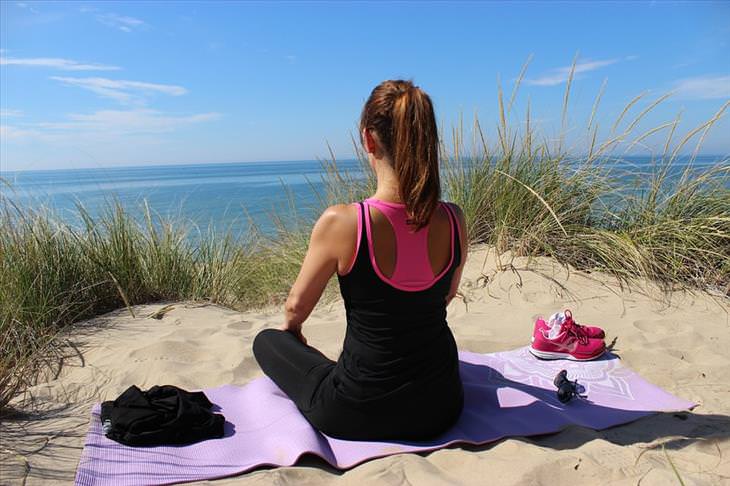
embodiment approach
In the second exercise, after you’ve found and explored the three dimensions of your body, take a short walk, concentrate on the dimensions of your body and examine how you respond to objects and people (e.g., do you shrink back when smiled at or do smile back).
 
In the last exercise, try to think of something or someone that warms your heart. Start walking again, keeping in mind the 3 dimensions of your body, and think about the person you chose. Pay attention to your walking, your rhythm, and the dimensionality your body creates. Soon you will notice the difference in your walking and posture and after that success, you will be one step closer to embodiment!

This is only for your information, kindly take the advice of your doctor for medicines, exercises and so on.     

https://gscrochetdesigns.blogspot.com. one can see my crochet creations  
https://gseasyrecipes.blogspot.com. feel free to view for easy, simple and healthy recipes    
https://kneereplacement-stickclub.blogspot.com. for info on knee replacement

Labels: , , , , , , , , , , ,

Sunday, February 17, 2019

Autistic adults more consistent in decision-making tasks

People with autism disorder may show more consistent choices in high-level decision-making tasks and are less likely to show a cognitive bias because they are not influenced by the way choices are presented, showed a research.
The findings indicate that individuals with autism are less susceptible to the effects of decoy options when evaluating and choosing the "best" product among several options relative to individuals without autism.

"People with autism are indeed more consistent in their choices than the neurotypical population. From an economic perspective, this suggests that people with autism are more rational and less likely to be influenced by the way choices are presented," said a psychology researcher.

People with autism are thought to focus more on detail and less on the bigger picture. Thus, in the study, researchers wanted to know if this tendency would apply to higher-level decision-making tasks.

For the study, the team recruited 90 adults with autism and 212 neurotypical adults to participate in an online decision-making study. 

The data revealed that, compared with neurotypical participants, participants with autism made more consistent choices and made fewer switches in their selections.

The results showed that individuals with autism are less likely to show a cognitive bias that often affects their neurotypical peers.

"These findings suggest that people with autism might be less susceptible to having their choices biased by the way information is presented to them -- for instance via marketing tricks when choosing between consumer products," he said.

THIS IS ONLY FOR INFORMATION, ALWAYS CONSULT YOU PHYSICIAN BEFORE HAVING ANY PARTICULAR FOOD/ MEDICATION/EXERCISE/OTHER REMEDIES.                                    PS- THOSE INTERESTED IN RECIPES ARE FREE TO  VIEW MY BLOG-                                                                                           https://gseasyrecipes.blogspot.com/       

                                                                                                                                                     FOR INFO ABOUT KNEE REPLACEMENT, YOU CAN VIEW MY BLOG-                                                  https:// kneereplacement-stickclub.blogspot.com/           
                                                                           FOR CROCHET DESIGNS                                                                                                                                                                                                  https://gscrochetdesigns.blogspot.com


Labels: , , , , , , , , ,

Saturday, May 03, 2014

Take a walk to release your creative juices


If you are unable to think of a catchy, creative way to present sales data or begin a newspaper column, take a walk. A brief stroll, even around your office, can significantly increase creativity, according to a handy new study. 

Most of us have heard by now that exercise, including walking, generally improves thinking skills, both immediately and in the longer term. Multiple studies have shown that animals and people usually perform better after exercise on tests of memory and executive function, which is essentially the ability to make decisions and organize thoughts (although prolonged, intense exercise can cause brief mental fatigue - so don’t take a math test after a marathon). 

Similarly, exercise has long been linked anecdotally to creativity. For millenniums, writers and artists have said that they develop their best ideas during a walk, although some of us also do our best procrastinating then. 

But little science has supported the idea that exercise aids creativity. 

So researchers at Stanford University recently decided to test that possibility, inspired, in part, by their own strolls. “My adviser and I would go for walks” to discuss thesis topics, said Marily Oppezzo, at the time a graduate student at Stanford. “And one day I thought: ‘What about walking and whether it really has an effect on creativity?’” 

With the enthusiastic support of her adviser, Daniel Schwartz, a professor in the Stanford Graduate School of Education, Dr Oppezzo recruited a group of undergraduate students and set out to see if she could goose their creativity. Gathering her volunteers in a deliberately dull, unadorned room equipped with only a desk and (somewhat unusually) a treadmill, Dr Oppezzo asked the students to sit and complete tests of creativity, which in psychological circles might involve tasks like rapidly coming up with alternative uses for common objects, such as a button. Then the participants walked on the treadmill. The treadmill faced a blank wall. While walking, each student repeated the creativity tests, which required about eight minutes. 

For almost every student, creativity increased substantially when they walked. Most were able to generate about 60 per cent more uses for an object, and the ideas were both “novel and appropriate,” Dr Oppezzo writes in her study, which was published this month in The Journal of Experimental Psychology: Learning, Memory, and Cognition. 

But the practical import of that finding would seem to be negligible, if creativity were to increase only while someone was walking. Mostof us cannot conduct brainstorming sessions on treadmills. So Dr Oppezzo next tested whether the effects lingered after a walk had ended. She had another group of students sit for two consecutive sessions of test-taking and subsequently walk for about eight minutes while tossing out ideas for object re-use, then sit and repeat the test. 


Again, walking markedly improved people’s ability to generate creative ideas, even when they sat down after the walk. In that case, the volunteers who had walked produced significantly more and subjectively better ideas than in their pre-exercise testing period. 

Finally, to examine another real-world implication of walking and creativity, Dr Oppezzo moved portions of the experiment outdoors. “Most people would probably guess that walking outside should be much better for creativity” than pacing inside a drab office. But surprisingly, her study undermined that assumption. When volunteers strolled Stanford’s pleasant, leafy campus for about eight minutes, they generated more creative ideas than when they sat either inside or outside for the same length of time. But they were not noticeably more creative as a result of their plain-air walk than when they subsequently walked on an indoor treadmill, facing a blank wall. 

“It really seems that it’s the walking that matters,” in terms of spurring creativity, Dr Oppezzo said. Just how a brief, casual stroll alters the various mental processes related to creativity remains unclear.


PS- THIS IS ONLY FOR INFORMATION, ALWAYS CONSULT YOU PHYSICIAN BEFORE HAVING ANY PARTICULAR FOOD/ MEDICATION/EXERCISE/OTHER REMEDIES.
PS- THOSE INTERESTED IN RECIPES ARE FREE TO VIEW MY BLOG-
HTTP:GSEASYRECIPES.BLOGSPOT.COM/
FOR INFO ABOUT KNEE REPLACEMENT, YOU CAN VIEW MY BLOG-
HTTP://KNEE REPLACEMENT-STICK CLUB.BLOGSPOT.COM/

FOR CROCHET DESIGNS


HTTP://MY CROCHET CREATIONS.BLOGSPOT.COM

Labels: , , , , , , , , , , ,

Tuesday, April 29, 2014

Thinking Problems Tied to Blockages in Neck Artery

Blockage of the carotid artery in the neck appears to increase the odds for memory and thinking problems according to a new study.

Their findings suggest more aggressive treatment might be needed for people with this condition, which is caused by plaque buildup in the artery.

The focus of diagnosis and management of carotid artery blockages has been prevention of stroke since that was the only harm that these blockages were thought to cause to patients.

"These results underscore the importance of assessing the status of memory and thinking in people with carotid artery narrowing,"  added a Dr.

In conducting the study, the researchers examined 67 people with symptomless carotid narrowing, or stenosis. For these participants, the diameter of their artery was cut in half. The study also included 60 people who did not have carotid blockage but did have risk factors, such as diabetes, high blood pressure,  high blood cholesterol and coronary heart diseases.

Researchers tested participants' thinking ability, examining their processing speed, learning, memory, decision-making and language.

They found participants with carotid blockage performed much worse on the thinking tests. They also scored lower on motor and processing speed evaluations as well as learning and memory tests. The researchers said language scores did not differ between the two groups of participants.

"If these findings are confirmed in larger studies, they hold significant implications for new treatment targets and open the door for more questions such as: should these patients be treated more aggressively with medications, cognitive rehabilitation, or even surgery to open up the artery," the Dr. said . He said he anticipates follow-up studies searching for causes and the best treatment options.
These are only preliminary findings until more tests are done, according to the researchers.


PS- THIS IS ONLY FOR INFORMATION, ALWAYS CONSULT YOU PHYSICIAN BEFORE HAVING ANY PARTICULAR FOOD/ MEDICATION/EXERCISE/OTHER REMEDIES.
PS- THOSE INTERESTED IN RECIPES ARE FREE TO VIEW MY BLOG-
HTTP:GSEASYRECIPES.BLOGSPOT.COM/
FOR INFO ABOUT KNEE REPLACEMENT, YOU CAN VIEW MY BLOG-
HTTP://KNEE REPLACEMENT-STICK CLUB.BLOGSPOT.COM/

FOR CROCHET DESIGNS


HTTP://MY CROCHET CREATIONS.BLOGSPOT.COM


Labels: , , , , , , ,