Friday, December 12, 2025

Probiotics for Alzheimer's, can they help ?

In the overall landscape of long-term health interventions, gut health is still an often ignored or dismissed subject. This is despite the fact that we have scientific evidence suggesting a direct link between the gut microbiome and digestion, cardiovascular health, immune system, and mental wellbeing. More recently, research had begun to examine the possibility of gut bacteria also having an effect on our cognitive health and the development of neurocognitive conditions like dementia and Alzheimer’s.

The more we learn about the ways our gut influences the brain via the gut-brain axis, the deeper the connection between what we eat and who we are becomes. With all the knowledge we have about the benefits of gut bacteria, one question remains unanswered - how can we effectively translate these findings into actionable health advice? 
 
Among the most promising candidates for improving gut health are probiotics. Some studies are suggesting that taking probiotics or possibly even eating probiotic-rich foods can improve cognition or even slow down the progression of Alzheimer’s disease. A recent meta-analysis reviewed 294 studies from 1984 to 2021 and found that probiotics do, in fact, have a beneficial effect on neurodegenerative diseases. Read on to find out the specifics. 
How taking probiotics can improve gut health 
 
Did you know that more than half of the human body weight consists of microbes? A big percentage of these beneficial microbes - around 5 pounds (2.7 kg) worth of them - live in the intestines, forming the gut microbiome. Every person’s microbiome is different, and researchers are now trying to work out which strains of bacteria are the most beneficial for our overall health and cognition specifically.
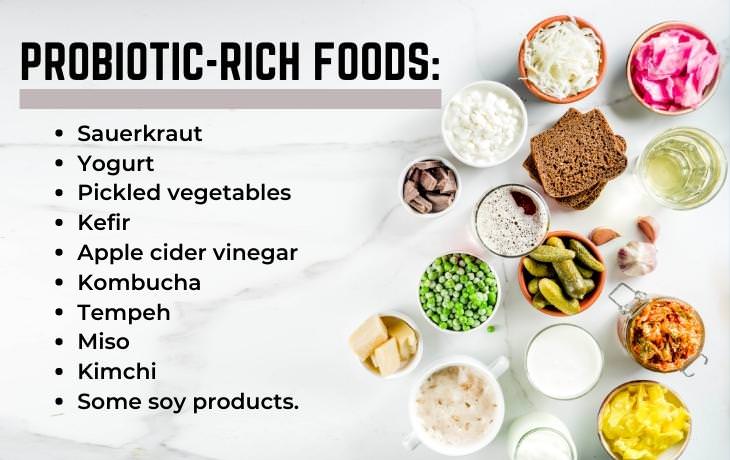
Probiotics For Dementia probiotic rich foods 
Probiotics are believed to be beneficial bacteria, and they exist not only in the human body but also in many fermented foods. The photo below lists the common food source of probiotics, and our article titled 7 Probiotics that Boost Your Health, Besides Yogurt, goes through most of these foods in detail. The idea is that eating probiotic-rich foods or taking food supplements that contain probiotics introduces beneficial bacteria into the intestines, strengthens the gut microbiome, and pushes out any harmful bacteria that might have taken up residence in the gut.

What about cognition and dementia specifically? 
 
The intestines are rich in nerves that regulate your digestion through signals to the spine and brain. These nerves are called the enteric nervous system, or the gut-brain. Researchers believe that an irritated and “unhappy” gut can also impact the brain, and they know that this is true because they have observed that things like a diet high in sugar can impair cognitive abilities and cause brain fog. 
 
Some scientists also suppose that a gut microbiome that’s unbalanced or insufficiently diverse, can contribute to neurodegenerative conditions like Alzheimer’s disease. It is also believed to contribute to a condition called mild cognitive impairment (MCI) - a state between dementia and normal cognition in aging adults. Both conditions are characterized by problems with memory, thinking, and language. To test the idea that diversifying the gut can improve these cognitive issues in older adults, researchers have patients take probiotics and examine their cognitive functioning. 
 
The previously-mentioned review article examined a great number of such studies and concluded that “probiotic supplementation considerably improved cognitive function in the participants with MCI, but it only caused a modest cognitive improvement in those with Alzheimer’s disease.” Therefore, taking probiotics can slow down the progression of these neurodegenerative diseases, especially if introduced when cognitive changes only begin to appear.

In addition, the researchers point out that taking probiotics improved the diversity of fecal microbiota in patients with Alzheimer’s disease. It is known that Alzheimer’s patients have a reduced diversity of microbes in fecal matter. Let us remind you that Alzheimer’s disease affects 6 million Americans and is the leading kind of dementia in the US. The causes of this disease are still unknown, so any new information that can get researchers closer to being able to treat or prevent this condition is extremely valuable. 
 
Is there a recommended dose of probiotics? 
 
Since research in probiotics is still relatively new, health organizations around the world don’t list any specific guidelines on how much or how often one should take probiotics. That said, the review study lists that the minimal dose listed in most of the studies they looked at was 1 x 10⁹ CFU (probiotics are measured in Colony-Forming Units (CFU), which refers to the number of viable cells), or about 1 billion per day. 
 
While this can be helpful if you’re taking probiotic supplements, it’s difficult to say how many probiotics you took if you get them through your diet. In this case, your best estimation is how you feel. If drinking too much yogurt or eating too many pickles makes you feel bloated or upset your digestion in any other way, lower the dose. 
 
Lastly, let us point out that you shouldn’t start taking probiotic supplements on your own. Even though probiotics are generally considered safe, older adults who want to take probiotics for cognitive health are more likely to experience gastrointestinal upsets, infections, or skin rashes than others. Therefore, you shouldn’t start taking probiotics without your physician’s supervision.


This is only for your information, kindly take the advice of your doctor for medicines, exercises and so on.   


Labels: , , , , , , , , ,

Sunday, October 26, 2025

Simple Memory Tricks That Help Me Every Single Day..

 How many times have you forgotten your password for something, your friend's phone number, the address for the office or the name of that guy you used to know? Sometimes we forget where we put our keys or if we turned off the oven, and when we forget, that can really take us out of balance.

Here are some simple tricks to remember these things, despite our difficulties. 
 
Forgetting Boring or Mundane Details
Problem: You tend to forget meetings, addresses, passwords and phone numbers, as well as historic dates and birthdays. Don't take it hard. In a reality where we are flooded with huge amounts of information, the brain isn't able to process everything at once. Even though it has a folder called 'declarative memory' where it plans to keep factual information of this kind, it isn't made to remember such things, and if we don't make a special effort to remember these facts, they will have a short shelf-life. 
 
Solution: The only way to turn boring information into part of our long-term memory is to store it correctly so we can access it later. If we don't make a conscious effort, it will be gone. The best way to do this is to add meanings, as we are configured to remember such things. For example: Connect a memory to something else you never forget, like a holiday. "My niece's birthday is 2 weeks after New Year's Eve." 
 
Another great way to remember boring facts and lists is to construct a short and simple story. For instance, if you need to remember a list of numbers, break them down into a few numbers and give each a part of the story. So, if you need to remember the number 821576 (as a password or code), you can imagine a story in which an 82-year-old grandfather has 15 grandchildren and is married to a 76-year-old named Margaret. The more details you give the story (his name is Jack and he is a retired race car driver), the easier it will be to recall these numbers. 
 
Forgetting to Carry Out Automatic Tasks
Problem: You don't remember if you turned the stove off, turned on the washing machine or made sure no lights are left on in the house. 
 
While we do these automatic tasks, we use the 'Procedural memory', the memory we use to store chains of actions (a simple one would be to first check if any lights are on, then to turn them off). This type of long-term memory is used to carry out action chains we learned, like riding a bicycle, tying our shoelaces or making coffee. Because of the automatic nature of this action, we usually don't really concentrate on doing it, and just let our body go through the motions. 
 
Solution: In most cases in which we think we forgot to do something like this, we probably DID remember to do it. But, if you find yourselves constantly doubting yourself, attach another action to the action you're obsessing about, and use it to make sure you remember doing it. For example, every time you turn off the stove, say loudly: "I turned off the stove", or take a long sip of water. Any action that will be easy to remember will help. Then when you doubt yourself it will be much easier to remember if you have something else to remember. 
 
Forgetting People's Names
Problem: You run into someone you met a few days ago, but you already forgot their name! You're not alone - this is one of the most common memory problems. The problem could be in the storage of the memory (you didn't pay much attention when you met the person) or in retrieval (you can't get out the name when it counts), or just a combination of both.

Solution: Most people learn visually instead of orally, which explains why we usually remember faces, but are quite bad with names. Next time you meet someone new, look at them really well and repeat their name for yourself at least three times. Use it in the conversation, as we tend to remember those better than just names. Try giving the name meaning, or rhyme it. 
 
For example, if you meet a man named Mark, you can secretly call him: "Mark of the Ark", or imagine him marking a paper. We know it sounds silly, but the more extra meanings you give to a word, the easier it will be to remember it! Remembering a collection of sounds is much harder than trying to remember an association. 
 
You Get Distracted
Problem: You go into a room and forget why you did so. You were looking for something, got distracted by the dog or something on TV, and then suddenly you can't remember what it was! 
 
Solution: Get a mental image of the thing you are looking for before you go look for it. If need be, associate that object with other objects or a logical chain of actions. So for instance, if you are on your way to the storage room to find your old bathing suit, on your way think of summer, pools and sunshine. This type of mental organization makes these associations to your current situation easier, and when you get there, you will not lose track of what you were doing. 
 
If you do still find yourself in that situation, ask yourself: What was the chain of actions that brought me here? The little things you were doing just before this will give you a clue as to what you are doing there. 
 
Losing Daily Items
Problem: You don't remember where you put the keys, wallet or your sunglasses. This is usually an attention problem. When we go into the house in a huff, while lost in thought or maybe talking on the phone, our mind wanders and we might place objects in various places without remembering where. As usual, if we don't make it clear to the brain that we must remember these things, it will let them disappear. 
 
Solution: This is a very similar problem to forgetting the lights on. Try not to put anything down while doing something else, and try to add an action to the putting down. Say: "This is where I'm putting my keys - on the armchair of the sofa." or "I'm putting my glasses in the blue box." Then you don't have to remember the exact location, just what you said, which is much easier, and even if you don't remember it perfectly, it will give you important clues of where to look. 
 
Another and perhaps even better way is to stick to your habits. This is one of those rare times when obsession actually pays off. Religiously place your items in the same place over and over again. Designate an easy-to-reach place where everything goes, and later sort them from that place into their rightful places. 
 
For instance, you can keep a big bowl next to the entry door, where you put keys, wallet, glasses etc. When you are not busy and can pay attention, go back to the bowl and put everything in its rightful place. Now that you are paying attention, you'll probably remember where they are.

Having trouble Remembering...ahh...what was it? Oh yes - Words.
Problem: Having a hard time remembering words, names of books and plays, names of actors, old tunes etc. This is a universal problem and it gets worse the older we get. It doesn't matter how much we pressure ourselves or force ourselves to remember - it just won't happen if our minds are preoccupied. 
 

This is only for your information, kindly take the advice of your doctor for medicines, exercises and so on.   


Solution: First, let go of stress. It is the killer of memory. The second worst thing for memory is multiplicity, or concentrating on a few things at once. Clear your head and focus only on the words you are trying to find. Sometimes, the word seems to be right on the tip of our tongue, but we can't get to it. Don't worry - it happens all the time and it is actually a biological process. Sometimes the actual biological pathway in the brain to that word may be blocked, and you have to find a way around. The best trick is not to think of the word itself, but think of a word that rhymes with it, or a word that has similar associations, or a word that is similar in meaning. 
 
For example: We're trying to find the word 'University', it's right on the tip of our tongue, but we can't remember it exactly. Try to think of: 'college', 'student', 'place of learning', 'municipality' etc. 
 
When the path to the brain is blocked, no amount of 'trying to remember' will help. The best way is to take an alternative route, and remember similar words. This will help you approach the word from a different direction or path.

Labels: , , , ,

Tuesday, September 16, 2025

Here's Why You Must Make Sure You Get Enough Vitamin B12!

Getting the proper amount of B vitamins is essential to your overall health, and vitamin B12 is one that benefits your whole body. Below you’ll find 8 ways in which this essential vitamin benefits your body. 
 
1. Improved Heart Health

Vitamin B12’s role in promoting heart health often gets overlooked, but it’s essential. Vitamin B12, B6, and folic acid work together to help reduce homocysteine, which is a protein that can build up in the blood and damage arterial walls. Thus playing a role in heart disease.

2. Healthy Nervous System
Vitamin B12 benefits your nervous system directly and helps to keep it in tip-top shape. When this vitamin is in short supply, you might develop annoying pins and needles in your extremities and/or numbness in your hands, legs, or feet. 
 
Vitamin B12 helps to produce the fatty sheath that surrounds and protects your nerves. When you are deficient in it, your nerve cells cannot function properly. 
 
3. Your Ability to Walk and Move
Tingling and numbness might be one of the first signs of B12-related nerve damage, but if it continues unaddressed, it can alter the way that you move. This can sometimes affect your balance, making you more likely to fall over. 
 
4. Your Oral Health 
There are many signs that your tongue can reveal about your health, and a B12 deficiency is one of them. A mild deficiency can trigger tongue inflammation. This painful condition can affect how you speak and eat. Your tongue may be red and swollen or look smooth since the tiny bumps that contain your taste buds stretch out and disappear. 
 
5. Your Eyesight
Another vital function vitamin B12 benefits is our vision, and a deficiency is typically related to nervous system damage that affects the optic nerve. The best defense is a good offense. Vitamin B12 can be found in animal foods such as meat, poultry, fish, and dairy products. If you don’t eat animal foods, you can get vitamin B12 from fortified foods or a supplement.


6. Your Memory  
Some research has suggested that a vitamin B12 deficiency is linked to dementia and memory issues, but it’s not clear whether supplements might help. The potential link might be a result of high levels of homocysteine in the blood, but it’s too early to draw any firm conclusions. 
 
 
7. Your Gut Health 
Everyone knows that eating enough fiber and drinking enough water are vital to healthy bowel movements, but a vitamin B12 deficiency can also cause constipation, diarrhea, loss of appetite, and weight loss. The exact mechanism through which a B12 deficiency causes GI issues is still unknown. 
 
8. Your Glow 
People with a vitamin B12 deficiency often look pale or have slightly yellow skin. Glitches in your body’s red blood cell production affect the size and strength of these cells. They might be too big to travel through your body, resulting in pale skin. If they’re too fragile, they might break down and cause an excess of bilirubin, which results in an orange-yellow skin tone.


This is only for your information, kindly take the advice of your doctor for medicines, exercises and so on.   

https://gscrochetdesigns.blogspot.com. one can see my crochet creations  
https://gseasyrecipes.blogspot.com. feel free to view for easy, simple and healthy recipes    
https://kneereplacement-stickclub.blogspot.com. for info on knee replacement
https://GSiyers home remedies.blogspot.com   is the latest addition to my blogs


Labels: , , , , , , , , , ,

Sunday, July 27, 2025

Improve Your Memory and Concentration with These 8 Pressure Points

We need good concentration and memory at every age and every stage of life. Regardless of whether we’re studying for an important exam or trying to remember how to get from one place to another, these abilities determine whether or not we’ll succeed in our mission. One of our strongest enemies in this struggle is stress, which negatively affects our concentration and memory.

However, you can turn this calm into a regular part of your life while focusing and refining your concentration and memory skills with 8 pressure points that will improve your mental abilities using only your hands. 
 
1.The Third Eye 
 pressure points for memory and concentration
 
In Chinese culture, the third eye is believed to be a "mystical organ" responsible for clairvoyance. According to the Chinese, the third eye point helps improve concentration and, memory, and also helps to treat symptoms of influenza, such as fever, blocked nose, and nasal congestion headaches.

The point lies between the eyebrows, in the area between the bridge of the nose and the forehead. Press the spot gently for 3-4 minutes and repeat 2-3 times a day. 
 
2. The Bigger Rushing  
The use of this pressure point is especially recommended for students preparing for tests – massaging it helps to get rid of the feeling of exhaustion that comes with memorizing a large amount of material, improves concentration and encourages mental clarity. In addition, you should massage it when facing a big and significant decision, as it will help you focus on the possibilities that are facing you.
 pressure points for memory and concentration
 
You’ll find this point at the top of the foot, where the big toe and second toe bones meet. Press gently on the point on both feet at the same time for two minutes, and repeat three times a day.


3. The Heavenly Pillar 
This pressure point is used to reduce the feeling of pressure and pain in the head, which results from too many thoughts "running around" inside. It’s also used to cure a sore throat, and its massage helps to loosen the neck and improve blood flow to the brain.

pressure points for memory and concentration

The point is about 1 cm below the base of the skull and 3 cm from the spine on both sides. Place the index and middle finger on the two points and massage them for 7-8 minutes. Repeat the process three times a day to get the best results. 
 
4. The Sun Point 
It's possible that your hands naturally massage your temples when you feel that your head is crammed with stressful thoughts or when it’s hard for you to think. Massaging these points helps improve memory and concentration, and prevents headaches, dizziness, and stress.

pressure points for memory and concentration

Gently press on your temples with two fingers, 1 cm from the outer edge of the eyebrows – for two minutes, three times a day. 
 
5. The Three-Mile point 
Massaging this point helps to strengthen concentration and memory and provides clarity of thought. It also helps reduce symptoms of ulcers, inflammation of the small intestine, nausea,gas and swelling, and nourishes the body with energy in case of exhaustion.

pressure points for memory and concentration

The point is at a distance of 3 fingers below the knee, on the outside of the leg. Bend your knee and you’ll be able feel it when the muscle moves under your fingers. Press it for 5 minutes, once a day. 
 
6. The Middle of a Person 
You can often witness children pressing this point when they feel stressed or worried, and that's because massaging it makes us focus on our thoughts better. In addition to improving concentration and memory, massaging this point also helps reduce menstrual pain and dizziness, and it is recommended to do it especially when you feel your head is not working at its best.

pressure points for memory and concentration
Place your finger under your nose and above the upper lip, in the center of your face. Gently press the point for two minutes every day, and if you do this regularly for four weeks, you will feel its effect noticeably.

7. The Gates of Consciousness
If you suffer from memory problems, massaging these points is highly recommended for you. In addition to the beneficial effect of improving memory, it also helps to soothe headaches, so it is recommended to perform every time you experience pain that interferes with your daily functioning.

pressure points for memory and concentration
The points are right at the base of the skull, on either side of the spine. Place your fingers on them and feel the hollow in the skull – you’ll find them there. Rub the area gently for 2-3 minutes and repeat three times a day. 
 
8. Under side of the toe 
This point comes not from Chinese medicine, but from reflexology, and you don’t even have to use your fingers to massage it and get the benefits it provides. The left toe will affect the right side of the brain and the right toe will affect the left side, but it is recommended to massage both at the same time to obtain clarity of mind.

pressure points for memory and concentration

Move your thumb on the underside side of the big toe and massage all of it for 1-2 minutes. Repeat the process every day, and if you want to improve your concentration while working or learning, just rub your toe into your shoe and use the floor to resist it. 
 
If you really want to improve your memory and concentration, you may want to massage these points every day for several weeks regularly. You can feel their effect significantly after four weeks, and you’ll see how easy it is to help our body and mind be at their best.

This is only for your information, kindly take the advice of your doctor for medicines, exercises and so on.   


Labels: , , , , , , , , , ,