Probiotics for Alzheimer's, can they help ?
In the overall landscape of long-term
health interventions, gut health is still an often ignored or dismissed
subject. This is despite the fact that we have scientific evidence
suggesting a direct link between the gut microbiome and digestion,
cardiovascular health, immune system, and mental wellbeing. More
recently, research had begun to examine the possibility of gut bacteria
also having an effect on our cognitive health and the development of
neurocognitive conditions like dementia and Alzheimer’s.
The more we learn about the ways our gut
influences the brain via the gut-brain axis, the deeper the connection
between what we eat and who we are becomes. With all the knowledge we
have about the benefits of gut bacteria, one question remains unanswered
- how can we effectively translate these findings into actionable
health advice?
Among the most promising candidates for improving gut health are
probiotics. Some studies are suggesting that taking probiotics or
possibly even eating probiotic-rich foods can improve cognition or even
slow down the progression of Alzheimer’s disease. A recent meta-analysis
reviewed 294 studies from 1984 to 2021 and found that probiotics do, in
fact, have a beneficial effect on neurodegenerative diseases. Read on
to find out the specifics.
How taking probiotics can improve gut
health
Did you know that more than half of the human body weight consists of
microbes? A big percentage of these beneficial microbes - around 5
pounds (2.7 kg) worth of them - live in the intestines, forming the gut
microbiome. Every person’s microbiome is different, and researchers are
now trying to work out which strains of bacteria are the most beneficial
for our overall health and cognition specifically.
Probiotics are believed to be beneficial
bacteria, and they exist not only in the human body but also in many
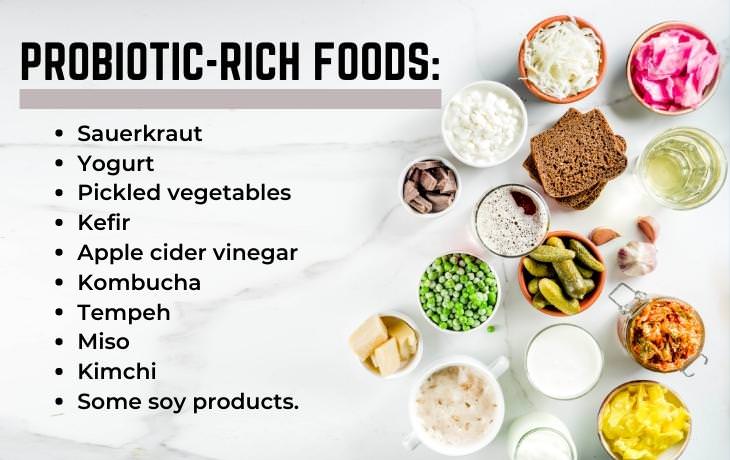
fermented foods. The photo below lists the common food source of
probiotics, and our article titled 7 Probiotics that Boost Your Health,
Besides Yogurt, goes through most of these foods in detail. The idea is
that eating probiotic-rich foods or taking food supplements that contain
probiotics introduces beneficial bacteria into the intestines,
strengthens the gut microbiome, and pushes out any harmful bacteria that
might have taken up residence in the gut.
What about cognition and dementia
specifically?
The intestines are rich in nerves that regulate your digestion through
signals to the spine and brain. These nerves are called the enteric
nervous system, or the gut-brain. Researchers believe that an irritated
and “unhappy” gut can also impact the brain, and they know that this is
true because they have observed that things like a diet high in sugar
can impair cognitive abilities and cause brain fog.
Some scientists also suppose that a gut microbiome that’s unbalanced or
insufficiently diverse, can contribute to neurodegenerative conditions
like Alzheimer’s disease. It is also believed to contribute to a
condition called mild cognitive impairment (MCI) - a state between
dementia and normal cognition in aging adults. Both conditions are
characterized by problems with memory, thinking, and language. To test
the idea that diversifying the gut can improve these cognitive issues in
older adults, researchers have patients take probiotics and examine
their cognitive functioning.
The previously-mentioned review article examined a great number of such
studies and concluded that “probiotic supplementation considerably
improved cognitive function in the participants with MCI, but it only
caused a modest cognitive improvement in those with Alzheimer’s
disease.” Therefore, taking probiotics can slow down the progression of
these neurodegenerative diseases, especially if introduced when
cognitive changes only begin to appear.
In addition, the researchers point out that
taking probiotics improved the diversity of fecal microbiota in
patients with Alzheimer’s disease. It is known that Alzheimer’s patients
have a reduced diversity of microbes in fecal matter. Let us remind you
that Alzheimer’s disease affects 6 million Americans and is the leading
kind of dementia in the US. The causes of this disease are still
unknown, so any new information that can get researchers closer to being
able to treat or prevent this condition is extremely valuable.
Is there a recommended dose of probiotics?
Since research in probiotics is still relatively new, health
organizations around the world don’t list any specific guidelines on how
much or how often one should take probiotics. That said, the review
study lists that the minimal dose listed in most of the studies they
looked at was 1 x 10⁹ CFU (probiotics are measured in Colony-Forming
Units (CFU), which refers to the number of viable cells), or about 1
billion per day.
While this can be helpful if you’re taking probiotic supplements, it’s
difficult to say how many probiotics you took if you get them through
your diet. In this case, your best estimation is how you feel. If
drinking too much yogurt or eating too many pickles makes you feel
bloated or upset your digestion in any other way, lower the dose.
Lastly, let us point out that you shouldn’t start taking probiotic
supplements on your own. Even though probiotics are generally considered
safe, older adults who want to take probiotics for cognitive health are
more likely to experience gastrointestinal upsets, infections, or skin
rashes than others. Therefore, you shouldn’t start taking probiotics
without your physician’s supervision.