Saturday, November 14, 2015

New blood test developed to improve cancer detection

THIS IS ONLY FOR INFORMATION, ALWAYS CONSULT YOU PHYSICIAN BEFORE HAVING ANY PARTICULAR FOOD/ MEDICATION/EXERCISE/OTHER REMEDIES.

FOR INFO ABOUT KNEE REPLACEMENT, YOU CAN VIEW MY BLOG
HTTP://KNEE REPLACEMENT-STICK CLUB.BLOGSPOT.COM/

FOR CROCHET DESIGNS- http://My Crochet Creations.blogspot.com/


A new blood-based RNA test can detect, classify and pinpoint the location of cancer with greater accuracy by analysing a sample equivalent to one drop of blood, scientists say.

Using this new method for blood-based RNA tests of blood platelets, researchers have been able to identify cancer with 96% accuracy, researchers said. "Being able to detect cancer at an early stage is vital.

We have studied how a whole new blood-based method of biopsy can be used to detect cancer, which in the future renders an invasive cell tissue sample unnecessary in diagnosing lung cancer, for instance," said Jonas Nilsson, cancer researcher at Umea University in Sweden. "In the study, nearly all forms of cancer were identified, which proves that blood-based biopsies have an immense potential to improve early detection of cancer," said Nilsson.

Researchers from Umea University, in collaborations with researchers from the Netherlands and the US, investigated how a new method of blood-based RNA tests of the part of the blood called platelets could be used in detecting and classifying cancer. The results show that blood platelets could constitute a complete and easily accessible blood-based source for sampling and hence be used in diagnosing cancer as well as in the choice of treatment method.

Blood samples from 283 individuals were studied of which 228 people had some form of cancer and 55 showed no evidence of cancer. By comparing the blood sample RNA profiles, researchers could identify the presence of cancer with an accuracy of 96% among patients.

Among the 39 patients in the study in which an early detection of cancer had been made, 100% of the cases could be identified and classified. In follow-up tests using the same method, researchers could identify the origin of tumours with a so far unsurpassed accuracy of 71% in patients with diagnosed cancer in the lung, breast, pancreas, brain, liver, colon and rectum.

The samples could also be sorted in subdivisions depending on molecular differences in the cancer form, which can be of great use in the choice of treatment method. The study was published in the journal Cancer Cell.

Labels: , , , , , , , , , , , , , ,

Monday, August 13, 2012

Colorectal Cancer

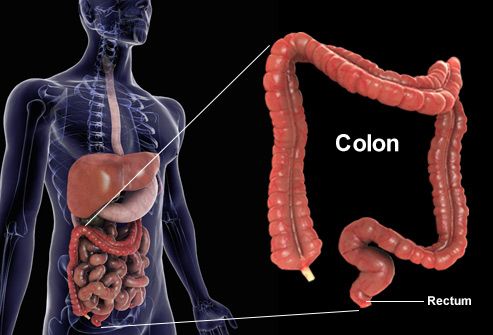
Exploded view of the human colon


What Is Colorectal Cancer ?
 when found early, it is highly curable. This type of cancer occurs when abnormal cells grow in the lining of the large intestine (colon) or rectum.
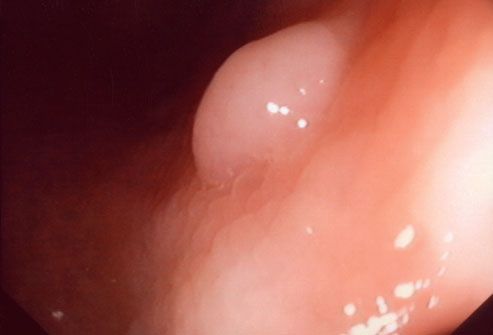
Colonoscopy image of a polyp on the colon lining
Symptoms
Colorectal cancers often begin as polyps -- benign growths on the interior surface of the colon. The two most common types of intestinal polyps are adenomas and hyperplastic polyps. They develop when there are errors in the way cells grow and repair the lining of the colon. Most polyps remain benign, but some have the potential to turn cancerous. Removing them early prevents colorectal cancer.


Factors  Beyond Your Control
Your risk of colorectal cancer depends on genetics and lifestyle. Factors you can't control include:
Age -- most patients are older than 50
Polyps or inflammatory bowel disease
Family history of colorectal cancer
History of ovarian or breast cancer


Factors You Can Control
 By Avoiding-
Diet high in red or processed meats, or meats cooked at high temperatures
Being overweight (excess fat around the waist)
Exercising too little
Smoking or drinking alcohol


Warning Signs
There are usually no early warning signs . For this reason it's important to get screened. Detecting cancer early means it's more curable. As the disease progresses, patients may notice blood in the stool, abdominal pain, a change in bowel habits (such as constipation or diarrhea), unexplained weight loss, or fatigue. By the time these symptoms appear, tumors tend to be larger and more difficult to treat.
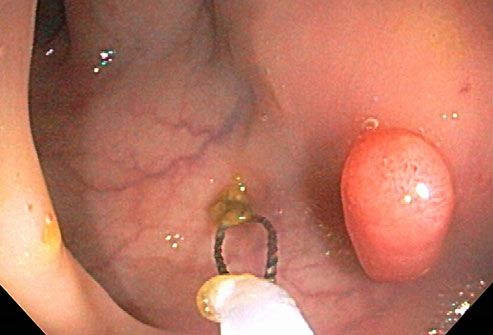
Close-up of colon polyp removal procedure


Screening
Because colorectal cancer is stealthy, screenings are the key to early detection. Beginning at age 50, most people should have a colonoscopy every 10 years. This procedure uses a tiny camera to examine the entire colon and rectum. These tests not only find tumors early, but can actually prevent colorectal cancer by removing polyps (shown here).


 Virtual Colonoscopy
There is now an alternative to colonoscopy that uses CT scan images to construct a 3-D model of your colon. Called virtual colonoscopy, the procedure can reveal polyps or other abnormalities without actually inserting a camera inside your body. The main disadvantage is that if polyps are found, a real colonoscopy will still be needed to remove and evaluate them.


X-Rays of the Colon (Lower GI)
Barium X-Rays of the colon  allows your doctor a glimpse at the interior of the colon and rectum, offering another way to detect polyps, tumors, and changes in the intestinal tissue. Like the virtual colonoscopy, any abnormalities that appear on the X-rays will need to be followed up with a conventional colonoscopy.
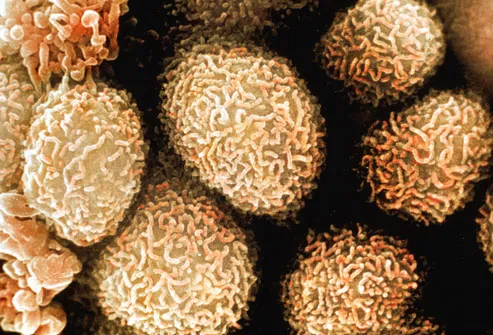
SEM micrograph of colon cancer cells

Diagnosing Colorectal Cancer
If testing reveals a possible tumor, the next step is a biopsy. During a colonoscopy, your doctor will remove polyps and take tissue samples from any parts of the colon that look unusual. This tissue is examined under a microscope to determine whether or not it is cancerous. Shown here is a color-enhanced, magnified view of colon cancer cells.


 Staging Colorectal Cancer
If cancer is detected, it will be "staged," a process of finding out how far the cancer has spread. Tumor size may not correlate with the stage of cancer. Staging also enables your doctor to determine what type of treatment you will receive.
Stage 0 -- Cancer is only in the innermost lining of the colon or rectum.
Stage I -- Cancer has not spread beyond the inner wall of the colon or rectum.
Stage II -- Cancer has spread into the muscle layer of the colon or rectum.
Stage III -- Cancer has spread to one or more lymph nodes in the area.
Stage IV -- Cancer has spread to other parts of the body, such as the liver, lung, or bones. This stage does NOT depend on how deep the tumor has penetrated or if the disease has spread to the lymph nodes near the tumor.


Surgery
In all but the last stage of colorectal cancer, the usual treatment is surgery to remove the tumor and surrounding tissue. In the case of larger tumors, it may be necessary to take out an entire section of the colon and/or rectum. The good news is that surgery has a very high cure rate in the early stages. If the cancer has spread to the liver, lungs, or other organs, surgery is not likely to offer a cure -- but removing the additional tumors, when possible, may reduce symptoms.


Treating Advanced Colorectal Cancer
When colorectal cancer has spread to one or more lymph nodes , it can still sometimes be cured. Treatment typically involves a combination of surgery, radiation  and chemotherapy. If the cancer comes back after initial treatment or spreads to other organs, it becomes much more difficult to cure. But radiation and chemotherapy may still relieve symptoms and help patients live longer.


Coping With Chemotherapy
Chemotherapy has come a long way from the days of turning people's stomachs. Newer drugs are less likely to cause this problem, and there are also medications to control nausea if it does occur.


Radiofrequency Ablation
Radiofrequency ablation (RFA) uses intense heat to burn away tumors. Guided by a CT scan, a doctor inserts a needle-like device that delivers heat directly to a tumor and the surrounding area. This offers an alternative for destroying tumors that cannot be surgically removed. In patients with a limited number of liver metastases that cannot be removed by surgery, chemotherapy is sometimes combined with RFA for tumor destruction.


How To Prevent Colorectal Cancer:
1) Diet
There are steps you can take to dramatically reduce your odds of developing colorectal cancer. Researchers estimate that eating a nutritious diet, getting enough exercise, and controlling body fat could prevent 45% of colorectal cancers. It is recommended to have a low-fat diet that includes plenty of fiber and at least five servings of fruits and vegetables per day.


2) Exercise
Physical activity appears to be a powerful weapon in the defense against colorectal cancer. In one study, the most active participants were 24% less likely to have the cancer than the least active people. It didn't matter whether the activity was linked to work or play. It is recommended exercising five or more days a week for at least 30 minutes a day.



Labels: , , , , , , , , , , , , , ,

Sunday, February 26, 2012

Alzheimer's Disease


Causes & Risk Factors

Age and family history are risk factors for AD.
  • As you get older, yoru risk of developing AD goes up. However, developing Alzheimer's disease is not a part of normal aging.
  • Having a close blood relative, such as a brother, sister, or parent who developed AD increases your risk.
  • Having certain combination of genes for proteins that appear to be abnormal in Alzheimer's disease also increases your risk.
Other risk factors that are not as well proven include:
There are two types of AD -- early onset and late onset.
  • In early onset AD, symptoms first appear before age 60. Early onset AD is much less common than late onset. However, it tends to progress rapidly. Early onset disease can run in families. Several genes have been identified.
  • Late onset AD, the most common form of the disease, develops in people age 60 and older. Late onset AD may run in some families, but the role of genes is less clear.
The cause of AD is not entirely known, but is thought to include both genetic and environmental factors. A diagnosis of AD is made when certain symptoms are present, and by making sure other causes of dementia are not present.
The only way to know for certain that someone has AD is to examine a sample of their brain tissue after death. The following changes are more common in the brain tissue of people with AD:
  • "Neurofibrillary tangles" (twisted fragments of protein within nerve cells that clog up the cell)
  • "Neuritic plaques" (abnormal clusters of dead and dying nerve cells, other brain cells, and protein)
  • "Senile plaques" (areas where products of dying nerve cells have accumulated around protein).
When nerve cells (neurons) are destroyed, there is a decrease in the chemicals that help nerve cells send messages to one another (called neurotransmitters). As a result, areas of the brain that normally work together become disconnected.
The buildup of aluminum, lead, mercury, and other substances in the brain is no longer believed to be a cause of AD.

Tests & Diagnostics

AD can often be diagnosed through a history and physical exam by a skilled doctor or nurse. A health care provider will take a history, do a physical exam (including a neurological exam), and perform a mental status examination.
Tests may be ordered to help determine whether other medical problems could be causing dementia or making it worse. These conditions include:
Computed tomography (CT) or magnetic resonance imaging (MRI) of the brain may be done to look for other causes of dementia, such as a brain tumor or stroke.
  • In the early stages of dementia, brain image scans may be normal. In later stages, an MRI may show a decrease in the size of different areas of the brain.
  • While the scans do not confirm the diagnosis of AD, they do exclude other causes of dementia (such as stroke and tumor).

Treatments

Unfortunately, there is no cure for AD. The goals in treating AD are to:
  • Slow the progression of the disease (although this is difficult to do)
  • Manage behavior problems, confusion, sleep problems, and agitation
  • Modify the home environment
  • Support family members and other caregivers
DRUG TREATMENT
Most drugs used to treat Alzheimer's are aimed at slowing the rate at which symptoms become worse. The benefit from these drugs is often small, and patients and their families may not always notice much of a change.
Patients and caregivers should ask their doctors the following questions about whether and when to use these drugs:
  • What are the potential side effects of the medicine and are they worth the risk, given that there will likely be only a small change in behavior or function?
  • When is the best time, if any, to use these drugs in the course ofAlzheimer's disease?
Two types of medicine are available:
Other medicines may be needed to control aggressive, agitated, or dangerous behaviors. These are usually given in very low doses.
It may be necessary to stop any medications that make confusion worse. Such medicines may include painkillers, cimetidine, central nervous system depressants, antihistamines, sleeping pills, and others. Never change or stop taking any medicines without first talking to your doctor.
SUPPLEMENTS
Many people take folate (vitamin B9), vitamin B12, and vitamin E. However, there is no strong evidence that taking these vitamins prevents AD or slows the disease once it occurs.
Some people believe that the herb ginkgo biloba prevents or slows the development of dementia. However, high-quality studies have failed to show that this herb lowers the chance of developing dementia. DO NOT use ginkgo if you take blood-thinning medications like warfarin (Coumadin) or a class ofantidepressants called monoamine oxidase inhibitors (MAOIs).
If you are considering any drugs or supplements, you should talk to your doctor first. Remember that herbs and supplements available over the counter are NOT regulated by the FDA.

Complications

  • Loss of ability to function or care for self
  • Bedsores, muscle contractures (loss of ability to move joints because of loss of muscle function), infection (particularly urinary tract infections andpneumonia), and other complications related to immobility during end stages of AD
  • Falls and broken bones
  • Loss of ability to interact
  • Malnutrition and dehydration
  • Failure of body systems
  • Harmful or violent behavior toward self or others
  • Abuse by an over-stressed caregiver

Prevention

Although there is no proven way to prevent AD, there are some practices that may be worth incorporating into your daily routine, particularly if you have a family history of dementia. Talk to your doctor about any of these approaches, especially those that involve taking a medication or supplement.
In addition, early testing of a vaccine against AD is underway.

Labels: , , , , , ,

Wednesday, March 02, 2011

Diagnosing Pancreatic Cancer


Diagnosing Pancreatic Cancer
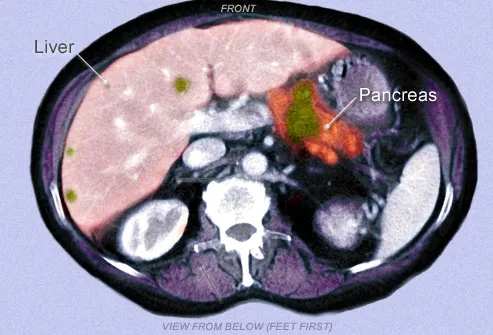
The challenge of this disease is finding it early. A doctor cannot see or feel a tumor during a routine exam. To help make the diagnosis (and determine the most appropriate treatment), imaging tests are performed (such as an ultrasound or CT scan) to view pictures of the abdomen and determine the extent of the problem. The green region shown in this colorized CT scan appears to be cancer in the pancreas and liver. The diagnosis comes from a biopsy — taking a tissue sample from the tumor — performed either with a needle through the skin or during an operation.

Labels: ,