Thursday, July 24, 2025

Learn How to Diagnose and Treat a Skin Bump

Skin lumps, also known as lipomas, are any areas of skin that have become abnormally raised, either on the surface or protruding from underneath. Somebody with a lipoma has an abnormal lump, ulcer, bump or sore, and it might also be an abnormally colored area on the skin's surface. Common skin lumps include warts, moles, actinic keratosis, and skin infections. While some may be a cause for concern, many types of skin lumps are benign. Keep reading to learn more about them.
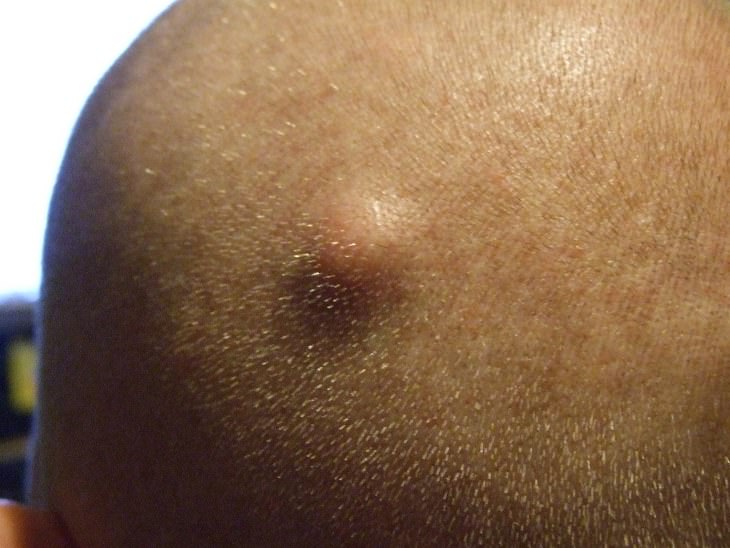

lipoma

The symptoms of lipoma

 There are various kinds of skin lipomas, but they usually have distinct characteristics. They are most commonly found on the back, neck, and shoulders, but may also appear on thighs, arms or your abdomen. If you suspect that you have one it will usually:

*be pale and colorless 
 
• grow slowly 
 
• be soft to the touch 
 
• be located just under your skin 
 
• move easily when prodded

The Risk Factors of a Lipoma While the cause of lipoma development is still unknown, there are a number of risk factors that can increase your susceptibility: 
• a family history of lipomas 
• being aged between 40 and 60 
• Cowden syndrome 
• Gardner's syndrome 
• Madelung's disease 
• adiposis dolorosa 
 
Diagnosing a Lipoma 
Lipomas are usually diagnosed through a physical exam. It should move easily when touched, feel soft and pain-free. Sometimes, a dermatologist may take a biopsy of the skin bump to send to the lab for testing and to rule out the possibility of cancer. This is done because a lipoma looks quite similar to a liposarcoma which actually is cancerous, but is usually painful and quick-growing. Further tests though CT scans and MRI are usually only needed when there is a suspicion of a liposarcoma.

Treating a Lipoma  
A lipoma that’s left untouched will not typically cause any problems. However, you can get it removed if it is bothering you or getting in the way of your day-to-day activities. The 3 most common treatment options are: 
 
Steroid injections - By injecting steroids into the affected area, the lipoma should drastically shrink, however it will not be removed entirely. 
 
Liposuction - This procedure works by sucking the fat out of a lipoma in order to reduce its size. 
 
Surgery - The most common procedure is to simply have the entire lipoma surgically removed. Once this takes place, the chance of it growing back is slim. 
 
The Outlook For Someone With a Lipoma 
Since a lipoma is a benign tumor, there is no real risk of one suddenly turning cancerous. Additionally, it will never spread through any surrounding tissues or muscles, and it certainly is not life-threatening. All in all, the outlook for someone with a lipoma is incredibly positive.


This is only for your information, kindly take the advice of your doctor for medicines, exercises and so on.   


Labels: , , , , , , , , , , , , , , , ,

Friday, March 03, 2023

Important Information About Abdominal Aortic Aneurysms

Many people are not familiar with the term "abdominal aneurysm," or its full name. An abdominal aortic aneurysm (AAA) is a pathological expansion in the abdominal aorta. The condition is usually asymptomatic and can be thought of as a "silent killer." According to Dr. Frank Levi, a senior vascular surgeon, the prevalence of this condition in people over 65 is between 2-12%. It is estimated that about a thousand people develop a life-threatening abdominal aneurysm every year. Still, only 60% of them receive preventive surgery when their aneurysm is diagnosed before it ruptures. If it does rupture, the risk of mortality is incredibly high, over 90%. Men over 65, current or former smokers, and those with first-degree relatives who have aortic aneurysms are all at risk.

abdominal aortic aneurysm
Before the 1950s, Dr. Levi explains, there was no reliable way to manage the illness. Today, the test is recommended to those aged 64 and up who have smoked in the past and/or currently, even if it was only in small amounts and for a short period, as well as to those with a close relative with the condition. Tobacco use and arteriosclerosis weaken the aorta wall, initiating an asymptomatic process where the artery, which usually measures 2-2.5 cm, starts to expand like a balloon, resulting in an aneurysm more than 3 cm in diameter. This process has been developing for years, "below the surface." One of the problems is that there are usually no symptoms.

The aorta expands slowly over many years. When it reaches a life-threatening diameter, a rupture may occur and then there is an immediate danger to life. "When the aneurysm ruptures, it leads to massive bleeding inside the body, and the person experiences abdominal pain and/or severe back pain accompanied by hemodynamic collapse (a state of shock/shaking, i.e. very low blood pressure) and usually loss of consciousness."
abdominal aortic aneurysm

After that, there are two possibilities: the person succumbs to the bleeding in a few minutes, or the bleeding is contained, and they manage to get to a hospital. In fact, the only way to save their life is to perform emergency surgery to repair the aneurysm and stop the bleeding. "As long as the aneurysm is not repaired, the patient is in immediate danger throughout their life," said Dr. Levi. "It is important to note that even organizing this type of surgery and completing it is a complex matter and may take several hours." It is often the case that an abdominal aneurysm does not produce any symptoms. 
 
This is why it is recommended to perform a screening if you're in a high-risk group. The test is non-invasive, quick, and painless, and it's done through abdominal ultrasound. If the test result reveals the diameter of the abdominal aorta to be over 3 cm, then it is considered an aneurysm, though mostly a small one that is not a major danger to the patient's life. Alternatively, a CT scan of the prostate or abdomen may be done. 
 
The treatment is effective. When an aneurysm is identified via ultrasound or any other scan, the patient must be referred to a vascular surgeon for further review and to determine if treatment is needed. This is because many of the aneurysms are too small, do not require treatment, and only need a monitoring plan. 

For men, an aneurysm with a size of 5.5 cm or more is an indication for treatment, while for women, the size must be 5 cm or greater as they usually have a slimmer aorta. A growth rate of 1 cm per year is another factor that might warrant treatment. If the aneurysm is smaller than that, the danger of it bursting is relatively low. Therefore, surgery may not be the best option due to the risks involved.
Nevertheless, these patients still need to have a follow-up plan for the aneurysm. Presently, when there is a requirement for an aneurysm to be treated, most operations are done with a minimally invasive approach as compared to the past when the surgery had higher chances of risks and complications. The procedure currently used is catheterization, wherein surgeons enter the vascular system through the arteries situated in the groin, navigate through the vascular system from the groin to the blood vessels in the abdomen and pelvis, and place a cloth-covered stent inside the blood vessels. This technique covers the entire aneurysmal area, and the blood flows beyond the stent, achieving a success rate of more than 95% with very low levels of complications, only a few percent. 
 
In conclusion, the best course of action is to abstain from smoking or get regularly checked. The ultrasound test is quick, straightforward, non-intrusive, and poses no discomfort. The elective surgery to fix the aneurysm includes hospitalization, but generally, it goes well, and the patient can come back to their home and life after a brief period of time.

This is only for your information, kindly take the advice of your doctor for medicines, exercises and so on.   

https://gscrochetdesigns.blogspot.com. one can see my crochet creations  
 
https://gseasyrecipes.blogspot.com. feel free to view for easy, simple and healthy recipes    
 
https://kneereplacement-stickclub.blogspot.com. for info on knee replacement

https://GSiyers home remedies.blogspot.com     is my latest addition to my blogs. I'm going to add posts there, do give me your valuable feed back on my blogs. Thanks a lot, take care, be healthy and be happy.

Labels: , , , , , , ,