Thursday, August 29, 2013

High uric acid level

A high uric acid level, or hyperuricemia, is an excess of uric acid in your blood. Uric acid is produced during the breakdown of purine, a substance found in many foods. Once produced, uric acid is carried in your blood and passes through your kidneys, where most of it leaves your body when you urinate.
A high uric acid level may result in attacks of gout, but not everyone who has high uric acid gets gout, and not everyone with gout has high uric acid.
Causes
A high uric acid level can be caused when your body either produces too much uric acid or your kidneys don't eliminate uric acid rapidly enough.
A high uric acid level may cause increasingly frequent attacks of gout, or it may never cause problems. A high uric acid level may also cause some people to develop kidney stones or kidney failure. And some people with a high uric acid level also develop high blood pressure, heart disease or chronic kidney disease, but it's often unclear whether this is a direct cause or merely an early warning sign of these conditions.
Factors that may cause a high uric acid level in your blood include: 
Diuretic medications (water pills) 
Drinking too much alcohol
Genetics (inherited tendencies)
Immune-suppressing drugs
Niacin, or vitamin B-3
Purine-rich diet — organ meat, game meat, anchovies, herring, gravy, dried beans, dried peas, mushrooms and other foods
Renal insufficiency — inability of the kidneys to filter waste
Tumour lysis syndrome — a rapid release of cells into the blood caused by certain cancers or by chemotherapy for those cancers
Also, you may be monitored for high uric acid levels when undergoing chemotherapy or radiation treatment for cancer.
Pl. note that these are common causes, but you need to see your physician for anything to be confirmed.

ps- this is only for information, always consult you physician before having any particular food/ medication/exercise/other remedies.

ps- those interested in recipes are free to view my blog-

http://gseasyrecipes.blogspot.com/

for info about knee replacement, you can view my blog-

http://Knee replacement-stick club.blogspot.com/

for crochet designs

http://My Crochet Creations.blogspot.com/

Labels: , , , , , , , , , , , , , , , ,

Friday, March 08, 2013

Gout- what it is, symptoms, diagnosis, treatment


What Is Gout?
Gout is a kind of arthritis caused by a build-up of uric acid crystals in the joints. Uric acid is a breakdown product of purines that are part of many foods we eat. An abnormality in handling uric acid and crystallization of these compounds in joints can cause attacks of painful arthritis, kidney stones, and blockage of the kidney filtering tubules with uric acid crystals, leading to kidney failure. Gout has the unique distinction of being one of the most frequently recorded medical illnesses throughout history.


ray showing uric acid crystals in big toe joint
Symptoms of Gout
Acute gout attacks are characterized by a rapid onset of pain in the affected joint followed by warmth, swelling, reddish discolouration  and marked tenderness. The small joint at the base of the big toe is the most common site for an attack. Other joints that can be affected include the ankles, knees, wrists, fingers, and elbows. In some people, the acute pain is so intense that even a bed sheet on the toe causes severe pain. These painful attacks usually subside in hours to days, with or without medication. In rare instances, an attack can last for weeks. Most people with gout will experience repeated bouts of gouty arthritis over the years.

Who are common victims of Gout?
Gout is nine times more common in men than in women. It predominantly attacks males after puberty, with a peak age of 75. In women, gout attacks usually occur after menopause. In some male population, about 10% have elevated blood uric acid levels, a condition known as hyperuricemia. However, only a small portion of those with hyperuricemia will actually develop gout. If your parents have gout, then you have a 20% chance of developing it.


Risk Factors for Gout
Obesity, excessive weight gain, especially in youth, moderate to heavy alcohol intake, high blood pressure, and abnormal kidney function are among the risk factors for developing gout. Certain drugs and diseases can also cause elevated levels of uric acid. Interestingly, a recent study demonstrated an increased prevalence of abnormally low thyroid hormone levels (hypothyroidism) in patients with gout.

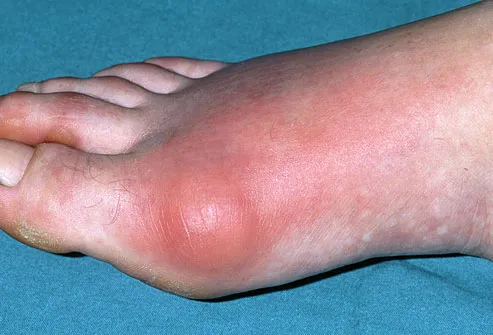
Inflamed toe joint in patient with gout
Inflammation of the affected Big Toe

The joint at the base of the big toe is the most common site of an acute gout attack. These attacks can recur unless gout is treated. See your doctor even if your pain from gout is gone. Over time, they can harm your joints, tendons, and other tissues.
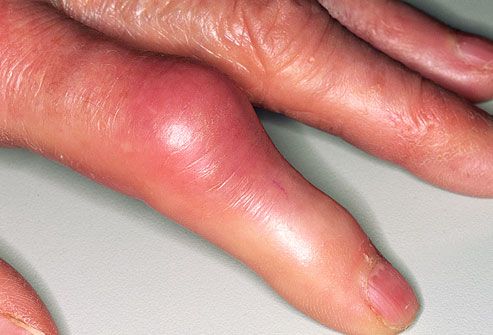
red, swollen index finger caused by acute gout
Fingers affected by deposits of Uric acid
Resting affected joints helps.
393b3a  bkg
Protrusion of elbow due to Gout

Diagnosing Gouty Arthritis
Gout is considered when a patient reports a history of repeated attacks of painful arthritis, especially at the base of the toes or in the ankles and knees. The most reliable test for gout is detecting uric acid crystals in the joint fluid obtained by joint aspiration. This common office procedure is performed with topical local anaesthesia  Using sterile technique, fluid is withdrawn (aspirated) from the inflamed joint with a syringe and needle.

Joint Fluid Analysis
Once the joint fluid is obtained, it is analysed for uric acid crystals and for infection. Your doctor may also do a blood test to measure the amount of uric acid in your blood.


How To Prevent Gout Attacks ?
Maintaining adequate fluid intake helps prevent acute gout attacks and decreases the risk of kidney stone formation in people with gout. Alcohol is known to have diuretic effects that can contribute to dehydration and precipitate acute gout attacks. Alcohol can also affect uric acid metabolism and cause hyperuricemia. It causes gout by slowing down the excretion of uric acid from the kidneys as well as by causing dehydration, which precipitates the crystals in the joints.

What can Prevent Gout Attacks?
Dietary changes can help reduce uric acid levels in the blood. Since purine chemicals are converted by the body into uric acid, purine-rich foods should be avoided. Foods rich in purines include shellfish and organ meats, such as liver, brains, and kidneys. Researchers have reported that meat or seafood consumption increases the risk of gout attacks, while dairy consumption seemed to reduce this risk. Weight reduction can be helpful in lowering the risk of recurrent attacks of gout.


Medications for Goutda
Certain medications reduce the pain and inflammation of gout attacks, such as anti-inflammatory drugs (ibuprofen and others), colchicine, and corticosteroids. Other medications decrease the level of uric acid in the blood and prevent the deposit of uric acid in joints (gouty arthritis), the kidneys (stones), and in tissue (tophi), helping to prevent further attacks and complications.


Labels: , , , , , , , , , , , , , , ,

Friday, November 09, 2012

SIMILARITIES BETWEEN GOUT AND DIABETES


Once termed “the kings’ disease,” gout used to be a problem 
primarily for wealthy people and royalty who lounged around 
drinking wine and eating rich food. But today, an estimated 
68% of American adults are either overweight or obese. As a 
result, gout and type 2 diabetes -- two diseases that can result 
from an unhealthy lifestyle -- are sharply on the rise.
Gout is an arthritic condition caused by having an excess 
build-up of uric acid. It causes sudden, extreme attacks of pain, 
swelling, and redness. Gouty arthritis most often strikes the big 
toe, but it also can show up in the feet, ankles, knees, hands, 
and wrists.

Type 2 diabetes, a disease characterized by high levels of 
sugar in the blood, also can result from eating too much and 
moving too little.
Gout and type 2 diabetes often co-exist in people with common 
physical characteristics and conditions, the most prominent 
being obesity.
A lot of the risk factors for type 2 diabetes are the same for gout according to a researcher.   By changing these risk factors, you can help prevent or fight both diseases.

SOME TIPS TO OVERCOME DIABETES & GOUT

  • Lose weight.
  • To prevent gout, type 2 diabetes, and a host of other health problems, one should keep a close eye on your body mass index (BMI) and waist circumference. According to the National Institutes of Health, waist size becomes very important when a person’s body mass index (BMI) is between 25 and 34.9. A BMI over 25 is considered overweight, and a BMI greater than 30 is considered obese. Keep your waist size below 35 inches if you are a woman and 40 inches if you are a man.

  • Exercise regularly. Regular exercise will help control weight 
  • and lower high blood pressure, both of which will lower your 
  • uric acid level and therefore lessen your chance of developing gout. Plus, it’s well documented that exercise improves the glucose intolerance associated with type 2 diabetes. It is recommends 30 minutes of moderate activity, at least five days a week. If you're having an acute gout attack or have damaged joints from weight issues, some activities may be difficult. Talk to your health care provider about the best exercise plan for you.

Skip the alcohol.
 A landmark study  examined the connection between drinking beer and gout. They found that people who drank two to four beers per week were 25% more likely to develop gout. And those who averaged at least two beers a day had a 200% higher risk. Beer and hard liquor appear to cause a rise in uric acid levels. The same doesn't appear to be true with wine, however. Binge drinking is also a very strong risk factor for gout. Plus, people who eliminate their two beers a day drop weight very quickly, which lowers risk of type 2 diabetes. So you get a two-for-one by cutting out the beer.


Avoid sugar-sweetened beverages
Early research suggests that beverages sweetened with sugar or high-fructose corn syrup, such as regular soft drinks, may increase the chances of developing gout. Even orange juice may increase gout. Eliminating sugary beverages is also a great way to cut calories from your diet, shed a few pounds, and improve your diabetes.


Go on a gout diet.
A gout diet aims to control uric acid production by reducing intake of foods high in purines. High-purine foods create increased levels of uric acid in the body. Some of the worst high-purine foods are liver and other organ meats, as well as anchovies. Other foods to avoid include lobster, shrimp, scallops, herring, mackerel, beef, pork, and lamb. Don't worry about cutting out purines completely. Just eat these foods in moderation: No more than one serving daily.

Eat more dairy.
Some studies have shown that drinking skim or low-fat milk or eating low-fat dairy products can help reduce risk of gout. There is evidence that eating low-fat dairy helps lower risk of type 2 diabetes as well. Aim for 16 to 24 fluid ounces of dairy per day.

Labels: , , , , , , , , ,