Sunday, June 12, 2016

5 sleep positions most suitable for chronic pain sufferers

this is only for your information, kindly take the advice of your doctor for medicines, exercises and so on.

https://gscrochetdesigns.blogspot.com. one can see my crochet creations

https://gseasyrecipes.blogspot.com. feel free to view for easy, simple and healthy recipes

https://kneereplacement-stickclub.blogspot.com. for info on knee replacement


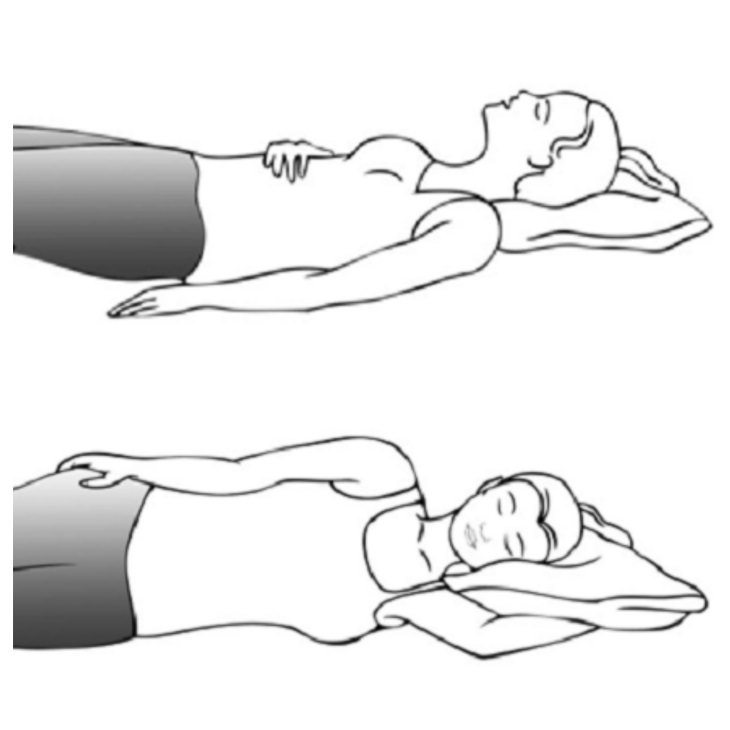
1. Neck Pain
Best sleep positions: On your side, or on your back
sleep positions
The following tips will ensure a comfortable sleep throughout the night:
  • Opt for a rounded pillow to support the natural curve of your neck.
  • Use a feather pillow which conforms to the shape of the neck. The drawback is that they tend to collapse over time, in which case your pillow will need to be replaced once a year.
  • You may also opt for a memory foam pillow that conforms to the contour of your head and neck. It is believed that memory pillows foster proper spinal alignment.
  • Avoid using a pillow that is too high or sticks out, as this will keep your neck flexed overnight and can result in morning pain and stiffness. 
  • If you sleep on your side, opt for a pillow that is high on your neck and low on your head to keep your spine in alignment.  
Avoid: Sleeping on your stomach
This position is tough on the spine, because the back is arched and your neck is turned to the side. While we don't often wake up in the same position in which we fell asleep, it is worth starting the night sleeping on your back or side in a well-supported, healthy position. 
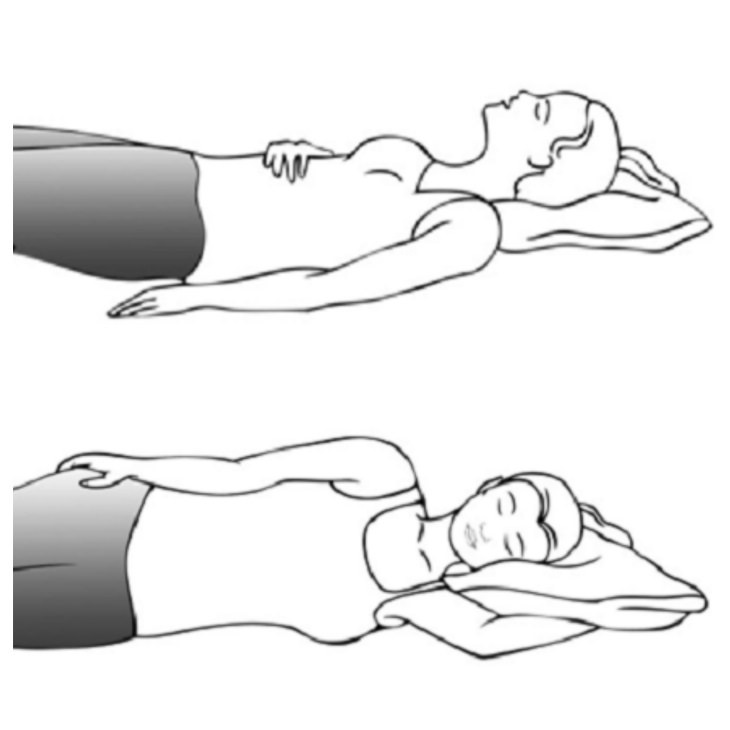
2.  Shoulder Pain
Best sleep positions: On your side, or on your back
sleep positions
Bear in mind the above mentioned tips, alongside the following:
  • Ideally keep your legs straight to minimize pressure on the spine. 
  • If keeping your legs extended is uncomfortable, flex the knees at a 90 degree angle to maintain a neutral posture. 
Avoid: Sleeping on your side without pillow support. 

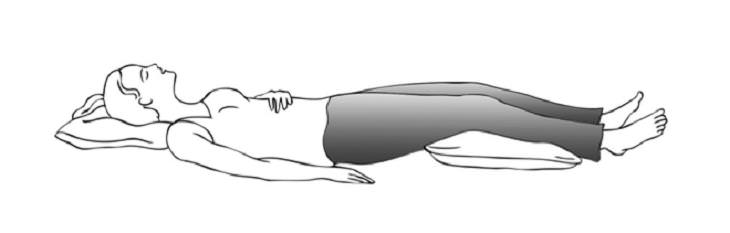
3. Low back pain
Best sleep position: On your back with pillows placed underneath your knees.
sleep positions
This sleeping position minimizes back arching, reducing low back pain. 
  • When sleeping on your back, avoid crossing your legs or sliding one knee over the other as this increases the pressure on your pelvis. 
  • Avoid a thick pillow and do not use more than one pillow when resting in this position. 
  • For extra comfort, and to reduce the pressure of gravity, you can use soft physical support in the form or rolled up towels or pillows at positions where your spine tends to naturally curve - predominantly at the lower back and under the knees. 
  • Keep your arms parallel to the torso as opposed to being elevated above your head. 
Avoid: Sleeping on your stomach or on your back without a pillow underneath the knees. 
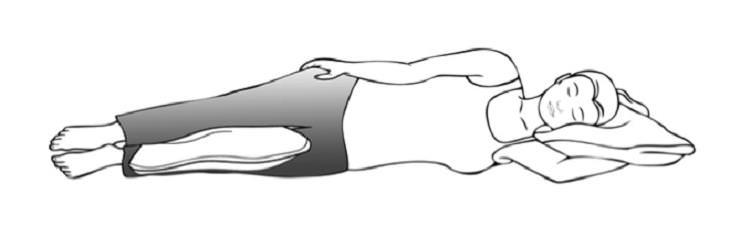
4. Hip Pain
Best sleep positions: On your side, with a pillow placed between the knees.
sleep positions
Sleeping with a pillow between your knees has a number of benefits:
  • It will prevent your upper leg from pulling your spine out of alignment.
  • It will reduce stress on your hips and lower back.
  • It will help pull your knees up slightly toward your chest,
  • Opt for a firm pillow.
Avoid: Sleeping on your back or stomach. 

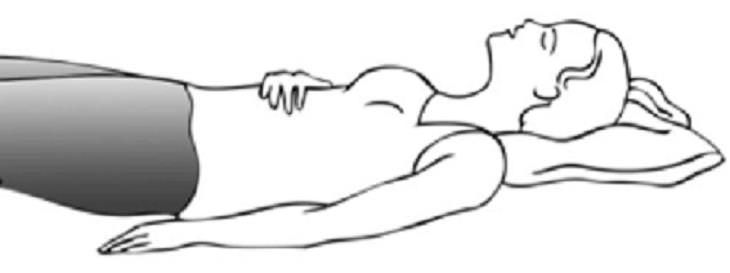
5. Jaw Pain, TMJ (Temporomandibular Joint Syndrome) and Headaches
Best sleep position: On your back, with arms at the side. Use a TMJ-friendly pillow.
sleep positions
While sleeping on your back can be a bad habit to get into, it has a number of benefits for TMJ sufferers. Bear in mind the following tips:
  • Use a small pillow under the arch of your spine, to make back sleeping more comfortable.
  • Consider changing your mattress. Opt for one that conforms to your body, making it a lot more comfortable and cozy to sleep on your back.
  • Your arm position should not be overlooked. Keeping your arms at the side is best. Avoid keeping your arms over your head as this can cause strain on the shoulders. 
Avoid: Sleeping on your back with your arms raised above your head, or lying on your stomach.

Labels: , , , , , , ,

Thursday, July 25, 2013

Tips from a Chiropractor to Get Rid of Neck and Back Pain

A chiropractor’s goal is to not only to relieve pain but to keep you pain-free between adjustments. The spinal manipulations used to correct sublaxations (misalignments) of the spine can relieve painful pressure in your neck, back and head, but chiropractors know that to maintain wellness, you should follow these simple tips to keep your back and neck aligned and reduce muscle or nerve pain.


Start your day with a stretchHow you start your day can help determine how much your lower back complains by the end of it. 
Stop doing sit-upsYes, strong abdominals are key to reducing pain in your back. But if you have back pain, traditional crunches and sit-ups actually make the pain worse, says a Dr. Instead, hold yourself in a yoga plank pose -- lie on your stomach and then lift your body so you’re balancing on your hands and your toes, like a push up. Hold the position as long as you can, increasing the time with each attempt.
Side planks will also firm up your core. From the plank position, rotate your body to the left so you are balancing on your outstretched left arm and on your left foot (either stack your right foot on top of your left or place your right foot down if it's necessary for balance). Reach your right arm upward. Hold it as long as you can and then switch sides.
Stretch out those hamstrings“I have more low back pain patients who sit at desk all day than are manual labourers,” says Dr. Our hamstrings get locked up from spending so many hours sitting in a chair. “So when we try to stand up from sitting, our hamstrings pull on our pelvis, causing misalignments in the spine and all kinds of pain." But a few simple stretches can counter this effect. While lying on your back, wrap a yoga belt around your foot and pull your leg up, keeping it straight. Feel the stretch along the back of your leg. Then try to stretch your leg across the groin -- over the left leg to right and vice versa -- and then out and away from your body towards your hips and work yourself up to holding the stretches for 90 seconds.
Stop staring at your smartphoneTake a look at your phone. Notice what you just did? In all likelihood your chin went to your chest and your neck curved into a C-shape. That’s totally bad for your neck. “There’s 12-15 pounds of weight in the human head,” he says. “The further the head is away from our shoulders looking down at our smartphones, [the more it] strains the muscles. The bones and the discs start to mash together and you get pain.” This goes for all handheld electronics, like iPads. To save your neck, prop up your arms so you’re looking at your phone straight on. If you’re using an e-reader in bed, hold it up on your bent knees instead of down on your lap.
Use your car's headrestDespite our best efforts, many of us spend our days staring at screens, our necks craned downwards. Use your drive time to release some of the tension you build up in your neck. While you’re driving, lean your head back against the headrest. Doing so will naturally raise your chin to a comfortable position and take some of the pressure off of your neck muscles, giving them a needed rest. You can get the same release by placing your hands behind your head and gently pushing your head toward your hands.
Stop sleeping on your stomachBelly snoozing is the worst position to sleep in. “You have to turn your head to the left or right, and that creates neck strain,” she says. Instead, either sleep on your back with pillows under your knees or on your side with pillows between your knees. Both positions help maintain the spine’s natural curvature. “In both positions, sleep with a small pillow under your head and pull the pillow down so it’s also supporting your neck.
Don’t cross your legsThis is going to be a hard one. If you sit at a desk all day, make sure your feet are parallel and planted firmly on the ground. If your feet don’t reach the ground, use a box or foot rest to prop them up. This will reduce pressure on your lower back. Also raise your computer screen so it’s at eye level to limit neck strain.
Get an upper body massageIf you’re plagued by headaches, see a massage therapist to relieve tension in your shoulders, neck and jaw. Tight muscles in these areas might be the source of your pain. If you grind or clench your teeth at night, you could be putting too much stress on the temporomandibular (TMJ) joint in your jaw. A night guard, available over-the-counter or from your dentist, could ease your headaches.
Sit up straightWhen your grandmother scolded you about slouching, she was doing more than trying to make you look better. She was likely saving you from a backache. “Sit up on your sit bones, not back on the sacrum, referring to the “fleshier” part of your tush. Think about the curve in your lower back and try to preserve it as you sit. “And whatever you’re working on, your keyboard and your computer screen should be square with your body.” So don’t put your laptop on your lap and hunch over it. You’re much better off putting it on a table.
Get up and moveToo much time spent in any one position -- sitting or standing -- can trigger back pain. The more active you are, the more you stretch out your muscles and get your body accustomed to physical activity so you're the less likely to suffer pain. “You need to eat well, drink well and move well,” he says. “If you get too sedentary you will have more pain.”
All of these strategies can help you stave off pain, but chiropractors also recommend regular adjustments that can help keep the spine aligned, the nervous system functioning properly and reduce the risk of recurring pain. Seeing your chiropractor on a regular basis, whether you’re in pain or not, will help you maintain your balance and your range of motion.
ps- this is only for information, always consult you physician before having any particular food/ medication/exercise/other remedies.

ps- those interested in recipes are free to view my blog-

http://gseasyrecipes.blogspot.com/

for info about knee replacement, you can view my blog-

http://Knee replacement-stick club.blogspot.com/

for crochet designs

http://My Crochet Creations.blogspot.com/

I've not given details about designs, but those interested are free to mail me for the same.

Labels: , , , , , , , , ,

Thursday, July 04, 2013

4 facial pains and what they mean

Facial pain, say experts, point to conditions that affect varied parts of the body

Twenty-three-year-old IT engineer,  made peace with recurrent headaches she had been battling for 10 years. She'd avoid brightly-lit and air-conditioned rooms, and when the pain got unbearable, she'd reach out to a painkiller. "That would sort me out for a few days, but it would be back in three days," she says.

A visit this year to pain specialist  however, led to the realisation that the source of the headache was in the muscles of her neck. Her posture was the culprit. She was diagnosed with the classic turtle-head posture-forward head and sloping shoulders.

The doctor, who says she receives 50 new cases a week at her clinics  says pain in the orofacial region (face, mouth, nose, ears, eyes, neck, and head) is usually the result of a problem somewhere far from it. Dr  says, "Patients often complain of chronic headaches at the top of the head along with stiffness at the base of the skull that radiates to the tips of the fingers. Often, this is wrongly attributed to stress."


4 facial pains and what they mean
Why does your face hurt


4 facial pains and what they could point to

A. Symptom: Deep, dull headache
Condition: Neck muscle spasms
Caused by: Whiplash (neck injury), poor posture and long hours at computer, physical stress

How does a spasm in the neck muscle play out as a headache, ? Medically termed as myofascial pain, this is common and characterised by discrete tender areas or trigger points. The spasm may occur in the centre of the neck muscle but it can play itself out at any point along the length and width of the muscle, like the top of the head. Therefore, a muscle spasm in the neck can show up as a debilitating headache, says Dr. "These deep, dull headaches are often referred to as cervical headaches and more commonly as 'tension headaches'. But the tension does not refer to psychological stress but actual tensile forces acting on the muscle, Dr. clarifies.

B. Symptom: Ache at base of skull, neck and face
Condition: Rounded shoulders (slouching)
Caused by: Poor sleeping posture (wrong pillow) and over-exercising upper body at the gym

The shoulder and the head share muscles that pass through the neck. Physiotherapist  explains: "The internally rotated (forward rotated) shoulders increase the compression on the collar bone and the attached muscles. There is a shortening of the pectoral (chest) and scapular (shoulder blade) muscles. As the head and neck are brought forward, the patient is forced to extend the back of the neck to keep the eyes horizontal, resulting in over-activity of the muscles at the base of the skull." When these muscles are tightened, the head and shoulders are pulled forward leading to Forward Head Posture and rounded or slouching shoulders. The constant effort to bring the head back into its normal position is what causes pain at the base of the skull, neck and face.

C. Symptom: Electric shock-like pain in cheeks, near nose and jaw
Condition: Trigeminal Neuralgia (TN)
Caused by: Blood vessel pressing on a nerve inside the skull, multiple sclerosis

 It's an impingement on a nerve branch in the spinal cord or brain stem that shows up as sharp, shooting, burning pain around the nose and above the lips. Neuro-surgeon  says, "The trigeminal nerve has three divisions that sub-serve sensations over 1) forehead, 2) cheeks, and 3) lower jaw. Though predominantly a sensory nerve, it also has a motor division that supplies the muscles that aid chewing. The nerve enters the brain stem in the trigeminal nucleus and from there it has projections higher up in the brain." All nerves are covered by a sheet called myelin, which works like an insulation around a wire, preventing leakage of current. The trigeminal nerve is myelinated, except in the last few millimeters where it enters the brain stem — here it remains naked, and ultrasensitive. It is this unmyelinated area where throbbing of a blood vessel makes it excitable, resulting in severe pain. This intermittent pain is triggered by even the slightest external stimulation — touch, brushing teeth, chewing, or even a draft of wind. "The pain is so severe, it can drive a person to contemplate suicide, says Dr.

D. Symptom: Ache in temples, ear pain, facial soreness, limited range of motion of mouth, clicking and joint noise
Condition: Jaw disorder
Caused by: Grinding of teeth in sleep, cradling phone between neck and shoulder, biting nails, clenching teeth during a task that requires focus

Temporomandibular Joint (TMJ) or the jaw joint is located in front of both ears and connects the lower jaw with the skull. The TMJ along with the muscles of mastication allow you to chew, yawn, shout, whistle, talk and sing. "Considering it is the most used joint in the body, a TMJ dysfunction can be severely debilitating," says Dr. "TMJ disorders can be felt as tooth pain even in the absence of dental pathology and can contribute to snoring and sleep apnoea," she adds.


ps- this is only for information, always consult you physician before having any particular food/ medication/exercise/other remedies.


ps- those interested in recipes are free to view my blog-

http://gseasyrecipes.blogspot.com/

for info about knee replacement, you can view my blog-

http://Knee replacement-stick club.blogspot.com/

for crochet designs

http://My Crochet Creations.blogspot.com/

I've not given details about designs, but those interested are free to mail me for the same.

Labels: , , , , , , , , , , , , , , ,