Monday, December 04, 2023

When Shoulder Pain Requires Immediate Attention

 When it comes to shoulder pain, there could be a number of reasons. It may range from a pulled muscle to a rotator -cuff tear, to a heart attack, and even lung cancer. Here is what you need to be on the lookout for: 

shoulder pain

Fractured collarbone  
Fractures of the collarbone are relatively common and painful. You may also find it difficult to move your arm after a break, and your shoulder will hurt and sag forward and downward. But how does this type of fracture arise? Usually, the cause is a fall on, or a direct impact to the shoulder. Miho Tanaka, MD, director of the Women’s Sports Medicine Program and associate professor of orthopedic surgery at the Johns Hopkins Hospital says if your collarbone is broken you'll likely know it. “It is very commonly localized, and most people can feel the ‘break’ in their collarbone because it is just under their skin.” Treatment usually entails an arm sling, stabilizing the area and physical therapy. If the bones have greatly shifted out of place, you might need surgery utilizing plates, screws or pins.


Pulmonary embolism 
 If you think that you have pulled a muscle in your shoulder but the pain is so severe that you have difficulty sleeping or lying down, get to the ER immediately. According to specialists, this type of shoulder pain could be a sign of a blood clot in your lungs. For treatment, you will be given anticoagulants or thrombolytic drugs to dissolve the clot and possible surgery. Without proper treatment, a pulmonary embolism can cause damage to your lungs and other organs, and may even be fatal. 
 
 
Subarachnoid hemorrhage 
Wherever it may occur, a hemorrhaging is terrible - however, it is particularly bad when it happens in the space between the brain and its protective tissues. One possible symptom is shoulder pain, as well as neck pain, vision problems, numbness, confusion, sensitivity to light, nausea, and seizures. This telltale sign of subarachnoid hemorrhage (SAH) is a sudden and debilitating headache, which may be caused by a brain aneurysm, trauma, or blood thinners. You'll need to seek immediate medical intervention to prevent brain damage and save your life.
shoulder pain

Cancer  
Shoulder pain may also be a symptom of cancer, most often, lung cancer. In a 2015 study, 14% of people with mesothelioma, (a type of cancer that develops from the thin layer of tissue that covers many of the internal organs (known as the mesothelium) usually the lungs and chest wall)reported shoulder pain, and this was most often the first symptom. Other types of lung cancer may also cause shoulder pain, including Pancoast tumors, which are located in the upper lungs, and metastatic lung cancer. What's tricky about lung cancer, related shoulder pain is that it is often called 'referred pain' because it starts elsewhere in the body and is often mistaken for arthritis. Other telltale signs that cancer is the cause is that it can be a chronic cough that sometimes produces blood, labored breathing, fatigue, unexplained weight loss, and recurrent respiratory infections. 
 
 
Heart problems 
Chest pressure or chest pain is the most common sign of heart issues, however, shoulder pain can be one too. According to the National Heart, Lung and Blood Institute, people with angina can experience shoulder pain. In addition, their arms, neck, jaw or back may also ache. Shoulder pain is also one of the many signs of a heart attack. Women especially need to pay attention to this unusual symptom, especially when it is accompanied by sudden and inexplicable fatigue, lightheadedness, shortness of breath and indigestion. For women, symptoms tend to be very different than in men. Women often don't experience traditional chest pain. So if you're feeling off, see a doctor right away.
shoulder pain

Bursitis  
It is possible that you have never heard of a bursa before - a fluid-filled sac that cushions and protects your joints. If it becomes inflamed, however, it can be extremely painful. A common cause of shoulder pain, bursitis, typically occurs in people over 50 who have diabetes, or a weakened immune system. Athletes are also at risk, particularly those who do a lot of repetitive overhead stretching, such as basketball players and swimmers. James Fedich, a New Jersey-based chiropractor says: “I tell patients it’s like a ziplock bag with some water in it, so it protects you,” Fedich explains. “If you triple the amount of water in the bag, it gets swollen and hurts.” That pain, he adds, is “typically constant, present even during rest, and usually gets worse with activity.” Treatment includes NSAIDs (nonsteroidal anti-inflammatories), ice, range of motion, and strength exercises as well as ultrasound therapy.


Thoracic outlet syndrome 
When blood vessels or nerves between your collarbone and uppermost rib (the thoracic outlet) are compressed, it may result in Thoracic outlet syndrome, characterized by shoulder and neck pain, as well as finger numbness. This could occur as a result of a car accident, repetitive activity (from things like typing, or pitching a baseball, as well as carrying heavy bags, obesity, or pregnancy. It is also possible that you are born with a predisposition to it if you have an extra rib or tight connective tissue between your spine and ribs. Physical therapy is the first line of defense, but in advanced cases, if nothing seems to work, surgery may be suggested. 
 
 
Gallbladder problems 
Pain in the right shoulder may indicate that you have a gallstone causing a blockage. Other likely areas for sudden and intensifying pain include the upper-right abdomen, the center of your abdomen, below the breastbone, and between the shoulder blades. “A gallbladder issue is typically diagnosed by a primary-care physician,” says Dr. Tanaka, “and it would be apparent to them because the shoulder joint itself won’t hurt with movement.” Other factors that can put you at risk for this condition include high-fat, high-cholesterol, and low-fiber diets, as well as having diabetes, or a family history of gallstones, which can put you at increased risk for this condition. For treatment, medications to dissolve gallstones are usually prescribed, but this could take months or years to work fully. Surgery to remove your gallbladder is also possible. 
 
 
Pinched nerve 
If you suffer from pain, numbness and pins and needles in your shoulder, arm, and hand, it's possible that you've got a pinched nerve. This happens when a bone, bulging disc, or swollen tissue compresses the nerves, extending from the upper spine to the neck and shoulder. Fedich says, “The nerves come out of the spine in little channels. If the muscles around the spine pull too tight, as when we sleep awkwardly, the channel can get closed off, causing a pinch of the nerve. It’s like someone stepping on a garden hose; water can’t flow freely. In the spine, that will lead to pain wherever the nerve goes.” Sometimes, the problem will go away on its own. If not, typical options include chiropractic adjustments, physical therapy, icing the area, ibuprofen, and corticosteroid injections.


This is only for your information, kindly take the advice of your doctor for medicines, exercises and so on.   

https://gscrochetdesigns.blogspot.com. one can see my crochet creations  
https://gseasyrecipes.blogspot.com. feel free to view for easy, simple and healthy recipes    
https://kneereplacement-stickclub.blogspot.com. for info on knee replacement
https://cancersupportindia.blogspot.com  for infor on cancer and health related topics
https://GSiyers home remedies.blogspot.com   is the latest addition to my blogs. I'm going to add posts there, do give me your valuable feed back on my blogs. Thanks a lot, take care, be healthy and be happy.

Labels: , , , , , , , , ,

Wednesday, June 08, 2022

Un-Hunch Your Shoulders With These Exercises

Given our day-to-day activities, we often find ourselves hunching over. We can blame it on all the time we spend doing computer work, driving, lifting babies, or scrolling through Facebook on our phones. All of these activities, and more, contribute to tight muscles, causing a significant hunch in the shoulders.
un-hunch your shoulders
Why do your shoulders hurt?  
More than 20% of people suffer from shoulder pain. This usually stems from stiffness in the shoulders after long hours hunched over a desk. There are a number of reasons why you might be experiencing shoulder pain. It could be from a recent injury like a torn rotator cuff or something that has developed over a long period of time.

According to the American Academy of Orthopaedic Surgeons, there are four main causes of shoulder pain: 
 
1. Tendon inflammation or tear: This includes conditions like tendinitis, tendon tears, and bursitis. They occur when small, fluid-filled sacs called bursa, which cushion the bones and reduce friction in the shoulders joints, become inflamed and swollen. It may also be possible for the top of your shoulder blade to rub against the rotator cuff tendons and bursa, which is called impingement. 
 
 2. Instability: Your shoulder becomes unstable when the top of your arm comes out of the socket, either from an injury or overuse. The more this happens, the more likely it will continue to reoccur, which leads to an increased risk of developing arthritis.  
 
3. Arthritis: Osteoarthritis occurs around middle age. You notice swelling, pain or stiffness in the shoulders which occur as a result of daily use or work injuries. It is also possible to develop other types of arthritis in the shoulder.  
 
4. Bone fracture: Got a broken collarbone, upper arm bone or shoulder blade? This usually happens after a fall or a car accident which causes severe pain, possibly around the shoulders. 
 
In rarer instances, shoulder pain can also be an indication of infection, nerve problems, or cancer - such as a Pancoast tumor, which is a type of lung cancer, or metastatic breast cancer. If you've got shoulder pain, don't panic, however. More often than not it is a minor issue. If the pain persists over several days, be sure to see a doctor. Suffer from neck and shoulder pain? These exercises will help.  
 
Other factors to consider 
There may be certain aspects of your lifestyle which may be hurting your shoulders without you even realizing it. It could be things like your mattress, for instance. Notice if it is too soft. Studies have found that a medium-firm mattress works best for people who experience neck and back pain. If your shoulder pain gets worse at night, it may be an issue with the rotator cuff, which could be irritating the bursa. At-home remedies for neck pain include sleeping in a semi-reclined chair, wearing a cooling or heating pad, and using a shoulder support pillow. Always try to be conscious of your posture throughout the day, whether you are sitting in front of a computer or driving. 
 
Finding relief 
If you have an aching shoulder, the first thing you do is look for instant relief. Luckily, there is plenty you can do yourself to help ease the pain. Unlocking tight shoulders and chest muscles is relatively easy with simple exercises, which can be done while sitting on a chair, standing, kneeling, or sitting on the floor. Meg Plotsky, a group exercise and corporate recreation coordinator at the Well & Being Spa at the Four Seasons Resort and Club Dallas, Las Colinas recommends the following exercises and stretches: 
 
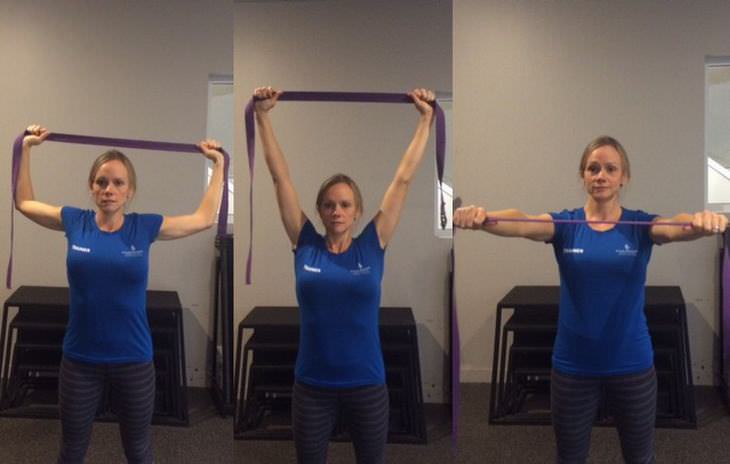
1. Goalpost stretch
un-hunch your shoulders
When your shoulders are rounded, the front of your chest collapses inward. So this stretch will help open up those chest muscles and re-set your shoulders so they are in their natural position. 
 
What to do: Grab a yoga strap, jump rope, or belt and come to a comfortable seated or standing position. Place the belt in both hands and straighten your arms out at shoulder height, keeping your palms facing down. Then bring your hands a little wider than shoulder-distance apart on the strap. Inhale, lifting the strap up and overhead, palms facing forward. When you exhale, bend the elbows to about shoulder height and lower the strap. Then, draw your shoulder blades down your back and in toward your spine. Inhale and reach your arms back up, exhale and return to your starting position, with your arms out in front of you at shoulder height. Repeat for three to five times.  
 
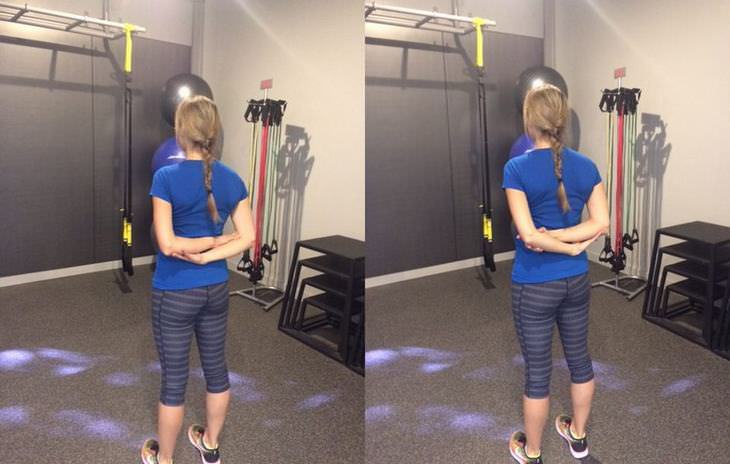
2. Back-bound hand stretch
un-hunch your shoulders
If you spend much of your day with your shoulders hunched, that inward rotation of your shoulders can become habitual. This move will help counteract that bad habit.  
 
What to do: Sit down comfortably, or come into a standing position and slide your shoulder blades down and away from your ears, and together toward your spine. Bring both arms and hands behind you and grab your right elbow with your left hand and your left elbow with your right hand. If you find this difficult, grab your wrist or forearm with the opposite hand. Then, lift your chest and press your shoulder blades down your back while drawing them toward your spine. Take 3 to 5 deep breaths, then switch sides by grabbing your left elbow with your right hand and your right elbow with your left hand. Once again, lift your chest and press your shoulder blades down your back and toward your spine, taking 3 to 5 breaths. 
 
3. Shoulder blade squeeze
un-hunch your shoulders
This move will strengthen the scapular/shoulder blade muscles, which prevent your shoulders from hunching forward, giving you a better awareness of good posture.  
 
What to do: Come into a seated position and sit up tall with a good posture. Bring your shoulder blades together as though you were holding a pencil between them and down away from your ears as you squeeze. Hold for 10 seconds, repeating 10 times, and repeat this move 3 or 4 times throughout the day. 
 
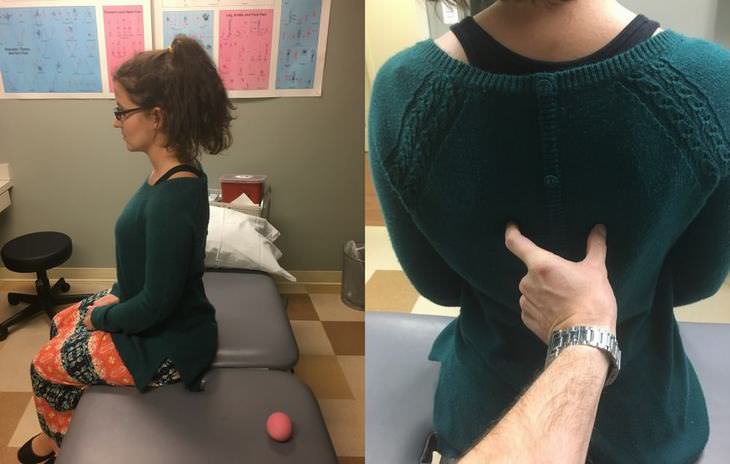
4. Soft tissue chest massage
un-hunch your shoulders
This move will loosen your chest muscles. This is important because when they're tight they pull your shoulders forward, worsening a hunch. 
 
 What to do: Take a lacrosse ball or a tennis ball and place it against your pectoral muscles, inside your shoulder bone and underneath your collarbone. Gently lean against a corner of a wall and with your chest resting against the ball on the wall, and your face in the space at the corner (as shown in image) Gently press into the wall with your body and massage throughout this area. If you find a tender spot, let the pressure of the ball sit against that knot until you feel the tightness release. 
 
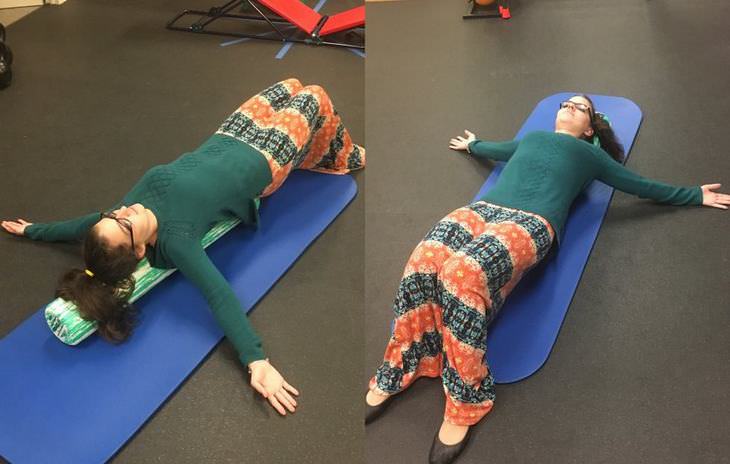
5. Supine T  
un-hunch your shoulders
This exercise is great to do first thing in the morning or right before you go to sleep. It's a relaxed chest-opener that helps loosen tight pecs, which may cause your shoulders to hunch forward. 
 
What to do: Lie flat on your back keeping your knees bent and your feet flat on the floor. Place your arms out to the side, keeping your palms face up, forming a 'T' with your body. To increase the stretch, place a rolled towel or foam roller lengthwise along your spine. Keep both your hips and head on the roller or towel and do this for 10 minutes each day.  
 
6. Resistance 'rowing' 
 un-hunch your shoulders
This exercise will strengthen the muscles in your upper back, which reinforces proper alignment in the shoulders.  
 
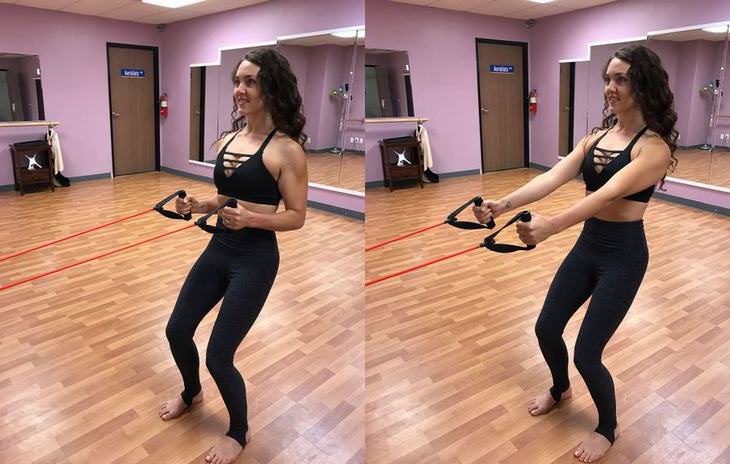
What to do: Attach a resistance band to a steady doorknob or piece of furniture at waist level. Grab the ends of the band and step a few feet away. Keep your feet parallel and hip distance apart. Soften your knees and keep your torso upright with an elongated spine - to help keep your spine straight you may also sit on a chair or stability ball. Bend your elbows back behind your waist while squeezing your shoulder blades together, then slowly return to your starting position. Begin with 10 reps, then increase to 2 or 3 sets of 10. For further resistance, step farther away from the doorknob. If you want less resistance, move closer.  
 
7. Wall angels 
 un-hunch your shoulders
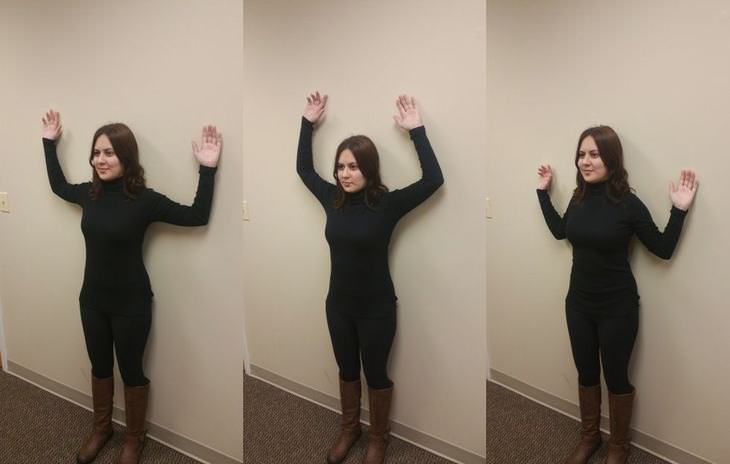
This exercise strengthens the muscles responsible for holding your shoulders back (the opposite movement of hunching them forward). It also reminds the brain where shoulder range of motion should be. 
 
What to do: Stand with your back against the wall and your arms out to your sides and then bend your elbows and rotate your arms so that the back of your hands will touch the wall exactly above your elbows. Move your arms up and over your head slowly, focusing on maintaining contact between your elbows, hands and the wall, then lower your arms. Go as high or as low as you can, keeping the backs of your hands and elbows in constant contact with the wall. Raise and lower your arms in this motion for 10 times, slowly, as if to make a snow angel on the wall.


This is only for your information, kindly take the advice of your doctor for medicines, exercises and so on.   

https://gscrochetdesigns.blogspot.com. one can see my crochet creations  
https://gseasyrecipes.blogspot.com. feel free to view for easy, simple and healthy recipes    
https://kneereplacement-stickclub.blogspot.com. for info on knee replacement


Labels: , , , , , , , , , ,

Sunday, May 08, 2022

Medical Reasons for Shoulder Pain

When it comes to shoulder pain, there could be a number of reasons. It may range from a pulled muscle to a rotator -cuff tear, to a heart attack, and even lung cancer. Here is what you need to be on the lookout for:

Fractured collarbone 
shoulder pain
Fractures of the collarbone are relatively common and painful. You may also find it difficult to move your arm after a break, and your shoulder will hurt and sag forward and downward. But how does this type of fracture arise? Usually, the cause is a fall on, or a direct impact to the shoulder. Miho Tanaka, MD, director of the Women’s Sports Medicine Program and associate professor of orthopedic surgery at the Johns Hopkins Hospital says if your collarbone is broken you'll likely know it. “It is very commonly localized, and most people can feel the ‘break’ in their collarbone because it is just under their skin.” Treatment usually entails an arm sling, stabilizing the area and physical therapy. If the bones have greatly shifted out of place, you might need surgery utilizing plates, screws or pins.

Pulmonary embolism 
If you think that you have pulled a muscle in your shoulder but the pain is so severe that you have difficulty sleeping or lying down, get to the ER immediately. According to WebMD, this type of shoulder pain could be a sign of a blood clot in your lungs. For treatment, you will be given anticoagulants or thrombolytic drugs to dissolve the clot and possible surgery. Without proper treatment, a pulmonary embolism can cause damage to your lungs and other organs, and may even be fatal. 
 
Subarachnoid hemorrhage 
Wherever it may occur, a hemorrhaging is terrible - however, it is particularly bad when it happens in the space between the brain and its protective tissues. One possible symptom is shoulder pain, as well as neck pain, vision problems, numbness, confusion, sensitivity to light, nausea, and seizures. This telltale sign of subarachnoid hemorrhage (SAH) is a sudden and debilitating headache, which may be caused by a brain aneurysm, trauma, or blood thinners. You'll need to seek immediate medical intervention to prevent brain damage and save your life.
Cancer  
Shoulder pain may also be a symptom of cancer, most often, lung cancer. In a 2015 study, 14% of people with mesothelioma, (a type of cancer that develops from the thin layer of tissue that covers many of the internal organs (known as the mesothelium) usually the lungs and chest wall)reported shoulder pain, and this was most often the first symptom. Other types of lung cancer may also cause shoulder pain, including Pancoast tumors, which are located in the upper lungs, and metastatic lung cancer. What's tricky about lung cancer, related shoulder pain is that it is often called 'referred pain' because it starts elsewhere in the body and is often mistaken for arthritis. Other telltale signs that cancer is the cause is that it can be a chronic cough that sometimes produces blood, labored breathing, fatigue, unexplained weight loss, and recurrent respiratory infections. 
 
Heart problems  
Chest pressure or chest pain is the most common sign of heart issues, however, shoulder pain can be one too. According to the National Heart, Lung and Blood Institute, people with angina can experience shoulder pain. In addition, their arms, neck, jaw or back may also ache. Shoulder pain is also one of the many signs of a heart attack. Women especially need to pay attention to this unusual symptom, especially when it is accompanied by sudden and inexplicable fatigue, lightheadedness, shortness of breath and indigestion. For women, symptoms tend to be very different than in men. Women often don't experience traditional chest pain. So if you're feeling off, see a doctor right away. 

 
Bursitis  
 shoulder pain
It is possible that you have never heard of a bursa before - a fluid-filled sac that cushions and protects your joints. If it becomes inflamed, however, it can be extremely painful. A common cause of shoulder pain, bursitis, typically occurs in people over 50 who have diabetes, or a weakened immune system. Athletes are also at risk, particularly those who do a lot of repetitive overhead stretching, such as basketball players and swimmers. James Fedich, a New Jersey-based chiropractor says: “I tell patients it’s like a ziplock bag with some water in it, so it protects you,” Fedich explains. “If you triple the amount of water in the bag, it gets swollen and hurts.” That pain, he adds, is “typically constant, present even during rest, and usually gets worse with activity.” Treatment includes NSAIDs (nonsteroidal anti-inflammatories), ice, range of motion, and strength exercises as well as ultrasound therapy.

Thoracic outlet syndrome  
When blood vessels or nerves between your collarbone and uppermost rib (the thoracic outlet) are compressed, it may result in Thoracic outlet syndrome, characterized by shoulder and neck pain, as well as finger numbness. This could occur as a result of a car accident, repetitive activity (from things like typing, or pitching a baseball, as well as carrying heavy bags, obesity, or pregnancy. It is also possible that you are born with a predisposition to it if you have an extra rib or tight connective tissue between your spine and ribs. Physical therapy is the first line of defense, but in advanced cases, if nothing seems to work, surgery may be suggested. 
 
Gallbladder problems 
Pain in the right shoulder may indicate that you have a gallstone causing a blockage. Other likely areas for sudden and intensifying pain include the upper-right abdomen, the center of your abdomen, below the breastbone, and between the shoulder blades. “A gallbladder issue is typically diagnosed by a primary-care physician,” says Dr. Tanaka, “and it would be apparent to them because the shoulder joint itself won’t hurt with movement.” Other factors that can put you at risk for this condition include high-fat, high-cholesterol, and low-fiber diets, as well as having diabetes, or a family history of gallstones, which can put you at increased risk for this condition. For treatment, medications to dissolve gallstones are usually prescribed, but this could take months or years to work fully. Surgery to remove your gallbladder is also possible. 
 
Pinched nerve  
If you suffer from pain, numbness and pins and needles in your shoulder, arm, and hand, it's possible that you've got a pinched nerve. This happens when a bone, bulging disc, or swollen tissue compresses the nerves, extending from the upper spine to the neck and shoulder. Fedich says, “The nerves come out of the spine in little channels. If the muscles around the spine pull too tight, as when we sleep awkwardly, the channel can get closed off, causing a pinch of the nerve. It’s like someone stepping on a garden hose; water can’t flow freely. In the spine, that will lead to pain wherever the nerve goes.” Sometimes, the problem will go away on its own. If not, typical options include chiropractic adjustments, physical therapy, icing the area, ibuprofen, and corticosteroid injections.


This is only for your information, kindly take the advice of your doctor for medicines, exercises and so on.   

https://gscrochetdesigns.blogspot.com. one can see my crochet creations  
https://gseasyrecipes.blogspot.com. feel free to view for easy, simple and healthy recipes    
https://kneereplacement-stickclub.blogspot.com. for info on knee replacement


Labels: , , , , , , , , ,