Monday, May 08, 2023

12 Surprising Health Benefits of Butter

Butter is a true delight to our taste buds, but many of us try to stay away from this dairy because it’s believed to be really bad for the waistline. However, when taken in moderation, butter has a wealth of health benefits – 12 of which can be found below.

Contains Saturated Fats
Saturated fats contain a lot of good cholesterol and helps to decrease bad cholesterol. Therefore, they are good for your heart and help prevent strokes. Furthermore, they are one of the necessary ingredients for brain development. They also help contribute towards weight loss.

Vitamin Powerhouse 
Butter contains vitamin A, D, and K which can all help revert the effects of tooth decay. Furthermore, they help improve your eyesight, keep your skin glowing, and contribute towards gene transcription
 
Mineral Store 
Important minerals such as copper, zinc, and manganese can be found in butter. These are powerful antioxidants that help fight against dangerous free radicals.
Has Fatty Acids  
Fatty acids boost your metabolism and immune system. Butter is believed to contain short and medium chains of fatty acids. 
 
Contains CLA 
CLA reduces fat mass in humans. This fatty acid is found in dairy products of those mammals that eat a plant-based diet. CLA helps fight against cancer, especially breast and colon cancer. 
 
Contains Butyrate 
Around 3-4% of butter is butyrate, a four-carbon fatty acid which is responsible for keeping your gut working right.

Contains Calcium  
Butter has plenty of calcium which is necessary for strong bones and teeth. 
 
Contains Omega-3 and Omega-6 Fats 
Butter is said to contain the perfect balance of both the omega fats which are necessary for brain functioning and skin-related issues.

Holds Good Cholesterol 
Butter contains the perfect level of good cholesterol. This is important for maintaining a healthy cellular function. Furthermore, it plays an important role in the development of the nervous system. 
 
Anti-Cancer Properties 
Butter’s high levels of beta carotene and Vitamin A has been known to help prevent colorectal and prostate cancer. 
 
Maintains Thyroid Health 
Most thyroid related diseases are because of a deficiency in Vitamin A. Butter contains plenty of vitamin A, so helps protect against thyroid diseases. 
 
Improves Sexual Health  
Studies have proven that the fat-soluble vitamins that are present in butter (A and D) can help boost your sexual performance.
 
 
This is only for your information, kindly take the advice of your doctor for medicines, exercises and so on.   

https://gscrochetdesigns.blogspot.com. one can see my crochet creations  
https://gseasyrecipes.blogspot.com. feel free to view for easy, simple and healthy recipes    
https://kneereplacement-stickclub.blogspot.com. for info on knee replacement
https://cancersupportindia.blogspot.com  for infor on cancer and health related topics
https://GSiyers home remedies.blogspot.com   is the latest addition to my blogs. I'm going to add posts there, do give me your valuable feed back on my blogs. Thanks a lot, take care, be healthy and be happy.
 

Labels: , , , , , , , , , , ,

Sunday, May 09, 2021

How to Keep Your Bones Strong

The base on which our whole body is built is the skeleton. It gives us our stability, as well as our ability to move and function. Our bones are also a factory for manufacturing red and white blood cells. It's extremely important to keep bones strong and healthy, especially in more advanced ages, when calcium seems to drain away.
human bones hand and foot
A little about bone depletion: 
Bone depletion, or osteoporosis, is a disease that occurs as a result of dwindling bone mass and a decrease in the levels of calcium. Throughout our whole life, our bones are in a continuous process of construction and deconstruction. However, at a young age, there is more construction than destruction. 
 
Things even out as we grow older. In our fourth decade, destruction finally overtakes construction. As a result, our bone density drops and our bones become more prone to fractures. When this process happens in an extreme way, it is known as bone depletion. It's important to note that losing calcium also makes the bones more sensitive, even if it happens slowly. At an older age, when our balance is not what it used to be, the danger only gets worse. 
 
Because women start with a bone density that is already about 30% less than men's, and because they produce less estrogen as they grow older, they face a bigger risk when it comes to bone depletion. 
 
What is the recommended calcium amount? 
The process of bone depletion in the body is a natural one and cannot be prevented. But it can be minimized in volume and influenced by maintaining our bones and building bone mass through correct nutrition. 
 
The daily calcium amount recommended for the general population is 1000 mg a day. For adults it is 1,200-1,500 mg a day. Vitamin D is also important, as it helps the calcium absorb in the body. So if you want to keep your bones strong, you should also consume vitamin D rich foods. You can get it from the sun or from certain food items.

10 Tips to Keep Our Bones Strong 
 
1. Consume milk products
dairy products on white background
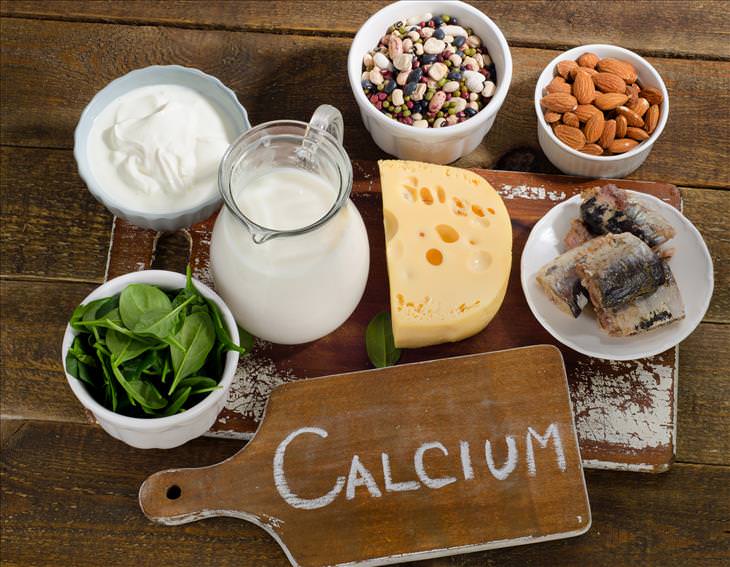
Every child knows that milk is rich in calcium and is essential for strengthening bones. This goes for all milk products, including cheese and yogurt. If you don't like cow's milk, try soy milk enriched with calcium.

2. Add nuts to your diet
Although milk has the highest ratio of calcium to volume, it is not the only source. Some nuts and seeds have handsome amounts of calcium. A 30-gram course of almonds contains 75mg of calcium, 30 grams of sesame seeds contains 37mg of calcium and sunflower seeds have 33mg of calcium. 
 
3. Eat dark green vegetables
brocolli
Broccoli, Chinese cabbage, arugula, parsley, lettuce and others are excellent sources of calcium, and contain many additional health advantages. This will help you to diversify your sources of calcium, which is important to maintain your health.

4. Take the right Vitamin A -  
Vitamin A appears in two forms. The first is retinol, which appears in animal products, such as the liver. The second is beta carotene and it is the way the vitamin comes from plants, especially orange vegetables like carrot, squash or sweet potato. Studies have found that consuming too much of retinol vitamin A raises the risk of bone fraction, while vitamin A in its plant form, Beta Carotene, does not damage the bones. 
 
5. Strengthen your bones with Vitamin K
This vitamin helps activate 3 essential proteins that are crucial for bone health. As in the case of calcium that comes from green vegetables, vitamin K also comes from the same sources. Two daily helpings of green vegetables a day give the body as much as it needs. 
 
6. Physical activity strengthens the bones
This might sound like no big news, but when we carry out a physical activity, we create pressure on our skeleton. While it is bad to overdo it, a moderate pressure is actually very health, as it sends the body signals to create more bone cells, increase the density and make it stronger. Operate the body with moderation, and don't go too far with it. 
 
7. Eat fish
100 grams of sardines contain an amazing amount of over 400 mg of calcium! It's recommended to consume fresh fish, of course, and not the canned variety. The little bones are also edible and contain a lot of calcium. Sardines, like salmon, are also a great source of vitamin D.

8. Reduce your consumption of carbonated drinks and treats
The acid that exists in some of the popular carbonated drinks raises the amount of acid in the blood. To compensate, the body uses the body's minerals, including calcium. If calcium is not readily available in the blood, the body will take it from the bones and this will harden the density and strength of the bone. There is no problem drinking them once in a while, but if it is a daily habit, you could be doing a lot of damage to your bones over time. 
 
9. Avoidance measures - 
Like a lot of other health problems, we return to smoking. Studies have shown that smoking harms bone density, and so does over-consumption of alcohol and caffeine. 
 
10. Resource allocation - We must carry out our calcium consumption in a smart way. Our body absorbs calcium best when it takes no more than 500 mg at a time. So, if you are planning on consuming a large amount of calcium-rich foods or drinks, try to divide the meal or eat again later, to make sure the body is able to absorb all you are giving it.

This is only for your information, kindly take the advice of your doctor for medicines, exercises and so on.     

https://gscrochetdesigns.blogspot.com. one can see my crochet creations  
https://gseasyrecipes.blogspot.com. feel free to view for easy, simple and healthy recipes    
https://kneereplacement-stickclub.blogspot.com. for info on knee replacement

Labels: , , , , , , , , , ,

Wednesday, February 26, 2020

Ways to Improve Your Bone Health After 50

Around 8 million women in America have osteoporosis, and an estimated 30 million more may get this disease, which can cause bones to break due to something as harmless as a sneeze or cough. Thankfully, there are ways to prevent additional bone density loss as you get older. Below, you’ll find 7 of them:

1. Know Where You Stand

If you’re not sure where you stand on the bone-strength scale, head to your doctor’s office for a couple of helpful tests.

One such test is the software program FRAX (Fracture Risk Assessment Tool), which was developed by the World Health Organization to help your physician calculate your probable osteoporosis risk over the next decade. It does this by assessing your lifestyle, health, risk factors, and genetic history.

However, the most accurate test is the bone-density test, also known as a dual-energy X-ray absorptiometry (DEXA) scan, which you should get when you reach menopause. During this simple and noninvasive test, the patient lies on a padded cushion as the screening device beams low-dose X-rays onto the hips and spine to measure bone-mineral density.

The patient will then get a “T score” that compares her bone density with women in their 30s, when bone strength is at its highest. A T score of +1.0 to -1 indicates normal bone-mineral density, a score of -1 to -2.5 indicates osteopenia, a condition in which bones are less dense than normal, and a score of -2.5 indicates osteoporosis.

2. Bone up With Calcium

Your bones store up to 99% of the calcium that your body needs for every function, including blood clotting, and muscle and nerve function. Women can lose up to 20% of their bone density during the 5-7 years after menopause due to a decrease in estrogen.

How this hormone strengthens bones isn’t entirely clear, but a study carried out by the University of Buffalo in 2007 found that it may maintain bone density by preventing an enzyme called caspase-3 from triggering the death of osteoblasts, cells that help grow new bone and teeth.

Therefore, this is why women over the age of 50 should get about 1,200 milligrams of calcium a day. Your best sources of calcium include low-fat and fat-free dairy products such as milk, cheese, yogurt, and ice cream.

However, it’s important that you don’t overdo it as too much calcium – more than 2,500 mg for adults 19-50, or more than 2,000 mg if you’re over 51 – can lead to constipation, kidney stones, and it can interfere with the body’s ability to absorb essential minerals such as iron and zinc.


3. Get More Vitamin D

If women don’t get enough vitamin D, they could lose up to 4% of their skeletal mass every year. This is why it’s vital to increase vitamin D intake. It helps to maintain calcium levels in the bones and aids in absorption.

You can get vitamin d from leafy greens and fortified dairy products, but the major source is sunlight, which triggers the production of this vitamin in your skin. Therefore, if you live in a cloudy climate, you’ll probably need to take some vitamin D supplements.

Many doctors believe that women over the age of 50 need 2,000-3,000 international units of vitamin D per day.

4. Eat Your Veggies

 Fruit and vegetables have high levels of nutrients essential for skeletal health, such as magnesium, potassium, vitamin C, vitamin K, and several B vitamins.

Magnesium helps cells to absorb calcium, vitamins C and K regulate the enzymes responsible for strengthening bone, and B vitamins help cells to regenerate.

According to a study, five servings of fruit and vegetables each day is all you need.

5. Quit Smoking

According to a study which was carried out on 4,332 women at the Universidade Federal de Sao Paulo in 2007, Smoking leads to bone loss and fractures in women older than 40.

Nicotine has toxic effects on bone-forming cells and lowers estrogen levels, which reduces bone density and leads to earlier menopause.

6. Drink Moderately

If you drank a lot of alcohol during your teenage years, you may have irreversible skeletal damage and a greater risk of future fractures and osteoporosis.

When researchers exposed adolescent rats to the human equivalent of binge drinking (four drinks on one occasion) thee days in a row, more than 300 genes responsible for bone formation and bone-mass maintenance were disrupted. This damage was long lasting too.

However, according to a 2009 study published in The American Journal of Clinical Nutrition, moderately drinking 1-2 glasses of wine a day can actually protect bones, especially if you’re postmenopausal. Researchers theorize that moderate drinking may affect estrogen concentrations or suppress bone breakdown to release minerals used in the rest of the body.

7. You Really can be Too Thin

Having a little extra paddle can help to protect your bones as a low body weight often goes hand in hand with low bone mass and an increased risk of fractures. In fact, a 10% weight loss results in up to 2% bone loss.

Fat is associated with bone-building hormones, such as estrogen, and when you lose weight, circulating estrogen starts to decrease.


This is only for your information, kindly take the advice of your doctor for medicines, exercises and so on.     

https://gscrochetdesigns.blogspot.com. one can see my crochet creations  
https://gseasyrecipes.blogspot.com. feel free to view for easy, simple and healthy recipes    
https://kneereplacement-stickclub.blogspot.com. for info on knee replacement
 

Labels: , , , , , , , , , , ,

Sunday, January 27, 2019

These 10 Tips Will Keep Your Bones Stronger for Longer

Bone mineral density refers to the amount of minerals in our bones, which indicates their strength and density. Bone mineral density that is below the normal levels, but is not low enough to be classified as osteoporosis, is known as osteopenia.

Osteopenia usually doesn't cause pain or other symptoms, but it is very important to understand how it can be prevented as it can progress to osteoporosis (where the bones become so weak that they fracture extremely easily). 

Aging is a common cause of low bone mineral density. Other factors that contribute to osteopenia include eating disorders, metabolism problems, exposure to radiation, chemotherapy, family history, lack of physical activity, smoking, regular consumption of sodas, and excessive alcohol consumption. There are no obvious symptoms of osteopenia. Therefore, you should take a bone density test every few years after you have turned 35.
Here are 10 top ways to prevent the loss of bone mineral density.


1. Consume Adequate Calcium 


Calcium is one of the most important nutrients for improving your bone density. Our bones are made of calcium, so this nutrient is essential for preventing any bone-related diseases. People between the ages of 19 and 50 should consume around 1,000 mg of calcium per day. Women, who are at a higher risk of contracting bone diseases, should consume 1,200 mg of calcium a day.
You can get your daily requirement from sardines, dark green vegetables, organic dairy products, blackstrap molasses, dried fruits, and fortified soy products such as tofu. If you do not have a balanced diet, you should speak to your doctor about taking calcium supplements.


2. Boost Your Vitamin D intake
Vitamin D is another essential nutrient that improves bone health and reduces the risk of osteopenia. Furthermore, vitamin D also helps your body utilize calcium better. You can get vitamin D into your body by eating eggs, salmon, swordfish, sardines, and fortified foods such as cereal and orange juice. Our bodies also produce vitamin D when exposed to the sun, so take the time to enjoy 10-15 minutes of early morning sun exposure each day.

3. Stay Active
Regular exercise is great for overall health and bone health is no exception to this rule. Our bones form and remodel in response to physical stress, thus regular physical activity is a great way to prevent the loss of bone mineral density. For good bone health, aim for around 30 minutes of weight-bearing activities most days of the week. Activities like walking, hiking, and dancing are all great choices.

4. Quit Smoking


Smoking is bad for our overall health, especially bone health. Smoking prevents the body from efficiently absorbing calcium, thus decreasing bone mass. In fact, smokers are at a much higher risk of fractures than non-smokers. Therefore, you should try to quit smoking as soon as possible. You can get help from professionals as well as family members and friends.

5. Consume Less Caffeine                                             
Coffee does have some health benefits when consumed in limited amounts, but too much caffeine in any form is no good for your bones. Excess caffeine intake can interfere with the body's ability to absorb calcium, which is vital for good bone health.

6. Eat Foods Rich in Vitamin K
Vitamin K will give a boost to your bone mineral density level. This particular vitamin helps the body make proteins for healthy bones and reduces the amount of calcium that is excreted by the body. Vitamin K rich foods include kale, Brussels sprouts, turnip greens, fermented dairy products, broccoli, and prunes.

7. Reduce Your Sodium Intake
Salt causes excessive calcium excretion through the kidneys. In fact, too much salt appears to be a risk factor for bone fragility. To improve your bone health, it's essential that you limit your salt intake. The American Heart Association suggests consuming less than 1,500 mg of salt a day.

8. Pump Up Your Potassium Level 

Potassium is known to be important for muscle health, but it is also beneficial for bone health. This mineral neutralizes acids that remove calcium from the body. The recommended daily intake of potassium for adults is 4700 mg. The best sources of potassium are avocados, bananas, strawberries, kiwis, mangoes, apricots, carrots, dates, sweet potatoes, spinach, broccoli, and red peppers.

9. Eat Magnesium-Rich Foods
To improve bone health and reduce the risk of getting osteopenia, you should eat magnesium-rich foods every day. Magnesium is needed in over 325 enzyme systems in the body that control thousands of chemical interactions and it's also vital for bone health. It stimulates the hormone calcitonin, which preserves bone structure by drawing calcium out of the blood and soft tissues and back into the bones.

Great sources of magnesium are almonds, avocados, beans, bananas, pumpkin seeds, tofu, soy milk, pecans, walnuts, potatoes with skin, yogurt, whole grains, and green leafy vegetables.

10. Eat Foods Rich in Vitamin C
Vitamin C can also help prevent loss of bone mineral density. Collagen is the main protein in bones, and vitamin C plays a major role in collagen synthesis. To get vitamin C into your diet, eat fruit and vegetables such as bell peppers, oranges, broccoli, strawberries, Brussels sprouts, kiwi, pineapple, and cauliflower. You can also take vitamin C supplements, but please consult your doctor first.

THIS IS ONLY FOR INFORMATION, ALWAYS CONSULT YOU PHYSICIAN BEFORE HAVING ANY PARTICULAR FOOD/ MEDICATION/EXERCISE/OTHER REMEDIES.                                    PS- THOSE INTERESTED IN RECIPES ARE FREE TO  VIEW MY BLOG-                                                                                           https://gseasyrecipes.blogspot.com/       
                                                                                                                                                                      FOR INFO ABOUT KNEE REPLACEMENT, YOU CAN VIEW MY BLOG-                                                  https:// kneereplacement-stickclub.blogspot.com/           
                                                                           FOR CROCHET DESIGNS                                                                                                                                                                                                  https://gscrochetdesigns.blogspot.com 
 

Labels: , , , , , , , , , , , , , ,