Wednesday, July 16, 2025

Are Wrinkles Your Body’s Way of Telling You Something?

In the majority of cases, face wrinkles are just a reflection of our natural age, lines that we deserve to wear proudly, as they show our rich life experiences, both good and bad. However, in some cases, wrinkles can be a sign of something more serious, especially if these appear only on one side or part of your face, emerge or deepen suddenly, or show up at a young age. More specifically, wrinkles can be an early sign of dangerous health conditions or a hint that you’re putting yourself through too much stress. Here are 6 things your wrinkles can tell about you:

1. Cardiovascular problems wrinkle causes bald man with deep forehead wrinkles

 
Although this may come as a surprise, research shows that wrinkles can point to cardiovascular problems, particularly to atherosclerosis and hypertension. More specifically, deep forehead wrinkles may indicate atherosclerosis (blocked blood vessels), according to a 2018 study. 
 
The study looked at 3,200 adults over the course of 20 years and found that the participants who had deep forehead wrinkles were 10 times more likely to die of heart disease. The researchers suggest that the correlation, though observational, can point to atherosclerosis, the leading cause of heart disease because blood vessels in our forehead are much finer, and so they are the first to be blocked by plaque buildup.

A different study drew a correlation between face wrinkles and hypertension, though only in women, pointing out that the participants who looked younger than their age had an overall lower blood pressure than their counterparts with worse skin.

2. Stress

wrinkle causes stressed out sad troubled woman elderly senior 
Is there any function or organ in our body that isn’t affected by stress? The answer is likely no, and our skin is no different and is often the first to take the fall. Younger adults swear that the so-called “stress breakouts” are a thing, and people who have been through a lot of stress do seem to age faster than the rest of us.

Of course, the frowning, the crying, and the poor lifestyle choices don’t help (yes, we’re talking about all that junk food we eat after a hard or sad day), but stress also affects our hormones, which play a key role in our skin health, among other things. Try not to submit to stress when you can, or at least try to avoid the harmful habits that we mentioned, your skin will thank you.

3. Skin cancer risk
 One of the major contributing factors of skin cancer (particularly melanoma) is excessive sun exposure. But skin cancer isn’t the only unwanted and non-refundable gift we get from the sun, wrinkles, and sunspots are part of the package as well.
Crepey wrinkles on the cheeks and wrinkles only on one side of the face (from UVA light exposure through the car window) are especially risky. Also, remember that even if you have no sunspots on your face, this doesn’t mean you’re safe, as we now know that the majority of wrinkles are the result of sun exposure. The bottom line is: how much and how often we wear sunscreen will show, whether we like it or not.

4. Weak bones
Both our skin and our bones rely on this one protein to keep them healthy and strong. You guessed it, we mean collagen, the most common protein in the human body. Knowing this, researchers at Yale looked at the correlation between the presence of deep wrinkles on the face and bone density in 40-50-year-old women and found that deeper wrinkles were linked to lower bone density, irrespective of the age. 
 
Though limited to postmenopausal women only, the results of the study let you estimate the health of your bones and your risk of fractures based on the appearance of your skin. 
 
5. Too Much Screen Time
 
wrinkle causes woman young blonde smiling closeup portrait
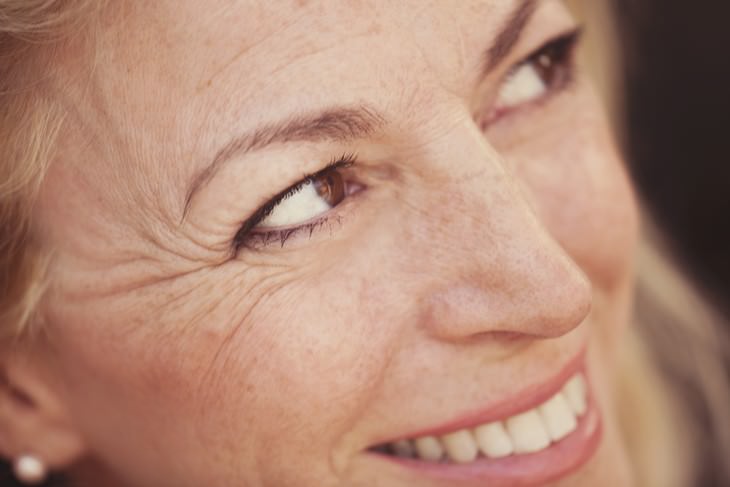
Remember the frowning we mentioned in the section about stress? Well, it turns out that many people do a lot of that, as well as a lot of squinting and eyebrow-raising while they’re using computers and mobile devices. Predictably, this causes premature wrinkles on the forehead, around the eyes, and especially between the eyebrows.

These have nothing to do with the light your devices emit and everything to do with the grimaces you make when you’re deeply concentrated on the task at hand. 
 
 
6. Your Personality
Sometimes, it’s not a dangerous disease or bad habit that’s showing through your wrinkles, it’s just your personality. Do you have smile lines, crows feet, and bunny lines? Well, it might be just because you’re a happy person that smiles a lot. The opposite is also true, unfortunately, and lip lines, the so-called eleven-shaped wrinkles on your forehead and frown lines can point towards you often being serious or looking grumpy when your face is relaxed (the latter is also called a “resting bitch face” in youth slang). 
 
In the end, your wrinkles may just be showing that you’re an expressive person and like to wear your heart on your sleeve, a character trait many people really appreciate.


This is only for your information, kindly take the advice of your doctor for medicines, exercises and so on.   


Labels: , , , , , ,

Tuesday, January 25, 2022

Your No-BS Wrinkle Erasing Guide

As we age, we gain wisdom, and with those, like an unwelcome hitchhiker, come wrinkles. This process is natural and inevitable, though it can be unnaturally accelerated through exposure to UVA sun rays and excessive stress. Every process in our body slows down, and that includes collagen production. This makes our bones more fragile and our skin less toned. The skin is the largest organ in the body and it varies to an incredible degree: it can be as thin as 0.07 mm on our eyelids or more than twice as thick on our upper back. This affects wrinkle accumulation. In this article, we will discuss neck and facial wrinkles and the best ways to smooth them.  
 
Why do we get wrinkles?
wrinkles on the neck
As always, we'd like to take an educational approach to this subject, so before we start using jargon and sprinkle the word "collagen" all over this article, it's important to establish what it is in the first place. Collagen is a protein found not only in our skin but also in our bones, blood vessels, tendons, ligaments, and muscles. Or, in short, in almost every connective tissue. It holds everything in place. As we mentioned in the introduction, the natural production of collagen degrades over time, causing our skin to decrease in elasticity. As the collagen in the skin diminishes, along with fat and water stored in the skin, the skin shrinks - causing a wrinkly look. Neck wrinkles will usually appear around your 40s and 50s. The skin of the neck is sensitive and even thinner than that on our faces.  
 
Prevent wrinkles with SPF
As with everything related to our body and health, preventing and performing daily upkeep is much easier than treating a problem once it has occurred. Your number one step to preventing wrinkles is the vigorous use of sunscreen. That is because the UVA rays emitted by the sun are the number one cause of premature aging. The sun emits both UVA and UVB rays. However, they differ in wavelength. UVB will burn you (remember B for burning) while UVA will cause long-term damage of aging: wrinkles and sunspots (remember A for aging). UVA rays are longer than UVB, meaning they can penetrate through clouds and windows. Therefore it is recommended to wear sunscreen every day of the year, even while staying indoors. On sunnier days, renew your layer every 2 hours. 
 
Facial Yoga
facial yoga

Facial yoga or facial exercises will help you increase blood flow and with it oxygenation to the area. It will also help with proper drainage and tightening the muscles of the neck and face area to keep everything looking tight. This goes under the category of traditional medicine (as opposed to western medicine), meaning it has been done for ages, but there isn't any modern scientific research to elaborate on and support its benefits. As the current research stands, facial yoga or yoga, in general, will have the same effects on your body, which is increased flexibility, more oxygen in the blood, and better posture. The latter can help with "tech-neck", the horizontal lines we get on our neck when we look down all day at a screen. Fixing your posture can help with that. 
 
Additional practices in that same category are facial cupping (rooted in Chinese culture), facial massages, using jade rollers, or gua-sha. Note that facial cupping is not recommended for those who have rosacea. As for the use of facial massaging tools, we'd like to debunk the myth that they will increase the production of collagen in the skin. There is no harm in using those tools. They may only help with a most temporary de-puffing of the face, but at the very least they're a nice pampering ritual for a relaxing moment at the end of a long day. However, they will not smooth out your wrinkles. For maximum de-puffing effect, keep them in the fridge. Some manufacturers market the use of a jade roller specifically. Choosing a healing stone over a steel roller is up to whether you believe in their healing powers or not. But if you do, then please review this guide on how to recognize a fake stone. As for how to use them, since they're a porous stone we would recommend washing your face, drying it, having the roll, and then finishing with your facial creams and serums. Wash your roller after each use.

Habits to acquire and habits to avoid
Some of your daily habits that can prevent premature wrinkles are: 
 
1. Sleeping on your back. This will diminish a puffy face when waking up. 
 
2. Regular exercising. 
 
3. Incorporate vegetables, fruits, and anti-oxidant foods into your diet. Avoid processed foods. 
 
4. Find a way to manage stress in your life. 
 
5. Try a silicon patch for hydration and smoothing out wrinkles. These go on the face, neck, and chest. You can purchase them online and in drug stores, but make sure to search for medical-grade silicone ones. 
 
6. Get a minimum of 8 hours of sleep. 
 
7. Stay hydrated and apply your sunscreen every single day of the year.

Now, let's discuss what to avoid. 
 
1. Any DIY treatments at home that call to apply anything from your kitchen to your face are not always recommended and should preferably be avoided. That is because, while natural, the active components of foods are not formulated to be put on your face. Acidic and harsh chemicals found in lemon, vinegar, and baking soda can irritate your skin. If they don't irritate you, they also won't yield long-lasting wrinkle-repairing results as, again, they are not formulated to penetrate the cells of your skin. There is a difference between using a raw lemon on your face and using a lemon-extract-based moisturizer. The latter will deliver better, safer results, while the former might harm you and won't deliver long-term benefits. 
 
Using sugar or coffee grounds is also a popular DIY exfoliating method that should be avoided. These substances, specifically coffee, can introduce harmful bacteria to your skin. In addition, the irregular size of the little grains will cause micro-tears on the surface of your skin. This is also the reason we would recommend mild chemical exfoliants over physical exfoliants. These include salicylic acid, glycolic acid, and lactic acid. While there are many more acids, these 3 are most researched.

Still, if you're an avid DIY-er, you can use avocado, oats, and honey on your face. We would still argue that store-bought, chemically-formulated, well-researched products are always safer and more efficient, but we can safely say that there is little to no harm in applying raw avocado, oats, or honey to the skin. These aim to be nourishing and calming. 
 
2. Cut down on alcohol if you consume it excessively. 
 
3. Avoid smoking.  
 
4. Avoid spraying perfume on the neck, put it on the body instead. 
 
Products and ingredients

If you don't have a skincare routine, establishing one can help the health of your skin. It doesn't have to be complex or expensive. Simply cleansing your face with a dedicated, mild soap, followed by a fragrance-free moisturizer and an SPF for the AM, is enough. This will keep your skin nourished and moisturized, and most importantly- protected from the sun. Companies like Aveeno, Cera-Ve, Cetaphil, and the likes, make good, reasonably-priced products. 
 
Additional treatment steps can be added to a routine for anti-aging benefits. Antioxidants (vitamin C being the most prominent one), peptides, and exfoliating acids are naturally-occurring chemicals that protect the skin and have been scientifically proven to increase collagen production and treat fine lines and pigmentation. An antioxidant serum can be used daily in the AM, peptides can be used even twice daily, but chemical exfoliates should be used up to 3 times a week, in the PM, followed by an SPF the next morning as they will make your skin more sensitive to the sun. You can also perform a physical exfoliation with dedicated soaps, but this is much harsher on the skin of the neck.

Besides SPF, which is considered the ultimate gold-standard anti-aging ingredient, there is also retinol. This is a form of vitamin A that has been proven in endless research to increase collagen production in the deep layers of the skin. It can be, however, very irritating to the neck area as it is more sensitive than the face. Simply using an SPF diligently can be enough; the use of additional active ingredients isn't a must.
 
In-office Procedures on varying levels of invasiveness
radio frequency for face
In-office procedures will be performed only by a doctor, and their purpose is more to treat rather than prevent wrinkles and sagging skin. These will be more expensive than anything discussed in the article so far, with a price range of 300$ to 2000$ per treatment session. 
 
Ultrasound therapy  
This treatment, like many others in this section, delivers heat to the deeper levels of the skin. This heat damages the cells but not the outer layer of the skin, so there is no scarring. The result is an increase in collagen production to make up for the loss of cells, which will gradually culminate in fuller tissues of the skin. You can see results in 3 months. There is no downtime- you can leave the clinic as if nothing happened! 
 
Radiofrequency  
This treatment can also be done on any other part of the body to target, apart from wrinkles, cellulite, and stretch marks. Results will be seen within 6 months. There is little to no downtime for this kind of therapy.

Laser resurfacing 
These are quite more invasive, so the downtime is 7 days. The results, however, will be seen within 2 weeks. 
 
This is only for your information, kindly take the advice of your doctor for medicines, exercises and so on.   

https://gscrochetdesigns.blogspot.com. one can see my crochet creations  
https://gseasyrecipes.blogspot.com. feel free to view for easy, simple and healthy recipes    
https://kneereplacement-stickclub.blogspot.com. for info on knee replacement


Labels: , , , , , , , , , , , , ,