Friday, December 10, 2021

Un-Hunch Your Shoulders With These Exercises

Given our day-to-day activities, we often find ourselves hunching over. We can blame it on all the time we spend doing computer work, driving, lifting babies, or scrolling through Facebook on our phones. All of these activities, and more, contribute to tight muscles, causing a significant hunch in the shoulders.

Why do your shoulders hurt? 
More than 20% of people suffer from shoulder pain. This usually stems from stiffness in the shoulders after long hours hunched over a desk. There are a number of reasons why you might be experiencing shoulder pain. It could be from a recent injury like a torn rotator cuff or something that has developed over a long period of time.
According to the American Academy of Orthopaedic Surgeons, there are four main causes of shoulder pain: 
 
 1. Tendon inflammation or tear: This includes conditions like tendinitis, tendon tears, and bursitis. They occur when small, fluid-filled sacs called bursa, which cushion the bones and reduce friction in the shoulders joints, become inflamed and swollen. It may also be possible for the top of your shoulder blade to rub against the rotator cuff tendons and bursa, which is called impingement. 
 
2. Instability: Your shoulder becomes unstable when the top of your arm comes out of the socket, either from an injury or overuse. The more this happens, the more likely it will continue to reoccur, which leads to an increased risk of developing arthritis.  
 
3. Arthritis: Osteoarthritis occurs around middle age. You notice swelling, pain or stiffness in the shoulders which occur as a result of daily use or work injuries. It is also possible to develop other types of arthritis in the shoulder. 
 
4. Bone fracture: Got a broken collarbone, upper arm bone or shoulder blade? This usually happens after a fall or a car accident which causes severe pain, possibly around the shoulders. 
 
In rarer instances, shoulder pain can also be an indication of infection, nerve problems, or cancer - such as a Pancoast tumor, which is a type of lung cancer, or metastatic breast cancer. If you've got shoulder pain, don't panic, however. More often than not it is a minor issue. If the pain persists over several days, be sure to see a doctor.

Other factors to consider 
There may be certain aspects of your lifestyle which may be hurting your shoulders without you even realizing it. It could be things like your mattress, for instance. Notice if it is too soft. Studies have found that a medium-firm mattress works best for people who experience neck and back pain. If your shoulder pain gets worse at night, it may be an issue with the rotator cuff, which could be irritating the bursa. At-home remedies for neck pain include sleeping in a semi-reclined chair, wearing a cooling or heating pad, and using a shoulder support pillow. Always try to be conscious of your posture throughout the day, whether you are sitting in front of a computer or driving. 
 
Finding relief  
If you have an aching shoulder, the first thing you do is look for instant relief. Luckily, there is plenty you can do yourself to help ease the pain. Unlocking tight shoulders and chest muscles is relatively easy with simple exercises, which can be done while sitting on a chair, standing, kneeling, or sitting on the floor. Meg Plotsky, a group exercise and corporate recreation coordinator at the Well & Being Spa at the Four Seasons Resort and Club Dallas, Las Colinas recommends the following exercises and stretches:  
 
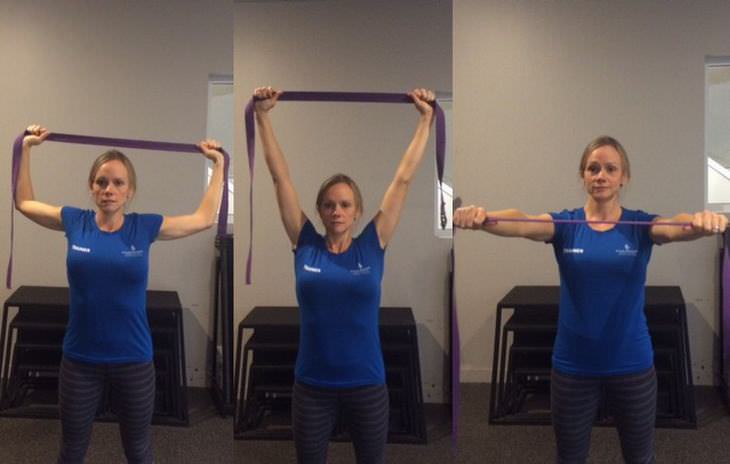
1. Goalpost stretch
un-hunch your shoulders
When your shoulders are rounded, the front of your chest collapses inward. So this stretch will help open up those chest muscles and re-set your shoulders so they are in their natural position. 
 
What to do: Grab a yoga strap, jump rope, or belt and come to a comfortable seated or standing position. Place the belt in both hands and straighten your arms out at shoulder height, keeping your palms facing down. Then bring your hands a little wider than shoulder-distance apart on the strap. Inhale, lifting the strap up and overhead, palms facing forward. When you exhale, bend the elbows to about shoulder height and lower the strap. Then, draw your shoulder blades down your back and in toward your spine. Inhale and reach your arms back up, exhale and return to your starting position, with your arms out in front of you at shoulder height. Repeat for three to five times. 
 
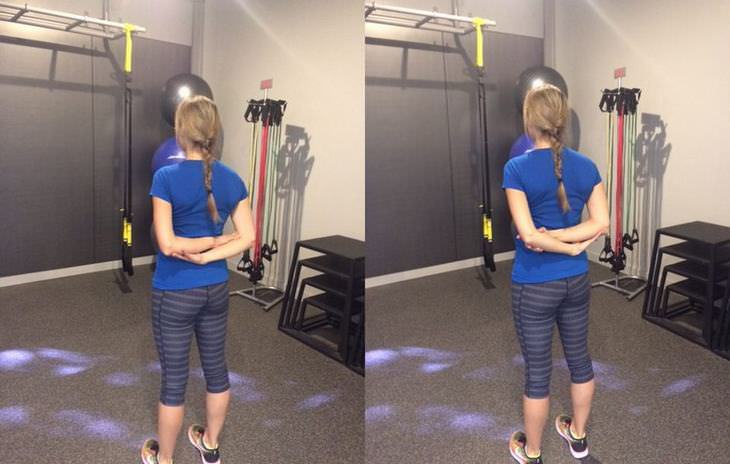
2. Back-bound hand stretch
un-hunch your shoulders
If you spend much of your day with your shoulders hunched, that inward rotation of your shoulders can become habitual. This move will help counteract that bad habit. 
 
What to do: Sit down comfortably, or come into a standing position and slide your shoulder blades down and away from your ears, and together toward your spine. Bring both arms and hands behind you and grab your right elbow with your left hand and your left elbow with your right hand. If you find this difficult, grab your wrist or forearm with the opposite hand. Then, lift your chest and press your shoulder blades down your back while drawing them toward your spine. Take 3 to 5 deep breaths, then switch sides by grabbing your left elbow with your right hand and your right elbow with your left hand. Once again, lift your chest and press your shoulder blades down your back and toward your spine, taking 3 to 5 breaths. 
 
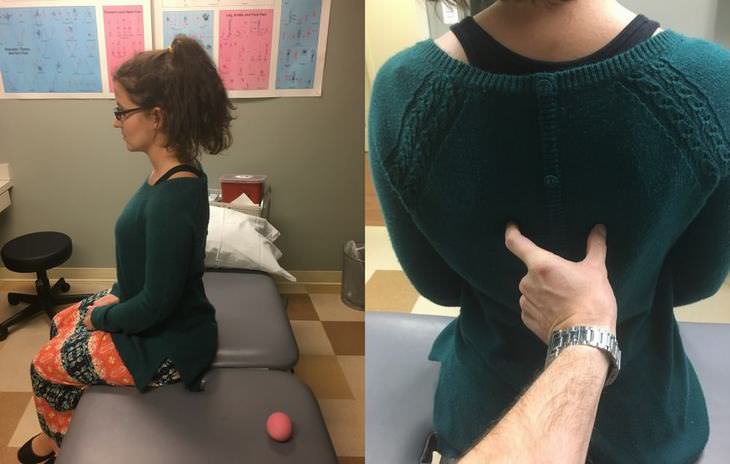
3. Shoulder blade squeeze
un-hunch your shoulders
This move will strengthen the scapular/shoulder blade muscles, which prevent your shoulders from hunching forward, giving you a better awareness of good posture.  
 
What to do: Come into a seated position and sit up tall with a good posture. Bring your shoulder blades together as though you were holding a pencil between them and down away from your ears as you squeeze. Hold for 10 seconds, repeating 10 times, and repeat this move 3 or 4 times throughout the day. 
 
 4. Soft tissue chest massage

un-hunch your shoulders
This move will loosen your chest muscles. This is important because when they're tight they pull your shoulders forward, worsening a hunch.  
 
What to do: Take a lacrosse ball or a tennis ball and place it against your pectoral muscles, inside your shoulder bone and underneath your collarbone. Gently lean against a corner of a wall and with your chest resting against the ball on the wall, and your face in the space at the corner (as shown in image) Gently press into the wall with your body and massage throughout this area. If you find a tender spot, let the pressure of the ball sit against that knot until you feel the tightness release. 
 
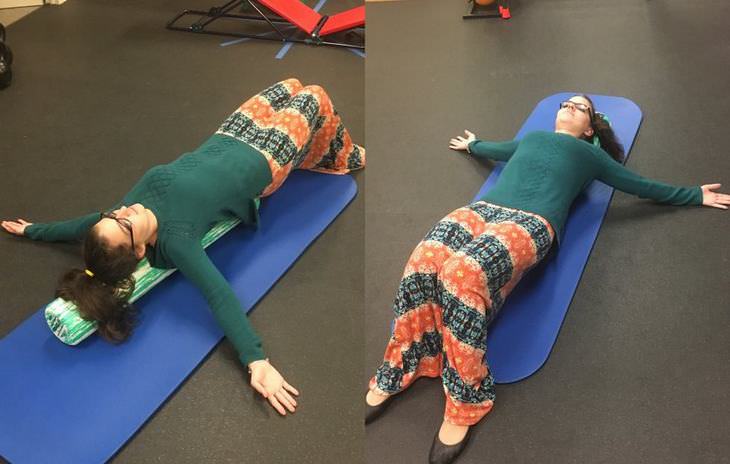
5. Supine T 
un-hunch your shoulders
This exercise is great to do first thing in the morning or right before you go to sleep. It's a relaxed chest-opener that helps loosen tight pecs, which may cause your shoulders to hunch forward.  
 
What to do: Lie flat on your back keeping your knees bent and your feet flat on the floor. Place your arms out to the side, keeping your palms face up, forming a 'T' with your body. To increase the stretch, place a rolled towel or foam roller lengthwise along your spine. Keep both your hips and head on the roller or towel and do this for 10 minutes each day. 
 
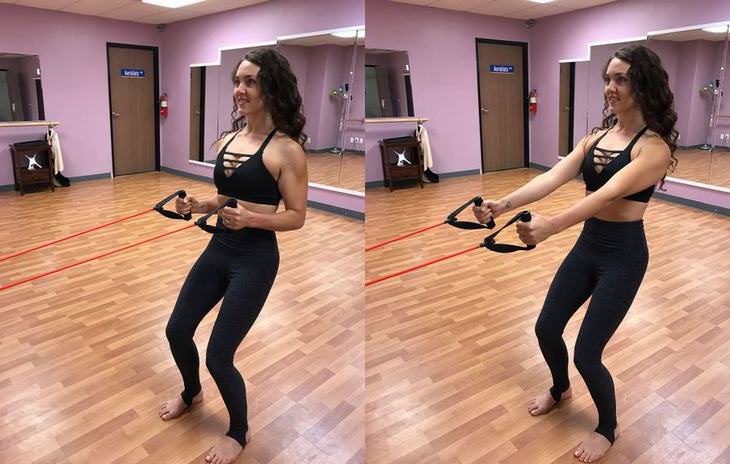
6. Resistance 'rowing'  
un-hunch your shoulders
This exercise will strengthen the muscles in your upper back, which reinforces proper alignment in the shoulders.  
 
What to do: Attach a resistance band to a steady doorknob or piece of furniture at waist level. Grab the ends of the band and step a few feet away. Keep your feet parallel and hip distance apart. Soften your knees and keep your torso upright with an elongated spine - to help keep your spine straight you may also sit on a chair or stability ball. Bend your elbows back behind your waist while squeezing your shoulder blades together, then slowly return to your starting position. Begin with 10 reps, then increase to 2 or 3 sets of 10. For further resistance, step farther away from the doorknob. If you want less resistance, move closer. 
 
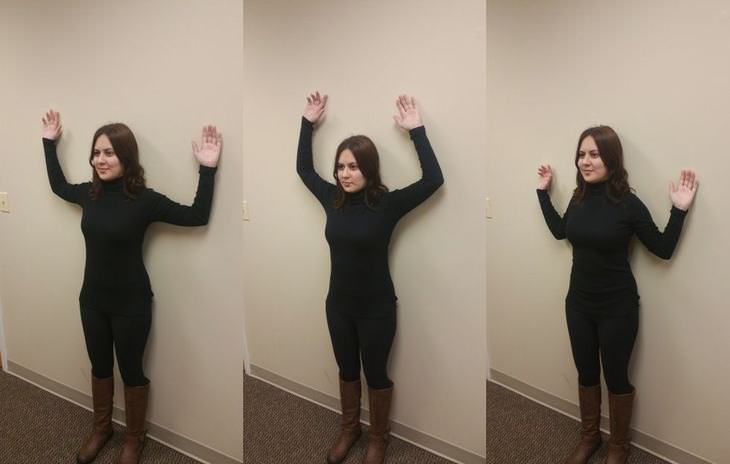
7. Wall angels 
un-hunch your shoulders
This exercise strengthens the muscles responsible for holding your shoulders back (the opposite movement of hunching them forward). It also reminds the brain where shoulder range of motion should be.  
 
What to do: Stand with your back against the wall and your arms out to your sides and then bend your elbows and rotate your arms so that the back of your hands will touch the wall exactly above your elbows. Move your arms up and over your head slowly, focusing on maintaining contact between your elbows, hands and the wall, then lower your arms. Go as high or as low as you can, keeping the backs of your hands and elbows in constant contact with the wall. Raise and lower your arms in this motion for 10 times, slowly, as if to make a snow angel on the wall.

This is only for your information, kindly take the advice of your doctor for medicines, exercises and so on.   

https://gscrochetdesigns.blogspot.com. one can see my crochet creations  
https://gseasyrecipes.blogspot.com. feel free to view for easy, simple and healthy recipes    
https://kneereplacement-stickclub.blogspot.com. for info on knee replacement


Labels: , , , , , , , , , ,

Sunday, July 05, 2020

Vitamin D Benefits You Should Know—and How to Get More in Your Diet


Vitamin D is famous for its bone-building and strengthening powers. “vitamin D promotes absorption of calcium in your gut, which ultimately allows for normal mineralization of your bones,”a nutritionist and author tells Health. Basically, the calcium that benefits your bones wouldn't be able to do its job without vitamin D. “You need vitamin D for bone growth—and to prevent bones from becoming brittle.” When teamed with calcium, it can help prevent osteoporosis, a disease that signifies that the density and quality of bone are reduced, she adds. 

Vitamin D can help strengthen muscles 
Along with its bone-building abilities, vitamin D is also influential in strengthening muscles. “Lack of vitamin D in the body can increase the risk of having weak muscles, which in turn increases the risk of falls,” Lana Nasrallah, MPH, RD, clinical dietician at UNC Health, tells Health. This is especially important for the elderly. “Vitamin D may help increase muscle strength thus preventing falls, which is a common problem that leads to substantial disability and death in older adults.”

Vitamin D can support the immune system and fight inflammation 
Dr. Nasrallah adds that vitamin D can also help build immunity. “It can support the immune system by fighting off harmful bacteria and viruses,” she says. In fact, this role in possibly preventing infections has become a critical concern during COVID-19 pandemic, as researchers are interested in its potential role in infection outcomes. “There is particular interest in its role in viral infections such as influenza and coronavirus,”a Yale Medicine hematologist, oncologist, and nutritionist, tells Health. He points to a 2017 BMJ analysis of 25 randomized control trials comparing vitamin D supplements to placebos, which found that vitamin D reduced the risk of acute respiratory infection with either daily or weekly vitamin D supplementation, particularly in individuals who were deficient in it. “Studies indicate that high latitudes and winter season are risk factors for both low vitamin D, increased influenza, and other respiratory illness and adverse outcomes,” he says. “We now are seeing a similar pattern with higher mortality rates in COVID-19 infections," though more research still needs to be done to determine whether the link is causal or merely a correlation. 

Vitamin D can help strengthen oral health
Because vitamin D helps our body absorb calcium, it plays a crucial role in supporting oral health, lowering the risk of tooth decay and gum disease. A 2011 review notes that while the research is scant, there's an "emerging hypothesis" that the vitamin is beneficial for oral health, due to its effect on bone metabolism and "its ability to function as an anti-inflammatory agent and stimulate the production of anti-microbial peptides."

Vitamin D can help prevent Type 1 and Type 2 diabetes 
While studies are not conclusive, vitamin D may be helpful for preventing both type 1 and type 2 diabetes, says Newgent. One such study, found that while vitamin D on its own did not effectively lower the risk of an overabundance of sugar in the blood, a combined daily intake of >1,200 mg calcium and >800 IU vitamin D could effectively lower the risk of type 2 diabetes. 

Vitamin D can help treat hypertension
According to a 2019 review  suggests that vitamin D may play a role in treatment of high blood pressure—one of the markers of cardiovascular disease—says Newgent. According to authors of the review, “even short-term vitamin D deficiency may directly raise BP [blood pressure] and promote target organ damage.” The researchers went on to add that, "due to the high correlation between vitamin D and hypertension, vitamin D supplementation therapy may be a new insight in the treatment of hypertension."

Vitamin D can help you lose weight 
Dr. Boyd points out that obesity is a known risk factor for low vitamin D levels—which means more vitamin D may help with weight loss. One 2009 study found that, in overweight or obese women with low calcium levels, those who took a daily dose of calcium paired with vitamin D were more successful shedding pounds than those who took a placebo supplement, due to an “appetite-suppressing effect” of the combination.

Vitamin D can help battle depression 
The sun can brighten up your mood, and so can vitamin D. According to a 2017 review article, the researchers found "a significant relationship between depression and vitamin D deficiency.” While they acknowledged that more research is needed to define the exact workings of it—such as, if low vitamin D levels are a cause or effect of depression—the authors recommend “screening for and treating vitamin D deficiency in subjects with depression” noting that it is an “easy, cost-effective and may improve depression outcome.”

Vitamin D may help reduce the risk of certain cancers.
Dr. Boyd points to various studies—that provide some evidence that vitamin D may have cancer fighting powers. “Evidence is increasing that vitamin D supplementation may improve cancer outcomes,” he explains. The cancers for which the most human data are available are colorectal, breast, prostate, and pancreatic cancer. 

The NCI specifically calls out a few reasons why researchers are interested in a link between vitamin D and a lowered risk of cancer. The organization points out that some research shows that incidence and death rates for certain cancers were lower among individuals living in southern latitudes, where levels of sunlight exposure are relatively high, than among those living at northern latitudes, though additional research needs to be done to find a specific causal or correlational link between more sunlight exposure and a lower risk of cancer. More experimental evidence, per the NCI, shows, that cancer cells and of tumors in mice, vitamin D has been found to have several activities that might slow or prevent the development of cancer cells and tumors in mice, including promoting cellular differentiation, decreasing cancer cell growth, stimulating cell death (apoptosis), and reducing tumor blood vessel formation (angiogenesis).

How to get more vitamin D
Despite being readily available through sunlight, some foods, and supplementation, many Americans are still getting inadequate amounts of vitamin D—according to the most recent information from the Centers for Disease Control and Prevention, two-thirds of the population had sufficient vitamin D, defined by the Institute of Medicine as a serum 25-hydroxyvitamin D (25OHD) value of 50–125 nmol/L. Because you can't necessarily find out if you a vitamin D deficiency on your own, the best thing to do is to consult a medial expert, says Cynthia Sass, RD, MPH, contributing nutrition editor for Health. "Ideally the best approach is to have your blood vitamin D level tested to find out if your blood vitamin D level is within the adequate range,” she explains. “This determines if a supplement is needed in order to achieve adequate blood vitamin D status, and if so, the proper dosage of supplemental vitamin D.” 

If you find out you are deficient or lacking in vitamin D intake, there are a few key ways you can up your daily dosage—staring with getting around 20 minutes of sunlight several times a week, according to Newgent. "The major cause of vitamin D deficiency is inadequate exposure to sunlight, an increasing feature in modern life," says Dr. Boyd. But remember: You still need to wear sunscreen whenever you step outside—even to get vitamin D.

Aside from the sun, you can also get extra vitamin D through a few (albeit very few) foods, like fatty fish (including salmon, tuna, mackerel, and sardines) and mushrooms (some of which are exposed to ultraviolet (UV) light to increase vitamin D levels), says Drs. Nasrallah and Newgent. Foods like milk, orange juice, yogurt, and breakfast cereals can also be fortified with vitamin D. And of course, you can always go the supplement route, in the form of vitamin D3, if your doctor thinks it's necessary. According to Dr. Boyd, many doctors now consider a daily dose of 1000-2000 IU of D3 safe and will assure optimal levels for most adults. As for when to take it, because vitamin is fat soluble, he suggests pairing it with your largest meal of the day, “containing fat to assure maximal absorption.” But again, check in with your doctor before you decide to try vitamin D in supplement form. 


This is only for your information, kindly take the advice of your doctor for medicines, exercises and so on.     

https://gscrochetdesigns.blogspot.com. one can see my crochet creations  
https://gseasyrecipes.blogspot.com. feel free to view for easy, simple and healthy recipes    
https://kneereplacement-stickclub.blogspot.com. for info on knee replacement


Labels: , , , , , , , , , , , , , ,