What Is Deep Sleep and How Much of It Do You Need?
Sleep is fascinating, it’s complicated and absolutely essential, all at
once. When you think of it, every one of us spends almost a third of
their lifetime snoozing away. We do until we don’t, that is, as more and
more people don’t actually sleep enough, be it by their own will or
because they physically can’t fall asleep at night. We’ve discussed the
topic of how much sleep you need and sleep deprivation, as well as the
best sleep positions, but the topic we’d like to focus your attention to
today is sleep cycles, and deep sleep in particular, because it turns
out that it’s not enough to sleep a specific amount of time each night,
but it’s also important to get enough deep sleep to wake up awake and
refreshed.
The 4 stages of sleep
You have probably encountered the term “sleep cycle” before. It refers
to a gradual, stage-by-stage cycle of sleep variations we go through
several times while we sleep at night. The sleep cycle consists of 5
main stages, each essential and special in its own right. The image
below illustrates the sleep cycle and the stages of sleep.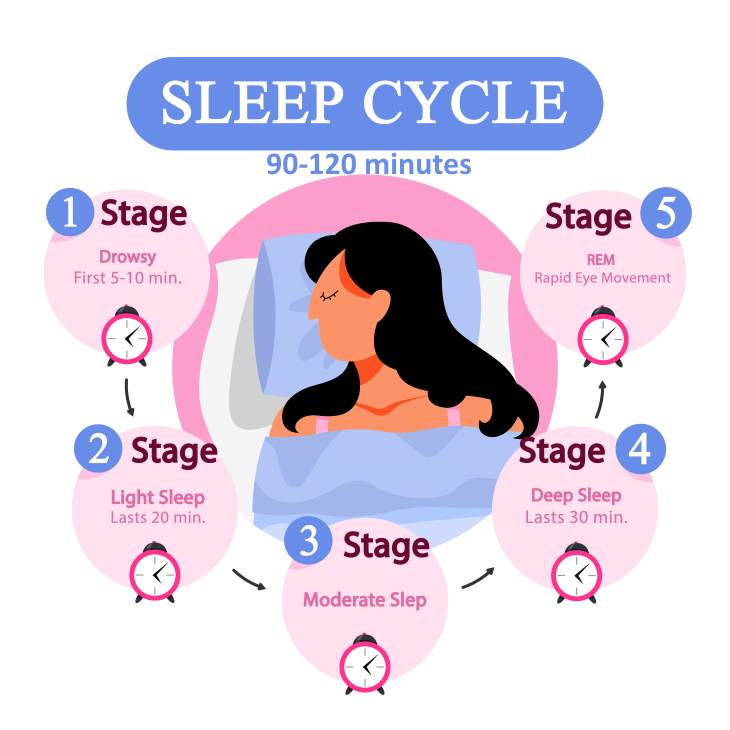
Stage 1. Drowsiness
This is the short transitional stage between being awake and falling asleep. During this stage, your muscles start relaxing, your breathing and heartbeat slow down and you’re getting ready for sleep. Muscle contractions and slow eye movements are typical for this stage.
Stage 2. Light Sleep
As was the case with the previous stage, during light sleep you’re still partly awake and quite easy to wake. Your body further relaxes and your brain waves slow down and eye movements typically stop. This stage can last 20 minutes or more, with research showing that this is the stage we spend the most time while we sleep.
Stages 3 and 4. Moderate and Deep Sleep
During these stages, people experience the deepest sleep, which is characterized by the slowest heart rate, brain waves, and breathing. During this crucial stage, a person fully relaxes and it’s very difficult to wake them up. Deep sleep is essential for the formation of new memories and the excretion of important hormones in the brain. This is the stage that allows your brain to relax and replenish itself after a long day of thinking and collecting information.
Stage 5. REM Sleep
The final stage of the sleep cycle is the so-called REM sleep, named
after the characteristic rapid eye movements observed during this stage.
During this stage, brain activity increases to its wakeful norm and we
start dreaming. Simultaneously, our bodies become temporarily paralyzed
to prevent us from acting out whatever we’re doing in our dreams.
How much sleep do we need?
As you may have guessed, deep sleep is necessary for us to feel rested
and refreshed in the morning, as this is the stage in our sleep cycle
during which we truly relax. Apart from that, deep sleep is essential
for us to make new brain connections - new memories, learning, etc. For
most adults, sleeping 7-9 hours a day will usually allow your body to
experience enough time spent in deep sleep.
The first few rounds of deep sleep will typically last a bit longer than
the further ones, and if you got too little deep sleep one day, your
body will typically be able to make up for the lost time the next day.
However, chronic lack of deep sleep can be more dangerous and make your
brain function worse and slower, making it difficult for you to remember
old information or memorize new things, as well as a feeling of
fatigue.
If you’re afraid this is happening to you, you might want to look at these 10 tips for better sleep, as well as this method to get more deep sleep. Apart from that, following these tips might also improve the quantity of deep sleep:
Stop looking at your phone right before sleep.
Try drinking relaxing herbal teas before bed.
Sleep in a cool room.
Use an eye mask.
Reduce stress in your everyday life.
Eat a light evening meal.