Friday, December 10, 2021

Un-Hunch Your Shoulders With These Exercises

Given our day-to-day activities, we often find ourselves hunching over. We can blame it on all the time we spend doing computer work, driving, lifting babies, or scrolling through Facebook on our phones. All of these activities, and more, contribute to tight muscles, causing a significant hunch in the shoulders.

Why do your shoulders hurt? 
More than 20% of people suffer from shoulder pain. This usually stems from stiffness in the shoulders after long hours hunched over a desk. There are a number of reasons why you might be experiencing shoulder pain. It could be from a recent injury like a torn rotator cuff or something that has developed over a long period of time.
According to the American Academy of Orthopaedic Surgeons, there are four main causes of shoulder pain: 
 
 1. Tendon inflammation or tear: This includes conditions like tendinitis, tendon tears, and bursitis. They occur when small, fluid-filled sacs called bursa, which cushion the bones and reduce friction in the shoulders joints, become inflamed and swollen. It may also be possible for the top of your shoulder blade to rub against the rotator cuff tendons and bursa, which is called impingement. 
 
2. Instability: Your shoulder becomes unstable when the top of your arm comes out of the socket, either from an injury or overuse. The more this happens, the more likely it will continue to reoccur, which leads to an increased risk of developing arthritis.  
 
3. Arthritis: Osteoarthritis occurs around middle age. You notice swelling, pain or stiffness in the shoulders which occur as a result of daily use or work injuries. It is also possible to develop other types of arthritis in the shoulder. 
 
4. Bone fracture: Got a broken collarbone, upper arm bone or shoulder blade? This usually happens after a fall or a car accident which causes severe pain, possibly around the shoulders. 
 
In rarer instances, shoulder pain can also be an indication of infection, nerve problems, or cancer - such as a Pancoast tumor, which is a type of lung cancer, or metastatic breast cancer. If you've got shoulder pain, don't panic, however. More often than not it is a minor issue. If the pain persists over several days, be sure to see a doctor.

Other factors to consider 
There may be certain aspects of your lifestyle which may be hurting your shoulders without you even realizing it. It could be things like your mattress, for instance. Notice if it is too soft. Studies have found that a medium-firm mattress works best for people who experience neck and back pain. If your shoulder pain gets worse at night, it may be an issue with the rotator cuff, which could be irritating the bursa. At-home remedies for neck pain include sleeping in a semi-reclined chair, wearing a cooling or heating pad, and using a shoulder support pillow. Always try to be conscious of your posture throughout the day, whether you are sitting in front of a computer or driving. 
 
Finding relief  
If you have an aching shoulder, the first thing you do is look for instant relief. Luckily, there is plenty you can do yourself to help ease the pain. Unlocking tight shoulders and chest muscles is relatively easy with simple exercises, which can be done while sitting on a chair, standing, kneeling, or sitting on the floor. Meg Plotsky, a group exercise and corporate recreation coordinator at the Well & Being Spa at the Four Seasons Resort and Club Dallas, Las Colinas recommends the following exercises and stretches:  
 
1. Goalpost stretch
un-hunch your shoulders
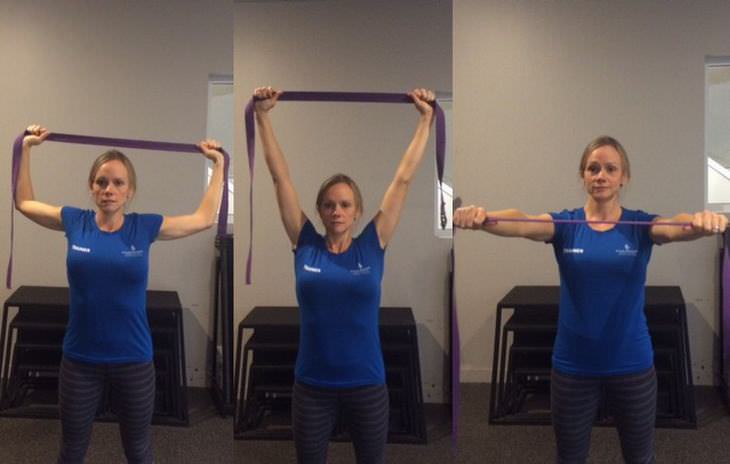
When your shoulders are rounded, the front of your chest collapses inward. So this stretch will help open up those chest muscles and re-set your shoulders so they are in their natural position. 
 
What to do: Grab a yoga strap, jump rope, or belt and come to a comfortable seated or standing position. Place the belt in both hands and straighten your arms out at shoulder height, keeping your palms facing down. Then bring your hands a little wider than shoulder-distance apart on the strap. Inhale, lifting the strap up and overhead, palms facing forward. When you exhale, bend the elbows to about shoulder height and lower the strap. Then, draw your shoulder blades down your back and in toward your spine. Inhale and reach your arms back up, exhale and return to your starting position, with your arms out in front of you at shoulder height. Repeat for three to five times. 
 
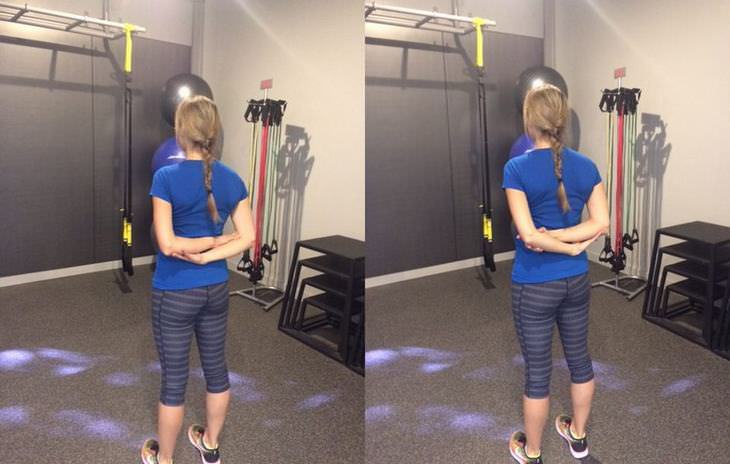
2. Back-bound hand stretch
un-hunch your shoulders
If you spend much of your day with your shoulders hunched, that inward rotation of your shoulders can become habitual. This move will help counteract that bad habit. 
 
What to do: Sit down comfortably, or come into a standing position and slide your shoulder blades down and away from your ears, and together toward your spine. Bring both arms and hands behind you and grab your right elbow with your left hand and your left elbow with your right hand. If you find this difficult, grab your wrist or forearm with the opposite hand. Then, lift your chest and press your shoulder blades down your back while drawing them toward your spine. Take 3 to 5 deep breaths, then switch sides by grabbing your left elbow with your right hand and your right elbow with your left hand. Once again, lift your chest and press your shoulder blades down your back and toward your spine, taking 3 to 5 breaths. 
 
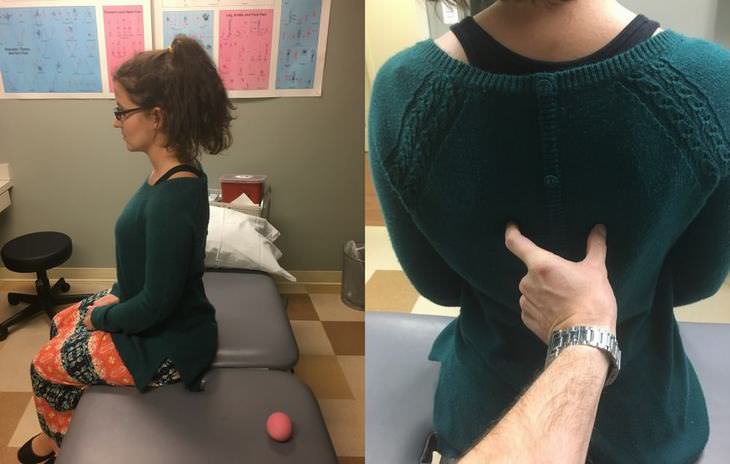
3. Shoulder blade squeeze
un-hunch your shoulders
This move will strengthen the scapular/shoulder blade muscles, which prevent your shoulders from hunching forward, giving you a better awareness of good posture.  
 
What to do: Come into a seated position and sit up tall with a good posture. Bring your shoulder blades together as though you were holding a pencil between them and down away from your ears as you squeeze. Hold for 10 seconds, repeating 10 times, and repeat this move 3 or 4 times throughout the day. 
 
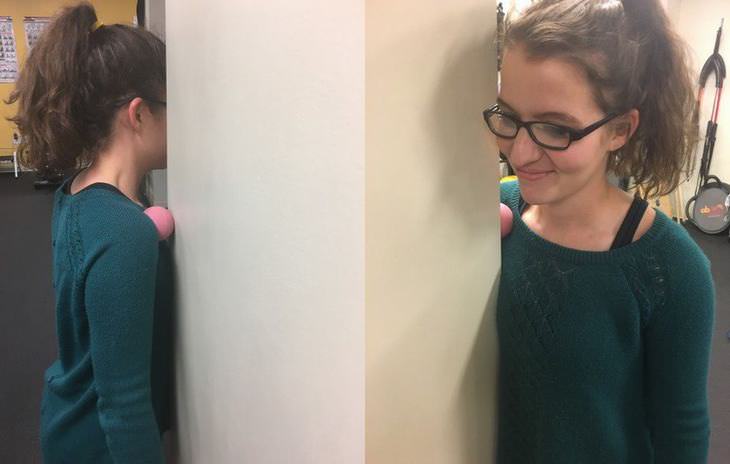
 4. Soft tissue chest massage
un-hunch your shoulders
This move will loosen your chest muscles. This is important because when they're tight they pull your shoulders forward, worsening a hunch.  
 
What to do: Take a lacrosse ball or a tennis ball and place it against your pectoral muscles, inside your shoulder bone and underneath your collarbone. Gently lean against a corner of a wall and with your chest resting against the ball on the wall, and your face in the space at the corner (as shown in image) Gently press into the wall with your body and massage throughout this area. If you find a tender spot, let the pressure of the ball sit against that knot until you feel the tightness release. 
 
5. Supine T 
un-hunch your shoulders
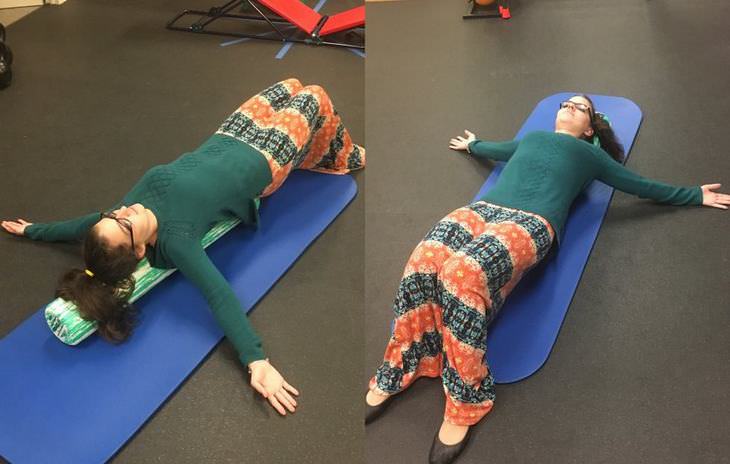
This exercise is great to do first thing in the morning or right before you go to sleep. It's a relaxed chest-opener that helps loosen tight pecs, which may cause your shoulders to hunch forward.  
 
What to do: Lie flat on your back keeping your knees bent and your feet flat on the floor. Place your arms out to the side, keeping your palms face up, forming a 'T' with your body. To increase the stretch, place a rolled towel or foam roller lengthwise along your spine. Keep both your hips and head on the roller or towel and do this for 10 minutes each day. 
 
6. Resistance 'rowing'  
un-hunch your shoulders
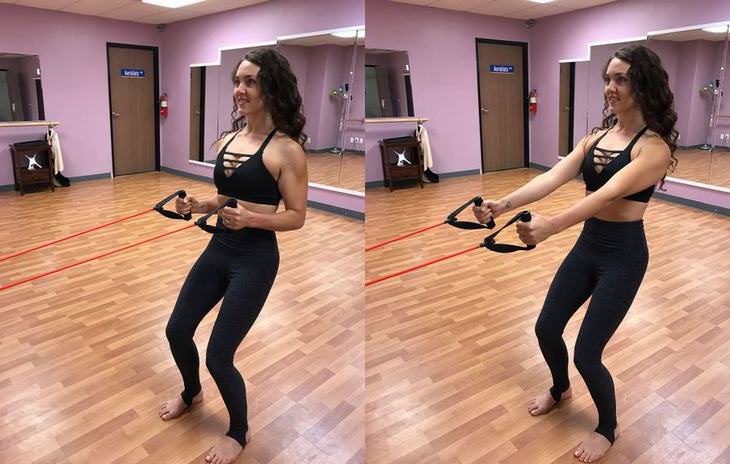
This exercise will strengthen the muscles in your upper back, which reinforces proper alignment in the shoulders.  
 
What to do: Attach a resistance band to a steady doorknob or piece of furniture at waist level. Grab the ends of the band and step a few feet away. Keep your feet parallel and hip distance apart. Soften your knees and keep your torso upright with an elongated spine - to help keep your spine straight you may also sit on a chair or stability ball. Bend your elbows back behind your waist while squeezing your shoulder blades together, then slowly return to your starting position. Begin with 10 reps, then increase to 2 or 3 sets of 10. For further resistance, step farther away from the doorknob. If you want less resistance, move closer. 
 
7. Wall angels 
un-hunch your shoulders
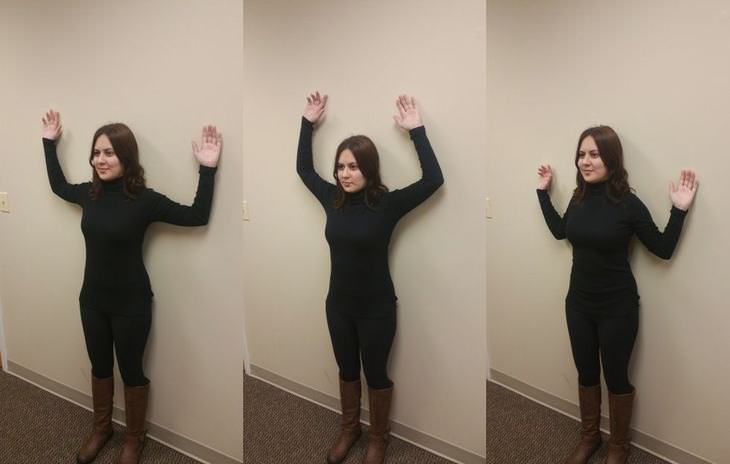
This exercise strengthens the muscles responsible for holding your shoulders back (the opposite movement of hunching them forward). It also reminds the brain where shoulder range of motion should be.  
 
What to do: Stand with your back against the wall and your arms out to your sides and then bend your elbows and rotate your arms so that the back of your hands will touch the wall exactly above your elbows. Move your arms up and over your head slowly, focusing on maintaining contact between your elbows, hands and the wall, then lower your arms. Go as high or as low as you can, keeping the backs of your hands and elbows in constant contact with the wall. Raise and lower your arms in this motion for 10 times, slowly, as if to make a snow angel on the wall.

This is only for your information, kindly take the advice of your doctor for medicines, exercises and so on.   

https://gscrochetdesigns.blogspot.com. one can see my crochet creations  
https://gseasyrecipes.blogspot.com. feel free to view for easy, simple and healthy recipes    
https://kneereplacement-stickclub.blogspot.com. for info on knee replacement


Labels: , , , , , , , , , ,

Friday, May 08, 2020

9 Natural Remedies For Nausea

Nausea is that unpleasant feeling of discomfort inside your stomach, oftentimes leading to vomiting. The most common causes for nausea can stem from food poisoning, side effects of certain medications, pregnancy, ulcers, motion sickness, and acid reflux digestion problems.

You don't need to head out to the doctor's office when you hear a rumbling in your stomach. There are plenty of natural remedies that can be found at home that can treat nausea. Here are 10 natural cures for nausea that will help soothe your stomach:

1) Ginger - Ginger is a powerful ingredient that's helpful in many situations. Adding ginger to a cup of hot tea can work wonders for an upset stomach. You can also drink Ginger Ale if you have any in your fridge, or make it from scratch (recipe listed below). Ginger promotes the secretion of various digestive juices and enzymes, which neutralizes stomach acid.

Directions For Making Ginger Tea:


    1 ginger root
    2-3 cups of water
    Honey (optional but recommended)
    Wax paper
    A cutting board

How To Prepare It:

Make sure you thoroughly wash the ginger to get all the bacteria out. You will then want to slice the ginger into tiny pieces. Place a cover with wax paper over the sliced ginger and crush it. Boil 2-3 cups of water over a medium-high flame before adding the ginger. Allow the ginger to boil between 3-5 minutes.

Remove the concoction from the heat and pour everything into a tea cup. You can also strain it before pouring it into the cup. Honey can increase the flavor, and help keep the nausea at bay. Find a comfortable chair, sit down, sip slowly and relax.

Directions For Making Ginger Ale:

    Add 2 cups of chopped ginger roots
    Add 3-4 strips of lemon or lime peels
    Add 3 quarts of chilled club soda
    Add 1/2 cup of sugar
    Add several ice cubes

How To Prepare It:

Add 2 cups of freshly peeled and chopped gingerroot with lemon or lime peel, and 4 cups of water. Let the mix boil over a high flame, and then at an active simmer. Let the Ginger Ale remain uncovered for 10 minutes.

Add some sugar while stirring, and continue to boil the mixture for about 15 minutes or so. Strain the ginger syrup over a large bowl, separating the ginger roots from the liquid mixture. Use a glass container to chill the syrup until cold, or up to a week. Mix ¼ cup of the syrup with 1 cup of the cold club soda and pour over ice.
 
2) Eat Some Milk Toast - Toast is an ideal food to digest for treating stomach disorders. Bread helps absorb excess stomach acid, which can trigger nausea and vomiting. The milk helps coat your stomach. Milk toast is very easy to make and very effective once consumed. DO NOT consume if you have gastroenteritis.

Directions For Making Milk Toast:

    1 cup of milk
    1 piece of toast
    Some unsalted butter

How To Prepare It:

Heat a cup of milk up, but make sure the milk is not boiling. Pour the milk into a small cereal bowl, and let it cool off for a few moments. Put the bread into the toaster, and spread a tiny bit of unsalted butter on it. Crush the toast into the milk, and eat slowly. Drink the tea with ginger after you've eaten the toast to soothe the stomach acids. 

3)  Smell a Sliced Lemon or Peppermint Oil - You would never think that the scents of peppermint oil and lemons could help cure nausea, but they do. The strong citrus scents in the lemon helps to soothe your stomach, while the peppermint oil can be gently rubbed onto your gums with your fingertips.

The lemon should be sliced in half before inhaling the citrus aromas. Lemon juice can also be extracted into your ginger tea for a great taste. You can keep a few wedges of lemon or lime in a Ziploc Bag in the freezer, and suck on the frozen cirtrus fruits to reduce nausea. 
 
4) Use A Cold Compress On Your Neck - Grab an ice pack from the freezer, but make sure it stays out for a few minutes before applying it on your neck. Apply the cool compress to the back of your neck to help reduce the nausea levels. If you don't have any ice pack, you can simply take a cold washcloth dipped in cool water and follow the same protocol.

5)   Stay On A BRAT Diet - B.R.A.T is an acronym for Bananas, Rice, Applesauce and Toast. These bland foods are low in fiber to limit any gastrointestinal disorders. If you're well enough to eat, you can start by consuming any of the above mentioned foods/ Remember to eat very slowly.
 
6)  Avoid Dehydration - You lose a large volume of fluid and electrolytes during a stomach virus or after you vomit. It's essential to replace the lost fluids to prevent dehydration from occurring. Make sure you drink plenty of cold water, but drink it in tiny sips. Alternatively, you can sip on some sports drinks to regain the lost electrolytes and stay fully hydrated. 

7) Get Some Air - It's crucial to step outside and breathe some fresh air. You can also open the windows to air out the house or sit on the balcony if you're too ill to walk far. If you're feeling a bit flushed, you can turn the fan on. Just make sure you keep it on a low speed. 

8)  Go To Bed - Go to the bedroom, and pull the shades down so that it's dark and cool in the room. Lie down with your head on a single flat pillow and keep your knees bent to prevent any pressure to your stomach area. Regularly breathe to avoid any stress, which could worsen the nausea.  

9) Stretch - A discomforting feeling in the upper back or neck region can trigger vomiting and nausea. Try doing some simple neck and back stretches in orde to alleviate the tension that is causing the upset stomach.

A Stretching Exercise For The Back:

Place a yoga mat or a towel down on the floor, and position your body as if you're about to do a push-up. Lift your upper body up, and arch your back as you tilt the head back as far as possible, the underneath of your chin facing the ceiling. Your body should form a "U" position.

A Stretching Exercise For The Neck:

Sit on a chair and tip your head forward, while touching your chin to your chest. Hold the stretch for about 10-15 seconds. It's important that you tilt NOT roll the neck to prevent pinched nerves or induce the nausea. Tilt your head to left, as if you’re trying to touch your ear to your shoulder. Hold the stretch for 10-15 seconds, before repeating to the other side.


This is only for your information, kindly take the advice of your doctor for medicines, exercises and so on.     

https://gscrochetdesigns.blogspot.com. one can see my crochet creations  
https://gseasyrecipes.blogspot.com. feel free to view for easy, simple and healthy recipes    
https://kneereplacement-stickclub.blogspot.com. for info on knee replacement

Labels: , , , , , , , , , , , ,

Thursday, November 14, 2019

5 Minute Lower Back Stretch for a Good Night's Sleep

A sedentary lifestyle is more dangerous than you might think. Apart from predisposing you to certain health conditions and making your back hurt, it can also mess up your sleep. The reason why has nothing to do with how tired or stressed you are either, as even after a happy day full of physical activity you may feel the long-term negative effects of a  sedentary lifestyle.lower back stretch exercise
The culprits behind these sleep problems are your hip flexor muscles, which can shorten dramatically if you don’t stretch them out regularly. Tight hip flexors, in turn, can cause persistent lower back pain, as well as difficulty breathing and other symptoms that can affect your sleep. To learn more about this condition and a 5-minute exercise to remedy it, continue reading.

How Can Hip Flexors Affect Our Sleep?

iliopsoas stretch
Hip flexor muscles do a lot more than just help us move our legs, they play an important role in maintaining good posture and supporting the spine. Apart from that, these muscles are tightly linked with other muscles and inflammation in the hip flexors may affect the entire spine, as well as the legs. The strongest and somehow also the least understood hip flexor is the Iliopsoas.
This group of deep pelvic muscles consists of two muscles: the iliacus and psoas, pictured below. These muscles play an important role in many activities, such as standing, sitting, and obviously, hip flexion. Excessive sitting can shorten and tighten the iliopsoas, commonly causing lower back pain, hip pain, and in more severe cases, herniated discs.
Unfortunately, an increasing number of people have shorter than normal hip flexors. When these muscles are tight or inflamed, they then cause any surrounding muscles to spasm as well, including the diaphragm. A tight diaphragm, in turn, will make it difficult for you to breathe deeply. Combine shortness of breath with lower back pain and muscle tension, and there have you - a sure recipe for bad sleep.


image.png

How to Stretch Out the Iliopsoas

First and foremost, note your sleeping position. Side sleeping in the fetal position will further shorten the muscle, and so it’s not a good option for people with a short iliopsoas. Next, you’ll need to stretch out the muscle to relieve any tension and pain, as well as allow normal breathing.
We offer you the following exercise you can do at home before bed to counteract the daily strain a sedentary lifestyle puts on your hip flexors. Below you’ll be able to find directions, as well as a video demonstrating the exercise: 
Directions:
1. Find an empty wall in your home and grab a mat, a large book or a yoga block.
2. Lie down on your back, supporting your pelvis with the book or block. At the same time, press your right foot against the wall.
3. Now flex your left knee and draw your left leg in towards your chest. Breathe deeply and hold this position for 1-2 minutes, and then repeat on the left side.


this is only for your information, kindly take the advice of your doctor for medicines, exercises and so on.     
https://gscrochetdesigns.blogspot.com. one can see my crochet creations  
https://gseasyrecipes.blogspot.com. feel free to view for easy, simple and healthy recipes    
https://kneereplacement-stickclub.blogspot.com. for info on knee replacement


Labels: , , , , ,