Sunday, March 15, 2020

Social Distancing: This is Not a Snow Day

I know there is some confusion about what to do next in the midst of this unprecedented time of a pandemic, school closures, and widespread social disruption. As a primary care physician and public health leader, I have been asked by a lot of people for my opinion, and I will provide it below based on the best information available to me today. These are my personal views, and my take on the necessary steps ahead.

What I can clearly say is that what we do, or don’t do, over the next week will have a massive impact on the local and perhaps national trajectory of coronavirus. We are only about 11 days behind Italy and generally on track to repeat what is unfortunately happening there and throughout much of the rest of Europe very soon.

At this point, containment through contact tracing and increased testing is only part of the necessary strategy. We must move to pandemic mitigation through widespread, uncomfortable, and comprehensive social distancing. That means not only shutting down schools, work (as much as possible), group gatherings, and public events, but also making daily choices to stay away from each other as much as possible to Flatten The Curve below.
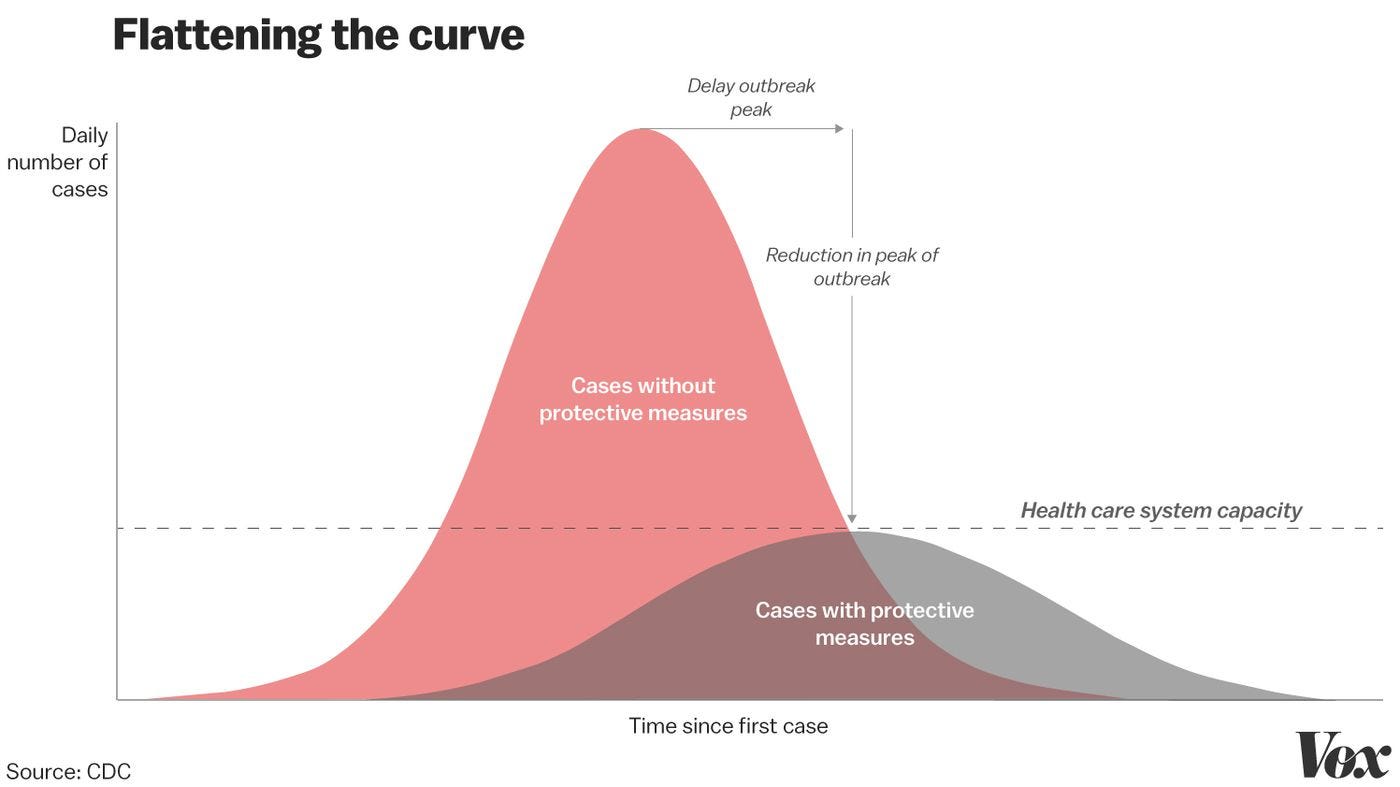
Our health system will not be able to cope with the projected numbers of people who will need acute care should we not muster the fortitude and will to socially distance each other starting now. On a regular day, we have about 45,000 staffed ICU beds nationally, which can be ramped up in a crisis to about 95,000. Even moderate projections suggest that if current infectious trends hold, our capacity (locally and nationally) may be overwhelmed as early as mid-late April. Thus, the only strategies that can get us off this concerning trajectory are those that enable us to work together as a community to maintain public health by staying apart.

The wisdom, and necessity, of this more aggressive, early, and extreme form of social distancing can be needed if situation worsens. I would urge you to take a minute to walk through the interactive graphs — they will drive home the point about what we need to do now to avoid a worse crisis later. Historical lessons and experiences of countries worldwide have shown us that taking these actions early can have a dramatic impact on the magnitude of the outbreak. So what does this enhanced form of social distancing mean on a daily basis, when schools are cancelled?

Here are some steps you can start taking now to keep your family safe and do your part to avoid a worsening crisis:

1. We need to push our local, state, and national leaders to close ALL schools and public spaces and cancel all events and public gatherings now.

A local, town by town response won’t have the adequate needed effect. We need a statewide, nationwide approach in these trying times. Contact your representative and your governor to urge them to enact statewide closures. As of today, six states have already done so. Your state should be one of them. Also urge leaders to increase funds for emergency preparedness and make widening coronavirus testing capacity an immediate and top priority. We also need legislators to enact better paid sick leave and unemployment benefits to help nudge people to make the right call to stay at home right now.

2. No kid playdates, parties, sleepovers, or families/friends visiting each other’s houses and apartments.

This sounds extreme because it is. We are trying to create distance between family units and between individuals. It may be particularly uncomfortable for families with small children, kids with differential abilities or challenges, and for kids who simply love to play with their friends. But even if you choose only one friend to have over, you are creating new links and possibilities for the type of transmission that all of our school/work/public event closures are trying to prevent. The symptoms of coronavirus take four to five days to manifest themselves. Someone who comes over looking well can transmit the virus. Sharing food is particularly risky — I definitely do not recommend that people do so outside of their family.

We have already taken extreme social measures to address this serious disease — let’s not actively co-opt our efforts by having high levels of social interaction at people’s houses instead of at schools or workplaces. Again — the wisdom of early and aggressive social distancing is that it can flatten the curve above, give our health system a chance to not be overwhelmed, and eventually may reduce the length and need for longer periods of extreme social distancing later (see what has transpired in Italy and Wuhan). We need to all do our part during these times, even if it means some discomfort for a while.

3. Take care of yourself and your family, but maintain social distance.

Exercise, take walks/runs outside, and stay connected through phone, video, and other social media. But when you go outside, do your best to maintain at least six feet between you and non-family members. If you have kids, try not to use public facilities like playground structures, as coronavirus can live on plastic and metal for up to nine days, and these structures aren’t getting regularly cleaned.
Going outside will be important during these strange times, and the weather is improving. Go outside every day if you are able, but stay physically away from people outside your family or roommates. If you have kids, try playing a family soccer game instead of having your kids play with other kids, since sports often mean direct physical contact with others. And though we may wish to visit elders in our community in person, I would not visit nursing homes or other areas where large numbers of the elderly reside, as they are at highest risk for complications and mortality from coronavirus.

Social distancing can take a toll (after all, most of us are social creatures). The CDC offers tips and resources to reduce this burden, and other resources offer strategies to cope with the added stress during this time.

We need to find alternate ways to reduce social isolation within our communities through virtual means instead of in-person visits.

4. Reduce the frequency of going to stores, restaurants, and coffee shops for the time being.

Of course trips to the grocery store will be necessary, but try to limit them and go at times when they are less busy. Consider asking grocery stores to queue people at the door in order to limit the number of people inside a store at any one time. Remember to wash your hands thoroughly before and after your trip. And leave the medical masks and gloves for the medical professionals — we need them to care for those who are sick. Maintain distance from others while shopping — and remember that hoarding supplies negatively impacts others so buy what you need and leave some for everyone else. Take-out meals and food are riskier than making food at home given the links between the people who prepare food, transport the food, and you. It is hard to know how much that risk is, but it is certainly higher than making it at home. But you can and should continue to support your local small businesses (especially restaurants and other retailers) during this difficult time by buying gift certificates online that you can use later.

5. If you are sick, isolate yourself, stay home, and contact a medical professional.

If you are sick, you should try to isolate yourself from the rest of your family within your residence as best as you can. If you have questions about whether you qualify or should get a coronavirus test, you can call your primary care team and/or consider calling the Massachusetts Department of Public Health at 617.983.6800 (or your state's department of health if you are outside of Massachusetts). Don’t just walk into an ambulatory clinic — call first so that they can give you the best advice — which might be to go to a drive-through testing center or a virtual visit on video or phone. Of course, if it is an emergency call 911.

I realize there is a lot built into these suggestions, and that they represent a real burden for many individuals, families, businesses, and communities. Social distancing is hard and may negatively impact many people, especially those who face vulnerabilities in our society. I recognize that there is structural and social inequity built in and around social distancing recommendations. We can and must take steps to bolster our community response to people who face food insecurity, domestic violence, and housing challenges, along with the many other social disadvantages.

I also realize that not everyone can do everything. But we have to try our absolute best as a community, starting today. Enhancing social distancing, even by one day, can make a large difference.

We have a preemptive opportunity to save lives through the actions we take right now that we will not have in a few weeks. It is a public health imperative. It is also our responsibility as a community to act while we still have a choice and while our actions can have the greatest impact.
We cannot wait.
 This is only for your information, kindly take the advice of your doctor for medicines, exercises and so on.     

https://gscrochetdesigns.blogspot.com. one can see my crochet creations  
https://gseasyrecipes.blogspot.com. feel free to view for easy, simple and healthy recipes    
https://kneereplacement-stickclub.blogspot.com. for info on knee replacement


by,  Asaf Bitton, MD, MPH, is the executive director of Ariadne Labs in Boston, MA.

Labels: , , , , , , , , , , , ,

Tuesday, February 18, 2020

Cancer education in school curriculum can pay off in the long run

A recent research has suggested that the inclusion of cancer education in middle and high school curricula can possibly improve cancer literacy among students, thus leading to reduced cancer rates.

The study led by researchers at the University of Kentucky Markey Cancer Center was published in the Journal of Cancer Education.

As many as 349 middle and high school students in Kentucky were given a baseline test to determine their cancer literacy, followed by a cancer education presentation.

Following the presentation, the students were tested again. Results showed that the scores for all individual items increased after the intervention, and the average test scores improved by 30 per cent.

The low levels of cancer literacy pre-intervention weren't too surprising, according to Nathan Vanderford, assistant director for research at Markey and director of the Appalachian Career Training in Oncology (ACTION) Program. Having grown up in rural Tennessee, Vanderford recalls that his early educational experiences didn't include much information on the topic.

"Thinking back on my own pre-college education, I do not recall learning in-depth about cancer in school," Vanderford said.

"From that perspective, the lower levels of cancer knowledge these students displayed at baseline are not too surprising. At the same time, given the increased information age we live in, there was some thought that perhaps students' baseline levels would be higher."

Kentucky is home to the highest overall rates of cancer incidence and death in the country. In the Appalachian region of the state, this problem is even more pronounced. Among many other factors, the lack of health literacy plays a part in the state's poor health. Research shows that people with inadequate health literacy are less likely to participate in preventive measures such as cancer screenings, one of the best ways to reduce cancer rates, and making healthy lifestyle choices.

Based on their study, Vanderford notes that implementing cancer education into the existing curriculum for middle and high school students could pay off in the long run by encouraging change in many behaviours that lead to higher cancer rates.

"Youth represent a vulnerable population that is at risk for beginning behaviours - like smoking - that increase cancer risk," Vanderford said.

"At the same time, this is a malleable group that may be more positively influenced by cancer prevention and control strategies. Our results highlight opportunities we have to provide cancer education material to students in a way that will greatly affect their cancer knowledge, which could result in lowering cancer risks through increased cancer prevention/control behaviours."


This is only for your information, kindly take the advice of your doctor for medicines, exercises and so on.     
https://gscrochetdesigns.blogspot.com. one can see my crochet creations  
https://gseasyrecipes.blogspot.com. feel free to view for easy, simple and healthy recipes    
https://kneereplacement-stickclub.blogspot.com. for info on knee replacement
 

Labels: , , , ,

Monday, November 25, 2019

Concussions in high school athletes may increase depression and suicide risk

One of the most common forms of traumatic brain injury, a concussion, could lead to an increased risk of depression and suicide in adults, says a recent study.

Research published suggests high school students with a history of sports-related concussions might be at an increased risk for suicide.


The research examined the link between self-reported history of concussion and risk factors for suicide completion.


It was the 1st study to include a nationally representative sample of high school students.
It's important to remember that when it comes to concussions, there's no visual test to confirm them. Unfortunately, you can't take your child to have a lab test done to diagnose one, said a researcher.


Common symptoms of a concussion include loss of consciousness, headache, confusion and change in mood.


Researchers discovered that teenagers who reported having a concussion in the last year were more likely to report feelings of depression, suicidal ideations and planned or previous suicide attempts.
Of the portion of students who reported a history of concussions, approximately 36 % reported they had felt sad ot hopeless ( compared to 31.1 % of all teens) and around 21 % had thoughts of suicide ( compared to 17%).


Male participants with a reported concussion in the last year were twice as likely to report having attempted suicide and 3 times more likely to report a history of receiving medical treatment for attempted suicide than those who did not have a recent concussion.


The study also revealed female students with a history of concussions had greater odds to report all risk factors of suicide.


They were more likely to have reported feeling sad or hopeless, having suicidal ideations, a planned suicide attempt, having attempted suicide, and were twice as likely to indicate a history of receiving medical treatment for an attempted suicide compared to female who did not report a concussion in the last year.


A recently published article revealed female high school athletes have higher concussion rates than their make counterparts.


The researchers noted that while the study did control for commonly associated suicide risk factors like sexual orientation and a history of being bullied, it did not account for other risk factors like drug or alcohol use.


There were no measures of per-concussion mental health for survey participants.


Concussions are a traumatic brain injury and they are even worse for young people with developing brains, said one of the authors. These injuries can have long term effects such as memory issues and sleep disturbances.


According to the National Suicide Prevention Lifeline, warning signs of suicide can include talking about feeling hopeless, withdrawing or social isolation, extreme mood swings and reckless or anxious behaviour.


Everyone needs to be aware of the warning signs of the risks that come with concussion- parents, teachers, coaches, but also the students themselves, the researcher said.


If there is any concern that a child may have suffered a concussion, it is critical to seek medical attention. If a child is diagnosed with a concussion, everyone in their support network should look for changes in mood or behaviour that may be warning signs of reduced mental well-being, added the researcher.


this is only for your information, kindly take the advice of your doctor for medicines, exercises and so on.     
https://gscrochetdesigns.blogspot.com. one can see my crochet creations  
https://gseasyrecipes.blogspot.com. feel free to view for easy, simple and healthy recipes    
https://kneereplacement-stickclub.blogspot.com. for info on knee replacement


Labels: , , , , , , , , , ,

Monday, December 17, 2018

School-based nutritional programs reduce student obesity

There is some evidence that school-based nutrition education programs increase healthy eating habits for children and adolescents. A recent study  suggests that school nutrition policies and programs promote healthier eating habits among middle school students limit increases in body mass index (BMI).

For the study, scientists followed almost 600 students from 12 schools in New Haven. In schools with improved nutrition strategies and projects, understudies had healthier body mass index trajectories (a measure of obesity) after some time, and before the finish of the examination, they detailed more beneficial practices than their companions in schools without the nutrition policies and projects.

Understudies in schools with improved help to implement nutrition strategies had an expansion in BMI percentile of under 1%, contrasted and understudies in schools without upgraded bolster for these arrangements and projects who showed increments of 3% to 4%.

Lead author said, “These findings can guide future school and community interventions. Childhood obesity is a serious health threat, and schools are a vital way to reach children and their families to reduce risks and promote health. These findings strongly support previous administration policies that provided healthier food for all children in public schools.”

This is the first study that intervals first school-based policy intervention. The researchers analyzed both behavioral and biological indicators. Results are among the most compelling to date, perhaps because of the strong community-university partnership, and the recognition that health and academic achievement often go hand-in-hand.

A researcher said, “This is some of the strongest evidence we have to date that nutrition education and promoting healthy eating behaviors in the classroom and cafeteria can have a meaningful impact on children’s health. These findings can inform how we approach federal wellness policy requirements and implementation in schools to help mitigate childhood obesity.”

The nourishing mediations in the schools considered included guaranteeing that all school-based suppers met government wholesome criteria; giving nutritional newsletters to understudies and their families; school-wide campaigns to confine sugary beverages and energize the utilization of water, and constraining the utilization of sustenance or refreshments as remunerations for scholastic execution or great conduct.

Scientists additionally tried whether a progression of approaches to advance physical movement would affect immature weight file. They verified that the physical action arrangements alone had practically no effect on body mass index.

Scientists noted, “More than one in five American teenagers are currently obese, and as many as one in two are overweight or obese. Being overweight or obese early in life affects health across the lifespan, contributing to a range of chronic diseases such as hypertension, diabetes, and depression that reduce productivity and shorten life expectancy.”

THIS IS ONLY FOR INFORMATION, ALWAYS CONSULT YOU PHYSICIAN BEFORE HAVING ANY PARTICULAR FOOD/ MEDICATION/EXERCISE/OTHER REMEDIES.                                                                                                                                                                                                                                                                                        PS- THOSE INTERESTED IN RECIPES ARE FREE TO  VIEW MY BLOG-                                                                                           https://gseasyrecipes.blogspot.com/                                                                                                                                                                             FOR INFO ABOUT KNEE REPLACEMENT, YOU CAN VIEW MY BLOG-                                                                                                                             https:// kneereplacement-stickclub.blogspot.com/                                                                                       FOR CROCHET DESIGNS                                                                                                                                                                                                                                 https://gscrochetdesigns.blogspot.com     

Labels: , , , , , , , , , , , , , , , ,

Saturday, December 15, 2018

Mental health of adolescents - 7 key facts Inbox

Every year, October 10 is celebrated as World Mental Health Day (WMHD). The main objective of observing WMHD is to raise awareness about mental health issues across the world and to mobilise efforts in support of mental health. The theme for this year’s World Mental Health Day is “Young people and mental health in a changing world.” This year, the World Health Organisation (WHO) is focusing on adolescents and the mental health problems that they deal with.

“Adolescence and the early years of adulthood are a time of life when many changes occur, for example changing schools, leaving home, and starting university or a new job. For many, these are exciting times. They can also be times of stress and apprehension, however,” said WHO. The feelings, if not recognised and managed, can lead to mental illness. WHO also stated that many young people living in areas affected by humanitarian emergencies such as conflicts, natural disasters, and epidemics are particularly vulnerable to mental distress and illness. Take a look at some important facts about young and adolescent mental health, as revealed by the WHO.

Adolescent mental health

According to the WHO, half of all mental health conditions start by 14 years of age, but most cases are undetected and untreated.

Worldwide, it is estimated that 10-20% of adolescents experience mental health conditions.

Suicide is the second leading cause of death among 15-29-year-olds.

Globally, depression is the ninth leading cause of illness and disability among all adolescents, whereas anxiety is the eighth leading cause. 

Adolescents with emotional disorders may also experience excessive irritability, frustration, or anger, apart from depression or anxiety.

Harmful use of substances (such as alcohol or drugs) is a major concern in several countries. This can lead to risky behaviours, including unsafe sex or dangerous driving.

Fortunately, there is a growing recognition of the importance of helping young people build mental resilience, beginning from the earliest ages. This helps adolescents cope with the challenges of today’s world in a better way.

Building mental resilience from an early age can help prevent or manage and recover from mental problems among adolescents and young adults. Yet, prevention begins with a better understanding of early warning signs and symptoms of mental illness.

First observed in 1992, World Mental Health Day began as an event of the World Federation for Mental Health by the then Deputy Secretary-General Richard Hunter, as per the official website.

THIS IS ONLY FOR INFORMATION, ALWAYS CONSULT YOU PHYSICIAN BEFORE HAVING ANY PARTICULAR FOOD/ MEDICATION/EXERCISE/OTHER REMEDIES.                                                                                                                                                                                                                                                                                        PS- THOSE INTERESTED IN RECIPES ARE FREE TO  VIEW MY BLOG-                                                                                           https://gseasyrecipes.blogspot.com/                                                                                                                                                                             FOR INFO ABOUT KNEE REPLACEMENT, YOU CAN VIEW MY BLOG-                                                                                                                             https:// kneereplacement-stickclub.blogspot.com/                                                                                       FOR CROCHET DESIGNS                                                                                                                                                                                                                                 https://gscrochetdesigns.blogspot.com   

Labels: , , , , , , , , , , , , , ,