Monday, April 13, 2020

How To Safely Remove Disposable Gloves

Unlike masks, the CDC did not issue any official guidelines recommending the general public to wear gloves when leaving the house. Wearing gloves does provide some protection by creating a barrier between your skin and potentially contaminated surfaces, and they can be helpful for disinfecting, your home,disinfecting your home, or if you’re taking care of someone suffering from Covid-19. However, if you're using gloves, there are a few important steps to remember on how to properly remove them and dispose of them so that they don’t cause more harm than good.

How To Remove and Dispose of the Gloves Safely


It is important to note that wearing gloves does not mean you don’t have to wash your hands as frequently. That is the tricky thing about them, they can create a false sense of security, but once you have touched anything, you should assume the gloves are contaminated and act accordingly.

Follow these tips when wearing and removing disposable gloves:
  • Wash your hands thoroughly before putting the gloves on.
  • To remove your first glove safely, grasp it from the outside and peel it off without touching your bare skin​.
  • Now comes the question we’ve all been waiting to ask - how do you safely remove the second glove without touching it? Tuck the fingers of your bare hand inside the glove, and invert it carefully before taking it off. That way, you avoid touching the outer, potentially contaminated, part of the glove.
  • Put both used gloves in the garbage​.
  • Wash your hands for 20 seconds at least after removing the gloves.
Even if you are planning on putting a fresh pair of gloves, you should not skip washing your hands before changing.
The CDC has created an infographic to make the steps easier to understand and follow.
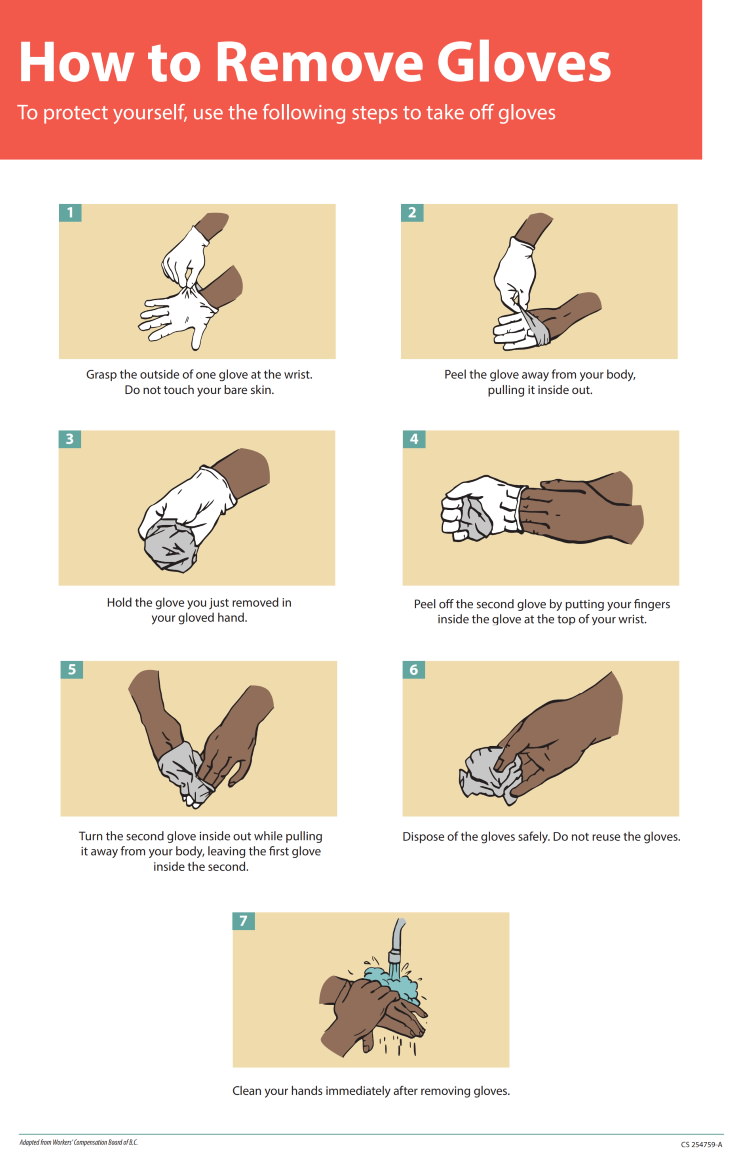


How To Remove and Dispose of the Gloves Safely

What Type of Gloves Should I Use?

Health experts recommend sticking to medical rubber latex gloves rather than improvised makeshift ones, like your winter pair. The reasoning for this is that these gloves may be too thick to invert while removing them and they cannot be tossed away after use. They need to be disinfected, and that can be difficult to do properly each time. 
That is also the general reason that gloves remain an aid for medical staff rather than the general public. They are helpful, but only when minded correctly. If you do not have a pack of gloves, there is no need to run and get one especially, as washing your hands properly still remains Covid-19’s most successful annihilator. 

This is only for your information, kindly take the advice of your doctor for medicines, exercises and so on.     

https://gscrochetdesigns.blogspot.com. one can see my crochet creations  
https://gseasyrecipes.blogspot.com. feel free to view for easy, simple and healthy recipes    
https://kneereplacement-stickclub.blogspot.com. for info on knee replacement

Labels: , , , , ,

Saturday, August 03, 2019

New treatment option for heart failure found

Higher doses of spironolactone, a diuretic (water pill), can prevent the need for dialysis in selected heart failure patients, found a recent study.

The aggressive approach relieved fluid overload safely and effectively in patients who were not responding to conventional diuretics.

Kidney and cardiovascular specialists conducted a pilot study in 19 patients to show that the higher doses of spironolactone, which prevented reabsorption of excess salt in the kidneys and maintained potassium levels, could be used safely in these very-ill patients, who were admitted to the hospital with heart failure exacerbation and don’t respond to conventional diuretics.

Spironolactone is usually given to these types of patients in doses of 25-50 milligrams. In the study published, the dose was increased to 100 and, at some administrations, even 200 milligrams.

“Heart failure patients come into our care with excessive fluid (salt plus water) on their body, making them short of breath, unable to walk and unable to lie flat. They are miserable because of shortness of breath and distension in their abdomen and legs,” said  one of the researchers of the study.

Generally, the treatment is a low-salt diet and diuretics. Furosemide (brand name Lasix) is one of the frequently used medications. When patients are admitted to the hospital, they are monitored on this regimen and usually improve.

But about 15 per cent to 20 per cent of patients do not get better,  the Dr. said. They continue to have a fluid overload.

“The reason is they get resistant to the commonly used loop diuretics, and a very high aldosterone level is one of the main reasons for this resistance,” she said.

Kidneys are made up of millions of tiny tubules called nephrons. Nephrons consist of four main segments, including a part, called the loop of Henle, where 20 per cent to 25 per cent of salt reabsorption happens. Loop diuretics target this section.

Spironolactone inhibits the action of aldosterone, a hormone that makes the kidney excrete too much potassium and retain salt in the distal segment, another part of nephrons.

Study participants who didn’t respond to standard therapy were given high-dose spironolactone and monitored for urine output and breathing. “Most of them had a dramatic increase in their urine output and significant improvement in their shortness of breath. We think some patients could avoid needing dialysis if treated in this manner” the Dr. said.

THIS IS ONLY FOR INFORMATION, ALWAYS CONSULT YOU PHYSICIAN BEFORE HAVING ANY PARTICULAR FOOD/ MEDICATION/EXERCISE/OTHER REMEDIES.                                    PS- THOSE INTERESTED IN RECIPES ARE FREE TO  VIEW MY BLOG-                                                                                           https://gseasyrecipes.blogspot.com/                                                                                                                                                FOR INFO ABOUT KNEE REPLACEMENT, YOU CAN VIEW MY BLOG-                                                  https:// kneereplacement-stickclub.blogspot.com/                                                                      FOR CROCHET DESIGNS                                                                                                    
                                https://gscrochetdesigns.blogspot.com

Labels: , , , , , , , , , , ,

Thursday, August 31, 2017

Human Stem Cells Fight Parkinson’s Disease in Monkeys

Scientists have successfully used “reprogrammed” stem cells to restore functioning brain cells in monkeys, raising hopes the technique could be used in future to help patients with Parkinson’s disease.
 
Since Parkinson’s is caused by a lack of dopamine made by brain cells, researchers have long hoped to use stem cells to restore normal production of the neurotransmitter chemical.


Now, for the first time,researchers have shown that human induced pluripotent stem cells (iPS) can be administered safely and effectively to treat primates with symptoms of the debilitating disease.


So-called iPS cells are made by removing mature cells from an individual—often from the skin—and reprogramming them to behave like embryonic stem cells. They can then be coaxed into dopamine-producing brain cells.


The scientists and a world-leader in iPS technology, said their experiment indicated that this approach could potentially be used for the clinical treatment of human patients with Parkinson’s.

In addition to boosting dopamine production, the tests showed improved movement in affected monkeys and no tumors in their brains for at least two years.


The human iPS cells used in the experiment worked whether they came from healthy individuals or Parkinson’s disease patients, the  team reported in the journal.


“This is extremely promising research demonstrating that a safe and highly effective cell therapy for Parkinson’s can be produced in the lab,” said a researcher who was not involved in the research.


The next step will be to test the treatment in a first-in-human clinical trial, which researcher told that he hoped to start by the end of 2018.


Any widespread use of the new therapy is still many years away, but the research has significantly reduced previous uncertainties about iPS-derived cell grafts.


The fact that this research uses iPS cells rather human embryonic stem cells means the treatment would be acceptable in countries such as Ireland and much of Latin America, where embryonic cells are banned.


Excitement about the promise of stem cells has led to hundreds of medical centers springing up around the world claiming to be able to repair damaged tissue in conditions such as multiple sclerosis and Parkinson’s.

While some treatments for cancer and skin grafts have been approved by regulators, many other potential therapies are only in early-stage development, prompting a warning last month by health experts about the dangers of “stem-cell tourism”.

 THIS IS ONLY FOR INFORMATION, ALWAYS CONSULT YOU PHYSICIAN BEFORE HAVING ANY PARTICULAR FOOD/ MEDICATION/EXERCISE/OTHER REMEDIES.
 PS- THOSE INTERESTED IN RECIPES ARE FREE TO VIEW MY BLOG-                        


HTTP:GSEASYRECIPES.BLOGSPOT.COM/

FOR INFO ABOUT KNEE REPLACEMENT, YOU CAN VIEW MY BLOG-                                                                              HTTP://KNEE REPLACEMENT-STICK CLUB.BLOGSPOT.COM/
FOR CROCHET DESIGNS

HTTP://MY CROCHET CREATIONS.BLOGSPOT.COM

Labels: , , , , , , , , , , ,