Saturday, August 21, 2021

Four ways older adults can get back to exercising – without the worry of an injury
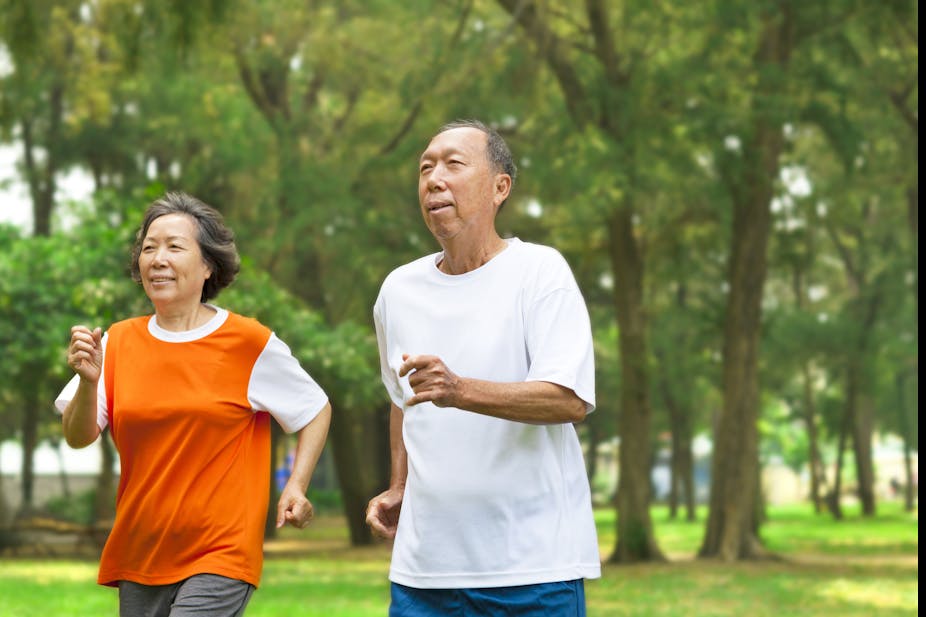
Older couple on a jog together. 

We naturally lose muscle mass as we get older. This process starts around the age of 36, and by the time we are 80 we’ve lost about 50% of our muscle mass. Long periods of inactivity can also cause us to lose a greater amount of muscle mass than we might normally. This has been the case during the COVID-19 pandemic, as many of us were less able to exercise as much as we use to do.

While most young people will be able to bounce back and regain their muscle mass easily, it may not be as easy for older people. This is because it can be more difficult to gain muscle mass as we age due to the changes in muscle structure, and doing too much too quickly can result in serious injuries. This is why older people need to get the balance right when easing back into exercise again.

Maintaining muscle mass

Maintaining muscle is important for many reasons. As we age, frailty can make it more difficult for us to be independent and do the things we need to do each day – from going shopping to meeting our friends. Being active maintains a healthy musculoskeletal system whilst also protecting us from some diseases, such as type 2 diabetes. Research also shows that strong active muscles can help prevent falls and lower injury risk.

But while it may be tempting to hit the gym and start lifting weights now that many COVID-19 restrictions have eased in the UK, if it’s been a while since you last exercised regularly, it’s important to ease back into things. Weak and de-conditioned muscles take time to build strength and doing too much vigorous, repetitive exercise can overload muscles and joints that have not been trained, leading to injury. 

Here are a few ways to get moving again without injuring yourself:

1. Progress slowly.

It’s best to gradually return to activity so you don’t overdo things or injure yourself. A staged approach, where you slowly introduce different exercises, will allow your muscles to recover between each session. Beginning with basic exercises around the house is a good starting point.

Then increasing the number and type of exercises you do can also help you from getting fatigued and losing form – which are prime conditions for an injury to occur. For example, starting with a short walk that then gets longer and progresses to a hill or rougher terrain allows for slow and persistent challenges for your body to become accustomed to while still helping you stay interested in exercising.

2. Reduce the time you spend sitting.

Long periods of sitting, if you have had to isolate or if you are working from home, significantly reduces muscle activity – and therefore muscle mass. So if you haven’t kept exercising during the pandemic, you can’t expect to pick up where you left off.

Take frequent breaks between meetings and introduce a walk at lunch. Stretching and moving around after long periods of sitting prevents fatigue and shortening of muscles – which can improve posture and balance, too.
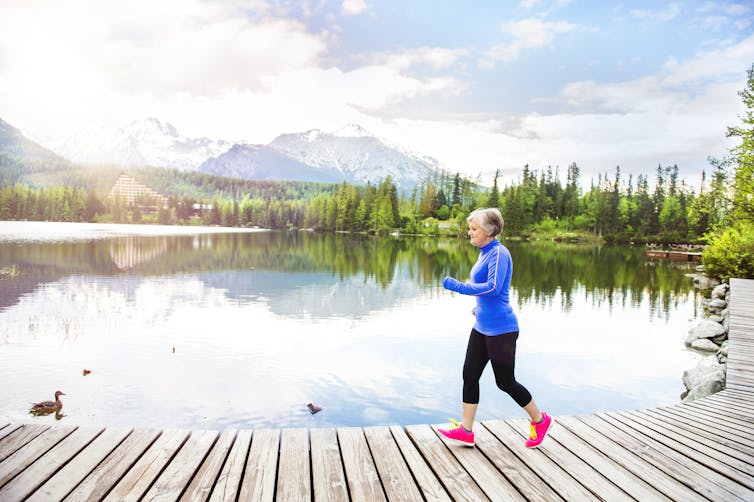
Older woman out for a jog on a pier by a lake.

3. Shake up the exercises you do.

Intense repetition of the same movement or activity can cause wear and tear, often referred to as repetitive strain. This is why it’s important to do different exercises, instead of the same thing every day. Alongside cardio workouts, which have benefits for our heart, lung, and circulatory system, try strength training.

Challenging our muscles as we get older with weight lifting and resistance training not only improves neuromuscular function – the communication between the brain and muscles – but improves balance and mobility too. Taking part in exercises that work your cardiovascular system as well as strengthen muscles improves overall wellbeing.

4. Work on the small things.

It’s important to work on our big prime muscles – such as our glutes or quads – with walking, running and gym exercises. But it’s just as important to work on our small postural muscles too.

For example, the small intrinsic muscles in our feet play an important role in improving strength and balance. Gripping a soft ball between your toes is an easy way to improve these small foot muscles.

Having stability within the joints of your body from postural muscles also allows for these big muscle groups to do their job when walking, running or at the gym. Paying attention to these core postural muscles with activation and control exercises will help prevent injury.

If you’re looking to get back to a regular exercise routine after many months off, it’s important to make sure you take things slow and change up your routine often. Developing a healthy balance of cardiovascular, strength and resistance training as well as core stability work will improve your musculoskeletal health as well as helping your overall health whilst preventing injury.

This is only for your information, kindly take the advice of your doctor for medicines, exercises and so on.   

https://gscrochetdesigns.blogspot.com. one can see my crochet creations  
https://gseasyrecipes.blogspot.com. feel free to view for easy, simple and healthy recipes    
https://kneereplacement-stickclub.blogspot.com. for info on knee replacement


Labels: , , , , , , , , , , ,

Wednesday, April 15, 2020

One type of exercise “reverses” aging’s effect on stem cells — study

As people age, they lose muscle mass and the risk of heart disease, dementia, and reduced immune function increases. As the years tick by, it becomes harder for people to bounce back from a workout, injury, or illness.

Consistent exercise can slow down this degenerative process — but a new study suggests we may not have to settle for slowing down. According to new research in mice, aerobic exercise may actually reverse aging’s effect on essential muscle stem cells involved with tissue regeneration. 


If the research translates to humans, it means jogging, swimming, cycling, and other aerobic activities can help older people recover as quickly and efficiently as their younger selves. In the far future, these results could inform the creation of a drug that de-ages muscle stem cells.

This finding was published Monday in the journal Nature Metabolism.

Researchers have known for a long time that exercise promotes healthspan, giving people extra disease-free years.

This discovery is “very different,” co-author Thomas Rando, a neurology researcher at Stanford University, tells Inverse.

“This is like taking, in a sense, a person who has already aged and acquired these diseases, and then reversed that process," Rando explains.

This study suggests that aerobic exercise can cause old cells to behave more like — and gain the characteristics of — young cells. To get there, the scientists rounded up young and old mice and gave them access to a running wheel for three weeks. Then, with a battery of tests, they analyzed how the mouse's muscle stem cells and muscle tissue responded.


They compared the mouse runners to a group of non-exercising mice who were given a locked wheel and no opportunity to run.

Within a single week, both young and old mice with the running wheels established a routine, running about 10 and 4.9 kilometers per night, respectively.

The human equivalent to the mice running wheel regime would likely be regular, aerobic exercise— swimming, running, cycling, Rando says. Not strength training or weight lifting.


After three weeks of voluntary wheel running, the mice were moved to cages without any wheels. Then, the researchers injured certain muscles and analyzed how the mice rebuilt the injured tissue.

They also transplanted muscle stem cells from old mice into other injured mice, and saw how well the cells functioned. Compared with young donor muscle stem cells, old donor muscle stem cells formed smaller and fewer fibers in the injured mice. But old muscle stem cells from exercising mice performed like young muscle stem cells, forming more fibers than non-exercising old muscle stem cells.

Overall, older mice who exercised experienced improved muscle stem cell function and accelerated muscle tissue repair.

The active, older mice didn't produce more muscle stem cells. Instead, exercise had a “rejuvenating” effect on old cells, Rando says. It triggered a Benjamin Button-effect and helped mice operate more like their younger selves.

These benefits disappeared one week after the mice stopped running, suggesting that what causes the rejuvenating effect is sustained exercise.

This implies that voluntary aerobic exercise may have benefits "above and beyond" the prevention of age-related diseases, and may actually improve tissue function directly, Rando says.

"The idea would be that that older individuals would recover faster and more efficiently like young people do in response to an injury," he explains

Surprisingly, young mice who ran the wheel did not experience improved muscle repair. This puzzled Rando and his team.

"It's as if young mice have already kind of plateaued," Rando explains. "They lose function with age and they can get back to that baseline, but it's hard to make them still better with more exercise."

Exercise’s effects on muscle stem cells and tissue repair come down to a tiny protein called cyclin D1, the study explains. Voluntary aerobic exercise restored cyclin D1 levels in dormant stem cells back to youthful levels, effectively accelerating muscle stem cell regeneration.

Discovering cyclinD1's critical role means researchers may be able to target the protein therapeutically or develop a drug that creates these positive de-aging effects, the researchers say.

But before any kind of anti-aging pill or prescribed exercise-regime comes down the pipeline, more research in humans is needed. 


Abstract: Ageing impairs tissue repair. This defect is pronounced in skeletal muscle, whose regeneration by muscle stem cells (MuSCs) is robust in young-adult animals, but inefficient in older organisms. Despite this functional decline, old MuSCs are amenable to rejuvenation through strategies that improve the systemic milieu, such as heterochronic parabiosis. One such strategy, exercise, has long been appreciated for its benefits on healthspan, but its effects on aged stem-cell function in the context of tissue regeneration are incompletely understood. Here, we show that exercise in the form of voluntary wheel running accelerates muscle repair in old mice and improves old MuSC function. Through transcriptional profiling and genetic studies, we discovered that the restoration of old MuSC activation ability hinges on restoration of Cyclin D1, whose expression declines with age in MuSCs. Pharmacologic studies revealed that Cyclin D1 maintains MuSC activation capacity by repressing TGF-β signalling. Taken together, these studies demonstrate that voluntary exercise is a practicable intervention for old MuSC rejuvenation. Furthermore, this work highlights the distinct role of Cyclin D1 in stem-cell quiescence.


This is only for your information, kindly take the advice of your doctor for medicines, exercises and so on.     

https://gscrochetdesigns.blogspot.com. one can see my crochet creations  
https://gseasyrecipes.blogspot.com. feel free to view for easy, simple and healthy recipes    
https://kneereplacement-stickclub.blogspot.com. for info on knee replacement

Labels: , , , , , , , , ,

Tuesday, February 06, 2018

Why hangovers get worse with age?

One of the finest lines that separate your early 20s from your late ones is your capability to handle a hangover. As tempting as a fun night of drinking with your buddies might seem, the idea of dealing with the ever so hated hangover the following day only becomes more and more dreadful with age.

While research suggests that hangovers start getting noticeable nastier at the age of 29, it is still unclear why it happens. Most experts believe body's fat content and diminishing ability to process alcohol is responsible for it, and here is exactly what goes down.

The body has the ability to adjust in order to survive, and that includes adjusting to heavy drinking too. The enzymes in the liver break down the alcohol to make it more digestible and tolerable to our system. But the liver also starts working in the opposite direction if you lower your drinking levels.

Simply put, the liver undergoes a sort of reset and starts producing lower amounts of alcohol dehydrogenase (ADH) enzyme, which is responsible for breaking down alcohol's content.

Funnily enough, a past study conducted, had found that alcohol-consumption peaks around the age of 25 for most people. This combined with our overall metabolism slowing down due to age is what contributes to the raging battle against dealing with alcohol in our system.

As a result, science says that the body fat content is also affected as we do not use up the energy stored in fat cells as quickly as in our younger years, just spurring the battle with hangovers.

It has been revealed that women are particularly more vulnerable to this after menopause, as the body produces less estrogen, meaning more production of fat cells, as fat cells also produce estrogen to create a biological balance.

Also, both men and women lose muscle mass. Muscle tissues comprise 75 percent water, while in the fat tissues, it is just 10 percent. Alcohol being water soluble is much more quickly absorbed by water-rich, or muscular bodies than by fattier bodies.

The problem of hangovers is also a two-fold one, affected not only by just absorption but dehydration too. While the root cause of hangover is yet to be revealed, experts believe it's a minor withdrawal of sorts along with major dehydration, which results in headaches.

Science also states that with age, our inherent feeling of thirst is replaced by fatigue – thus leaving us more dehydrated, as we don't realize that what our body really needs is a big glass of water.

Simultaneously, aging degrades kidney function too. The body loses its ability to retain the proper balance of water, which increases risks of dehydration, ultimately leading to a hangover.

But The Alcohol Hangover Research Group believes that instead of dehydration, the major symptoms of hangover can be linked to sleep. They suggested that hangover symptoms are most consistent with the effects of cytokines.

The quality and quantity of sleep a person gets was shown to be linked to how bad their symptoms were in the hangover state, and while they didn't explore causes, the fact that sleep degrades with age has been supported by science too.

So be it lack of water or poor sleep – if you're nearing your 30s, you might want to keep in check the number of drinks you allow to come your way!

THIS IS ONLY FOR INFORMATION, ALWAYS CONSULT YOU PHYSICIAN BEFORE HAVING ANY PARTICULAR FOOD/ MEDICATION/EXERCISE/OTHER REMEDIES.    

PS- THOSE INTERESTED IN RECIPES ARE FREE TO VIEW MY BLOG-                      
HTTP:GSEASYRECIPES.BLOGSPOT.COM/
FOR INFO ABOUT KNEE REPLACEMENT, YOU CAN VIEW MY BLOG-                                                        
HTTP://KNEE REPLACEMENT-STICK CLUB.BLOGSPOT.COM/
FOR CROCHET DESIGNS

HTTP://MY CROCHET CREATIONS.BLOGSPOT.COM

Labels: , , , , , , , , , , , , , ,