Tuesday, October 15, 2013

10 Muscle Moves to Help Tame Diabetes

Why Do Strength Training?
If you have diabetes, you know the importance of controlling your blood sugar. But did you know that strength training can play a starring role? Simple moves done regularly can prompt your muscles to absorb more sugar. You'll also burn more calories around the clock when you take up strength training. Your mood, cholesterol levels, and blood pressure may improve, too.

Beginning an Exercise Program
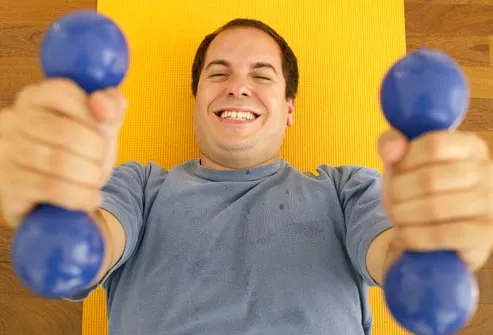
Most people with diabetes can work out safely, but check with your doctor first. You should aim for strength training at least twice a week and regular cardio, either five days a week for 30 minutes, or three days for 50 minutes. Always exercise caution, and if a move doesn't feel right, check with a fitness expert. Flexibility work can be helpful, too, especially if you haven't broken a sweat in a while.

Your Strength Training Routine
Get ready to learn 10 at-home exercises that work your major muscle groups. For each one, begin with one set of 10-15 reps. Rest 30-120 seconds before the next move. Start with resistance bands or light dumbbells that allow you to focus on form. When you can do two or three sets easily, grab heavier weights. You should eventually use weights that you can only lift 8-10 times in the first set.

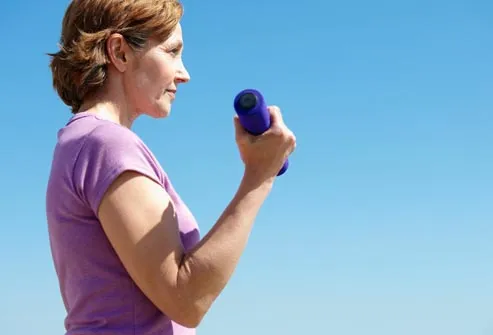
Upper Body: Standing Biceps Curl
Grab a dumbbell in each hand and stand with your palms facing your thighs. Squeeze your biceps as you lift the weights. On the way up, your forearm should rotate so your palms end up facing your shoulders at the top. Lower the weights slowly to starting position. Try to avoid using momentum on the way down.biceps curl
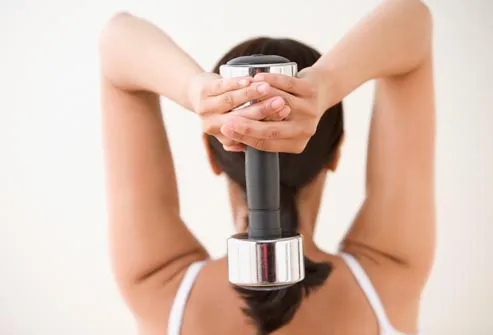
Upper Body: Triceps Extension
Stand with one foot slightly in front of the other, and hold a single dumbbell with both hands wrapped around the handle. Slowly raise the dumbbell overhead. Straighten your elbows as you raise the weight toward the ceiling. Slowly bend your elbows and lower the weight behind your head. Keep your upper arms still and vertical to the floor. Keep your shoulder blades down and back as you repeat.triceps extension
Upper Body: Shoulder Press
You can do the shoulder press while sitting or standing. Hold a dumbbell in each hand and raise them until they are level with your ears. Your elbows should be bent at a 90-degree angle. This is your starting position. Now push the weights up, until your arms are fully extended. Slowly lower to the starting position.
shoulder press

Upper Body: Chest Press
Lie on your back with your knees bent and your feet flat on the floor. Hold a dumbbell in each hand at chest level and raise them above your chest until your elbows are straight but not locked. Pause a second and then slowly lower the weights toward your chest.
chest press

Upper Body: Seated Row
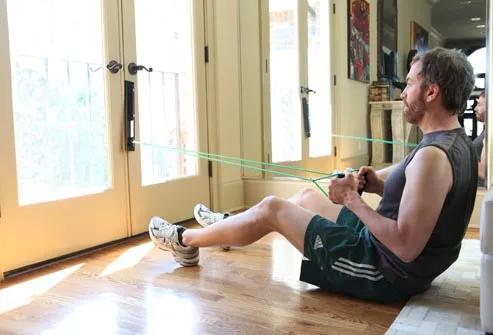
Sit on the floor with your feet together and your knees bent. Hold a dumbbell or the end of a resistance band in each hand with your arms straight in front of you, palms facing each other. Keeping your back straight, bend the elbows as you pull the weights/bands to your sides. Keep your elbows close to your body and slowly straighten your arms.
dumbbells, mat and resistance band


Classic Crunch
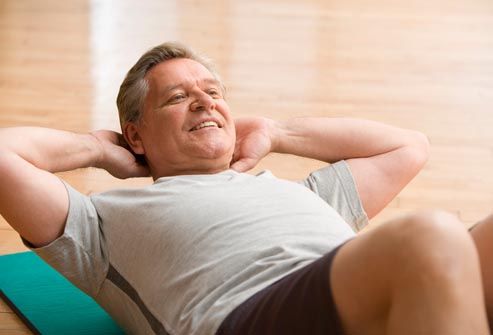
Lie on your back, feet flat on the floor, knees bent. Put your hands behind your head. Pull your shoulder blades together and your elbows back. The elbows should aim sideways and stay there throughout the exercise. Squeeze the abs and curl your shoulders and upper back off the floor. Lower down slowly, keeping your lower back pressed to the floor at all times.
crunch

Plank
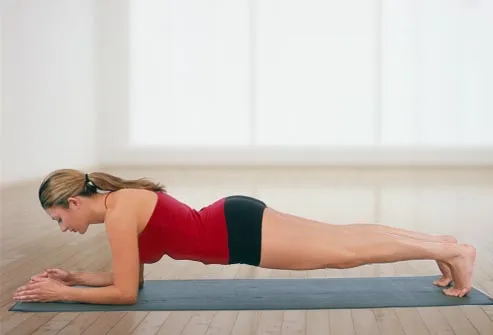
Lie face-down with your elbows directly under your shoulders, palms down, and your toes tucked under. From this starting position, tighten your abs as you lift your torso and thighs off the floor. You'll be supported only by your toes and forearms. Hold this position for 5 seconds or more. Keep the back straight as you slowly lower to the starting position
plank

Lower Body: Squat
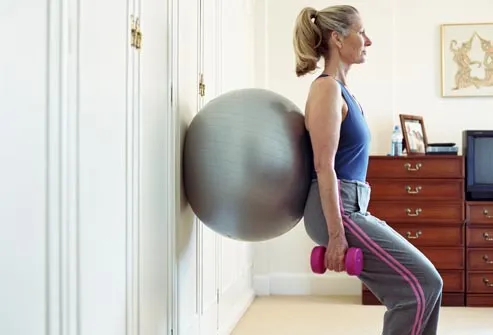
Stand with your feet shoulder-width apart. Bend your knees and lower yourself as if you were sitting in an imaginary chair. Your thighs should be parallel to the ground and your knees should not push forward past your toes. Lean forward slightly as you stand back up. You can also do squats while leaning against a stability ball placed between your back and a wall.
squat with medicine ball


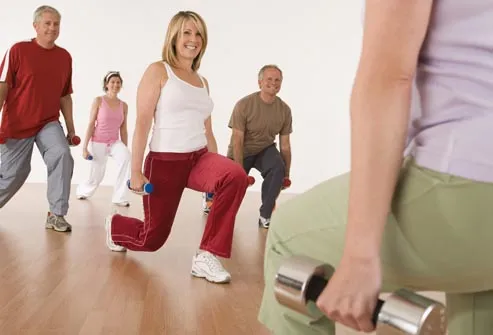
Lower Body: Lunges
Stand with your legs shoulder-width apart and step your right leg back, bending the knee toward the floor without allowing it to touch. Your left thigh should be nearly parallel with the floor. Press down on the left heel and bring the right leg back to a neutral stance. Do 8-12 reps and then change sides, stepping back on the left leg. To make the lunges more challenging, hold a dumbbell in each hand. 
group lunge


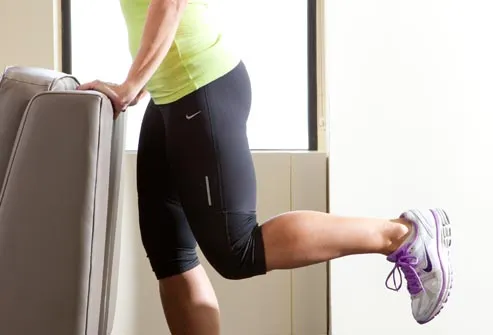
Lower Body: Hamstring Curl
Hold onto the back of a chair. Flex your left foot and bend the knee, bringing your heel toward your buttocks. Keep your right leg slightly bent. Lower your left foot back to the floor. Do 8-12 reps and then repeat with the right leg. To make this exercise more challenging, ask your doctor if it is safe for you to wear ankle weights.
hamstring curl

Strength Training and Blood Sugar
If you take certain diabetes medications, you may need to take precautions to avoid a dangerous drop in blood sugar (hypoglycemia). Ask your doctor if you should check your blood sugar or eat a snack before working out. Keep snacks or glucose tablets with you when you're exercising in case you develop symptoms of low blood sugar, such as shaking or weakness.

Strength Training and Insulin
If you take insulin, you may need to adjust the dose before and after exercise. Begin with a gentle workout to see how it affects your blood sugar. Check your levels before, during, and after exercise. If you work out within an hour or two of a meal, you may need to reduce your meal-time insulin dose. Check with your doctor before making any insulin changes. Oral diabetes medicines may also need to be lowered when you exercise.

Who Should Not Lift Weights?
Weight-lifting is not recommended for people with diabetes-related eye problems (such as retinopathy) that are not being treated. Likewise, very intense cardio work is not a good idea with untreated retinopathy. Both can increase pressure in the eyes. If you have nerve damage in your feet, sitting or lying on the floor may be a better bet. Remember, check with your doctor before beginning a fitness program.

ps- this is only for information, always consult you physician before having any particular food/ medication/exercise/other remedies.
ps- those interested in recipes are free to view my blog-

http://gseasyrecipes.blogspot.com/


for info about knee replacement, you can view my blog-


http://Knee replacement-stick club.blogspot.com/


for crochet designs


http://My Crochet Creations.blogspot.com

Labels: , , , , , , , , , , , , , , ,

Saturday, October 08, 2011

Tips to tackle diabetes

Emotional support is as important as good nutrition and fitness, like in any other disease.
 Switch to high-fiber foods. Eat whole grains. Refined carbs with high glycemic loads – such as white bread and processed foods – increase diabetes risk.

Studies show that people who eat whole grains have a lower risk of developing the disease. Why? Fiber. It allows the body to digest food without the spike in blood sugar.


 Write down all that you eat.  Keep track of the food you eat, how much you exercise and your weight loss. It's a useful tool where you can start to see patterns, as when you eat what your weight & blood sugar increases.

 Don't keep sitting in a place for too long, be on the move. 
Want to cut your diabetes risk by 35%? Just take a brisk hour-long walk daily, she says. Even after your hour is up, find ways to stay active throughout the day. Carry groceries from the car to the house in two trips instead of one, she suggests. Get extra exercise with a fun activity like a dance class. Take your dog for a walk as it will help you both !


Transplant your trans fats.  Trans fats – anything containing partially hydrogenated oils – boost belly fat and increase heart disease and diabetes risk. Plus they’re high in calories.

Trans fat can also raise your cholesterol levels, which can raise heart disease risk. Replenish your cupboards with foods containing polyunsaturated fats such as nuts, fish and soybean oil.

 Make a plan. Set a goal for each workout to maximize your exercise routine. When you know what you want to accomplish, you’ll be able to set aside enough energy to follow through, whether it’s a one-hour walk or three sets of tricep extensions. 

Losing a little weight, will boost you to work better.


Pick your proteins. A few simple swaps can do wonders for your diet. Cut back on red meat and go for more poultry, seafood and legumes, such as beans, lentils and nuts. All are good sources of protein, but leaner choices are lower in saturated fat, cholesterol and calories, which, in turn, can reduce your risk of heart disease and other diabetes complications.

 Treat your feet. Did you know that more than 60% of foot and leg amputations are diabetes-related? According to the ADA, foot problems usually occur when nerve damage (neuropathy) results in a loss of feeling in your feet. make sure that each morning & night you check your feet to know if there are any sores, as most diabetic patients have no sensation in their feet, so if you check regularly then you know that you've not hurt yourself anywhere. Better to wear shoes, as it protects you feet better than open sandals.


Quit smoking as it is bad for your diabetes & your heart, also you're well aware that smoking leads to                 various cancers too. So, why invite trouble.


Lift weights. Heart disease is a major concern for people with diabetes. But the risk of both chronic illnesses is lower when the body is lean, she says.

Experts suggest you lose 5-10% of your body weight and do 30 minutes of moderate physical activity a day, five times a week.

Strength-training is good to get rid of visceral fat (the kind that surrounds internal organs and creates the pot belly), because it’s the most dangerous for cardiovascular health.

 You are what you drink. High-fructose corn syrup in sodas and other beverages is bad news, especially for those at risk for diabetes. These drinks have loads of sugar and empty calories that leave you feeling unsatisfied. Swap your soda for water or unsweetened 
beverages.

Even fruit juice is high in sugar, so stick to the fruit itself. But if you take diabetes medication, keep juice or other fast-acting sugars handy in case your blood sugar dips too low.


Labels: , , , , , , , , ,

Sunday, May 15, 2011

How to have healthy joint


1)  Keep joints healthy by keeping them moving. The more you move, the less stiffness you’ll have. Whether you’re reading, working, or watching TV, change positions often. Take breaks from your desk or your chair and move around.

2)  With overuse or injury, cartilage on the end of the joints can break down, causing a narrowing of the joint space and the bones to rub together. Painful bony growths, or spurs, may form. This can lead to inflammation, swelling, stiffness, and possibly osteoarthritis, the most common type of arthritis. Another type of arthritis is rheumatoid arthritis, an autoimmune disease characterized by extreme inflammation.

3)  Injury can damage joints. So protecting your joints your whole life is important. Wear protective gear like elbow and knee pads when taking part in high-risk activities like skating. If your joints are already aching, consider wearing braces when playing tennis or golf.

4) Lose just a few pounds and you'll take some strain off your hips, knees, neck, and back. Extra pounds  increase the risk of cartilage breakdown. People with excess body fat may also have higher levels of substances that cause inflammation. Even a little weight loss can help. Every pound you lose takes four pounds of pressure off your knees.

5) Experts now say that stretching before exercise actually causes muscles to tighten, increasing the risk of muscle pulls. Overstretched joints are more susceptible to injury, especially for people with arthritis. Instead, try sport-specific exercise -- like slowly kicking before swimming. This warms up not only the muscles, but also loosens up the joints, ligaments, and tendons around them.

6)  To protect your joints,slow-impact exercises like bicycling and swimming are better options. That's because high-impact, pounding, and jarring exercise can increase your risk of joint injuries and may slowly cause cartilage damage. Light weight-lifting exercises are another option. Consult your doctor, if you already have arthritis.

7) Stronger muscles around joints mean less stress on those joints. Research shows that having weak thigh muscles increases your risk of knee osteoarthritis, for example. Even small increases in muscle strength can reduce that risk. Avoid rapid and repetitive motions of affected joints.

8)  Move joints through their full range of motion to reduce stiffness and keep them flexible. Range of motion refers to the normal extent joints can be moved in certain directions. If you have arthritis, your doctor or physical therapist can recommend daily range-of-motion exercises.

9) Stronger abs and back muscles help with balance. The more balanced you are, the less likely you are to damage your joints with falls or other injuries. So include core (abdominal) strengthening exercises in your routine.

10) It's normal to have some aching muscles after exercising. But if your pain lasts longer than 48 hours, you may have overstressed your joints. Don't exercise so hard next time. Working through the pain may lead to injury or damage.

11) If you have joint pain from rheumatoid arthritis (RA), eat more fish. Fatty cold water fish like salmon and mackerel are good sources of omega-3 fatty acids. Omega-3s may help keep your joints healthy, as well as reduce inflammation, a cause of joint pain and tenderness in people with RA. Try fish oil capsules if you don't like fish.

12)  Calcium and vitamin D help keep bones strong. Strong bones can keep you on your feet, and prevent falls that can damage joints. Dairy products and green, leafy vegetables like broccoli and kale are good sources of calcium. If you don't get enough calcium in your diet, ask your doctor about supplements.

13) Stand and sit up straight. Good posture protects your joints all the way from your neck down to your knees. One easy way to improve posture is by walking. The faster you walk, the harder your muscles work to keep you upright. Swimming can also improve posture.

14) Consider your joints when lifting and carrying. Carry bags on your arms instead of with your hands to let your bigger muscles and joints support the weight.

15) Ice is a natural pain reliever. It numbs pain and helps relieve swelling. If you have a sore joint, apply a cold pack or ice wrapped in a towel. Leave it on for up to 20 minutes at a time. No ice or a cold pack, try a bag of frozen vegetables wrapped in a towel. Never apply ice directly to the skin.

16) Physical trauma can contribute to cartilage breakdown and OA. If you injure a joint, see your doctor right away for treatment. Then take steps to avoid more damage. You may need to avoid activities that over stress the joint or use a brace to stabilize it.

http://arthritis.webmd.com/slideshow-keep-joints-healthy?ecd=wnl_cbp_051211

Labels: , , , , , , , , , , , ,