Monday, February 10, 2025

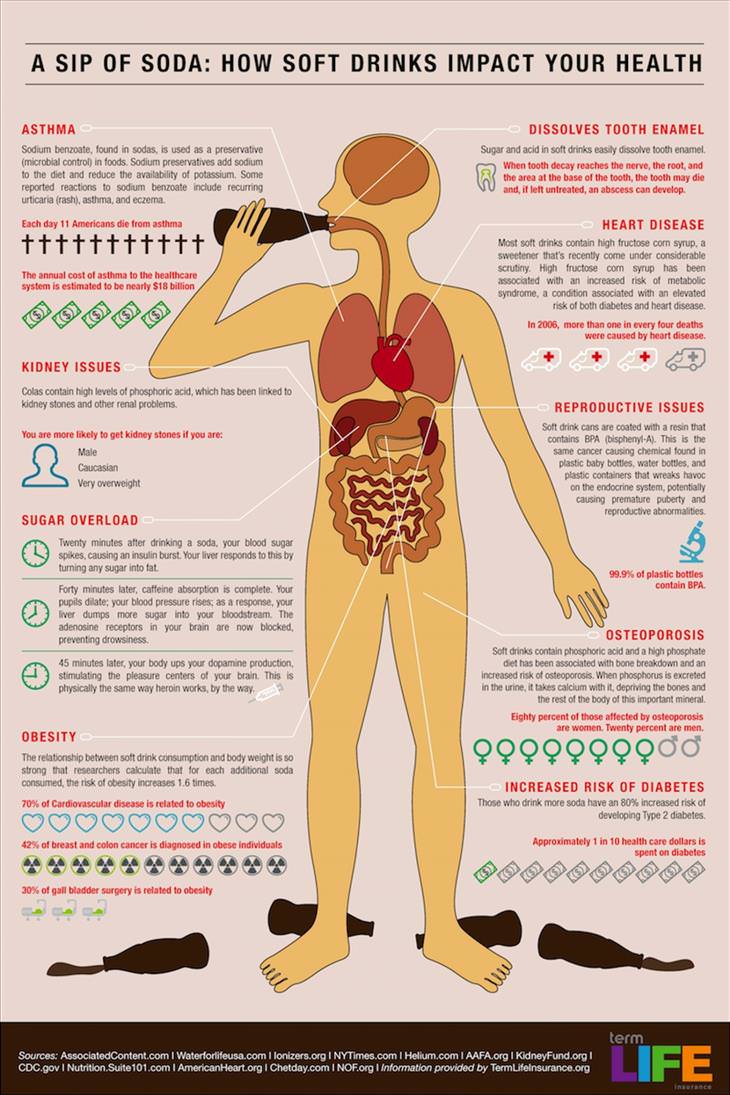
 Many people choose to drink less water than they sodas, often without fully realizing the consequences. While soft drinks may be refreshing and enjoyable, they are far from a healthy alternative. In fact, their high sugar content, artificial ingredients, and acidity can lead to a range of health problems over time. 

So, just how unhealthy are soft drinks? What are the potential risks associated with regular consumption? The negative effects can vary depending on the amount consumed, but even moderate intake can contribute to a variety of health issues.


soda-health-effects

This is only for your information, kindly take the advice of your doctor for medicines, exercises and so on.   

https://gscrochetdesigns.blogspot.com. one can see my crochet creations  
https://gseasyrecipes.blogspot.com. feel free to view for easy, simple and healthy recipes    
https://kneereplacement-stickclub.blogspot.com. for info on knee replacement
https://GSiyers home remedies.blogspot.com   is the latest addition to my blogs. I'm going to add posts there, do give me your valuable feed back on my blogs. Thanks a lot, take care, be healthy and be happy.


Labels: , , , , , , , ,

Friday, July 12, 2024

What exactly is Wilson's disease- causes and symptoms

Unless you have Wilson's disease, or you know someone who does, you've probably never heard of this rare genetic condition. With non-specific symptoms that mainly affect the brain and the liver, this slippery condition is tricky to diagnose, and it can have serious complications if left untreated.

What is Wilson disease?

Wilson disease is a rare genetic condition that occurs when your body accumulates too much copper, especially in the liver and brain. Your body needs a small amount of copper from food to stay healthy, but without treatment, Wilson disease can lead to high copper levels that cause life-threatening organ damage.

Who does Wilson disease affect?

Wilson disease is passed on from parents to their children. It requires a copy of the abnormal gene from each parent. It’s very difficult to know who will develop it because parents often have no symptoms to let them know that they carry the abnormal gene. If you have other close relatives with the disease, you’re more likely to be at risk.

How common is Wilson disease?

Wilson disease affects an estimated 1 out of every 30,000 people. It’s more common among people with a family history of the condition. There are more people who have only one copy of the abnormal gene (carriers). Carriers won’t usually have symptoms, even though they can give the disease to their children. Because there are no symptoms in carriers, it’s hard to know exactly how many people in the general population have an abnormal copy of the gene.

How does Wilson disease affect my body?

Wilson disease, without early diagnosis and treatment, can lead to life-threatening complications. Toxic levels of copper build up in your body, especially in the liver and brain, and put you at risk of organ damage. Increased copper levels will affect how you feel, often making you very tired or weak and uncomfortable or in pain. If you have weakness, tiredness or pain that doesn’t go away, reach out to your healthcare provider for advice.

Symptoms and Causes

 What are the symptoms of Wilson disease?

Symptoms of Wilson disease vary a lot from person to person.

Wilson disease is present at birth (congenital), but the symptoms don’t appear until copper builds up in your liver, brain, eyes or other organs. People who have Wilson disease typically develop symptoms between ages 5 and 40. However, some people develop symptoms at younger or older ages.

Some people are diagnosed with other liver or mental health disorders when they actually have Wilson disease. This is because symptoms can be nonspecific and similar to other conditions until copper levels are measured.


Liver symptoms

People with Wilson disease often develop symptoms of hepatitis (inflammation of the liver) and can have an abrupt decrease in liver function (acute liver failure). These symptoms may include:

  • Fatigue.
  • Nausea and vomiting.
  • Poor appetite.
  • Pain over the liver, in the upper part of your abdomen.
  • Dark urine color.
  • Light color of stool.
  • Yellow tint to the whites of your eyes and skin (jaundice).

Some people with Wilson disease have symptoms only if they develop chronic liver diseases and complications from cirrhosis. These symptoms may include:

  • Fatigue and weakness.
  • Unexpected weight loss.
  • Bloating from a buildup of fluid in the abdomen (ascites).
  • Swelling of the lower legs, ankles or feet (edema).
  • Itchy skin.
  • Severe jaundice.

Central nervous system symptoms

People with Wilson disease may develop central nervous system symptoms that affect their mental health as copper builds up in their body. These symptoms are more common in adults but do also occur in children.

Nervous system symptoms may include:

  • Problems with speech, swallowing or physical coordination.
  • Stiff muscles.
  • Tremors or uncontrolled movements.

Symptoms of Wilson disease that affect a person’s mental health include:

  • Anxiety.
  • Changes in mood, personality or behavior.
  • Depression
  • Disruptions to thoughts and feelings that make it difficult to tell what’s real and what isn’t (psychosis).

Eye symptoms

Many people with Wilson disease have green, gold or brown rings around the edge of the corneas in their eyes (Kayser-Fleischer rings). A buildup of copper in the eyes causes the Kayser-Fleischer rings. Your healthcare provider can see these rings during a special eye exam called a slit-lamp exam.

Most people diagnosed with Wilson disease who have symptoms that affect their nervous system also have Kayser-Fleischer rings. About half of the people diagnosed with Wilson disease who only have symptoms that affect their liver also have Kayser-Fleischer rings.

Other symptoms of Wilson disease

Wilson disease can affect other parts of your body and cause symptoms including:

  • Hemolytic anemia.
  • Bone and joint problems ( arthritis or osteoporosis).
  • Heart problems (cardiomyopathy).
  • Kidney problems (renal tubular acidosis or kidney stones)


This is only for your information, kindly take the advice of your doctor for medicines, exercises and so on.   

https://gscrochetdesigns.blogspot.com. one can see my crochet creations  
https://gseasyrecipes.blogspot.com. feel free to view for easy, simple and healthy recipes    
https://kneereplacement-stickclub.blogspot.com. for info on knee replacement
https://cancersupportindia.blogspot.com  for infor on cancer and health related topics
https://GSiyers home remedies.blogspot.com   is the latest addition to my blogs. I'm going to add posts there, do give me your valuable feed back on my blogs. Thanks a lot, take care, be healthy and be happy.


Labels: , , , , , , , , ,

Friday, March 11, 2022

Feel breathless while walking? Know what’s normal and what’s not

Shortness of breath can be due to a number of reasons

How often do you panic when you feel short of breath even after walking a few steps? Many of us connect breathlessness to either heart or lungs and start home remedies without even consulting a doctor. With few people, what follows after noticing the shortness of breath is a few days of rigorous physical activity to "pump the heart sufficiently and make it work properly" and "doing more exercises so that the body opens up".

This is wrong.

Shortness of breath can be due to a number of reasons. In order to assess the right reason behind it, one should either make note of its occurrence and the activities which trigger it.

readmore

What is shortness of breath?

Shortness of breath is when the body does not get enough air to breathe in. In this case, the person tends to breathe harder and faster but is unable to provide sufficient air inside. Literally the person gasps for air even.

The medical term for shortness of breath is dyspnea.

The situation can be best described when a non-runner runs for some time and then pants for air.

Shortness of breath is a problem when you experience it even after doing minor physical works like walking stairs or walking normally on an even surface.

Due to this, the normal functioning of an individual is affected.

​What are the probable causes?

​What are the probable causes?

There are a number of medical and non-medical reasons behind shortness of breath. One can experience breathlessness while being at high altitudes, or when the air quality is at a dangerous level, or when the temperature is too high or even after doing a heavy workout.

There are several medical conditions that trigger breathlessness in an individual. Issues like allergies, asthma, heart problems, pulmonary disease, pneumonia, obesity, tuberculosis also cause dyspnea.

Recently, COVID is also said to be affecting the breathing ability of patients. Many people who have typical COVID symptoms like sore throat, runny nose have also experienced breathing problems during the infection.

readmore

What are the underlying medical complications?

​What are the underlying medical complications?

As mentioned above, a number of reasons can affect the breathing capacity of an individual. “The medical condition depends upon the cause of breathlessness as it can be due to lung, heart, kidney or muscle problem. So if unaddressed, it may lead to major diseases of the lung, kidney, heart or any muscular system. Mainly in lung can lead to irreversible changes if neglected or not diagnosed during the early course of disease,” says Dr Dr Kashmira Jhala, consultant pulmonologist, Apollo Hospitals, Ahmedabad.

It is therefore recommended to take doctor's advice if the issue persists for a long time.

​When is it normal and people should not overthink about it?

​When is it normal and people should not overthink about it?

If it occurs due to the result of any event like having a sleepless night or due to high temperature, there is nothing to worry about. If the situation is non-medical and can be improved, so can be the issue of breathlessness.

“Pulmonary lung function test should be done to know lung capacity and underlying problem. It is like a screening test for breathlessness. If it is normal and other functions of the body are also normal, then the person can be kept under observation and monitored during lung function tests on a regular interval,” says the expert.

​When should one be worried?


​When should one be worried?

When the condition persists for a long time, one should definitely see a doctor. “If the symptom is continuous, progressive and associated with other symptoms, then one should not neglect it. If the primary baseline lung function test-pulmonary function test (PFT) is not normal then definitely one should visit a pulmonologist. Post covid, now everyone is aware about the PFT. So, it should be used regularly and commonly to know your lung capacity,” says Dr Jhala.

​What are the other symptoms to watch out for?

​What are the other symptoms to watch out for?

Other symptoms like chest pain, chest heaviness, wheezing, coughing, night awakening, snoring, edema of both legs and tiredness should also be checked if one is experiencing shortness of breath says the doctor.

This is only for your information, kindly take the advice of your doctor for medicines, exercises and so on.   

https://gscrochetdesigns.blogspot.com. one can see my crochet creations  
https://gseasyrecipes.blogspot.com. feel free to view for easy, simple and healthy recipes  

Labels: , , , , , , ,

Wednesday, January 19, 2022

Signs you should STOP taking Vitamin D supplements

The role of Vitamin D and what happens when you get too much of it?

Vitamin D, also known as the 'sunshine' vitamin, plays an important role in taking care of our overall health. Not only does it ensure the proper functioning of our immune system, but it also looks after the development of our muscle cells.

Exposure to sunlight is the best and the most natural way to increase Vitamin D levels in your body. However, eating highly nutritious foods and/or taking supplements can also help you attain the required amount of vitamin D in the body.

When do you need Vitamin D supplements?

Vitamin D is very different from other vitamins. It is said to be a kind of hormone, in fact a steroid hormone secreted from the skin when it is exposed to sunlight.

Given that a very few foods can provide you with this essential nutrient, in the absence of sufficient sunlight, in cold winter weathers, it could become difficult to get enough vitamin D, leading to vitamin D deficiency.

This is when supplements come into play. Taking Vitamin D supplements is an effective way to meet your nutritional needs and prevent deficiency. It is easy to take and most often safe to consume. However, too much of it can also lead to various side effects and complications. Read on to find out all about them.

What is Vitamin D toxicity and when should you stop taking your supplements?

Vitamin D toxicity or hypervitaminosis D is a very rare condition that signals elevated levels of vitamin D in the body. It is usually an outcome of excess intake of vitamin D supplements, which is hardly ever the case with sun exposure or eating vitamin D-rich foods.

As per experts, supplements should be taken only when extremely necessary. People living under extremely cold weather, with no access to sunlight, are recommended to take vitamin D supplements. Ideally, your foods can also be a great source of essential nutrients, but at times, you may need an extra dose of the sunshine vitamin, which is okay.

However, much to everyone's surprise, too much Vitamin D in the body can cause many health problems. Before it gets more complicated, you must stop taking any more supplements. That said, here are some signs that can tell you that you need to stop your supplementation. 

Hypercalcemia is a common sign of too much Vitamin D in the body

Vitamin D allows your body to absorb calcium, which is important for building strong healthy bones. However, excess amounts of Vitamin D in the body can lead to a condition called hypercalcemia, which indicates elevated levels of blood calcium, which can cause discomforting and potentially dangerous symptoms.

Normally, the level of calcium in the body is between 8.5 to 10.8 mg/dL. When it exceeds the normal level, it could trigger gastrointestinal symptoms like nausea and vomiting, weakness, and frequent urination.

Bone pain

When there is excess calcium in the bloodstream due to high levels of vitamin D in the body, it may become difficult for the hormones to knit together the nutrient to the bones. This may lead to aching or painful bones, an increased risk of bone fractures and injuries and additionally, can cause certain changes to the posture.

Kidney problems

Hypercalcemia due to Vitamin D toxicity can also lead to kidney complications. Elevated levels of blood calcium levels can also harm the organ's ability to concentrate urine, resulting in unusually large quantities of urination, a condition known as polyuria.


This is only for your information, kindly take the advice of your doctor for medicines, exercises and so on.   

https://gscrochetdesigns.blogspot.com. one can see my crochet creations  
https://gseasyrecipes.blogspot.com. feel free to view for easy, simple and healthy recipes    
https://kneereplacement-stickclub.blogspot.com. for info on knee replacement

Labels: , , , , , ,