Friday, July 30, 2021

There’s a Better Way Than Finger Prick to Monitor Diabetes

One of the unpleasant adjustments diabetes patients must get accustomed to is regular finger pricks as a means to monitor blood sugar levels. A new study suggests that there is a more efficient and painless way to monitor diabetes. The clinical trial published in the Journal of American Medical Association (JAMA) found that the use of a real-time glucose monitor helps patients manage their condition better in the long term.

Over the course of 8 months, the researchers followed 175 diabetes patients who used a continuous glucose monitor (CGM) instead of a standard blood glucose meter. During this time, the group’s overall hemoglobin A1C levels dropped by 1.1 percent. The blood sugar of participants using a lancet, on the other hand, only dropped by 0.16 percent. Remarkably, the group using continuous glucose monitors spent an average of 3.8 hours more each day within the optimal range of blood sugar and 3.6 hours less in the dangerous high-glucose range. 
 
This study is among the first ones to focus on type 2 diabetes patients who use basal insulin, the long-lasting variety which is taken once or twice a day. Earlier research had shown that the monitors improved glucose control for patients with type 1 diabetes as well.
CG monitors are to become the new standard, according to the study
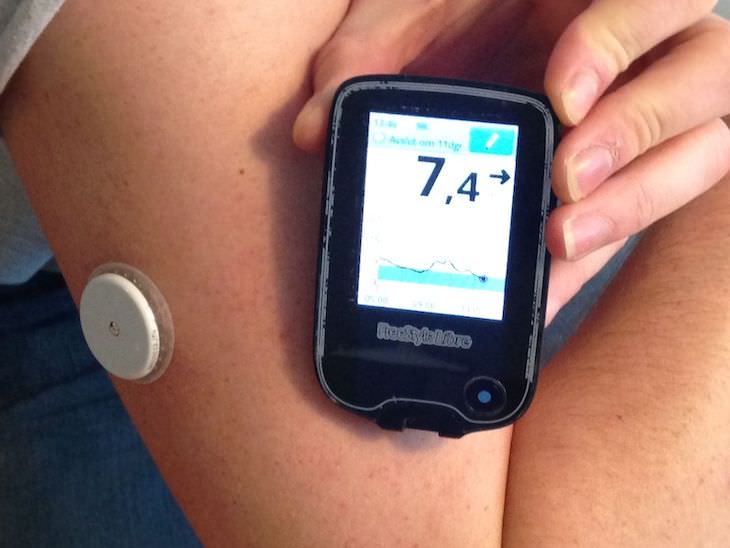
Study Finds CG monitors more efficient for diabetes patients, continuous glucose monitor
Along with testing the functionality of continuous glucose monitoring, the team also looked at the impact these devices have on patients’ quality of life and how they aid in the management of their condition. With the help of a continuous monitor, participants were better able to manage their blood sugar levels throughout the day. As a result, life satisfaction scores increased as well. 
 
A CGM works through a tiny sensor inserted under your skin, usually on your stomach or arm. The sensor measures your interstitial glucose level, which is the glucose found in the fluid between the cells. The sensor tests glucose every few minutes, and a transmitter wirelessly sends the information to a monitor.
 
“For me, what’s most exciting is that this work demonstrates that using continuous glucose monitoring is effective in substantially improving blood sugars levels and decreasing the risks of hypoglycemia in those that were randomized to use a continuous glucose monitor compared with the usual finger-prick,” said one of the authors of the study, Rodica Busui, M.D., Ph.D., vice chair of clinical research at Michigan Health’s Department of Internal Medicine, in a university release. 
 
Busui added that he and his team hope that this game-changing technology soon becomes available to all patients with diabetes.

This is only for your information, kindly take the advice of your doctor for medicines, exercises and so on.   

https://gscrochetdesigns.blogspot.com. one can see my crochet creations  
https://gseasyrecipes.blogspot.com. feel free to view for easy, simple and healthy recipes    
https://kneereplacement-stickclub.blogspot.com. for info on knee replacement

Labels: , , , , , , , , , , ,

Tuesday, February 25, 2020

AI Used to Measure Sugar in the Blood

Researchers hope this can someday replace the invasive finger prick. 

Anyone suffering from diabetes knows how important tracking sugar in the blood is. Technology has improved that process but it still requires needles and finger pricks.

Researchers at the University of Warwick in the UK are trying to change that, applying artificial intelligence to the problem.

In a paper published in journal Scientific, the scientists led by Dr. Leandro Pecchia demonstrated how they could detect sugar in the blood using ECG signals and off-the-shelf-wearable sensors. 


The AI system works just as well
Two pilot studies of healthy volunteers showed the system's average sensitivity and specificity was about 82% which is comparable with the current system used to detect hypoglycemia.  As it stands continuous glucose monitors or CGMs are available via the NHS for detecting sugar levels in the blood. They measure the glucose in fluid using a sensor with a needle. The senor sends alarms and data to a device. The devices often need to be calibrated two times a day and include fingerprick blood glucose level tests. 


Fingerpicks are never pleasant and in some circumstances are particularly cumbersome. Taking fingerpick during the night certainly is unpleasant, especially for patients in pediatric age," said Dr. Pecchia in a press release announcing the work. “Our innovation consisted in using artificial intelligence for automatic detecting hypoglycemia via few ECG beats. This is relevant because ECG can be detected in any circumstance, including sleeping.”


Subject's own data used to train the AI algorithm

What may have made the Warwick scientists' method so effective is that the AI algorithms are trained with the subject's own data. If cohort data was used the system would not give back the same results.

"Our approach enables personalised tuning of detection algorithms and emphasize how hypoglycaemic events affect ECG in individuals. Basing on this information, clinicians can adapt the therapy to each individual. Clearly more clinical research is required to confirm these results in wider populations. This is why we are looking for partners., Dr. Pecchia said.

This is only for your information, kindly take the advice of your doctor for medicines, exercises and so on.     

https://gscrochetdesigns.blogspot.com. one can see my crochet creations  
https://gseasyrecipes.blogspot.com. feel free to view for easy, simple and healthy recipes    
https://kneereplacement-stickclub.blogspot.com. for info on knee replacement


Labels: , , , , , , ,

Sunday, February 14, 2016

Finger Prick Blood Test May Help Detect Cancer

THIS IS ONLY FOR INFORMATION, ALWAYS CONSULT YOUR PHYSICIAN BEFORE HAVING ANY PARTICULAR FOOD/ MEDICATION/EXERCISE/OTHER REMEDIES.

FOR INFO ABOUT KNEE REPLACEMENT, YOU CAN VIEW MY BLOG
HTTP://KNEE REPLACEMENT-STICK CLUB.BLOGSPOT.COM/

FOR CROCHET DESIGNS- http://My Crochet Creations.blogspot.com/


 A simple finger prick blood test may be used to diagnose cancer, say scientists who have developed a new technology to detect disease biomarkers in the form of nucleic acids, the building blocks of all living organisms.

Nucleic acids consist of chains or sequences of bases stretching from just a few to millions of elements long. The exact order in which these bases are found, even over short distances, is strongly tied to their functions, and therefore can be used as direct indicators of what is going on inside cells and tissue.

For example, one family of these nucleic acids known as microRNAs are only about 20 bases long, but can signal a wide range of diseases, including cancer.

In the new technique, nanotechnology is used to determine whether a specific target nucleic acid sequence exists within a mixture, and to quantify it if it does through a simple electronic signature.

"If the sequence you are looking for is there, it forms a double helix with a probe we provide and you see a clear signal. If the sequence is not there, then there is not any signal," said Adam R Hall from Wake Forest Baptist Medical Centre in US.

"By simply counting the number of signals, you can determine how much of the target is around," said Mr Hall. In the study, researchers first demonstrated that the technology could effectively identify a specific sequence among a background of competing nucleic acids, and then applied their technique to one particular microRNA (mi-R155) known to indicate lung cancer in humans.

They showed that the approach could resolve the minute amount of microRNAs that can be found in patients. "We envision this as a potential first-line, noninvasive diagnostic to detect anything from cancer to the Ebola virus," said Hall.

"Although we are certainly at the early stages of the technology, eventually we could perform the test using a few drops of blood from a simple finger prick," Hall said.

The findings were published in the journal Nano Letters.

Labels: , , , , , , ,

Monday, January 11, 2016

New Smartphone-Based System Could Help Diabetics Control Blood Sugar

THIS IS ONLY FOR INFORMATION, ALWAYS CONSULT YOUR PHYSICIAN BEFORE HAVING ANY PARTICULAR FOOD/ MEDICATION/EXERCISE/OTHER REMEDIES.

FOR INFO ABOUT KNEE REPLACEMENT, YOU CAN VIEW MY BLOG
HTTP://KNEE REPLACEMENT-STICK CLUB.BLOGSPOT.COM/

FOR CROCHET DESIGNS- http://My Crochet Creations.blogspot.com/


Diabetics may soon be able to ditch constant finger pricks and insulin injections, thanks to a new smartphone-based system that can automatically control blood-sugar levels.

A smartphone, combined with a tiny sensor and wearable insulin pump, can stand in for pancreas, monitoring blood-sugar levels and delivering insulin as needed, researchers said.

The system will enter two final phases of international trials this year.

"We've been working on this specific artificial pancreas as it's called since 2006," said lead researcher Boris Kovatchev, director of the University of Virginia Center for Diabetes Technology.

The system works with a readily available blood-glucose sensor - about the size of a flash drive - that can be worn in a variety of places on the body, such as an arm, leg, or the abdomen, 'Ars Technica' reported.

The sensor reads blood-glucose levels every five minutes and wirelessly reports the results to a specially designed app on a nearby android smartphone.

The app's algorithm analyses the data and wirelessly controls a discreet, wearable insulin pump, which can be hooked to a belt or other piece of clothing. The pump has a very fine needle that delivers insulin into the blood stream.

For traditional management strategies and for Kovatchev's original version of the smartphone app, the goal is to keep blood-glucose levels at a specific target number.

This makes it easy to under- or over-shoot that specific target during manual blood-sugar management, and it means an automatic system has to frequently tweak levels.

Researchers have come up with an improved version of the smartphone app algorithm that does not aim for a specific blood-glucose number, but rather a "zone."

These patient-specific short ranges of healthy blood-glucose levels are easier targets that can be stably maintained, avoiding constant adjustments that can lead to swings, Francis Doyle III, dean of Harvard's Paulson School of Engineering and Applied Sciences said.

The new algorithm will be able to adapt to each patient's sugar shifts and insulin sensitivity.

 Download the Gadgets 360 app for Android and iOS to stay up to date with the latest tech news, product reviews, and exclusive deals on the popular mobiles.

Labels: , , , , ,