Sunday, September 12, 2021

Why You Should Never Pre-Rinse Your Dishes

Rinse the plates, pop them in the dishwasher, press start, and repeat. Washing dishes is one of those monotonous chores that we’ve done so many times, we hardly even think about it anymore. It’s one of those mindless tasks.
However, as it turns out, we have been carrying out this said routine completely wrong – you’re not supposed to pre-rinse your dishes before putting them in the machine.
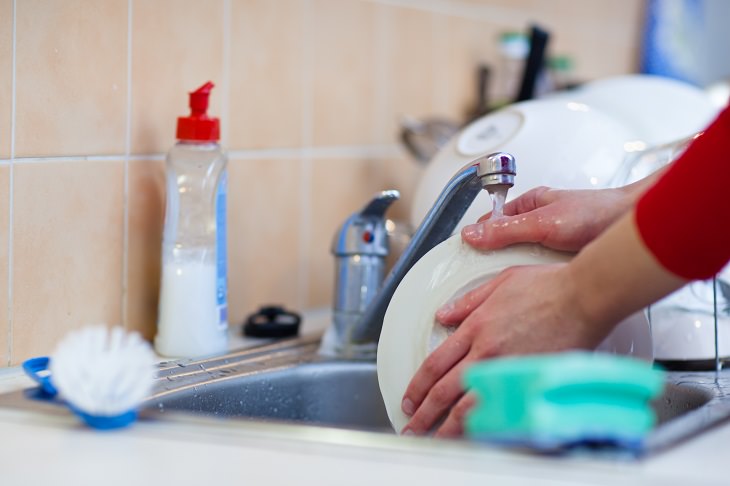
Don't Rinse Dishes
Believe it or not, but it’s actually more beneficial to not rinse your dishes before putting them into the dishwasher. Modern dishwashers have sensors inside of them to figure out how long to run a cycle, and even if you press “normal” on the panel, the length and temperature of the cycle can vary depending on how dirty the sensor detects the dishes to be.

Morgan Brashear, a Cascade scientist with Procter & Gamble, says that “the water in the pre-wash will remove any loose soils the same way they would be removed with water alone by rinsing in the sink. The machine will then recognize that there’s food present and will run a more thorough cleaning cycle. If you pull a helicopter cleaner and you rinse all your dishes except for one casserole dish with some baked cheese, nothing will come off in the pre-wash, telling your dishwasher that there’s no food present, and it will run a shorter cycle, leading to a less thorough clean and potentially some cheese left on the dish.” 
 
Some dishwashers get rid of gunk with an internal garbage filter or disposal. If your dishwasher is a newer model, it likely has a filter (if it runs quietly, it’s a filter system), which needs to be cleaned regularly in order to function properly. 

However, it’s important to remember that a dishwasher isn’t a garbage disposal. Too much solid residue during a wash can slow things down. So keep up with the habit of scraping off leftover food, but feel free to leave behind plate residue for your dishwasher to tackle. 
 
Instead of giving the plates a full rinse, your best bet is to scrape any large food particles into the trash can before loading and letting the dishwasher do its job. Brashear also points to using the right detergent, ideally one that’s designed to break down food, to help the process run cleanly and smoothly.

And the best part about skipping helicopter cleaning? You don't only save time and money, but you can save up to 20 gallons of water per each load of dishes.

This is only for your information, kindly take the advice of your doctor for medicines, exercises and so on.   

https://gscrochetdesigns.blogspot.com. one can see my crochet creations  
https://gseasyrecipes.blogspot.com. feel free to view for easy, simple and healthy recipes    
https://kneereplacement-stickclub.blogspot.com. for info on knee replacement


Labels: , , , ,

Friday, July 30, 2021

There’s a Better Way Than Finger Prick to Monitor Diabetes

One of the unpleasant adjustments diabetes patients must get accustomed to is regular finger pricks as a means to monitor blood sugar levels. A new study suggests that there is a more efficient and painless way to monitor diabetes. The clinical trial published in the Journal of American Medical Association (JAMA) found that the use of a real-time glucose monitor helps patients manage their condition better in the long term.

Over the course of 8 months, the researchers followed 175 diabetes patients who used a continuous glucose monitor (CGM) instead of a standard blood glucose meter. During this time, the group’s overall hemoglobin A1C levels dropped by 1.1 percent. The blood sugar of participants using a lancet, on the other hand, only dropped by 0.16 percent. Remarkably, the group using continuous glucose monitors spent an average of 3.8 hours more each day within the optimal range of blood sugar and 3.6 hours less in the dangerous high-glucose range. 
 
This study is among the first ones to focus on type 2 diabetes patients who use basal insulin, the long-lasting variety which is taken once or twice a day. Earlier research had shown that the monitors improved glucose control for patients with type 1 diabetes as well.
CG monitors are to become the new standard, according to the study
Study Finds CG monitors more efficient for diabetes patients, continuous glucose monitor
Along with testing the functionality of continuous glucose monitoring, the team also looked at the impact these devices have on patients’ quality of life and how they aid in the management of their condition. With the help of a continuous monitor, participants were better able to manage their blood sugar levels throughout the day. As a result, life satisfaction scores increased as well. 
 
A CGM works through a tiny sensor inserted under your skin, usually on your stomach or arm. The sensor measures your interstitial glucose level, which is the glucose found in the fluid between the cells. The sensor tests glucose every few minutes, and a transmitter wirelessly sends the information to a monitor.
 
“For me, what’s most exciting is that this work demonstrates that using continuous glucose monitoring is effective in substantially improving blood sugars levels and decreasing the risks of hypoglycemia in those that were randomized to use a continuous glucose monitor compared with the usual finger-prick,” said one of the authors of the study, Rodica Busui, M.D., Ph.D., vice chair of clinical research at Michigan Health’s Department of Internal Medicine, in a university release. 
 
Busui added that he and his team hope that this game-changing technology soon becomes available to all patients with diabetes.

This is only for your information, kindly take the advice of your doctor for medicines, exercises and so on.   

https://gscrochetdesigns.blogspot.com. one can see my crochet creations  
https://gseasyrecipes.blogspot.com. feel free to view for easy, simple and healthy recipes    
https://kneereplacement-stickclub.blogspot.com. for info on knee replacement

Labels: , , , , , , , , , , ,

Tuesday, May 05, 2020

Coronavirus sensor you stick at the top of your chest can track symptoms

It looks like a Band-Aid, but it's a flexible wireless sensor that sits where your throat and chest meet, picking up coughing and breathing problems associated with COVID-19. The device, announced Monday, can monitor early signs of coronavirus infection and the progression of the illness.

Developed in hard-hit Chicago by Northwestern University and the Shirley Ryan AbilityLab, the device adheres to the skin below your suprasternal notch -- the little well at the base of your throat where airflow is closest to the skin and where tracheostomies are performed. This patch, however, is noninvasive and is related to a sensor for monitoring speech and swallowing in recovering stroke patients. That design was tuned to track coughing and breathing problems that are central to COVID-19.


"We don't use a microphone," says Professor John Rogers, director of Northwestern University's Center on Bio-Integrated Electronics. "There are problems with microphones with ambient noise and tremendous invasions of privacy. We use a high-bandwidth, tri-axis accelerometer to measure movement of the surface of the skin" to capture details of breathing and coughing, not unlike a digital stethoscope.

The patch also detects heart rate and temperature.

Once a day you peel it off and place it on a wireless charger, which triggers the patch to sync its stored data with a nearby iPad. From there the data is uploaded to a HIPAA-compliant cloud where a proprietary AI algorithm examines it for anomalies related to COVID-19. The device has no external ports for power or connectivity, making it easier to disinfect.

AI has taken something of beating lately for promising more than it could deliver in health diagnosis.

"We like AI, but we're not wedded to it. We're wedded to things that work," says Rogers. "We use digital filtering algorithms that look for particular signatures in the data. We're looking for trends, not an absolute gold standard measurement. And we have a good understanding of the underlying physics."

At this early stage, the data is double-checked by a trained human before any indications are forwarded to medical providers. Twenty-five test subjects have been wearing the device for two weeks so far, generating about 1,500 hours of history and one terabyte of data.
Arun Jayaraman, research scientist at Shirley Ryan AbilityLab

Missing from the sensor patch is a blood oxygen perfusion sensor, but Rogers suggests that is coming in the near future. Fingertip pulse oximeters, which measure oxygen perfusion, are the latest personal health product to be snapped up after some reports indicated that low blood oxygen was a hallmark of onset of COVID-19.

A lab at Northwestern's Chicago campus is currently producing dozens of new patches a week. It has the ability to scale to hundreds of devices a week before making the patch available for volume manufacturing via license.

Beyond this pandemic, the Northwestern COVID-19 sensor joins an array of activity trackers, glucose monitors and blood-pressure sensors that suggest we'll soon wear a clinic's worth of medical sensors to get in front of health issues before they turn serious.

"I think that demands a hardware platform that is virtually imperceptible," says Rogers. "Health care in general will be improved when you move from episodic monitoring of status to continuous. I've always thought that makes sense."

The information contained in this article is for educational and informational purposes only and is not intended as health or medical advice. Always consult a physician or other qualified health provider regarding any questions you may have about a medical condition or health objectives.

This is only for your information, kindly take the advice of your doctor for medicines, exercises and so on.     

https://gscrochetdesigns.blogspot.com. one can see my crochet creations  
https://gseasyrecipes.blogspot.com. feel free to view for easy, simple and healthy recipes    
https://kneereplacement-stickclub.blogspot.com. for info on knee replacement


Labels: , , , , , , ,