Thursday, September 19, 2024

Breast Cancer Symptoms: Signs Of The Disease That You Can See On Your Skin

Breast cancer, the most prevalent global cancer in women and can be fatal if untreated. Early detection is crucial; symptoms include changes in skin texture, such as dimpling and eczema-like rash or redness on the nipple. Inflammatory breast cancer (IBC), a rare and fast-growing form of breast cancer shows signs on your skin.

Breast cancer is a cancer that develops in the milk ducts and/or the milk-producing lobules of the breast. The World Health Organisation (WHO) says that breast cancer is the most prevalent cancer in the world with 2.3 million women being diagnosed with the disease and 685, 000 deaths globally in 2020. Breast cancer when in its earliest form is not life-threatening, however, if it is not treated, it can spread to other tissues and organs which can turn out to be fatal.
Breast cancer if detected in the early stages can be treated. For that to happen you should know the symptoms of the condition that can eventually help in early diagnosis and treatment.
One of the changes you might see is the change in the skin texture on or around your breast area, including dimpling. A report in mirror.co.uk, states that according to biotech company Roche, which specialises in diagnostics, “Dimpling of the skin could suggest that the tiny channels in the breast, called lymph vessels, which help get rid of waste products from the body, have become blocked. This causes the breast to become inflamed and swollen and a large area of skin to develop little dimples, like orange peel. In some cases, this is a sign of a type of breast cancer known as inflammatory breast cancer.”

 Another sign is developing an eczema-like rash or redness on the nipple or the surrounding area. Roche says, “This is a very rare symptom of breast cancer. In a small number of cases it is linked to a disease that is associated with breast cancer called Paget's disease. While its cause remains unknown, Paget's disease causes an eczema-like itchy red rash on the nipple or surrounding area.”

Inflammatory breast cancer (IBC) is a rare and fast-growing form of cancer which can show its signs on the skin. Cleveland Clinic says, “Unlike most breast cancers, IBC doesn’t usually cause lumps in breast tissue. Instead, it appears as a rash, creating skin texture on the affected breast similar to an orange peel. IBC causes pain, redness, swelling and dimpling on the affected breast.”
IBC usually happens when cancer cells tend to block the lymph vessels. When the lymph vessels are blocked, it causes inflammation. People think of this inflammation as an infection.

Here are some other symptoms of inflammatory breast cancer, according to Cleveland Clinic

  • Areas of discolouration (red, pink or purple), a bruise or rash spread over one-third of your breast.
  • Pain, swelling, itchiness, firmness or tenderness in one breast.
  • Warmth, burning, heaviness or enlargement of one breast.
  • Inverted or retracted nipple (a nipple that points inward).
  • Swollen lymph nodes near your collarbone or under your arm.


Labels: ,

Friday, May 26, 2023

If This Little Mark Appears On Your Nail - Get Tested!

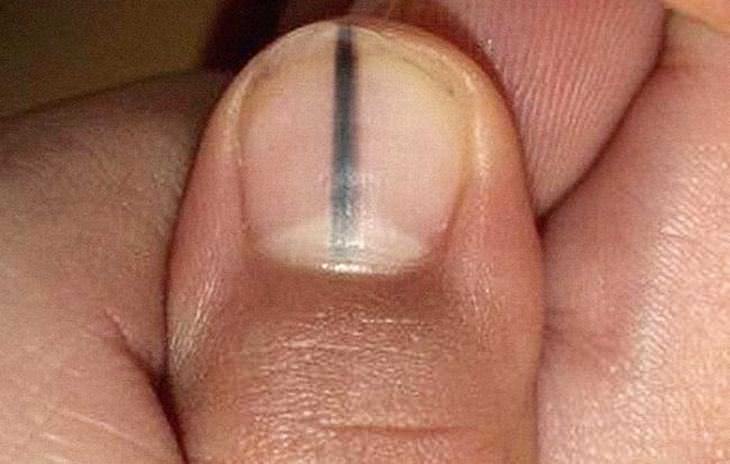
Your nails can reveal a great deal about your health. One thing to look out for is a dark mark on your nail, which might be more serious than you think. That's the warning one woman received when she complained to her nail technician about a black vertical line on her thumbnail. Initially, she had wanted a dark nail polish to cover the stripe on her nail, which ran from her cuticle to the edge of her nail. 
 
The woman had been going to salons for years where workers told her the black line was either a blood blister, a sign of calcium deficiency, or just a hereditary mark. But, in this visit, the nail technician told her to go see a doctor immediately - and she did. A couple of weeks later, the woman called to tell the nail technician that the vertical black stripe on her nail had been diagnosed as an aggressive melanoma, which had spread to her lymph nodes.
black line on nail
Nail melanoma is officially called subungual melanoma if it is under the nail, or periungual melanoma if it's around the nail - rare, but potentially deadly. Half of all melanoma cases occur in those of Asian decent, 35% in darker-skinned people, and just 2.5% in white individuals. 
 
One of the reasons why this is so serious is because more often than not, patients do not receive an accurate diagnosis right away. In fact, more often than not, the average delay of diagnosis for subungual melanoma patients is two and a half years, and it's not because people don't notice the black mark, but rather because it is usually attributed to something else.
 
 In addition, a subungual melanoma looks like something called a subungual hematoma, or a 'blood blister. This is usually caused by some kind of trauma, which may be caused by slamming your finger in the car door. This will cause the tiny blood vessels underneath your nail to rupture, causing blood to leak out and discolor the nail. 
 
In this instance, however, a new, healthy nail will begin to grow in and the discolored nail will grow out. The pattern of discoloration also tends to be more irregular, with puddles or drops, while with subungual melanoma, it develops as an organized band, arising in the root of the nail and extending to its edge. 
 
So, if you notice a new, dark mark underneath any of your fingernails or toenails, and can't remember any kind of trauma that could have caused it. Your doctor will probably do a biopsy to check for melanoma. The good news is that if you catch it early, surgical removal can get rid of any of the cancerous cells before they're able to spread.


This is only for your information, kindly take the advice of your doctor for medicines, exercises and so on.   

https://gscrochetdesigns.blogspot.com. one can see my crochet creations  
https://gseasyrecipes.blogspot.com. feel free to view for easy, simple and healthy recipes    
https://kneereplacement-stickclub.blogspot.com. for info on knee replacement
https://cancersupportindia.blogspot.com  for infor on cancer and health related topics
https://GSiyers home remedies.blogspot.com   is the latest addition to my blogs. I'm going to add posts there, do give me your valuable feed back on my blogs. Thanks a lot, take care, be healthy and be happy.

Labels: , , , ,

Saturday, August 07, 2021

Arterial Thrombosis Associated With COVID-19 Can Cause Limb Amputation, Death

This is growing evidence confirming the association between COVID-19 and arterial thrombotic events. Various studies have shown that COVID-19 infection leads to clots in the arteries that are responsible for carrying oxygen-rich blood to the body from the heart, and this can be termed arterial thrombosis. Many post-Covid patients have suffered from limb and life-threatening blood clots in the arteries of the legs. The arterial thrombosis induced owing to COVID-19 infection is characterized by dire outcomes, strikingly increased rates of amputation and death.

Dr Rahul Sheth, Interventional Radiologist, Zen Multispeciality Hospital, Mumbai said that they have treated 24 patients for lower limb arterial clots in the hospital. "We have been able to save 17 limbs, where no amputation was required. 7 patients required some form of amputation since they presented late. Out of the 24 patients, 2 presented in the first wave, and 22 in the second wave," he said.

Explaining about the COVID-19 infection and arterial thrombotic link, he stated, "It is postulated that Covid-19 increases the blood's viscosity of the blood causing clots. When the blood flow in the artery is blocked due to the clots, there is no oxygen supply to the body parts. When this affects the legs, it can lead to severe leg pain, cold limbs and if untreated will progress to gangrene, requiring amputation or removal of the limb to save the patient's life. These blood clots can also travel all over the body and damage distant organs." 

Early symptoms of arterial thrombosis to watch out for

Dr Sheth noted that timely follow-up, early detection of symptoms, and prompt treatment will prevent complications and the limbs can be saved from gangrene setting in and amputation.

According to the expert, the symptoms will be noticeable sometimes during active COVID or sometimes even 7 to 10 days post COVID recovery. The golden period to treat is within 24 hours after the onset of the symptoms.

He cautioned that any symptoms like leg pain, pain in walking, the cold limbs should not be ignored, and a doctor should be consulted.

Examination of the affected leg and palpation of the foot pulses should be done. If the pulses are absent, then immediate admission should be done, followed by an arterial colour Doppler. This colour doppler is like sonography for the blood vessels to detect the blockage. Then, a peripheral angiography is performed to confirm the diagnosis and decide on a treatment plan. Two main options are there; endovascular, where the clots are removed using a special catheter and a clot-busting drug is given to dissolve the clots; or surgical wherein an incision is made in the artery and the clot removed using a device. Endovascular is preferred nowadays since the clots in the small blood vessels in the leg and foot can also be cleared Dr Sheth elaborated.

"There is no awareness regarding this condition and the patients ignore the early symptoms. Some come to the hospital in advanced stages with discolouration of skin or gangrene. The first 12 to 24 hours of symptoms are crucial, blood circulation needs to be restored; ideally earlier the better. Don't take severe leg pain or any abnormal changes in the body casually, during the post-covid period," asserted Dr Sheth.

A post-covid patient who suffered arterial thrombosis

A 46-year-old woman from Sion, Mumbai, who had a past medical history of hypertension and obesity was tested Covid positive on March 21, 2021. She was admitted to Zen Multispeciality Hospital, Mumbai on 27th March 202. According to doctors there, she had fever with cough, her Covid pneumonia CT score was 8/25 and oxygen saturation was 92%, and needed 4 litres of oxygen. She was treated with the help of steroids and Remdesivir for 6 days. She recovered well and her saturation was 98% on room air with no breathlessness. The patient was discharged on day 10 on oral steroids, antibiotics, and ecosprin in the first week of April.

But 9 days post-discharge, she experienced pain in the left foot. She took pain killers, but nothing seemed to work in her favour. To her dismay, 24 hours later pain worsened. An orthopaedic advised her an arterial colour doppler, which revealed clots (thrombosis) in the main artery supplying the leg (the superficial femoral artery), with poor blood flow in the leg.

According to doctors at Zen Multispeciality Hospital, she came with severe left leg pain, the leg and foot were cold with the toes showing discolouration. After examination, clots were found in the left leg arteries. With a special catheter, the doctors aspirated the clots and gave a clot-busting drug to dissolve the leg clots. This drug was given for 12 hours through a catheter in the leg. They then repeated an angiogram which showed near total clearance of the clots. Now, the pain has disappeared, and her foot feels warm to the touch. The pulses in the foot are back, and she can move her toes like before.

The patient urged other patients like her to be careful and avoid delaying treatment.

This is only for your information, kindly take the advice of your doctor for medicines, exercises and so on.   

https://gscrochetdesigns.blogspot.com. one can see my crochet creations  
https://gseasyrecipes.blogspot.com. feel free to view for easy, simple and healthy recipes    
https://kneereplacement-stickclub.blogspot.com. for info on knee replacement


Labels: , , , , , , ,

Thursday, July 29, 2021

Coronavirus: What is COVID toes? Causes, symptoms and all you need to know

All you need to know about COVID toes

The novel coronavirus has impacted people in various ways. From taking a toll on respiratory health and other vital organs, the SARs-COV-2 virus has also affected people's fingers and toes. While it may not seem very dangerous, it can lead to discomfort and pain. Currently termed as 'COVID toes', while rare, it is said to be more prone in younger patients. A 13-year-old teenager recently reported suffering from the ailment, which prevented her from walking and also made it difficult for her to wear shoes. That said, for those of you, unaware of this unusual COVID effect, here's what it is and everything else you need to know.

What is COVID toes?

As per the College of Podiatry, Covid toes is the name given to chilblain-like lesions which appear on the toes of some people after having contracted COVID-19. According to research, it can occur both on fingers and the toes. However, it is more common. Besides causing lesions, it can lead to bright red colouration on the fingers or toes, which eventually turns purple. The most dangerous aspect of this ailment is that it can go from impacting one toe to all the other toes.

readmore

Are there any specific causes?

Up until now, there have been no specific causes behind COVID toes, however, research is still ongoing.

Experts believe that COVID toes is an outcome of the immune system reacting to an active coronavirus infection. That means it could be an antiviral immune response triggered by the immune system of younger patients, which in turn results in changes in microangiopathic - small blood vessel disease.

Another theory suggests that COVID toes could be a direct result of the SARs-COV-2 virus. Walking barefoot in homes, lack of physical movements and a sedentary lifestyle is said to be some of the causes.

readmore

Associated symptoms

For many people, COVID toes only lead to discoloration and swelling of the feet or hands. However, it can be painless and people usually don't feel anything.

In other cases, in addition to the swelling and the discolouration, COVID toes can cause blisters, itchy rashes, painful bumps and areas of rough skin. In severe cases, a small amount of pus may also develop under the skin.

Treatment

In most cases, COVID toes heals on its own. However, if the ailment lingers on for longer periods of time, contact a dermatologist, who can prescribe you the right medications or ointments to apply on the affected area.

This is only for your information, kindly take the advice of your doctor for medicines, exercises and so on.   

https://gscrochetdesigns.blogspot.com. one can see my crochet creations  
https://gseasyrecipes.blogspot.com. feel free to view for easy, simple and healthy recipes    
https://kneereplacement-stickclub.blogspot.com. for info on knee replacement


Labels: , , , , , , , , , , , , ,