If This Little Mark Appears On Your Nail - Get Tested!
Your nails can reveal a great deal about
your health. One thing to look out for is a dark mark on your nail,
which might be more serious than you think. That's the warning one woman
received when she complained to her nail technician about a black
vertical line on her thumbnail. Initially, she had wanted a dark nail
polish to cover the stripe on her nail, which ran from her cuticle to
the edge of her nail.
The woman had been going to salons for years where workers told her the
black line was either a blood blister, a sign of calcium deficiency, or
just a hereditary mark. But, in this visit, the nail technician told her
to go see a doctor immediately - and she did. A couple of weeks later,
the woman called to tell the nail technician that the vertical black
stripe on her nail had been diagnosed as an aggressive melanoma, which
had spread to her lymph nodes.
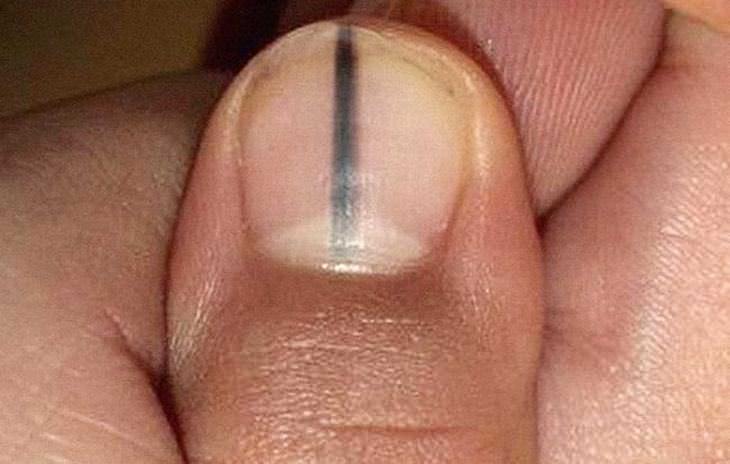
Nail melanoma is officially called
subungual melanoma if it is under the nail, or periungual melanoma if
it's around the nail - rare, but potentially deadly. Half of all
melanoma cases occur in those of Asian decent, 35% in darker-skinned
people, and just 2.5% in white individuals.
One of the reasons why this is so serious is because more often than
not, patients do not receive an accurate diagnosis right away. In fact,
more often than not, the average delay of diagnosis for subungual
melanoma patients is two and a half years, and it's not because people
don't notice the black mark, but rather because it is usually attributed
to something else.
In addition, a subungual melanoma looks like something called a
subungual hematoma, or a 'blood blister. This is usually caused by some
kind of trauma, which may be caused by slamming your finger in the car
door. This will cause the tiny blood vessels underneath your nail to
rupture, causing blood to leak out and discolor the nail.
In this instance, however, a new, healthy nail will begin to grow in and
the discolored nail will grow out. The pattern of discoloration also
tends to be more irregular, with puddles or drops, while with subungual
melanoma, it develops as an organized band, arising in the root of the
nail and extending to its edge.
So, if you notice a new, dark mark underneath any of your fingernails or
toenails, and can't remember any kind of trauma that could have caused
it. Your doctor will probably do a biopsy to check for melanoma. The
good news is that if you catch it early, surgical removal can get rid of
any of the cancerous cells before they're able to spread.
This is only for your information, kindly take the advice of your doctor for medicines, exercises and so on.
https://gscrochetdesigns.blogspot.com. one can see my crochet creations
https://gseasyrecipes.blogspot.com. feel free to view for easy, simple and healthy recipes
https://kneereplacement-stickclub.blogspot.com. for info on knee replacement
https://cancersupportindia.blogspot.com for infor on cancer and health related topics
https://GSiyers home remedies.blogspot.com is the latest addition to my blogs. I'm going to add posts there, do give me your valuable feed back on my blogs. Thanks a lot, take care, be healthy and be happy.
https://gscrochetdesigns.blogspot.com. one can see my crochet creations
https://gseasyrecipes.blogspot.com. feel free to view for easy, simple and healthy recipes
https://kneereplacement-stickclub.blogspot.com. for info on knee replacement
https://cancersupportindia.blogspot.com for infor on cancer and health related topics
https://GSiyers home remedies.blogspot.com is the latest addition to my blogs. I'm going to add posts there, do give me your valuable feed back on my blogs. Thanks a lot, take care, be healthy and be happy.
Labels: dark mark on nail- subungual/ periungual mmelanoma, discoloration, irregular, nails reveal abt health, subungual hematoma- blood blister
posted by G S Iyer at 6:46 AM
0 comments
