Friday, March 22, 2019

Common heart drug may up sudden cardiac arrest risk

A  drug commonly used to treat high blood pressure and chest pain could be associated with an increased risk of sudden cardiac arrest, according to a study. 

Doctors examined over 60,000 people to determine whether nifedipine and amlodipine or dihydropyridines — widely used for high blood pressure and angina — were linked with out-of-hospital cardiac arrest.

The results, showed that high-dose (60 mg/day) nifedipine was significantly associated with an increased risk of out-of-hospital cardiac arrest with any dose of amlodipine.

There was no risk associated with amlodipine.

“Nifedipine and amlodipine are often used by many cardiologists and other physicians, and the choice often depends on the prescriber’s preference and personal experience,” said a cardiologist.

The findings are surprising given that both the drugs have been in use for many years.

However, the researchers urged caution when interpreting the results.

“The findings need to be replicated in other studies before action could be taken by doctors or patients,” the Dr. said.

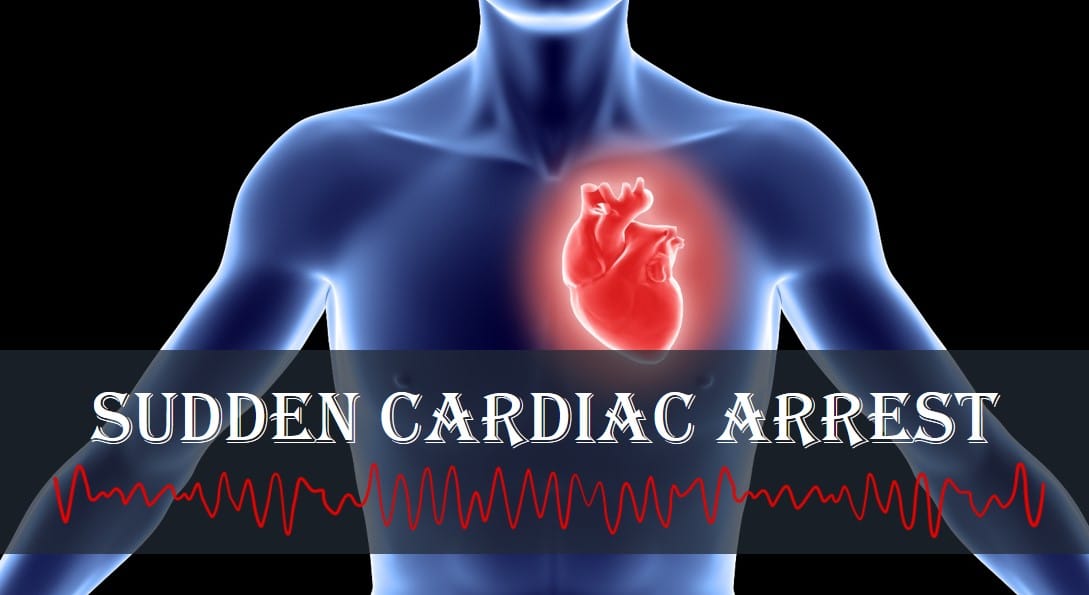
In sudden cardiac arrest, the heart stops pumping after a cardiac arrhythmia (ventricular fibrillation/tachycardia). This can be lethal if untreated. 
 
THIS IS ONLY FOR INFORMATION, ALWAYS CONSULT YOU PHYSICIAN BEFORE HAVING ANY PARTICULAR FOOD/ MEDICATION/EXERCISE/OTHER REMEDIES.                                    PS- THOSE INTERESTED IN RECIPES ARE FREE TO  VIEW MY BLOG-                                                                                           https://gseasyrecipes.blogspot.com/                                                                                                                                                         FOR INFO ABOUT KNEE REPLACEMENT, YOU CAN VIEW MY BLOG-                                                  https:// kneereplacement-stickclub.blogspot.com/           

                   FOR CROCHET DESIGNS                                                                                                                                                                                                  https://gscrochetdesigns.blogspot.com


Labels: , , ,

Tuesday, December 06, 2016

Cardiac arrest: What increases your risk? What to do, how can it be prevented?

Since cardiac arrest strikes immediately without warnings, it is important that we educate ourselves about this dangerous medical condition and know what to do when faced with such situation.
Here are some important things you need to know about cardiac arrest.

A cardiac arrest happens when your heart stops pumping blood around your body. Also called sudden cardiac arrest (SCA), it is a medical emergency, characterised by loss of consciousness and abnormal or absent breathing. Before this occurs, some people may experience chest pain, shortness of breath, or nausea.

What causes sudden cardiac arrest?

The immediate cause of cardiac arrest is usually an abnormal heart rhythms, called arrhythmias. Other possible causes of cardiac arrest include - coronary artery disease, heart attack, physical stress, major blood loss, lack of oxygen, intense physical exercise, and some inherited disorders etc. Sometimes, the cause of SCA is unknown.
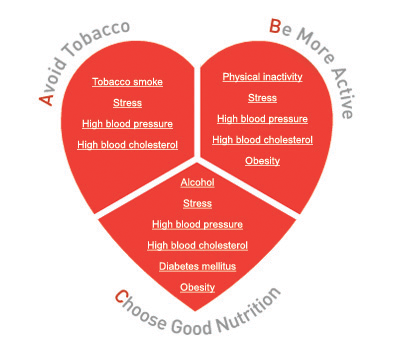
There are certain factors that may put you at risk of SCA, including smoking, obesity, high blood pressure, high blood cholesterol, diabetes, alcoholism, a sedentary lifestyle.

Can SCA be prevented?

Reducing your risk is the best strategy because there's no sure way that tells your risk of SCA. Preventive measures may include-
  • Screening for heart disease, especially, if you have a family history
  • Leading a healthy lifestyle such as - eating a nutritious, balanced diet and staying physically active
  • Maintaining a healthy weight
  • Not smoking.

What to do if someone has SCA?

This medical emergency needs immediate cardiopulmonary resuscitation (CPR) or use of a defibrillator, without which the person will die within a few minutes. Immediate CPR can help restore partial flow of oxygenated blood to the brain and other vital organs until more definitive medical treatment is available. In case you don't know CPR, you should immediately call emergency medical help. Hospital care includes drugs, an implantable device or other medical procedures.

 this is only for your information, kindly take the advice of your doctor for medicines, exercises and so on.


https://gscrochetdesigns.blogspot.com. one can see my crochet creations

https://gseasyrecipes.blogspot.com. feel free to view for easy, simple and healthy recipes

https://kneereplacement-stickclub.blogspot.com. for info on knee replacement

Labels: , , , , , , , , , , ,

Sunday, January 24, 2016

The Tell-Tale Signs and Symptoms of a Heart Attack

THIS IS ONLY FOR INFORMATION, ALWAYS CONSULT YOUR PHYSICIAN BEFORE HAVING ANY PARTICULAR FOOD/ MEDICATION/EXERCISE/OTHER REMEDIES.

FOR INFO ABOUT KNEE REPLACEMENT, YOU CAN VIEW MY BLOG
HTTP://KNEE REPLACEMENT-STICK CLUB.BLOGSPOT.COM/

FOR CROCHET DESIGNS- http://My Crochet Creations.blogspot.com/


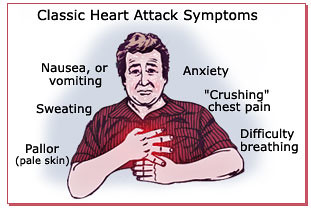
 Here are the tell-tale signs and symptoms of a heart attack:  
What happens during a heart attack?

During a heart attack, the blood flow to the heart muscle is either reduced or completely stops. This typically happens because of a blood clot that is blocking an artery. When the heart muscle does not get oxygen-rich blood, it ceases to work.
 
Some common heart attack symptoms:

- A heart attack often causes chest pain.
- There is a feeling of fullness or a clasping pain in the center of the chest. Most victims describe the pain as akin to an elephant standing on the chest (extreme pain). It usually lasts for about 15 minutes.
 
- One also experiences shooting pain in the shoulders, neck, arm, back and sometimes even the teeth and jaw.
 
- One finds increasing episodes of chest pain.
 
- Prolonged pain in the upper abdomen.
 
- Shortness of breath.
 
- The victim might experience heavy sweating.
 
- Since the heart’s pumping action is severely impaired during a severe heart attack, the victim might lose his/her consciousness.
 
 
* In rare cases, as in patients who are diabetic, the heart attack may not be very painful, and sometimes can even be entirely painless.
 
 
Some symptoms that may also appear include:
  • Pain in the abdomen
  • Heart burn
  • Unusual tiredness
  • Nausea
  • Tightness or pain in the neck, shoulders or upper back


Heart attack symptoms are not the same for everyone

Not everyone who has a heart attack has the same symptoms. Many a time, we also tend to ignore a heart attack thinking it might be mere abdominal discomfort due to gas pains or indigestion. If you have more than a few of the symptoms listed above, then you are likely to be having one. Get emergency help immediately.
 
What to do in case of a heart attack?
 
Rush to a hospital. Immediately. If you recognize that you or someone around you is having a heart attack, get immediate medical help.
 
Take Disprin (Asprin): As soon as you recognize it is an attack, crush a disprin, dissolve it in water and make the person drink it.
 
Emergency numbers: Every office and home must keep a list of emergency numbers like that of an ambulance service and hospital.
 
A heart attack is different from a cardiac arrest
sudden-cardiac-arrest-vs-heart-attack-sm.jpg
Do not confuse a heart attack with cardiac arrest. In the case of cardiac arrest, the heart suddenly stops. It occurs due to an electrical disturbance that obstructs the heart’s pumping function, which results in stopping blood flow to the rest of the body. Below are two fact files detailing the differences between a heart attack and cardiac arrest: 
 
Sudden Cardiac Arrest Fact File 

SCA is a chaotic electrical condition of the heart resulting in the loss of blood flow to the brain and body. The most common form of SCA is ventricular fibrillation.

Causes 
Electrical impulses of the heart become chaotic due to a blow to the chest or other (sometimes-unknown) health-related issues. As a result, the heart stops beating regularly and begins to flutter rapidly.

Symptoms 
Typically, there are no symptoms to SCA. Usually, the first indication of SCA is when the victim faints. The second sign is breathing cessation.

Victim's Response 
A sudden cardiac arrest victim always loses consciousness from lack of oxygen.

Risk of Death 
A victim of SCA will die unless treated. If left untreated, the chances of survival decrease by 10% per minute. Typically, permanent brain damage occurs within 5-7 minutes.

Treatment 
The only treatment for SCA is defibrillation from an automated external defibrillator (AED). A shock from the AED stops the chaotic electrical activity and allows the heart's sinus node to resume a normal electrical impulse.
 
Heart Attack Fact File 

The medical term for a heart attack is myocardial infarction: a blockage of the coronary arteries leading to a decrease in blood flow. When this happens, the heart muscles die or become permanently damaged.

Causes
Plaque made of cholesterol and other cells builds up in the walls of the heart’s arteries. When the build-up is great enough, the plaque creates a blockage, known as an occlusion, which restricts the blood supply to the heart muscle.

Symptoms
Warning signs of a heart attack include a tightening feeling in the chest, a sore or numb left arm, lower back, neck, and/or jaw. Other signs include bad indigestion, a feeling that something heavy is sitting on your chest, and shortness of breath.

Victim's Response 
The victim of a heart attack is usually conscious and alert.

Risk of Death
Most victims can recover fully and lead normal lives, but about a third of heart attacks are deadly. A heart attack can lead to sudden cardiac arrest.

Treatment
One treatment of a heart attack can be angioplasty, which opens up the blocked vessels with a medical balloon. Afterwards, a stent can be placed in the artery to help keep it open. Other treatments include clot-busting drugs called thrombolytics or nitroglycerin to reduce chest pain.

So, remember this information, and most of all, remember the ABCs of heart care: Avoiding Tobacco, stress and fatty foods, Being more active and Choosing the right nutrition and life style that will keep your heart healthy!

Labels: , , , , , , , ,