Thursday, July 16, 2026

Mouth taping: Sleep fix or health risk?
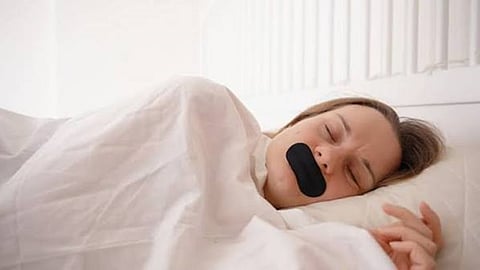
 Mouth taping: Sleep fix or health risk? 

 A small strip of tape placed over the lips before bed has become the latest sleep trend on social media, with many claiming it reduces snoring, improves sleep quality and even benefits oral health. Known as mouth taping, the practise is meant to encourage breathing through the nose instead of the mouth while sleeping. However, doctors say the trend warrants closer scrutiny because what works for a few people may not be safe or effective for everyone.

 One of the biggest questions surrounding the trend is whether there is enough scientific evidence to support its growing popularity. Addressing this, Dr Venu Babu Pentyala, consultant root canal specialist at Anu’s Dental, says, “Current scientific evidence supporting mouth taping is limited. While a few small studies suggest it may reduce snoring in selected people with mild sleep-disordered breathing, there is no strong evidence that it improves oral health. It should not be viewed as a universal solution and should only be considered after medical evaluation.”

Researchers have also been examining whether the practice is actually effective for improving sleep. Sharing what current studies indicate, Dr V Nagarjuna Maturu, senior consultant and clinical director, clinical and interventional pulmonology at Yashoda Hospitals, shares, “A recent 2025 scoping review identified only a small number of studies, many of which were of modest quality and involved carefully selected patients. While some studies have reported improvements in snoring and mild obstructive sleep apnea (OSA), the findings are inconsistent and insufficient to recommend mouth taping as a standard treatment. At present, it should be viewed as an experimental adjunct rather than an evidence-based therapy.”

 Many people do not realise how breathing through the mouth night after night can affect their teeth and gums. Explaining its impact on oral health, Dr Venu expresses, “Chronic mouth breathing dries the mouth, reducing saliva that naturally protects teeth and gums. This increases the risk of cavities, gum disease, bad breath, enamel erosion, oral infections, and gum inflammation. In children, prolonged mouth breathing may also affect jaw growth, facial development, and tooth alignment.”

Explaining the common medical reasons behind it and when it should be checked, Dr Nagarjuna narrates, “Mouth breathing during sleep is usually a symptom rather than the problem itself. Common causes include nasal blockage due to allergies, sinus disease, a deviated nasal septum, enlarged adenoids, and obstructive sleep apnea. Persistent mouth breathing accompanied by loud snoring, witnessed pauses in breathing, excessive daytime sleepiness, morning headaches, dry mouth, or poor-quality sleep should prompt evaluation by a physician or sleep specialist. Identifying and treating the underlying cause is far more important than simply preventing mouth breathing.”

Labels: , , , , , , , , ,

Saturday, May 31, 2025

Can Your Sleeping Position Affect Your Digestion?

We spend a third of all our lifetime asleep, and it’s no news that sleep deprivation or oversleeping can have serious negative effects on our health and wellbeing. But it isn’t only the quantity of your sleep, but also its quality that can either help or harm you. 
 
In fact, it is possible to go even further with this argument and state that the right sleeping position can enhance your well-being, just like a good yoga class or a workout do. This includes all of your organs and systems, and especially your digestive system. Learn how to enhance your sleeping position and avoid common mistakes in this article.

sleeping positions good sleeping positions

Did you know that according to scientific research the best sleeping position isn’t sleeping on your back, but rather on your left side? The reasoning behind this is the inner asymmetry of our organs. 
 
It is best to release pressure from the digestive tract during sleep, as it is one of the few organs that doesn’t enter a rest mode when you fall asleep. In fact, specific digestive processes are even more active at night than they are during the day. 
 
By sleeping on your left side, you’re letting gravity do the digestive work for you, which makes it easier to normalize bowel movements, especially to people who already suffer from irritable bowel syndrome, lazy bowel syndrome, inflammatory bowel disease, and other conditions. 
 
Here are the health benefits of sleeping on your left side:  
Reduces heartburn 
Helps digestion
Boosts brain health 
Reduces snoring or sleep apnea

sleeping positions sleeping on the left side

Even if you’re a side sleeper naturally, still pay attention to these tips to stack your bones correctly and prevent any possible muscle or joint pain that can develop when you’re constantly sleeping on one side. 
 
Tips for side sleeping:  
Find a firm pillow that’s just tall enough. 
 
Measure the distance between your neck and the shoulder and find a pillow that’s just the same height. 
 
Place a pillow or blanket between your knees to support your spine. 
 
Keep your arms parallel at the level of your face or below.


                                     Sleeping on Your Back 
 
Though sleeping on your side is ideal for a lot of people, others might want to consider sleeping on their back as well. 
 
Apart from being the best position for retaining smooth, wrinkle-free skin on your face, it can also be beneficial for people with joint and spine problems, as well as injuries and chronic pain. 
 
Sleeping on your back may be beneficial to those of you who suffer from: 
 
hip or knee pain 
 
shoulder pain 
 
 arthritis     
 
 Fibromyalgia 
 
stuffy nose and sinuses 
 
headaches.

sleeping positions sleeping on the back

Here are some pro tips to consider to sleep on your back correctly: 
 
Relieve or prevent lower back pain by putting a pillow under your knees. 
 
Try to keep your arms and legs spread out more or less symmetrically to avoid putting pressure on your spine and joints. 
 
Elevate your head and neck by using a pillow to about 6 inches (15 cm). 
 
This tip is beneficial to those of you who suffer from heartburn, snoring, but can’t sleep on their left side, as well as those who suffer from headaches and sinus buildup and nasal congestion. 
 
                                 Sleeping on Your Stomach 
 
Sleeping on your stomach is the worst choice you could make. It can trigger back pain and neck pain because your weight is not evenly distributed throughout your spine, which puts a strain on a specific region. 
 
The only benefit of sleeping on your tummy is the clearing of the passageways, which may help some of you who have sleep apnea or snore

sleeping positions sleeping on the stomach

Though we don’t advise sleeping on your stomach, here are some tips that can make this position safer for your health:
 
Stop using a pillow or use a very thin one on your pelvis to release the pressure. 
 
To avoid neck pain and stiffness, alternate the side you turn your head during the night. 
 
Keep your arms and legs straight and to your sides. Otherwise, your legs or arms could go numb, hurt your joints and your spine will be in an even more awkward position. 
 
Finally, remember that it’s OK if you alternate your sleep positions during the night, as it can help prevent muscle stiffness, especially if you’re a side or stomach sleeper. 
 
I hope you found these tips helpful. If you want to read even more about healthy sleep positions, we have a fascinating article about 5 Sleep Positions for Chronic Pain. Have a good night! For those sleeping positions, kindly see my next post.


This is only for your information, kindly take the advice of your doctor for medicines, exercises and so on.   

Labels: , , , , , , , ,

Tuesday, April 27, 2021

Why you should sleep on your left side

Benefits to sleeping on your left side

If you sleep on your right side, stomach, or back, then you may have to consider it’s time for a change. There are a lot more health benefits to sleeping on the left and it could make the world of difference to your health.

It reduces snoring

If you are a regular snorer, you probably have to endure your partner’s constant moaning while they have to endure your nightly snoring. It’s a lose-lose situation. But all is not lost! Sleeping on your left side is an easy way to take control. When you’re on your back and in a deep sleep, your jaw relaxes and exacerbates the snoring. So, next time, roll over onto your left and test it out.

Fight acid reflux

Although eating before going to bed isn’t healthy, our busy lifestyles today make it difficult to eat at appropriate times. If you have a late supper or simply overindulge before bedtime, you may find you suffer from acid reflux during the night. Well, researchers say that sleeping on the left can alleviate acid reflux symptoms.

It helps your heart

There are heart benefits too when sleeping on your left as it helps promote blood circulation through the body. So, if you suffer from any heart ailment, then this is an easy way to help your heart do its job while you’re asleep.

Pregnant women will love this

If you’re pregnant and finding it difficult to sleep comfortably, you may be surprised to hear there is a physical reason for this. Sleeping on your right causes the uterus to put pressure on your liver as its located on the right side. So, when you sleep on the left, you won’t feel this discomfort!

It helps your lymph nodes

Another surprising health benefit is that your lymph nodes function better when sleeping on the left. Sleeping in this position assists the body in easily filtering liquids through your system but when sleeping on the right, it makes the lymph nodes more sluggish.

This is only for your information, kindly take the advice of your doctor for medicines, exercises and so on.     

https://gscrochetdesigns.blogspot.com. one can see my crochet creations  
https://gseasyrecipes.blogspot.com. feel free to view for easy, simple and healthy recipes    
https://kneereplacement-stickclub.blogspot.com. for info on knee replacement


Labels: , , , , , , ,