Monday, January 02, 2023

Is It Eczema or Just Dry Skin? How to Tell the Two Apart

Winter is the season of snow, holiday cheer, and… dry skin. Indeed, the cold weather isn’t kind to the face and body, and for those who suffer from certain skin ailments, it’s also the time for annual flare-ups. This is the case with eczema, a skin condition that affects over 31 million people in the US.  
 
In fact, eczema can manifest itself through itchy and dry skin or scalp, as evident by the alternative name of the condition, which is “the itch that rashes.” This uncomfortable condition isn’t as easy to treat as regular dry skin, so knowing how to tell the difference between these two conditions is crucial.
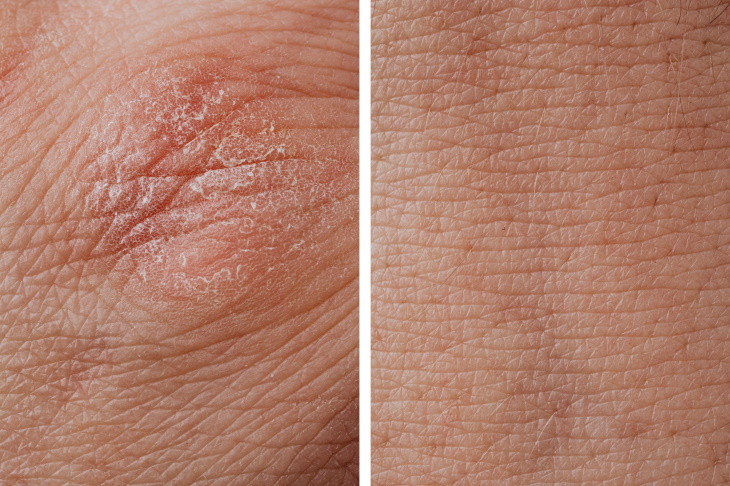
Dry skin and eczema – how are they different? 
 Types of Eczema Dry skin and eczema
Eczema makes your skin itchy and flaky, so isn’t it the same as dry skin? This is a common question people have, especially in the winter when the dry and windy weather turns the skin red and itchy. While it’s certainly true that some forms of eczema (like contact- or seborrheic dermatitis) are more likely to appear in the winter, there’s a principal difference between the two.

Dry skin is a skin type, whereas eczema is a chronic inflammatory skin condition. Even when eczema is triggered by an environmental cause, such as wearing woolen socks or taking a walk in cold weather, it won’t go away when we change the environment back to the baseline. 
 
Unlike your itchy feet or dry hands that can be easily remedied by a layer of thick cream and a change of attire, an eczema flare-up will probably take longer to go away. The dry patches won’t always respond to moisturizing and may start developing thicker, darker, and itchier plaques. 
 
If this pattern sounds familiar, and you experience some of the other symptoms we’ll mention, your “dry skin” may actually be an eczema flareup. 
 
What is eczema?
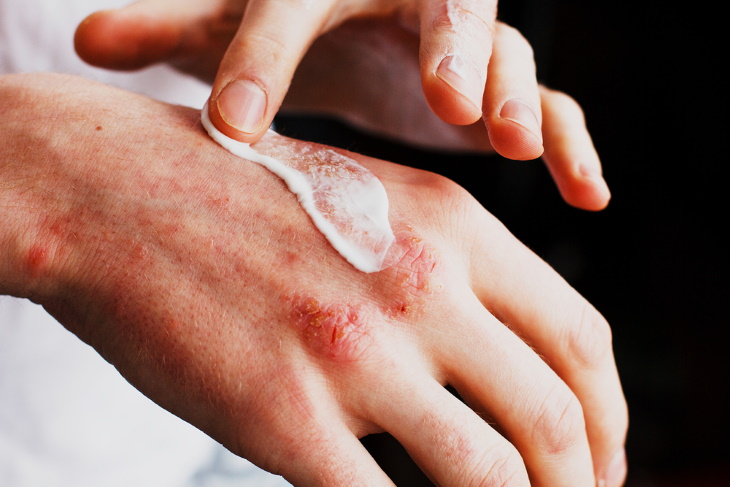
Types of Eczema applying cream on rash
Eczema is an inflammatory skin condition that causes one’s skin to become dry, bumpy, and extremely itchy. The name of the condition comes from the Greek word ekzein, meaning “to boil,” which alludes to the itching and burning sensations that often accompany the condition. 
 
Individuals with eczema have a weakened skin barrier, which means that their skin is less effective at retaining moisture and protecting itself from germs and other environmental stressors. 
 
In the past, it was thought that eczema was a condition that mainly affected children. Upon closer inspection, demographic studies reveal that anyone can develop eczema. In fact, the National Eczema Association reports that 10% of all people develop eczema in their lifetime.

In a percentage of the population, eczema only appears later in life. Though the causes are difficult to pin down, medical experts suggest that it may have something to do with post-menopausal changes in older women, as well as the general tendency of skin becoming drier in late adulthood. 
 
Eczema occurs in people of all skin tones, but it may look different depending on your skin tone. On pale skin, the rash usually appears in red patches. On medium or dark skin tones, it can take a darker brown hue or even look ashy or purplish.

General symptoms of eczema include 
 
Dryness 
Sensitive and inflamed skin 
Itchiness - eczema can be so itchy that people scratch the skin until it bleeds 
A rough, scaly, and raised rash 
Oozing or crusting bumps 
 Hyperpigmentation. 
 
Since eczema ranges from mild to severe, not every individual with eczema will experience all these symptoms
 
Types of eczema

The terms eczema and atopic dermatitis are often used interchangeably, but the latter is merely one of seven different forms of this condition. Each type appears differently and comes with slightly different symptoms and treatments. Here’s a brief rundown of them all: 
 
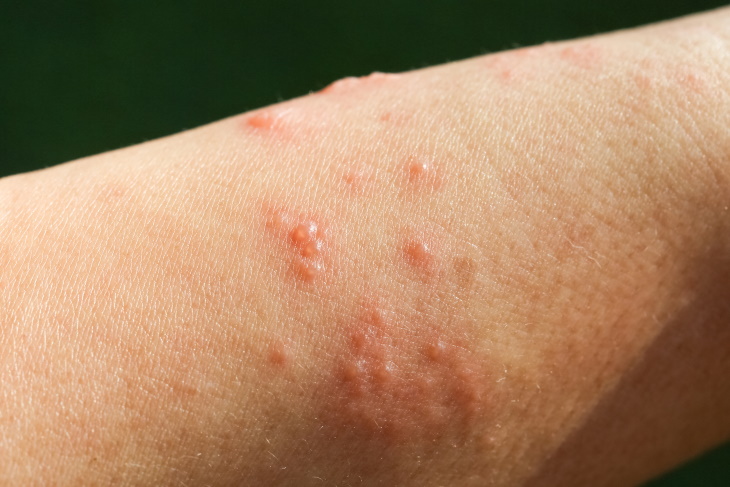
Atopic dermatitis (AD) is the most common form of eczema. It often begins in childhood and lessens or disappears by adulthood. AD manifests itself as a rash consisting of small itchy bumps filled with fluid. It often appears inside the elbows and behind the knees. Sometimes, AD turns into seborrheic or contact dermatitis in adulthood.
Types of Eczema Contact dermatitis
Neurodermatitis looks like AD. The patchy rash can appear anywhere on the body, scalp, and the back of the neck. Neurodermatitis is extremely itchy, to the point that people with this condition are known to scratch in their sleep until the skin starts bleeding and becomes infected.

Contact dermatitis occurs when the skin gets in contact with an irritant, like bleach, nickel earrings, or latex gloves. The irritant causes itchy hives or pus-filled blisters to appear on the skin. Over time, the blisters heal, but the skin may remain leathery or scaly for some time. 
 
Nummular eczema is easier to identify because it causes round, ring-shaped spots on the skin. It can be triggered by dry skin and insect bites, and it’s more common in people who already have another kind of eczema. 
 
Seborrheic dermatitis causes dandruff or a rash to form in an area of the body with a lot of oil glands, like the scalp, eyebrows, or nose. Oftentimes, seborrhea is triggered by stress or hormonal changes in the body.

Stasis dermatitis occurs on the lower legs and the tops of the feet. It happens in people with blood flow issues and varicose veins, especially after a whole day of walking. When fluids ooze through weakened blood vessels in the skin, they cause an itchy rash to appear on the legs or feet. This type of eczema is more common in older adults. 
 
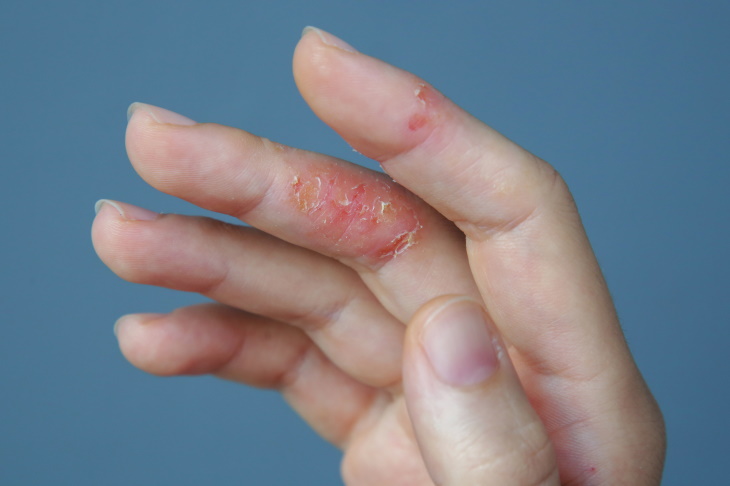
Dyshidrotic eczema is also known as hand eczema, although it can also appear on the soles of the feet. In patients with this condition, itchy and painful blisters form on the hands and feet, including between the fingers. Professionals who often get their hands wet and are frequently exposed to chemicals, such as hairdressers, are more likely to have this condition.
 
What causes eczema? 
Eczema doesn’t have a single cause; it’s a complex condition that develops when several risk factors intersect.  First and foremost, the skin condition has a well-known link to allergies or asthma. Oftentimes, eczema flare-ups occur as an inflammatory immune reaction to a known allergen, such as dust, certain metals, fragrance, bleach, certain foods, etc. These allergic triggers are different for each person, so detecting your irritant does require a bit of detective work.
Types of Eczema Dyshidrotic eczema
People who have asthma also have a significantly higher risk of eczema, which brings us to the second prominent factor in the development of eczema – genetics. To be brief, people who have family members with asthma, allergies, eczema, or dermatitis are more likely to suffer from eczema themselves. Scientists have also identified a specific genetic mutation that contributes to eczema. This mutation is linked to a protein known as filaggrin that weakens the skin’s ability to retain moisture. 
 
Last but not least, one’s environment is also a factor. We often think that our environment plays a minor role in our physical health, but this is not the case with eczema. People who live in extreme climates, those who work with irritating chemicals and pollutants, those who wear and try a wide variety of beauty products, as well as those under massive stress are all more likely to suffer from eczema. That’s why you often need to consider your life holistically when addressing a chronic condition like eczema.  
 
How is eczema treated? 
Diagnosing the condition is the first step to success, and that is best done by a dermatologist, who will be able to tell it apart from similar-looking skin conditions like psoriasis or fungal skin infections. 
 
Just like dry skin, most mild cases of eczema can be effectively treated at home. However, if you notice that the rash doesn’t go away on its own, you may need medicine to resolve the flare-up.

For home remedies for eczema kindly view my home remedies blog, thanks.
 
 
 This is only for your information, kindly take the advice of your doctor for medicines, exercises and so on.   

https://gscrochetdesigns.blogspot.com. one can see my crochet creations  
https://gseasyrecipes.blogspot.com. feel free to view for easy, simple and healthy recipes    
https://kneereplacement-stickclub.blogspot.com. for info on knee replacement

https://GSiyers home remedies.blogspot.com     is my latest addition to my blogs. I'm going to add posts there, do give me your valuable feed back on my blogs. Thanks a lot, take care, be healthy and be happy.

Labels: , , , , , , , , , , , ,

Monday, January 06, 2020

How to Use a Potato to Heal Your Entire Body (Including Detox, Fever, and Infection

Potatoes have gotten a lot of flak in recent years due to their carbohydrate-rich nature. Proponents of low-carbohydrate diets shun potatoes as awful and unhealthy. However, potatoes—particularly raw potatoes or the juice of a raw potato—have a never-ending list of health benefits.


In this article I am going to cover the health benefits of raw potatoes and various remedies using potatoes. In the second part of the article, I’ll explain how to detox with potato on feet, how to use potato as a remedy for fever and how to use it to draw out infection and sickness.

Potatoes – Health Benefits

There are many different types of potatoes that come in all shapes and sizes. Potatoes are packed with nutrients such as potassium,  thiamin and niacin as well as vitamin C, making them an ideal part of a healthy diet. They can also be used to treat various ailments, either taken internally or as a topical treatment.
To get a serving of potato juice—either to use in smoothies as a nutrient-rich accompanist to other fruits and veggies, or for use as a topical medicine—simply cube up two medium potatoes, then run them through your juicer. This should yield a half-cup of potato juice. You can leave the skin on but make sure to scrub it thoroughly.
You may wish to mix the potato juice with other fruit and vegetable juices or smoothies, as the taste of potato juice alone is mild and not so palatable.

Nutrients In Potato Juice

Potassium – A 1/2-cup of potato juice provides almost 27% of the daily recommended dietary intake of potassium for all adults. Read more about the importance of potassium in my article about potassium deficiency---- causes, symptoms and what to do.
Vitamin C – A 1/2-cup of potato juice provides more than 50% of the dietary reference intake of vitamin C for adults.
Thiamine (vitamin B1) – A 1/2-cup of potato juice provides 20% of the recommended dietary allowance for adult men, and almost 22% for adult women.
Niacin (vitamin B3) – A 1/2-cup of potato juice provides almost 20% of the recommended dietary allowance for adult men and 22.5% for adult women.

Home Remedies Using Raw Potato

The list of remedies using raw potatoes or their juice is virtually infinite. Although some of these remedies are simply folk remedies passed down through the generations, others have been studied empirically and are backed by hard science. Here are a few great potato remedies you may wish to try.

Digestive health and stomach problems

Potatoes have been used for centuries by people with digestive issues ranging from heartburn to indigestion. A 2006 study found that two-thirds of patients with digestive upset reported their problems abating when they used potato juice to treat them.

According to the study from 2013, potato juice has also been used to relieve gastritis (inflammation of the stomach), stomach ulcers and helps cleanse the intestines and reduce the amount of acid in the gastrointestinal system.

Stomach (peptic) ulcers

Another folk remedy with roots in real science is use of potato juice for stomach ulcer treatment and prevention.
A team of scientists from the University of Manchester, led by professor Ian Roberts, found that potatoes could prevent and even cure stomach ulcers because of a never-before-known molecule in the juice of the potato that fends off the bacteria that pave the way for stomach ulcers.

Cancer-killing properties

Although potatoes may not be the answer to curing all cancer types, one 2013 study published by researchers from China’s Northeast Agricultural University found that a substance in potato juice called patatin was able to halt the proliferation of cancer cells in mice with melanoma cancer.

Lipid panel improvement and antioxidant qualities

If you had bad cholesterol and high triglyceride levels, potato juice may be the answer to getting your lipid panel numbers where they need to be.
This may be in part due to the antioxidant qualities that potatoes possess. A 2012 study performed by Polish researchers from the Poznan University of Life Sciences found that potatoes are high in antioxidative activity—and that this quality increases when potatoes are processed via juicing.

Arthritis

According to the  Studies from 2013, one to two teaspoons of potato juice taken before each meal can help to improve arthritis symptoms.
Alternately, you can boil clean potato peelings in a pot of water for three to five minutes, then strain and cool. You can drink one cup of this up to four times per day to relieve arthritis pain and inflammation.

Scurvy

Scurvy is a disease caused by a deficiency of vitamin C, whose symptoms are swollen, bleeding gums and problems with wound healing. Due to the high levels of vitamin C, potato juice can be beneficial for fending off scurvy when taken regularly.

Skin care

Potatoes are a wonderful natural cleanser, especially for facial skin. Grate a raw potato and rub it over the skin, then rinse. The nutrients in the potato can absorb into the skin to nourish and moisturize your face, leaving you glowing and healthy.
Some people say that potato juice can be used on your face to whiten the skin and remove dark spots and hyperpigmentation. But I was unable to find any research to support it.
Here’s how to use a potato to whiten your skin and remove dark spots:
  1. Grate a small potato, put it in a cheesecloth and squeeze out the juice.
  2. Using a cotton ball, apply the potato juice on the skin areas where you have hyperpigmentation or dark spots.
  3. Use once a day before going to bed to a get a more even skin tone.

Burns, sores, cuts, cracks

To treat minor skin injuries, grate a small amount of potato and mix with honey or olive oil. Apply this mixture to the affected area and fix in place with a bandage for about two hours.
To treat a sunburn, slice a potato thinly and place them on the burned area for a few minutes to moisturize skin and relieve pain.

Headaches

To treat a headache with potato, slice the tuber thinly and place the slices on the forehead.
To treat chronic headaches, take one-quarter cup of hot potato juice before each meal, no more than three times per day.

Awaken tired eyes

You can perk up sleepy eyes by placing a slice of potato over each eyelid and leaving them on for just a few minutes.

Improving liver function

To improve the function of your liver, try a potato skin tea. Just boil the peelings from one large potato in one cup of water for five minutes. Strain and drink once cooled. Drink this daily to keep your liver and gallbladder at top performance.

Relief from swelling and itching

Potato slices can be applied to swollen, tender skin to reduce swelling and can also relieve itching associated with insect bites or dermatitis. Place a slice on the affected area and leave it in place until it warms to body temperature, and replace as needed.

Detox with Potatoes on Feet

Your skin is sometimes called the third kidney because if its role in body detox. I’ve already mentioned that you can draw out toxins through your skin by taking detox baths or you can even detox your armpits.

There are many books and websites that claim that you can detox your entire body through your feet. While there is no scientific evidence to support it, a lot of people say that they use foot detox pads.
Instead of buying foot detox pads, why not use a potato on your feet as a simple way to detox your body.
Here’s how to use the potato foot detox:
  1. Put two thin slices of raw potato in a pair of tight fitting socks and place the potato slices under your feet.
  2. Leave for a few hours to draw out toxins from your body.

Potato Slices in Socks as a Remedy for Fever

I’ve recently learned about a folk remedy for fever using potatoes. If you suffer from fever, all you need to do is put a slice of chilled raw potato at the bottom of your feet. Put it in your sock and leave for a 2-3 hours to break the fever.
While there is no scientific evidence to support it, a lot of people claim that it helps to reduce fever.

Do Potatoes on Feet Pull Out Sickness?

There is an anecdotal evidence that potatoes can pull out sickness but I couldn’t find scientific evidence to support it. The idea of putting potatoes in your socks for sickness could be attributed to foot reflexology which can be traced back to ancient Egyptian and Chinese civilizations.

According to reflexology, each area in your foot corresponds to an area in your body. Reflexology uses massage therapy techniques to stimulate nerves, mostly in the palm of your hand and bottom of your foot. Each of these nerves branches off to different organs and glands in your body. I have already mentioned that potatoes have a wide range of health benefits and nutrients. So possibly, according to reflexology, when placed under your feet, these nutrients spread thorough your body to kill bacteria and viruses.

Feel free to leave a comment if you use potatoes on feet for sickness as this will allow me to share the information with other readers.

Do Potatoes Draw Out Infection?

A lot of people use a potato poultice to draw Infection from wounds, boils, or skin abscesses. Depending on the infection, it may help to draw out the pus within 1-3 days. According to the Journal of Medicinal Plants Studies, potatoes have been used for healing burns, skin cracks, sores, and other types of skin infections. Raw potatoes are also used to relieve swelling and itching caused by insect bites.

Here is how to make a raw potato poultice to treat infection and relieve inflammation:
  1. Grate or scrape the raw potato (peel and pulp). Remember to thoroughly wash the potato skin first.
  2. Put the grated potato in a gauze.
  3. Place the gauze and grated potato over the infected skin area and cover with a cloth bandage to hold into place.
  4. Leave the potato poultice on the inflamed skin area for 1-2 hours each session to help pull out the infection. Rinse the affected area in a salt water wash after each application.
  5. Use for 24 hours to reduce inflammation and heal the infection.
Please see your doctor if the infection gets worse or doesn’t improve. Also be aware of other signs that your infection gets worse. You shouldn’t use the potato poultice on an open wound.

Is a Sweet Potato a True Potato?

Sweet potatoes are a completely different type of vegetable from potatoes.
Traditional types of potatoes  like the ones used to make fries, potato mash, and roast potatoes are from the nightshade family  Solanaceae. However,  sweet potatoes aren’t actually potatoes because they are from the morning glory plant family.
Sometimes, potatoes are called ‘white potatoes’ or ‘Irish potatoes’ to distinguish them from sweet potatoes.

Potatoes – A few precautions

Potatoes can heal, but there is such a thing as too much of a good thing in this case—avoid ingesting too much of potato juice per day, as higher dosages may be toxic. It is recommended not to drink more than half a cup of potato juice daily.
Also, potatoes with a greenish color under the skin should be avoided, as these contain higher levels of a chemical called solanine, which can interfere with nerve activity and cause severe nausea, diarrhea and cramping.

this is only for your information, kindly take the advice of your doctor for medicines, exercises and so on.     
https://gscrochetdesigns.blogspot.com. one can see my crochet creations  
https://gseasyrecipes.blogspot.com. feel free to view for easy, simple and healthy recipes    
https://kneereplacement-stickclub.blogspot.com. for info on knee replacement
 

Labels: , , , , , , , , , , , , ,