Sunday, January 09, 2022

7 things to know about using disposable plastic containers, for piping hot food or otherwise

 Takeaways have been a lifeline for hawkers and other food and beverage businesses amid the COVID-19 pandemic, especially when dining out was banned.

The “dabao” (takeaway) culture was alive and well in Singapore, however, even before the pandemic.

And much as the authorities and zero-waste advocates have called on consumers to bring their own reusable containers when visiting their favourite food stalls, most people find it more convenient to use the single-use containers provided by the businesses.

But what exactly are these containers made of, are they suited for all kinds of food and is it safe to reuse them? CNA Insider’s Talking Point web original series seeks answers from pharmacologist and toxicologist Henry Leung.

1. WHAT’S IN MY CONTAINER?

Disposable food containers are generally made of plastic resins mixed with some additives, said Leung. Additives are chemical substances that could improve the performance of the plastic by, for example, making it more flexible, or improve its physical appearance.

“Some of these additives are added if the disposable box is designed to hold high-temperature food,” added the senior lecturer at Nanyang Polytechnic’s School of Chemical and Life Sciences.

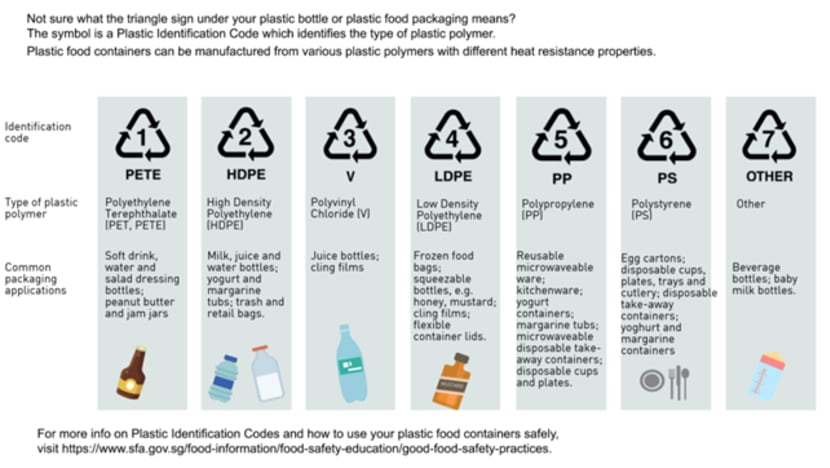
As for the container’s main ingredient, the resin identification code at the bottom of some containers — in the middle of the recycling logo — lets you know what type of plastic it is. Here is what the numbers mean:

  • Code 1: Polyethylene terephthalate (PET)
  • Code 2: High-density polyethylene (HDPE)
  • Code 3: Polyvinyl chloride (PVC)
  • Code 4: Low-density polyethylene (LDPE)
  • Code 5: Polypropylene (PP)
  • Code 6: Polystyrene (PS)
  • Code 7: Polycarbonate (PC) and other plastics
 

2. WHICH TYPE OF PLASTIC IS THE SAFEST?

It depends on what the container is being used for, such as hot food or food to be microwaved. Consumers should choose the correct plastic for their intended use, and this applies to reusable containers too, advised Leung.

“If your container is (going to be) consistently heated, you might want to look at a heat-resistant, reusable plastic container,” he said. Polypropylene (Code 5), for example, is the most suitable for microwaving because of its resistance to heat.

There are also containers designed to be put in the fridge and freezer, such as high-density polyethylene (Code 2).

“(In contrast), some … disposable plastic containers, (if) put in the freezer, will very likely crack because they’re not designed to work at extreme temperatures,” Leung added.

3. IS IT SAFE TO USE DISPOSABLE CONTAINERS FOR PIPING HOT SOUP?

If hot soup is poured into a container that is not made for such high temperatures, the plastic will deform immediately, said Leung.

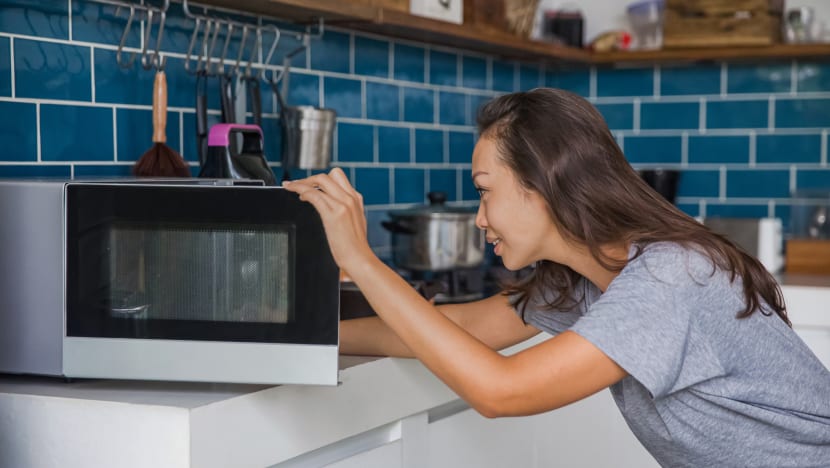
Containers that are safe for the microwave would feature the label but may also include instructions to remove the cover first.
 

4. CAN I REUSE DISPOSABLE CONTAINERS?

They are recommended for one-time use. “They are safe for their immediate intended purpose but not beyond what they are designed for,” the Singapore Food Agency (SFA) states on its website.

If you must reuse disposable plastics, then a “like-for-like” approach is important, said Leung. This means refilling a container of bottled water with water instead of, say, coffee.

He also reminds his friends and colleagues to look out for telltale signs that they should stop using a container.

Discolouration in a particular area could mean it was overheated. After repeated use, the takeaway container’s texture could change and become harder or softer. “These are signs that it has gone beyond the limits of the plastic formulations,” said Leung.

“If you ignore all these signs and continue using the plastic container, you’d be taking the risk of accumulating more of these chemicals than you’re exposed to normally.”

While it is important to be environmentally friendly, there is “no point” in using disposable containers inappropriately, he added.

Instead of risking chemicals from these containers leaching into one’s food or beverage, consider reusable containers with at least the plastic identification code and a food safety label.

This is only for your information, kindly take the advice of your doctor for medicines, exercises and so on.   

https://gscrochetdesigns.blogspot.com. one can see my crochet creations  
https://gseasyrecipes.blogspot.com. feel free to view for easy, simple and healthy recipes    
https://kneereplacement-stickclub.blogspot.com. for info on knee replacement


Labels: , , , , , , ,

Monday, August 23, 2021

Myths about Food Safety You Shouldn’t Believe

There are a lot of misconceptions about food safety we have been blindly believing for years now. Perhaps because we are bombarded with so much information and despite having a wealth of information available to us at our fingertips, many of us tend to ignore certain food safety and safe food handling practices. Food storage, cooking, cleaning, and eating are an essential part of our lives and hence it’s important to not be fooled by any misconceptions related to food safety.

Here, we have attempted to debunk some common food safety myths that you should always keep in mind.

Myth 1: If the food looks and smells fine, it’s good to eat
Food Safety Myths, smelling food
A lot of us do this. We just take a whiff of the food we are about to eat, and if it smells and looks fine, we don’t think much about eating it right away. That can be risky, though. 
 
Some bacteria, molds, and yeasts can change the look, flavor, smell, or texture of food, and then it's easy to tell if it’s gone bad. However, harmful bacteria can only be seen under the microscope, and several types of bacteria that do cause illness don’t always affect the taste, smell, or appearance of food. That’s why you must pay attention to how you store food. If, for example, you aren’t sure how long a leftover food has been kept in the refrigerator, then don’t take the risk – just toss it out. Just because that 5-day old milk or soft apple smells okay, doesn’t mean it actually is. 
 
Myth 2: The microwave will kill all bacteria in the food
Food Safety Myths, microwave
Many of us assume that heating food in the microwave oven will instantly kill all bacteria in it and make it safe to eat. 
 
While it’s true that the heat in microwaves can kill bacteria, they can’t be 100% relied upon for your food’s safety. That’s because foods with uneven shapes or variants in thickness might seem cooked by the microwave but they still might be cold spots left in the food, where harmful bacteria can survive. We've all experienced that 'cold spot' at times. So, even if you’re using a microwave to heat the food, it doesn’t automatically mean that it’s safe and you, therefore, must not neglect any aspect of food safety.  
 
Myth 3: You can’t drink milk past the date on the carton  Food Safety Myths, milk
Don’t toss out that carton of milk just because it’s gone by “best before” date. This happens since we often get confused between a “best before” date and a “use by” date. The “best before” date is more a recommendation and most research suggests that properly stored unopened milk is safe to consume up to a week after that date. Opened milk, meanwhile, can last at least 2–3 days past that date. However, milk shouldn’t be taken past its “use by” date, as it could have grown harmful bacteria and can make you sick.
 
Myth 4: The last food you ate is what caused you food poisoning
Apart from some toxins and viruses, most harmful microorganisms usually take a few days to make you sick. Symptoms of food poisoning typically take 1-3 days to develop and can even take as long as three weeks to fully take hold. So don’t be quick to blame your stomach illness on that sushi you had at a restaurant last night for you may have gotten sick from something you ate a few days ago. Also, the underlying cause of the symptoms might not be food poisoning at all. If you feel you have a food-borne illness, seek medical attention.

Myth 5: You don’t need to wash produce if you are going to peel it
Even if you do not plan to eat the skin of the fruit or vegetable, it’s always a good idea to wash it first before consuming it. The reason being that dirt and bacteria can easily be transferred from the surface when peeling or cutting produce, according to the U.S. Food and Drug Administration (FDA). 
 
Here’s another story that will make sure you wash your produce before eating. In 2011, an outbreak of salmonella from cantaloupe was traced to germs clinging to the melon's rinds and transferred to the flesh inside when the fruit was cut. Bacteria can stick easily to the rough surface of fruits like cantaloupes. And even a small amount of bacteria can be dangerous if it reaches the inside of firm fruits such as melons and cucumbers. 
 
Food experts hence recommend scrubbing their rind with a clean vegetable brush and washing your hands with soap and warm water afterward.
 
Myth 6: As long as you cut off the mold, the rest of the food is fine 
Don’t be under the assumption that if you cut or scrape the mold out of food, the remaining part will be safe to eat. That’s not always true. Moldy bread, especially, is better off thrown away as the mold is more likely to be growing beyond the areas you can see. Molds usually extend deep into the food and merely scraping off the visible part won’t make the food safe to eat. 
 
However, molds have a hard time growing inside firm fruits and vegetables. So if you cut off at least an inch around the spot of mold in the affected fruit or veggie, you can still eat it. Just make sure that you wash the knife properly afterward to avoid cross-contaminating your produce.
 
Myth 7: It’s safe to eat raw cookie dough/cake mix
Food Safety Myths, raw cookie dough
While making cookie dough, it's hard to can’t resist licking the batter from the spoon. It might be yummy, sure, but it’s not safe. The Centers for Disease Control and Prevention (CDC) has stated that raw dough can contain germs that make you sick. While there’s a risk of the bacteria in uncooked eggs too, there have been incidents in the recent past of two outbreaks of E. coli infections linked to raw flour as well. The CDC believes that since raw flour hasn’t been treated to kill germs, it might well be contaminated in the field or at other steps during flour production. Bacteria are completely eliminated only when food made with flour is cooked. This is why you should avoid eating raw dough or batter.

Myth 8: Plastic chopping boards are safer than wooden ones
It’s commonly believed these days that plastic cutting boards are much safer than wooden ones. This belief stems from the idea that since they are easier to clean and sanitize, plastic boards are safer to use. Experts say that although plastic boards are definitely easier to clean, cutting on them also leaves lots of grooves where bacteria can hide. And while the wooden boards are tougher to sanitize, there aren’t many deep scratches on their surface and therefore they can actually be more sanitary in the long run.
 
So as long as you are thoroughly sanitizing both the chopping boards, there’s not much difference between them. A good way to clean both types of boards is to pour a solution of 1 gallon of water mixed with 1 tablespoon of bleach on their surface and let them dry. This will stop moisture-loving bacteria from growing on them.

This is only for your information, kindly take the advice of your doctor for medicines, exercises and so on.   

https://gscrochetdesigns.blogspot.com. one can see my crochet creations  
https://gseasyrecipes.blogspot.com. feel free to view for easy, simple and healthy recipes    
https://kneereplacement-stickclub.blogspot.com. for info on knee replacement

Labels: , , , , , , , , , , ,