Sunday, January 09, 2022

7 things to know about using disposable plastic containers, for piping hot food or otherwise

 Takeaways have been a lifeline for hawkers and other food and beverage businesses amid the COVID-19 pandemic, especially when dining out was banned.

The “dabao” (takeaway) culture was alive and well in Singapore, however, even before the pandemic.

And much as the authorities and zero-waste advocates have called on consumers to bring their own reusable containers when visiting their favourite food stalls, most people find it more convenient to use the single-use containers provided by the businesses.

But what exactly are these containers made of, are they suited for all kinds of food and is it safe to reuse them? CNA Insider’s Talking Point web original series seeks answers from pharmacologist and toxicologist Henry Leung.

1. WHAT’S IN MY CONTAINER?

Disposable food containers are generally made of plastic resins mixed with some additives, said Leung. Additives are chemical substances that could improve the performance of the plastic by, for example, making it more flexible, or improve its physical appearance.

“Some of these additives are added if the disposable box is designed to hold high-temperature food,” added the senior lecturer at Nanyang Polytechnic’s School of Chemical and Life Sciences.

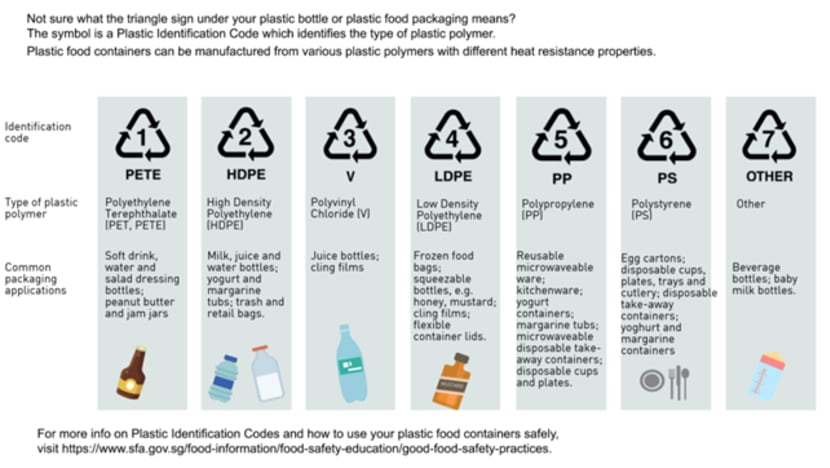
As for the container’s main ingredient, the resin identification code at the bottom of some containers — in the middle of the recycling logo — lets you know what type of plastic it is. Here is what the numbers mean:

  • Code 1: Polyethylene terephthalate (PET)
  • Code 2: High-density polyethylene (HDPE)
  • Code 3: Polyvinyl chloride (PVC)
  • Code 4: Low-density polyethylene (LDPE)
  • Code 5: Polypropylene (PP)
  • Code 6: Polystyrene (PS)
  • Code 7: Polycarbonate (PC) and other plastics
 

2. WHICH TYPE OF PLASTIC IS THE SAFEST?

It depends on what the container is being used for, such as hot food or food to be microwaved. Consumers should choose the correct plastic for their intended use, and this applies to reusable containers too, advised Leung.

“If your container is (going to be) consistently heated, you might want to look at a heat-resistant, reusable plastic container,” he said. Polypropylene (Code 5), for example, is the most suitable for microwaving because of its resistance to heat.

There are also containers designed to be put in the fridge and freezer, such as high-density polyethylene (Code 2).

“(In contrast), some … disposable plastic containers, (if) put in the freezer, will very likely crack because they’re not designed to work at extreme temperatures,” Leung added.

3. IS IT SAFE TO USE DISPOSABLE CONTAINERS FOR PIPING HOT SOUP?

If hot soup is poured into a container that is not made for such high temperatures, the plastic will deform immediately, said Leung.

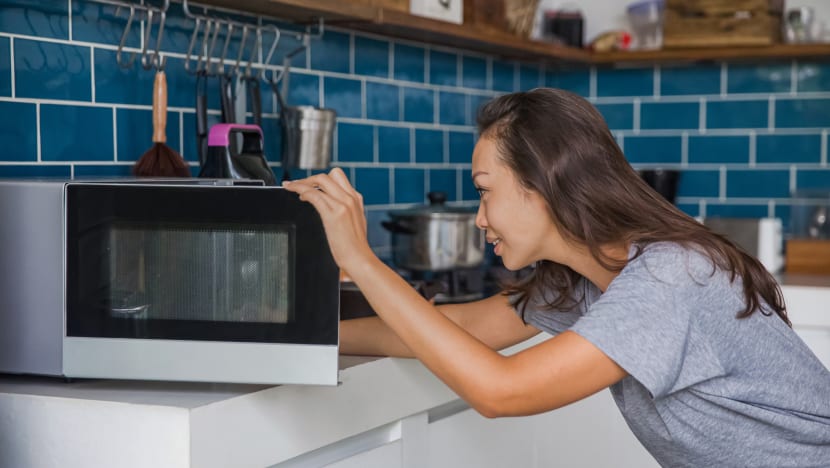
Containers that are safe for the microwave would feature the label but may also include instructions to remove the cover first.
 

4. CAN I REUSE DISPOSABLE CONTAINERS?

They are recommended for one-time use. “They are safe for their immediate intended purpose but not beyond what they are designed for,” the Singapore Food Agency (SFA) states on its website.

If you must reuse disposable plastics, then a “like-for-like” approach is important, said Leung. This means refilling a container of bottled water with water instead of, say, coffee.

He also reminds his friends and colleagues to look out for telltale signs that they should stop using a container.

Discolouration in a particular area could mean it was overheated. After repeated use, the takeaway container’s texture could change and become harder or softer. “These are signs that it has gone beyond the limits of the plastic formulations,” said Leung.

“If you ignore all these signs and continue using the plastic container, you’d be taking the risk of accumulating more of these chemicals than you’re exposed to normally.”

While it is important to be environmentally friendly, there is “no point” in using disposable containers inappropriately, he added.

Instead of risking chemicals from these containers leaching into one’s food or beverage, consider reusable containers with at least the plastic identification code and a food safety label.

This is only for your information, kindly take the advice of your doctor for medicines, exercises and so on.   

https://gscrochetdesigns.blogspot.com. one can see my crochet creations  
https://gseasyrecipes.blogspot.com. feel free to view for easy, simple and healthy recipes    
https://kneereplacement-stickclub.blogspot.com. for info on knee replacement


Labels: , , , , , , ,

Thursday, July 18, 2019

Menstrual Cups Are Safe and Reusable

A new study has found that menstrual cups, an inexpensive and reusable method of sanitary protection for menstruating women, are safe and as unlikely as disposable pads or tampons to leak.
The study, the first major scientific review of the devices, was published on Wednesday. The researchers said at least 70% of women who have tried menstrual cups said they would like to continue using them.

This research is a review of 43 earlier studies gathering data on 3,300 women. It includes studies conducted on women from rich and poor countries, from different decades since the 1960s, but mostly since 2009.

In many parts of the world, and particularly in India, menstruation and sanitary protection remain taboo subjects. Sanitary protection is either unavailable or unaffordable for many women around the world, as the authors noted of the study noted. In India, many women use a cloth instead of sanitary products, increasing the risk of infections. Several reports show that during menstruation, women and girls are considered "impure" and are forced to stop going to school.  

In this context, the authors set out to evaluate if menstrual cups are safe, affordable and effective menstrual products. Menstrual cups are made from medical grade silicone, rubber or latex and collect blood, rather than absorb it, as pads and tampons do. They last from four to 12 hours.
  
According to a report, there are two types of menstrual cups: vaginal cup, a bell-shaped product, and a cervical cup, “which is placed around the cervix high in the vagina much like a diaphragm for contraception”. Menstrual cups are reusable and can be used for up to ten years, depending on the product, though they are more expensive than sanitary pads or tampons.

The study found that leakage was “similar or less when using the menstrual cup than when using disposable pads and tampons”. However, its adoption requires a “familiarisation phase”, and peer support seemed to be important for uptake in low and middle-income countries, the study found.

The research did not find any increased risk of infection, but found some incidental case reports of damage. “We identified several incidental case reports of vaginal damage, toxic shock syndrome, or urinary tract complaints after menstrual cup use, and difficulty retrieving the menstrual cup was also reported,” the authors wrote. Toxic shock syndrome is a potentially life-threatening condition and is caused by bacteria which enter the body through foreign objects.

The syndrome was reported by five women. The authors said however, since the overall number of menstrual cup users is unknown, they could not determine if the product is safer than tampons, which are known to boost the risk of toxic shock syndrome.

“For consumers purchasing menstrual products, the results highlight cups as a safe and cost-effective option,” according to a medical person.

Yet, even in rich countries, only a fifth of women on average knew about the new devices, three of the studies found.

The study says that its findings can “inform policy makers and programmes that menstrual cups are an alternative to disposable sanitary products, even where water and sanitation facilities are poor”. It notes that providing information, training and following up may on correct may be needed to ensure that the products are used over the long term. “Further studies are needed on cost-effectiveness and environmental impact comparing different menstrual products, and to examine facilitators for use of menstrual cups, with monitoring systems in place to document any adverse outcomes,” the researchers conclude.

In India, efforts are being made to dispel the secrecy and taboo surrounding menstruation and menstrual hygiene. While a large proportion of women still use cloths during menstruation, initiatives encouraging women to use sanitary pads have received an overwhelming response. ( Now, sanitary pads are made hygienically and at very less price in India, the initiative was started by a man, who has taught many ladies to start manufacturing it. A movie was also made called - Padman and has won some awards).


Menstrual Cups Are Safe and Reusable: New Study

THIS IS ONLY FOR INFORMATION, ALWAYS CONSULT YOU PHYSICIAN BEFORE HAVING ANY PARTICULAR FOOD/ MEDICATION/EXERCISE/OTHER REMEDIES.                                    PS- THOSE INTERESTED IN RECIPES ARE FREE TO  VIEW MY BLOG-                                                                                           https://gseasyrecipes.blogspot.com/                                                                                                                                                FOR INFO ABOUT KNEE REPLACEMENT, YOU CAN VIEW MY BLOG-                                                  https:// kneereplacement-stickclub.blogspot.com/                                                                      FOR CROCHET DESIGNS                                                                                                    
                                https://gscrochetdesigns.blogspot.com

Labels: , , , , , , , , ,

Friday, May 31, 2019

With Homegrown Menstrual Cups, This Duo is Helping Women Get Rid of Period Discomfort


As leading citizen activists of waste management, the problem of Bengaluru’s growing mountains of garbage was well-understood by  environmentalists.

For years, the two have been key members of citizen-led movements which aim to raise awareness about the city’s garbage problems and propose sustainable solutions, while also influencing urban waste management policy.

Several landmark legislations including household-level waste segregation and the expedited implementation of Karnataka’s ban on manufacture, sale and use of single-use plastics were made possible by the sustained efforts of these groups.

We realised that even after segregation, the volume of garbage was huge and a Herculean task for the authorities to manage,” say one of them.

This set into motion initiatives like Borrow-A-Bag implemented at the ward-level, to reduce the use of plastic carry bags by making reusable cloth bags easily accessible.

With the efforts of volunteers supported  and elected representatives, the programme effectively reached 20 wards in the city, which declared themselves plastic-free. It reduced plastic bag usage by up to 50 per cent,she says. Through community events, the groups demonstrated that it was possible to organise zero-waste celebrations on a large scale.

Also gaining steam was a citizen’s movement called ‘Green The Red’, which launched the Cup and Cloth Campaign, earlier this year, to raise awareness among urban and rural women about sustainable menstrual hygiene products, and promote their inclusion in government health schemes.

With these initiatives, the duo learnt that it was possible to change attitudes towards consumption and disposal on a large scale, just by showing that an alternative way was possible.

What was needed, however, was a consolidated platform—of solutions that were affordable and accessible to all. This turned them from activists into entrepreneurs.

They started StoneSoup in 2015. The name harks back to an old folk tale that encapsulates the collective contribution which goes into creating something of value. In it, a hungry traveller convinces the people of a town to each share an ingredient that goes into making a hearty soup to feed the village folk.
Today, StoneSoup offers a range of products and services—sustainable alternatives that replace daily use products—composting kits, natural cleaners, cloth diapers and cloth bags.

Their most popular offerings, however, are menstrual cups—a substitute for single-use pads and tampons, that are superior, both from the standpoint of women’s health and from an environmental perspective.


“We wanted to create an Indian brand of menstrual cups,” she explains.

The awareness sessions they were already conducting as advocates of ‘Green The Red’ gave them a wealth of data from actual and potential users.

“That really put us in a good place by giving us insights on how to design the product, market it, and address people’s concerns,” she says.

Their design is innovative and intuitive—no rim lines and stain-causing grooves; no vestigial parts like the stem—nothing that can confuse users. A StoneSoup cup is smooth and bell-shaped, with a few grip lines.

“We made a cup that was the smallest size—to fit most women, and changed the shape from a V to a U to increase the volume,” she says  about what makes the StoneSoup cups more functional.
With design done, the next step was to put these cups within the easy reach of Indian women. One obvious solution was to be visible on major e-commerce platforms and mainstream retail stores—places well-suited to Indian buying behaviour. StoneSoup is also working to make cups available in chemist shops.
The other was to change the packaging so that the cup looked less like a medical device and more like an accessory—compact, attractive, portable and premium.

Manufactured in Bengaluru, the cups are available in a range of firmness—from soft to hard—making them suitable for various body types, levels of physical activity and flow.

StoneSoup cup users include women who are athletes, cyclists, gymnasts, and frequent travellers. The cups are priced between Rs 550 and Rs 1,200 and can be used for up to ten years.

The benefits of cups are well known. They’re safer for women’s reproductive health than plastic pads whose chemical fragrances and absorbents have been linked to allergies, irritations and discomfort.

For civic agencies, a switch from disposables could make garbage management easier and more cost-effective by reducing the expenditure on transport, treatment and disposal, and eliminating such practices as open burning, burying and incineration, and the health hazards they pose.

Reusable menstrual care products have been steadily gaining popularity in India with a number of homegrown and foreign brands available in the market. “But,” she says  “a majority of women buy cups for environmental reasons.”

“We wanted to reach out to others who are doing it for convenience,” says one of them.

And cups do offer all the convenience of disposables, plus they’re safe, economical and durable.

StoneSoup sisterhood

As new entrepreneurs, the duo was keen to start a business that created livelihoods for women. As a first step, they tapped into – a network of citizen volunteers, who, as part of the Green The Red Movement, help women adopt sustainable menstruation practices through awareness sessions and demonstrations.

They also serve as resellers of these products and receive a portion of the margins. Leveraging the vast Saathi Network helps to reduce the adoption barrier, especially among women who want to understand usage patterns from existing users, and need hand-holding, once they become adopters.

StoneSoup cups are priced lowest with Saathis to reduce the price barrier, especially in rural areas and among the urban poor, says Malini. StoneSoup also organises large-scale cup donation drives with its basic variant—the Pratham cup.

The entrepreneurs say that all their efforts are focused on building a viable business that reduces garbage.
“But sustainable businesses are not ones that make billion dollars and then donate those billions to charity. We believe in giving along the way, without fighting to be the cheapest in the market,” says Smita.
StoneSoup’s cup-storage pouches come from the rural parts of South India and its period pride earrings are handmade by Dalit women artisans. The duo also supports and promotes NGOs and SHGs that manufacture other sustainable menstrual health solutions such as cloth pads.
The global menstrual cup market is expected to grow at 3.50% between 2018 and 2023, with India among the significant contributors. For now, however, the uptake of menstrual cups in the country is low due to a variety of reasons including taboos against insertables, high cost, and lack of awareness, especially in rural India, about the existence of these products.

Today, close to 50 per cent women aged 15-24 years in rural India and 77 per cent in urban India use locally prepared sanitary napkins and disposable menstrual hygiene products.

In a context where sewage and waste management infrastructure is rudimentary at best, the rise in non-biodegradable pads signals great health and environmental risks.

StoneSoup is attempting to change this narrative by showing that garbage need not only be managed by quick fixes, but it can also be reduced; that rashes, allergies and discomfort during periods need not just be treated, they can be done away with, for good.

“All we’re saying is that women have the right to alternatives so that they can choose what’s best for their health, environment and pocket,” the duo say.


Labels: , , , , , , , , , , , , , , ,