Your body communicates when something is
wrong. The color and state of your fingernails can let you know when
something is going awry inside your body. Sometimes they can be minor
vitamin deficiencies and other times more serious conditions. These
changes can be subtle, or blatant and it’s worth noting any differences
because many diseases are reflected on your fingertips. As always these
are warning signs and it’s important not to rely solely on your nails
for a health check. Consult with a medical professional who can consider
other symptoms and run blood tests.
1. Red nails
If your nails go from a pink shade to a darker red, you might have heart
disease. If the redness extends to the sides of your nails and cuticle,
this might be a sign of the autoimmune disease Lupus. There are other
possible explanations for this reddening, but it’s best to consult with
your doctor, who can run tests.
2. Unusually white nails
This phenomenon is often called Terry’s nails and has three possible
explanations. One is that you have developed a fungal nail infection,
often accompanied by reddened or dark fingertips. Another reason could
be that your nails have begun to detach from the nail bed and the blood
supply is interrupted. Thirdly, this is also a side effect of
chemotherapy. Terry’s nails also might indicate that you have a more
severe illness like anemia, iron deficiency, diabetes, liver cirrhosis,
organ failure or hyperthyroidism.
3. Thick or overgrown nails
If your nails are growing thicker and faster than usual, you might be
suffering from a serious fungal nail infection. You might also notice
that the nails have become discolored. These symptoms are common results
of having either psoriasis or arthritis.
4. Detached from the nail bed
When nails begin to detach from the nail bed without trauma or pressure,
you might have a hormonal imbalance. Similarly, if your nails have
separated, you might be suffering from hyperthyroidism – a condition
where your thyroid gland is releasing too many hormones into your
system. For both scenarios, a doctor can recommend treatment to reverse
these conditions.
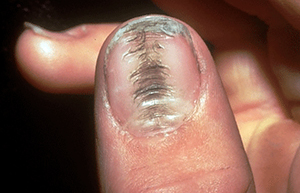
5. Dark vertical stripes
Many people ignore stripes on their fingernails because they don’t cause
any pain however some can indicate very serious illnesses. If you find
that you have dark vertical stripes, known as linear melanonychia. This
could be a sign of Subungal Melanoma, an aggressive form of skin cancer
that only affects the nail bed.
6. Blue nails
If you find your nails suddenly have changed to a blue or purple tinge,
it’s likely you have developed hypoxia, a lack of oxygen, often
triggered by poor circulation to your feet, ears, and hands. Impaired
circulation is easily reversible and is not a serious health issue
unless it goes untreated.
7. Dents or Depressions
If you start seeing dents or depressions on the surface of your nails
this might be a sign of eczema, psoriasis, or reactive arthritis, a form
of arthritis that like Lupus, finds your immune system attacking your
joints. More than half of psoriasis sufferers experience nail
depressions or dents, and therefore it’s recommended that you consult
with a dermatologist.
8. Discolored nails
Nails should naturally by a healthy pink color and when you notice them
altering shades you should take note. If they turn brown, this may
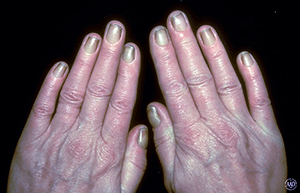
indicate that you have a thyroid disease or are malnourished. Green
nails indicate a severe fungal nail infection, nail psoriasis or even
jaundice, tuberculosis, sinusitis, or lympheodema. If you are taking
prescription drugs like antimalarial pills, you might find yourself with
grey tinged nails.
9. Spoon nails
In medical circles, this is called
Koilonychia, a condition known for causing nails to become excessively
soft and appear scooped out, much like a spoon. This symptom commonly
indicates hemochromatosis, a liver condition where there is too much
iron being produced in your system. Spoon nails also commonly indicate
hypothyroidism. There are other diseases such as heart disease, anemia
and impaired blood flow that are associated with this phenomenon.
10. Brittle nails
Characterized by thin, frail, crumbling nails this common nail problem
often indicates a deficiency in vitamins, with vitamin B7 being the
usual culprit. This can be easily reversed with an over-the-counter
multivitamin supplement. Frail nails are also often associated with nail
psoriasis, thyroid disorders, or fungal nail infections.
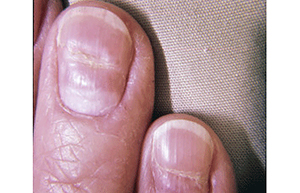
11. White stripes
While dark striped nails usually indicate cancerous growth, white
stripes are more commonly seen as indicative of a disorder. It usually
indicates an imbalanced or a non-nutritious diet, lacking in proteins.
This problem can easily be resolved with an increase in proteins rich
foods such as fish, quinoa, nuts, seeds, and lean meats.
12. Curved nails
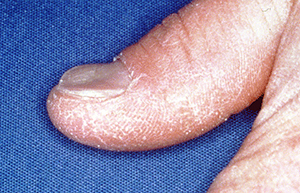
This condition is sometimes called nail clubbing and involves an
unnaturally large nail bed, curving around the tips of the fingers. It
is not an overnight condition and can take several years to form. The
cause is often hypoxia, a lack of oxygen. It is not a symptom to ignore
as it can be associated with serious diseases like irritable bowel
syndrome, liver disease, lung problems, AIDS and cardiovascular
concerns.
curved fingernails health warning.
13. Loose nails
Loose nails not caused by injury can signify fungal nail infection, nail
psoriasis, amyloidosis (excess protein in the blood), hyperthyroidism,
sarcoidosis or Raynaud’s disease a.k.a. poor blood circulation. In rarer
cases, severe allergies to some antibiotics are known to loosen nails
from nail beds.
14. Blue nail base
If you find your nails are a white shade on a blue nail base, this might
be a sign of a nutrient deficiency such as a lack of iron. When the
nails are extremely white and the base blue or purple, this could denote
a problem with the liver or pancreas. It is also a common symptom in
the initial stages of diabetes when your body is not able to process and
metabolize sugars correctly.
15. Yellow nails
Usually, yellow nails are a sign of an unpleasant fungal infection and
it’s advisable to purchase anti-fungal tablets or a topical cream to
treat this. You can also treat it with a more natural solution such as
applying essential oils. Yellow nails can also be indicative of more
serious illnesses namely a lung problem, such as fluid accumulation
around the pleurae (a lung membrane) or emphysema.
This is only for your information, kindly take the advice of your doctor for medicines, exercises and so on.
https://gscrochetdesigns.blogspot.com. one can see my crochet creations https://gseasyrecipes.blogspot.com. feel free to view for easy, simple and healthy recipes https://kneereplacement-stickclub.blogspot.com. for info on knee replacement https://cancersupportindia.blogspot.com for infor on cancer and health related topics https://GSiyers
home remedies.blogspot.com is the latest addition to my blogs. I'm
going to add posts there, do give me your valuable feed back on my
blogs. Thanks a lot, take care, be healthy and be happy.
Have you noticed a change to any of your nails lately? A change in
color, texture, or shape can be harmless, but it can also be a sign of
disease. If you notice any of the following changes to a fingernail or
toenail, it’s time to see a board-certified dermatologist.
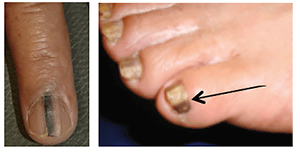
1. Medical name: Acral lentiginous melanoma
Melanoma under nailMedical name: Acral lentiginous melanoma
Dark streak If a fingernail or toenail has a new or changing dark
streak, it’s time to see a dermatologist for a skin cancer check. That
dark streak could be melanoma, the most serious type of skin cancer.
Not every dark streak is a melanoma, but it’s always good to have a
dermatologist examine one. Caught early and treated, that may be the
only treatment you need.
Allowed to grow, treatment becomes more difficult.
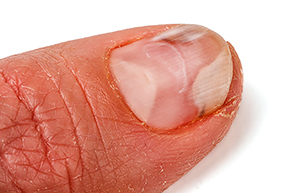
2. Medical name: Onycholysis
Nail lifting up
If a nail starts to lift up so that it’s no longer
completely attached, you’ll likely see white discoloration, as shown
here. When a nail lifts up, the cause is often:
A fungal infection
Psoriasis
Injury from an aggressive manicure
Injury form cleaning under your nails with a sharp object
A dermatologist should examine any nail that’s lifting up. You may need
treatment to clear an infection. A dermatologist can also give you some
tips that may help the new nail grow out normally.
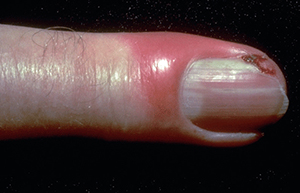
3. Medical name: Paronychia
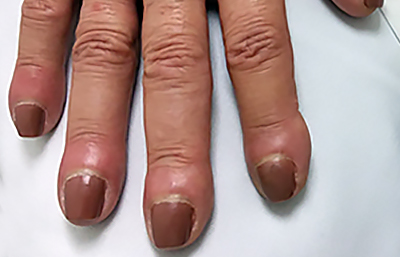
Redness and swelling around a nail
If you have redness and swelling around a nail, you may
have an infection. When diagnosed early, you can often treat an
infection with soaks and antibiotics. If an open sore forms, you’ll need
more extensive treatment.
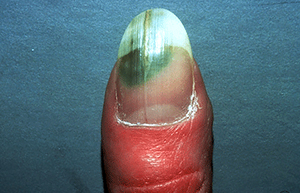
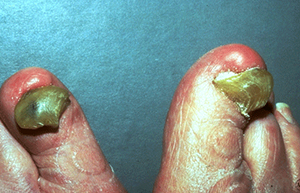
4. Medical name: Paronychia
Greenish black color
When bacteria cause a nail infection, the nail can turn greenish black as shown here.
Without treatment, a nail infection tends to worsen. Treatment
can get rid of your pain and tenderness and help clear the infection..
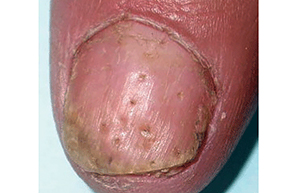
5. Medical name: Pitting
Pitted nails
If you have dents in your nails that look like they
were made by an icepick, this could be a sign that you have a disease
that affects your entire body.
People who have pits in their nails may have:
Psoriasis
Atopic dermatitis
Alopecia areata
Seeing a board-certified dermatologist for a diagnosis is important.
Dermatologists are the specialists who diagnose and treat these
diseases. Treatment can help you feel more comfortable and prevent the
disease from worsening.
6. Medical name: Yellow nail syndrome
Yellow nails
Wearing red nail polish without a base coat or smoking
can turn your nails yellow. If your nails turn yellow, thicken, and seem
to stop growing, it could be a sign of something going on inside your
body.
Lung disease and rheumatoid arthritis can cause yellow nails. You may
also have a serious nail infection, which requires treatment.
7. Medical name: Beau lines
Deep grooves (or gaps)
Lines that run the length of a nail are common and
usually nothing to worry about. If you see deep grooves that run the
width of your nail like the ones shown in this picture, it means that
something slowed (or stopped) your nails from growing for a while.
When something causes your nail(s) to completely stop growing for a
while, you may see a gap. If this happens, you’ll have a place on your
nail(s) that’s missing nail. The medical name for this condition is
onychomadesis (on-ah-coe-ma-dee-sis).
A fever, injury, chemotherapy, or major stress can cause your nails to grow slowly or stop growing.
If you cannot think of what could may have caused your nails to grow
slowly or stop growing, see your dermatologist or primary care doctor.
Once you find and get rid of the cause, nails often start growing
normally.
8. Medical name: Onychogryphosis
Ram’s horn nails
This happens when the nails thicken and overgrow. Some people get Ram’s horns because the condition runs in the family.
If you have a disease, such as psoriasis, ichthyosis, or circulation problems, you may also develop Ram’s horn nails.
Cutting and treating these nails requires help from a podiatrist or dermatologist.
9. Medical name: Koilonychia
Thin, spoon-shaped nails
If you have thin fingernails that dip down in the
middle and look like spoons, you may not be getting enough iron. People
develop an iron deficiency for many reasons, including:
Lack of proper nutrition
A health problem with their stomach or intestines
Sensitivity to gluten (celiac disease)
High altitude
Getting a proper diagnosis and treatment can help you feel better.
10. Medical name: Onychotillomania
Washboard nails
If you have grooves and ridges in the center of your
thumb that look like the ones shown in this picture, you may have
developed a habit of picking at (or pushing back) the cuticles on your
thumbnails. Many people are unaware that they do this.
A dermatologist may be able to help you break the habit, allowing healthy nails to grow out.
11. Medical name: Clubbing
Curved nails
The curving can begin so gradually that many people are
unaware it's happening. As the nails continue to curve downward,
fingertips often swell and the nails start to feel spongy when pressed
on.
If you notice your fingernails start to curve, it’s time to see a
board-certified dermatologist. Curved nails can be a harmless trait,
which runs in the family. Curved nails can also be a sign that you have a
disease in the:
Lungs
Heart
Liver
Stomach or intestine
12. Color change
A disease inside your body can cause your nails to
change color. Certain color changes can be a warning sign of a specific
disease, as the following table shows.
specific disease, as the following table shows.
Color
Disease or other health problem
Blue nails
Not enough oxygen in your bloodstream
White nails
Liver disease, diabetes
Pale nails
Anemia
Half pink, half white nails
Kidney disease
Yellow nails
Lung disease, nail infection
Dusky red half-moons
Could be lupus, heart disease, alopecia areata, arthritis, dermatomyositis
Blue half-moons
Could be sign of poisoning
Seeing a change to your nails or the half-moons doesn’t always mean that you have a disease.
Still, it’s important to see a board-certified dermatologist if you notice any changes. Board-certified dermatologists
specialize in diagnosing and treating the skin, hair, and nails. They
have the expertise to tell you whether the change is harmless or
requires medical testing.
This is only for your information, kindly take the advice of your doctor for medicines, exercises and so on.
https://gscrochetdesigns.blogspot.com. one can see my crochet creations https://gseasyrecipes.blogspot.com. feel free to view for easy, simple and healthy recipes https://kneereplacement-stickclub.blogspot.com. for info on knee replacement https://cancersupportindia.blogspot.com for infor on cancer and health related topics https://GSiyers
home remedies.blogspot.com is the latest addition to my blogs. I'm
going to add posts there, do give me your valuable feed back on my
blogs. Thanks a lot, take care, be healthy and be happy.
Your
body communicates when something is wrong. The color and state of your
fingernails can let you know when something is going awry inside your
body. Sometimes they can be minor vitamin deficiencies and other times
more serious conditions. These changes can be subtle, or blatant and
it’s worth noting any differences because many diseases are reflected on
your fingertips. As always these are warning signs and it’s important
not to rely solely on your nails for a health check. Consult with a
medical professional who can consider other symptoms and run blood
tests.
1. Red nails If your nails go from a pink shade to
a darker red, you might have heart disease. If the redness extends to
the sides of your nails and cuticle, this might be a sign of the
autoimmune disease Lupus. There are other possible explanations for this
reddening, but it’s best to consult with your doctor, who can run
tests.
2. Unusually white nails This phenomenon is often
called Terry’s nails and has three possible explanations. One is that
you have developed a fungal nail infection, often accompanied by
reddened or dark fingertips. Another reason could be that your nails
have begun to detach from the nail bed and the blood supply is
interrupted. Thirdly, this is also a side effect of chemotherapy.
Terry’s nails also might indicate that you have a more severe illness
like anemia, iron deficiency, diabetes, liver cirrhosis, organ failure
or hyperthyroidism.
3. Thick or overgrown nails If your nails
are growing thicker and faster than usual, you might be suffering from a
serious fungal nail infection. You might also notice that the nails
have become discolored. These symptoms are common results of having
either psoriasis or arthritis.
4. Detached from the nail bed When
nails begin to detach from the nail bed without trauma or pressure, you
might have a hormonal imbalance. Similarly, if your nails have
separated, you might be suffering from hyperthyroidism – a condition
where your thyroid gland is releasing too many hormones into your
system. For both scenarios, a doctor can recommend treatment to reverse
these conditions.
5. Dark vertical stripes Many people ignore
stripes on their fingernails because they don’t cause any pain however
some can indicate very serious illnesses. If you find that you have dark
vertical stripes, known as linear melanonychia. This could be a sign of
Subungal Melanoma, an aggressive form of skin cancer that only affects
the nail bed.
6. Blue nails If you find your nails suddenly
have changed to a blue or purple tinge, it’s likely you have developed
hypoxia, a lack of oxygen, often triggered by poor circulation to your
feet, ears, and hands. Impaired circulation is easily reversible and is
not a serious health issue unless it goes untreated.
7. Dents or Depressions If
you start seeing dents or depressions on the surface of your nails this
might be a sign of eczema, psoriasis, or reactive arthritis, a form of
arthritis that like Lupus, finds your immune system attacking your
joints. More than half of psoriasis sufferers experience nail
depressions or dents, and therefore it’s recommended that you consult
with a dermatologist.
8. Discolored nails Nails should
naturally by a healthy pink color and when you notice them altering
shades you should take note. If they turn brown, this may indicate that
you have a thyroid disease or are malnourished. Green nails indicate a
severe fungal nail infection, nail psoriasis or even jaundice,
tuberculosis, sinusitis, or lympheodema. If you are taking prescription
drugs like antimalarial pills, you might find yourself with grey tinged
nails.
9. Spoon nails In medical circles, this is called
Koilonychia, a condition known for causing nails to become excessively
soft and appear scooped out, much like a spoon. This symptom commonly
indicates hemochromatosis, a liver condition where there is too much
iron being produced in your system. Spoon nails also commonly indicate
hypothyroidism. There are other diseases such as heart disease, anemia
and impaired blood flow that are associated with this phenomenon.
10. Brittle nails Characterized
by thin, frail, crumbling nails this common nail problem often
indicates a deficiency in vitamins, with vitamin B7 being the usual
culprit. This can be easily reversed with an over-the-counter
multivitamin supplement. Frail nails are also often associated with nail
psoriasis, thyroid disorders, or fungal nail infections.
11. White stripes While
dark striped nails usually indicate cancerous growth, white stripes are
more commonly seen as indicative of a disorder. It usually indicates an
imbalanced or a non-nutritious diet, lacking in proteins. This problem
can easily be resolved with an increase in proteins rich foods such as
fish, quinoa, nuts, seeds, and lean meats.
12. Curved nails This
condition is sometimes called nail clubbing and involves an unnaturally
large nail bed, curving around the tips of the fingers. It is not an
overnight condition and can take several years to form. The cause is
often hypoxia, a lack of oxygen. It is not a symptom to ignore as it can
be associated with serious diseases like irritable bowel syndrome,
liver disease, lung problems, AIDS and cardiovascular concerns.
13. Loose nails Loose
nails not caused by injury can signify fungal nail infection, nail
psoriasis, amyloidosis (excess protein in the blood), hyperthyroidism,
sarcoidosis or Raynaud’s disease a.k.a. poor blood circulation. In rarer
cases, severe allergies to some antibiotics are known to loosen nails
from nail beds.
14. Blue nail base If you find your nails are a
white shade on a blue nail base, this might be a sign of a nutrient
deficiency such as a lack of iron. When the nails are extremely white
and the base blue or purple, this could denote a problem with the liver
or pancreas. It is also a common symptom in the initial stages of
diabetes when your body is not able to process and metabolize sugars
correctly.
15. Yellow nails Usually, yellow nails are a sign
of an unpleasant fungal infection and it’s advisable to purchase
anti-fungal tablets or a topical cream to treat this. You can also treat
it with a more natural solution such as applying essential oils. Yellow
nails can also be indicative of more serious illnesses namely a lung
problem, such as fluid accumulation around the pleurae (a lung membrane)
or emphysema.